Simulations of bounded drift diffusion showed that these observations were consistent with a prior-induced offset and drift rate, revealing a mechanism by which prefrontal circuits can implement Bayesian-like inference.
These findings are consistent with an approximate hierarchical inference process as proposed by Lange et al. (2021) @wrongu from @haefnerlab in which initial prior beliefs become entrenched through confirmation bias.
We found that prior expectations impact the DV′s trajectory both before *and* during stimulus presentation such that DV trajectories with a smaller dynamic range result in more biased and less sensitive perceptual decisions.
Importantly, we leveraged a task design that produced a bias in monkeys’ perceptual judgements, but not their motor reports. This allowed us to isolate the perceptual component of the decision variable.
New preprint from @ThomasALanglois and @julie_charlton_ ! https://t.co/LExXWComj3
We asked how prior expectations are combined with sensory signals to form a perceptual decision in macaque PFC.
Happy to share a new preprint by the brilliant and indefatigable @MiguelVivarLazo. The first of several stories we want to tell with this rich dataset, which features joint measurements of choice, reaction time, and confidence along with ensemble recordings from LIP...
Check out the exciting work of @MiguelVivarLazo and @chris_fetsch who examine the temporal evolution of choice and confidence signals in LIP using a similar explicit confidence reporting task https://t.co/thZcY70ZU4
New from the lab, work by @zoebsinger and @CMZiemba. Here we investigated how population activity in early sensory cortex informs perceptual choices as well as perceptual confidence. https://t.co/ME5KJujT34
Hot off the Press:
"Abstract deliberation by visuomotorneurons in prefrontal cortex" - Julie A. Charlton & Robbe L. T. Goris has been published in Nature Neuroscience
https://t.co/UIJnVfL1Mk
@julie_charlton_@NatureNeuro
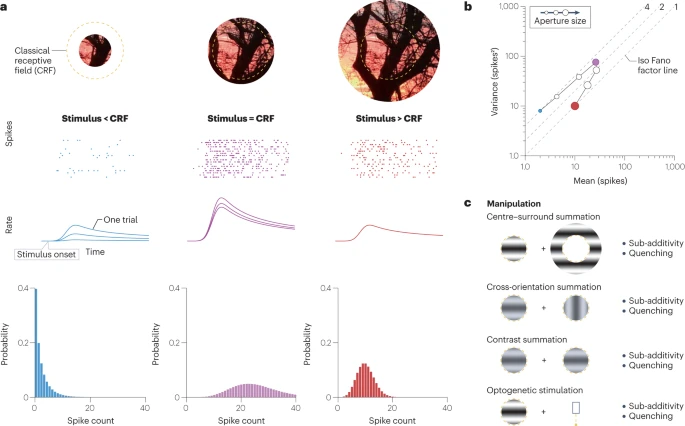
Response sub-additivity and variability quenching in visual cortex — a Perspective by Robbe L. T. Goris, Ruben Coen-Cagli, Kenneth D. Miller, Nicholas J. Priebe & Máté Lengyel
https://t.co/vzfjiQz98r
@GorisLab@CoenCagli_Lab@kendmil@lengyel_m
Sub-additivity (aka. response normalization) and variability quenching often go hand-in-hand in cortex. Why? We provide some potential answers: https://t.co/0eaneVC20p -- a review with @GorisLab@CoenCagli_Lab@kendmil and Nick Priebe.
The Goris lab has two posters at #SfN23 . Tomorrow morning come learn about metacognitive learning. At Tuesday's afternoon session learn about how neural population dynamics predict the use of prior information in perceptual decision making.
This afternoon, Ruben Coen-Cagli and Robbe Goris are co-hosing a mini-symposium: Suppression and Variability in Visual Cortex highlighting theoretical and empirical work which is revealing the link between these two concepts. Come checkout our great line-up of speakers! #SfN23
At #SfN23? This afternoon I'm excited to share our work on the representation of uncertainty in visual cortex in the minisymposium on suppression and variability in visual cortex.