Thrilled to share I’ve been promoted to Associate Professor at @ucddublin, just 2.5 years after starting!
Perfect timing as I launch my @ERC_Research Starting Grant "SurFSUP" on wave-driven propulsion.
I’ll be recruiting 2 PhDs + 2 postdocs from 2026—get in touch if interested!
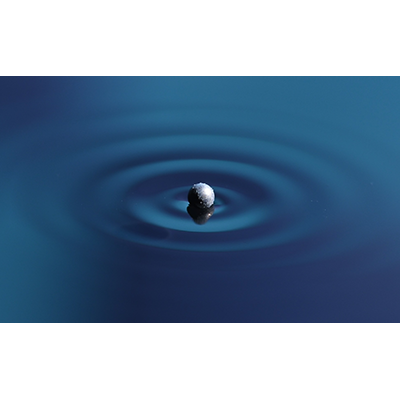
A vibrating floating body can generate waves that propel it along the surface, leading to rich collective dynamics. An invited article reviews these wave-driven systems and their potential to inspire advances in robotics, active matter, & fluid mechanics.
https://t.co/azXK82ycCS
💙💛 Warmest congratulations to Assistant Professors Mary O’Keeffe, Lucía Tiscornia, Kevin Daly and Graham Benham, who have each been awarded prestigious European Research Council (ERC) Starting Grants worth over €1.5m.
The awardees will each receive over €1.5 million for their respective research projects, which explore topics including long-term pain, criminal governance, infectious livestock diseases, and wave technology.
The recipients are among 478 early-career researchers selected by the ERC from across Europe. A total funding of €761 million was awarded to help them launch their own projects, build research teams and pursue promising ideas.
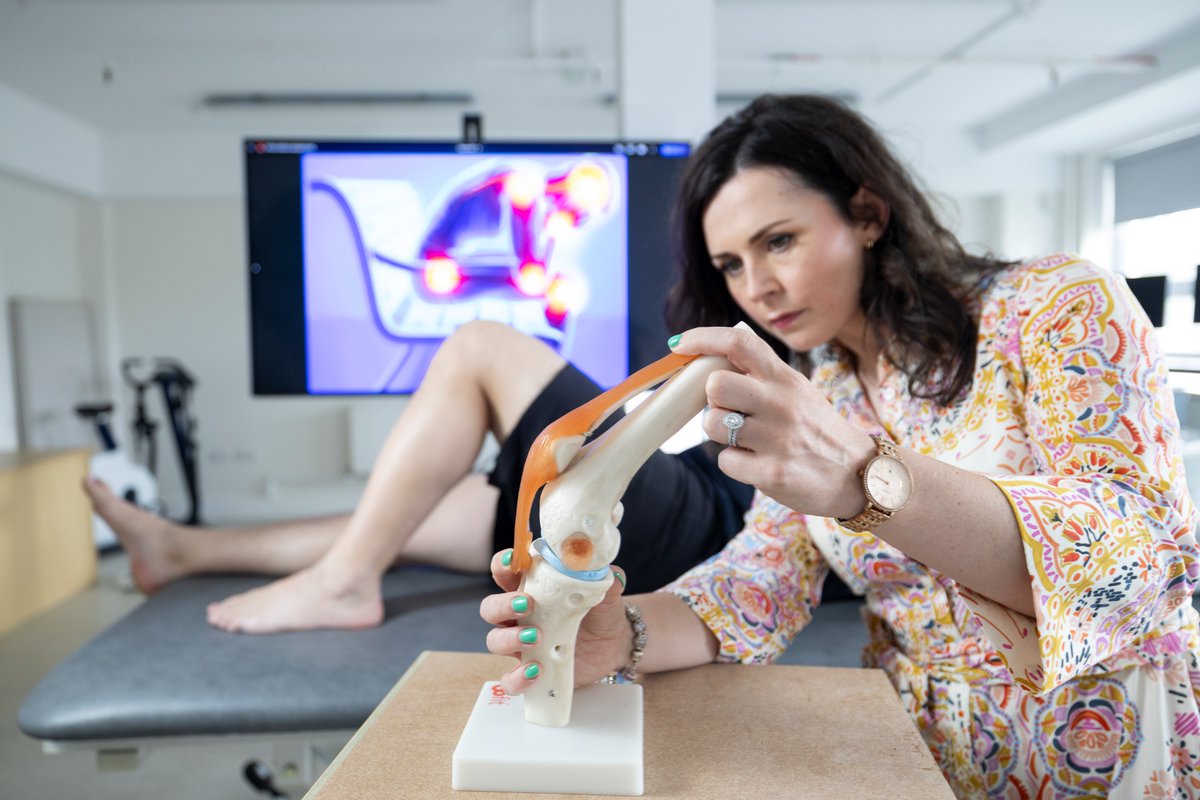
Dr Mary O’Keeffe from the UCD School of Public Health, Physiotherapy and Sports Science was awarded for her project PainSupportLink, which will explore the links between social disadvantage and chronic pain.
Dr Lucía Tiscornia from the UCD School of Politics and International Relations received the grant for her project CRIMLATAM, which will explore how criminal organisations such as gangs, mafias and drug cartels operate in Argentina, Chile and Costa Rica.
Dr Kevin Daly from the UCD School of Agriculture and Food Science was awarded for his project HERDPATH, which will use DNA molecules from thousands-of-years-old sheep and goat remains to reveal how infectious diseases adapted to their hosts and how livestock adapted in return.
Dr Graham Benham from the UCD School of Mathematics and Statistics received the grant for SurFSUP, a project that investigates wave-driven propulsion – the way in which a floating body, such as a water snake, propels itself forward by generating surface waves.
4 UCD researchers have been announced as recipients of highly competitive ERC Starting Grants! #ERCStG
Congratulations to Dr Mary O’Keeffe, Dr Graham Benham, Dr Kevin Daly & Dr Lucia Tiscornia! 💫💫💫💫
@ERC_Research
➡️https://t.co/BUnCLXlISN
What a pleasure it is to host this amazing conference at my own university @ucddublin ! I have already seen so much exciting fluid dynamics research. It has been great catching up with old friends and making new research connections with people from all over the world. #EFDC2
🌊 While EFDC 2025 brings fluid dynamics minds together in Dublin this week, the Journal of Fluid Mechanics continues to publish cutting-edge research shaping the field. Explore the latest articles here: https://t.co/W8ojNfZZGD
#EFDC2025#FluidDynamics#JFM
€175 billion for Horizon Europe: 2028–2034 budget proposal doubles funding.
Fuelling deep tech, supporting world-class research, we are turning ideas into real-world impact.
Discover how we’ll drive innovation & competitiveness across Europe: https://t.co/Pk9zovQoz0
Vortex rings can be almost perfectly reflected when approaching a water-air interface! This complex interaction is analyzed across a wide range of Froude numbers and incident angles, combining experiments, simulations, and a momentum conservation model.
https://t.co/p4mtxHrGmb
When winds are low, windsurfers will “pump” to generate momentum. Using a miniature sail in an experimental water channel, a study published in @PhysRevFluids shows how this maneuver affects the forces that help propel the board forward.
Read more: https://t.co/0GbRBJaFJz
📢 PRFluids Editors' suggestion: In light winds, windsurfing athletes pump the sail to generate propulsion and keep the board afloat. Sport-mimetic experiments study how pitching motions affect forces and performance, exploring sailing race strategies.
🔗 https://t.co/nIw3jagHXQ
📢 PRFluids Editors' suggestion: A metal disk on the water surface can be kept afloat by a water jet impacting it from above. Turczynowicz et al. show that the water displaced by the jet results in an increased buoyancy force that balances gravity.
🔗 https://t.co/y5Ac6zCWNQ
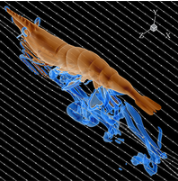
Shrimp swim by paddling 5 pairs of appendages. Using simulations, Lou et al show how they move to minimize drag. Check out their recently published paper here: https://t.co/E24eBTeGqT #FluidDynamics#Biofluids
Engineers led by Howard Stone discovered that a super-soft material can turn itself inside out to squeeze thru a narrow gap, opening the door to potential new engineering applications. It resembles gels used to engineer a wide range of products. Read more: https://t.co/OrEuNwuELt
📢 PRFluids Editors' suggestion: rotations may lead to brain injuries. Using a soft hydrogel ball in water as a simplified brain model, Wang et al. combine theory & experiments to show that the strongest deformations occur during rotational deceleration
https://t.co/1ovgmrGmMU
Read a new #openaccess article in #JFMRapids:
"Experiments on water-wave interactions with a horizontal submerged elastic plate" by Gatien Polly, Alexis Mérigaud, Benjamin Thiria and Ramiro Godoy-Diana.
📚 https://t.co/Wc5aLyZXZq
#JFM#OA#JFMRapids
🚨 The APS Division of Fluid Dynamics seeks nominations for Invited presentations and Proposals for mini-symposia and focus sessions for the 2025 APS Division of Fluid Dynamics Annual Meeting in Houston, Texas, USA.
Due dates: March 24 to Gretar Tryggvason ([email protected])
🏁 Ready, set, go! Palazzolo et al. from @Inria@inria_sophia use Bayesian techniques to find the optimal bio-inspired microswimmer, improving speed and efficiency, and going beyond the known diversity of pusher and pullers.
Find out more: https://t.co/TJBWAgmLhb #fluiddynamics