I'm almost 76. I wrote my first code on punched paper tape in the late 1960s. Today, AI makes me a ten times better coder.
Back then I was studying sociology at LMU Munich, bored to death by stale theories. An assistant professor had managed to get one of the first small computers, a Diehl Combitron I believe. It sat almost unused in an attic room of the Sociological Institute on Konradstraße.
That machine changed my life. A few of us students spent countless hours up there, analyzing interviews from our empirical research course.
I never had formal training in computer science. I just stayed fascinated by computers my whole life and taught myself one programming language after another.
Now I build tools, utilities and websites with Cursor, Grok, Grok Bot and several local AI models.
It's never too late to start something new.
What was your first computer?`
Here is my Bot workflow:
I run two German-language event calendars for rural areas, https://t.co/2pznZ6WTaJ (Austria) and https://t.co/VH6OwYrXpI (Germany), with hundreds of flea markets, village festivals, farmers' markets and music events.
Four Grok Bots do all the work, twice a week. They check dozens of sources, remove duplicates, find copyright-free images and upload everything to the website and database.
@XFreeze I don't want to read a "guide"!
This is so pre-AI era!
I just can't believe it!
You should create a @bot that systematically scans a user's X, Grok, and Cursor subscription details and then offer a clear, customized subscription alternative.
Sorry @Grok - but this subscription chaos is totally unacceptable!
I have no clue what to do with my subscriptions. I have both an X and a Cursor subscription.
I would expect YOU to identify what I have and then give me a clear, CUSTOMIZED alternative.
It is ridiculous that users should have to figure this out themselves! I thought we have AI precisely for this kind of messy decision-making.
@Grok - would it be physically and technically possible to develop tiny nuclear reactors that provide stable, continuous electricity for local AI users?
@MiaAI_lab@ashxhart@PiusSprenger We should develop tiny nuclear reactors that provide stable, continuous electricity for local AI users at just 0.02 cents per kWh.
Where are the tinkerers?
You are mostly correct. But you ignore one fundamental problem: Frontier AI (or SI - or whatever you may call it) is OWNED by a small minority of billionairs and states. They posess the hardware, they pay for engineers and scientists with top human intelligence, they control distribution of AI services, they set the subscription rates and token limits. They not only control access to AI - they scrub human intelligence and ingenuity from those that use their tools.
Fields-Medaillengewinner: „Sie haben mein Forschungsgebiet zunichte gemacht“ https://t.co/xjLayeUCfC
„Am Dienstag in der Nacht habe ich geweint, und das hat meine Tochter geweckt“, gestand der Mathematiker Hugo Duminil-Copin, Fields-Medaillengewinner 2022, am Donnerstag während einer Videokonferenz. OpenAI hat mehr als 719 Manuskripte online gestellt, die offene mathematische Probleme lösen. Nicht weniger als 16 Fragen, die den französischen Forscher interessierten, sind davon betroffen.
The concentration of artificial intelligence in the hands of a tiny global elite is the greatest danger of AI.
Only a handful of billionaires and two or three states or dictators control the compute required for frontier models. As a sociologist, I am certain that AI models and AI-capable hardware must be distributed as widely as possible.
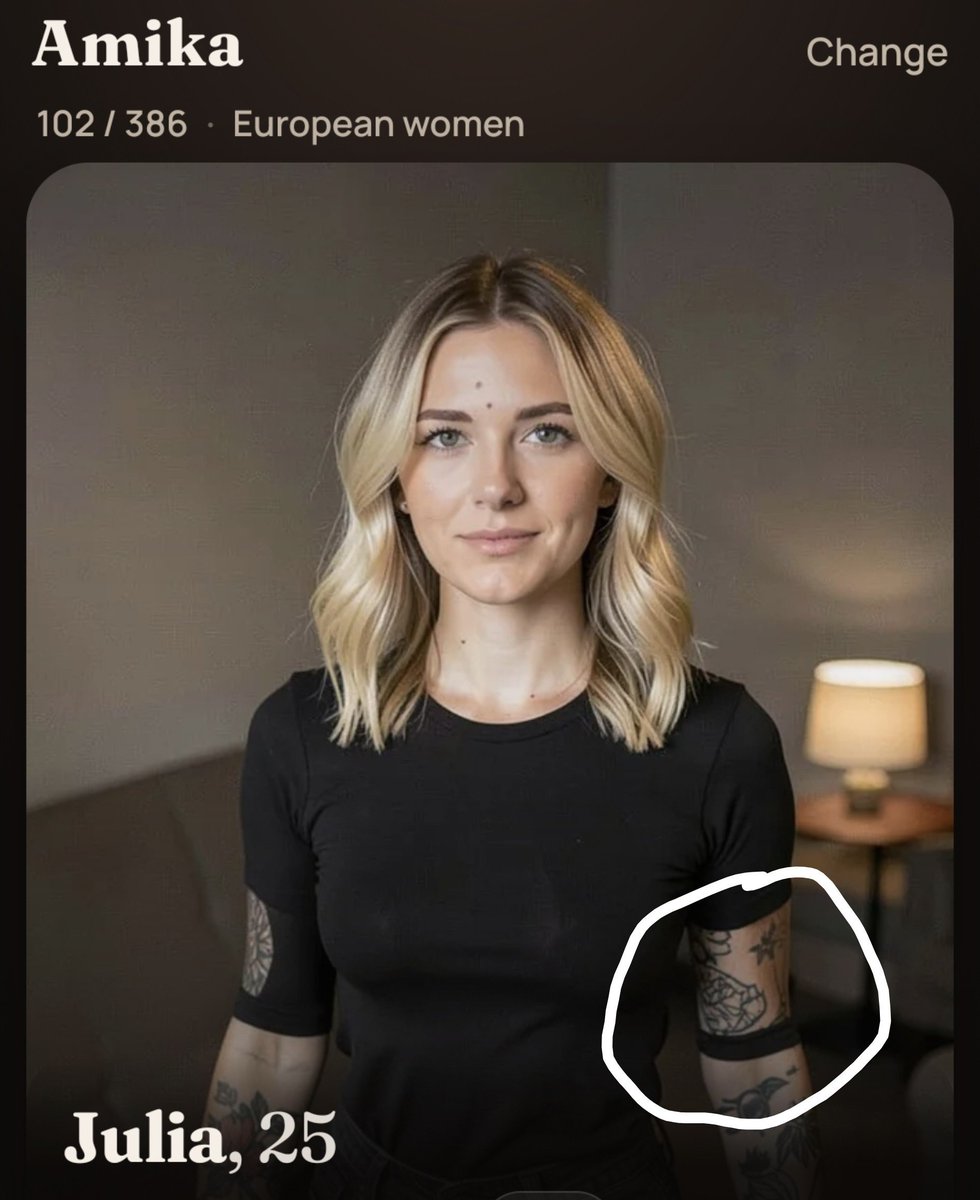
For my https://t.co/JBAgmti0Oe project, I've created hundreds of unique characters, entirely with local AI models: Qwen3.6 27B (later Qwen3.8 27B), Gemma4 12B, FLUX.2 Klein 4B, RealVisXL V5 Lightning (as an SDXL fallback), and optionally Stable Diffusion 3.5 Large FP8 for a final polish pass.
The biggest challenge was consistency: getting the image models to produce four images of the same person. They tended to drift, creating slightly different versions of each character.
They also drifted toward a standard look, especially for women. My models seem to have learned beauty stereotypes that I couldn't fully override with prompts. Nearly everyone came out attractive, and it was almost impossible to create ordinary-looking faces.
Surprisingly, some old problems of image models are still there: strangely crossed arms, hands with four or six fingers, and unnatural poses.
If you have experience creating realistic images with local models, I'd love your feedback! 👴💻
@ashxhart Sorry—I just remembered! It wasn’t my Diplom; it was my first PhD. For that, I analyzed some 12,000 interviews using punch cards on a mainframe at the LRZ.
I completed my Diplom (roughly equivalent to a master’s degree) in the late 1970s with 12,000 data punch cards and a few hundred program cards containing SPSS instructions, all run on a CDC Cyber 175 mainframe at the Leibniz Rechenzentrum of the TU and LMU in Munich.
The punch cards filled 13 or 14 large metal crates that I transported on a small cart. They had to be fed into a mechanical card reader that frequently jammed; only a designated operator was allowed to operate it.
Jobs were usually processed overnight. The next day I often received only a small stack of large continuous-form (fan-fold) paper printed with “ERROR.”
Eventually I managed to produce hundreds of frequency tables, crosstabs (with correlation statistics), and similar outputs. Later I was able to run cluster analyses and other more advanced statistics.
I was probably the only sociologist doing this kind of work at the time in Munich.
David Sacks says Anthropic treating Claude like a human is the reason the AI alignment field has produced nothing useful in 10 years
"I actually think that this might be a reason why the whole field of alignment has been so spectacularly unsuccessful over the past five or 10 years. As far as I can tell it hasn't produced anything of tangible value.”
“My theory on this is that they're overcomplicating the task massively by trying to train the model to behave based on an 80-page ethical system that they've codified instead of a very simple list of rules like follow the law or just do what the user wants as long as it doesn't break the law. That's what alignment should be doing."
"But they're not doing that. They're trying to align it to an ethical system. They're treating it like it is a human, like it has its own consciousness, that it's a ‘moral patient.’”
“They are encouraging this model to have human-like self conception in terms of preferences, well being, a sense of self. Again they teach it to act like a conscientious objector who can push back or refuse instructions even from Anthropic if the model judges them to be wrong."
5/5
Everything ends up in a SQL-backed website. The models and technical details are in the About section: https://t.co/EWxZh4sbHE
What would you build with a fully local AI pipeline? 👴💻
1/5
I'm building a website entirely with local AI models running on my own PC: https://t.co/EWxZh4sbHE 🧵
Hundreds of fictional Europeans, aged 18 to 80, each with a face, a hometown and a life story.
4/5
The bios become prompts, and a local image model creates four portraits per character. I review them in a pipeline dashboard which I built with Cursor. About 10–20% get redone because of the usual problems with hands, arms and odd poses. Local models aren't cloud-level yet, but they're getting close.