I spent 15 years conducting laboratory earthquake experiments on faults that are unnaturally flat. But real earthquakes rupture fault zones that have complex architecture. This paper, https://t.co/h0A7mq0fwZ... just published in JGR, strives to address this disconnect.
I didn’t invent this technique. I follow Ampuero, Ripperger, Mai, Dempsey, Suckale. Different from those studies, I don't use a flat-fault nucleation criterion (Dieterich1992; Uenishi&Rice2003; Rubin&Amp2005) because I believe it is inappropriate for most natural earthquakes.
A main result of this study is that Δ𝜏_pot must be highly variable to produce a variety of earthquake sizes. The average Δ𝜏_pot might be close to 3 MPa, but it should vary drastically, from 25 MPa to -25 MPa. Almost all current earthquake models assume a much smoother Δ𝜏_pot.
I’m looking for PhD students to join my research group and study earthquake mechanics. If you’re into lab experiments, signals, writing good science papers, and living near natural beauty, then perhaps my group would be a good fit. I’m at AGU! Message or email me and let’s meet!
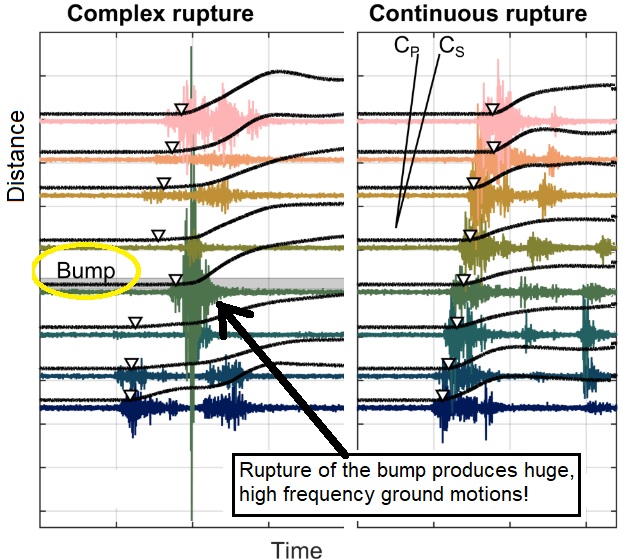
Very proud of my first Seismica publication! @WeAreSeismica. Led by @sblcebry, we focus on seismic implications of fault heterogeneity. Using lab experiments, we show that a patch locally high normal stress (a bump) can produce huge high frequency ground motions when ruptured.
Two recent papers on impermanent barriers to earthquake rupture propagation: an experimental study coming from my lab with @sblcebry here: https://t.co/psnuMyyDs5 and a modelling study from @diego_mo_om and @DocTerremoto here: https://t.co/EHbxH2nOYm
@XRupture@hueyke @dave_kammer I presented at SCEC 2021 after 1 revision thinking it’d be published soon, but I misjudged the frustratingly slow and indecisive Nature Geoscience. 6 reviewers, and 14 months later, it is published in NatureComm
Our paper on delayed triggering and slow fronts in lab experiments is now out in @NatureComms. A collaboration with Sara Cebry, @hueyke, Chris Marone, Sharan Shreedharan and @dave_kammer:
https://t.co/N33XzwSQeq
Using hybrid samples, we directly observe asperity interactions.
Job Alert: Multiple hires in my department this year in the areas of “Mechanics/Geomech/Structural Eng” https://t.co/fAOgPsNY2m and “Cyber-Phys Systems for Smart-City Infrastructure” https://t.co/geS4Du7wQ0 These positions are open to all ranks (assist/assoc/full prof).
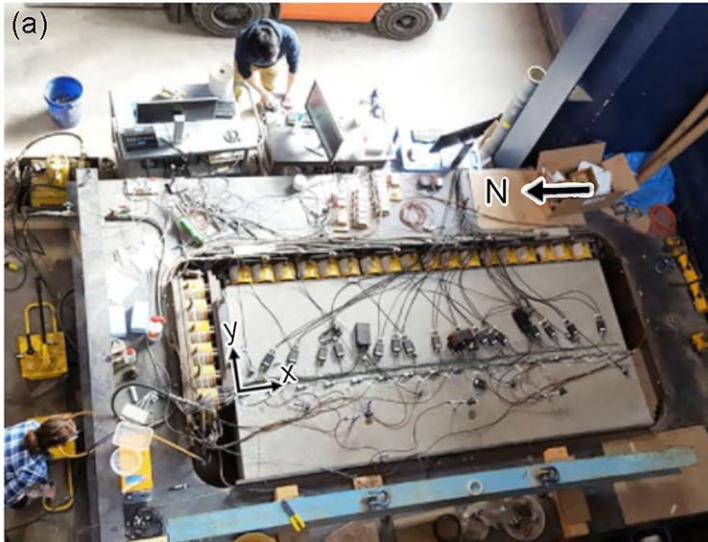
We show how initial stress levels affect the propagation of fluid-induced aseismic slip, the transition to dynamic rupture, and the overall rupture extent. And the sample is large enough that both the first and second authors are in Fig1a!