Nibbling on $LULU before today's earnings release. The Street hates it. Trading at levels not seen since December 2018. Yet Wilson proxy fight is behind us. Revenue is almost 4x where it was in 2018. And $VSXY surprised on the upside earlier this week. [Disclosure: I'm wearing $500 of lulu clothing while reading their financials]
In the last week, I've heard four unique company leaders that admitted they "blew through token budgets with AI tools" in the first few months of this year. That explains why Anthropic and OpenAI revenue went parabolic in the last quarter. But all four execs are working on how to get control of that spend.
As these companies prep IPOs, I don't hear enough concern about the physics of that spending wave. As quick as the revenue came, it can decline. Too many observers are modeling 3x-10x revenue growth for the next 2 years.
Usage-based pricing models can and will produce more up and down revenue action than SaaS revenue models ever did.
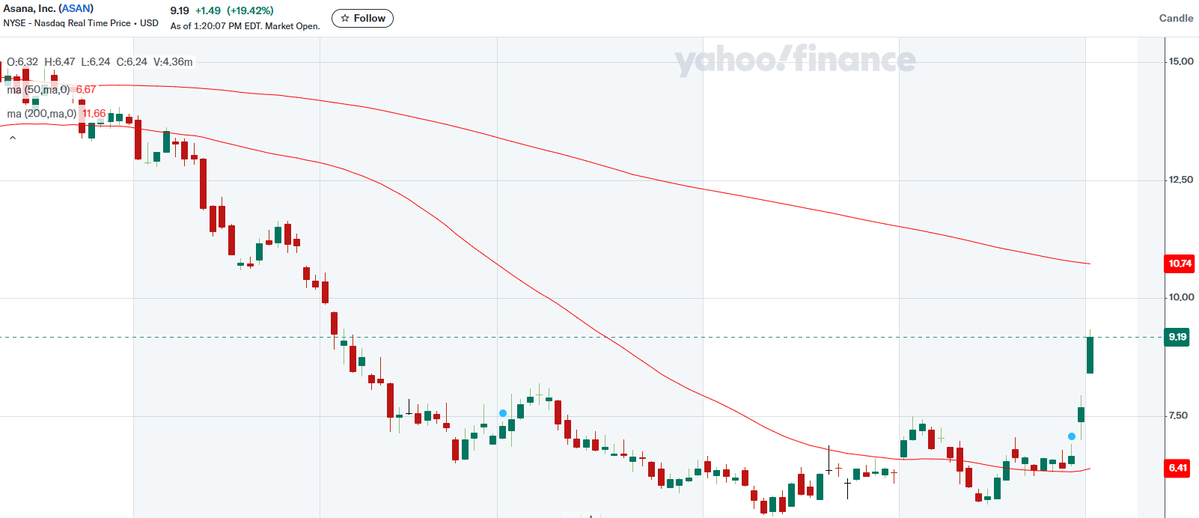
This is what conviction looks like. $ASAN was building a base leading up to last weeks' earnings release. New CEO was in the seat almost a full year. Street expectations for growth was muted. Short interest was building--despite favorable release from $TEAM earlier in the month. Channel checks indicated strengthening retention and AI attach rates. Built a sizable position last week and will be opening the good wine tonight! Cheers!
A quote from $LULU founder @ChipYVR in his proxy campaign piece….
“It is clear to those who understand creative, premium businesses that technocratic MBAs have taken control of lululemon, and the business has suffered ever since.”
This founder frustration is common but isn’t written about enough. When the MBAs take over, decisions slow down, future bets get smaller and more risk averse, and the most innovative ideas drown in ROI theater.
"The one thing money doesn't buy you is friends that believed in you when you had nothing."
@GavinSBaker told Dan this, paraphrasing @PalmerLuckey
It was Dan's answer to the kindest thing:
"Before I started at Jefferies, I had about a 6 or 9 month period where I wasn't working.
My friend Carter let me sleep on his couch.
When I got my job at Jefferies, I suggested to him a bunch of different distressed debt situations.
He trusted me with a few hundred thousand dollars of his money. It turned into a little over a million dollars.
He then rolled that into my fund. It really enabled me to get my business started..
The @RepThomasMassie loss is a clear microcosm of how Congress places negative value on individual conviction and actual leadership. Massie is the kind of talent that leadership purists admire. But unfortunately, his loss proves that actual constitutional conservatism is out of favor today—in both parties. Voters don’t want true representative democracy. They want Sales Reps for their party leader. Ben Sasse was right when asked why he left the Senate. He said Washington isn’t about governing or management—it’s just performative branding for one of two party leaders. The good news is that Massie will start a new chapter deploying his talent in an arena that can actually make an impact.
It was only a few months ago the tech media was writing the obituary on CPUs. The narrative was the GPU had made them obsolete. Turns out agentic AI is still highly reliant on CPUs. And shareholders of $INTC, $AMD, and $QCOM have enjoyed that realization. The same realization will happen with the application layer of software.
JOLTS: Openings flat, hires up but layoffs also up slightly. Certainly no major sign of erosion, but also no major break from "low-hire, low-fire" stasis.
Data: https://t.co/gRAJfT6CuF
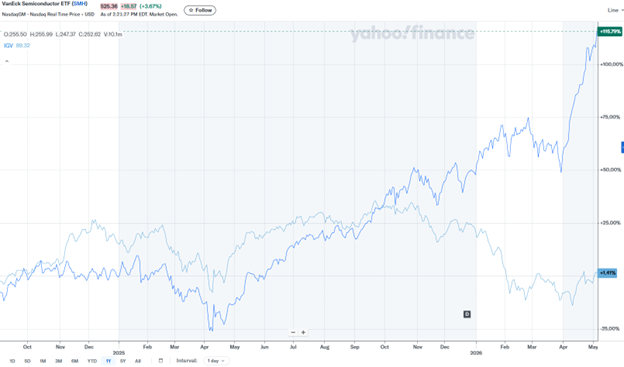
Here's a daily chart of the Semiconductor index ($SMH) versus Software index ($IGV). Both ETFs generally move in lock step. The correlation coefficient of their daily charts was 0.82 from May 1, 2025 to Oct 31, 2025. Then from Nov 1, 2025 to May 1, 2026, the "r" fell all the way to 0.18. When will the mean reversion start?
It puzzles me how little discussion I've seen regarding the risks to OpenAI in the Musk trial. They certainly have more to lose than Musk. Even with low odds of the court unwinding OpenAI's restructure, the fact that odds are non-zero would cause a re-rate of the entire AI ecosystem. And the possible outcome of OpenAI paying 11-12 figure damages would heighten fears of their ability to make good on long term contracts.
I enjoyed dinner last night with 40 business leaders in Omaha for Berkshire Hathaway's annual meeting (thank you Ted Bridges and Bob Slezak for hosting). Can you guess the anchor topic of discussion in a room full of investment-minded brainiacs? Yep--AI and it's impact on jobs and education.
I'm not in the camp that says AI will create a sudden rupture in history. I find it exciting moreso than scary. I see it as the latest chapter in a 50+ year story: the steady automation of human work. Nothing more. Nothing less.
In the 1970s-1990s, automation meant industrial robotics. Factories didn't disappear. But the nature of work inside the factories evolved. Less human assembly lines, more technicians, operators, and supply chain managers.
In the 1990s-2010s, bandwidth turned information into a utility. The automation innovation came down to access. Geographic boundaries melted away. Publishing and distribution went to zero marginal cost. Travel agencies struggled, online travel booking sites emerged. Newspaper classified revenue was displaced by Ebay and Craigslist. Remember how the internet was supposed to hollow out US-based radiologists? Turns out the number of practicing radiologists in the US has almost doubled since 1990.
Now we have AI. It's automating repetitive thinking tasks. It's big. But it's the same pattern as each automation wave in the past. It commoditizes low-leverage knowledge work. It expands what can be achieved by individuals and small teams. It creates new roles for tool prompting, orchestration, and oversight. Engineers will directly author less code--but police more activity of digital agents. LLMs will deliver on the promise that WebMD never quite achieved--being a better, more direct primary care doc (thus solving a shortage in general practice docs).
AI isn't the end of work. It's another turn of the same flywheel that's been spinning for decades. Don't let the dystopian narrative fog up your opportunity goggles. Make sure the next generation of talent is focused on skills related to creativity, judgment, leadership, original thinking, and swiftness to act.
@newstart_2024 "Coddling" is different than "loving kids too much". Coddling is when a parent seeks to solve every problem for a child--which in turn prevents the child from learning how to solve problems on their own and later expecting a workplace that optimizes for their comfort.
Takeaways from #Atlassian earnings release:
-Enterprise demand for work management apps is re-accelerating
-AI is now monetizable. While many investors were expecting seat contraction, the best SaaS apps are growing per account revenue by monetizing AI usage.
-Growth of deal sizes indicates an unlock in CIO spend.
This report bodes well for the whole category. $ASAN $MNDY $TEAM
$TEAM's blowout earnings are a glass of cold water thrown on the #SaaSpocalypse crowd. >30% revenue growth at scale. FCF margins of 31%. This will buoy the entire category. The narrative will soon shift from "AI kills work management SaaS" to "work management SaaS is the core system of record where AI can be deployed". $ASAN $MNDY $NOW
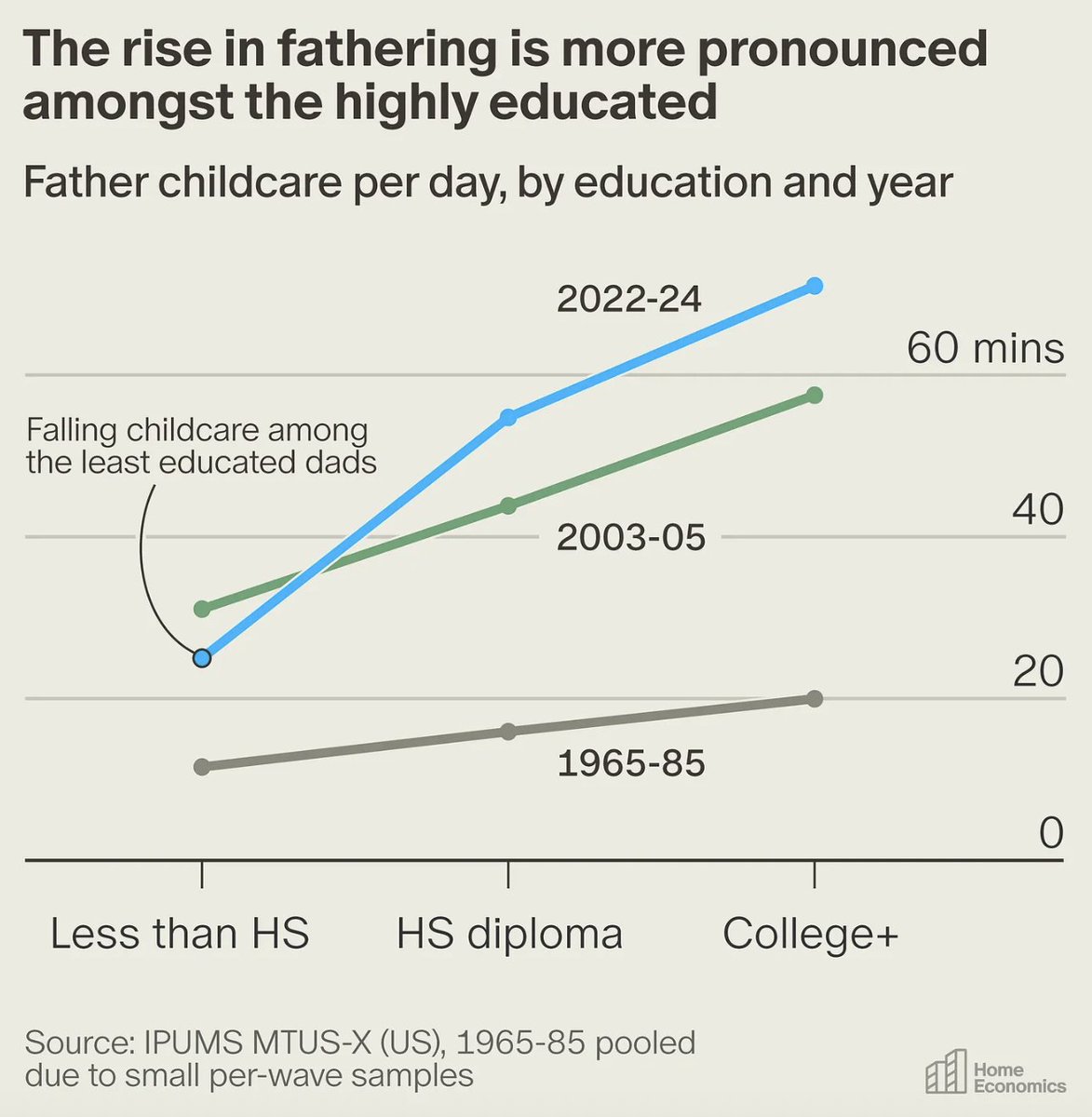
New newsletter: MODERN FATHERHOOD WOULD BE UNRECOGNIZABLE TO A 1950'S DAD
Compared to their Boomer parents, childcare time among Millennial dads has more than doubled.
Compared to their Silent Generation grandparents, it’s nearly quadrupled.
You will be hard-pressed to find any part of day-to-day modern life that has changed more in the last half-century than the way today’s parents—and fathers, in particular—spend their time.
The new American dad is more present and more exhausted—but also, more satisfied with life. What's behind this half-century transformation? Today's piece combines history, economic analysis, and gorgeous charts galore from @AzizSunderji