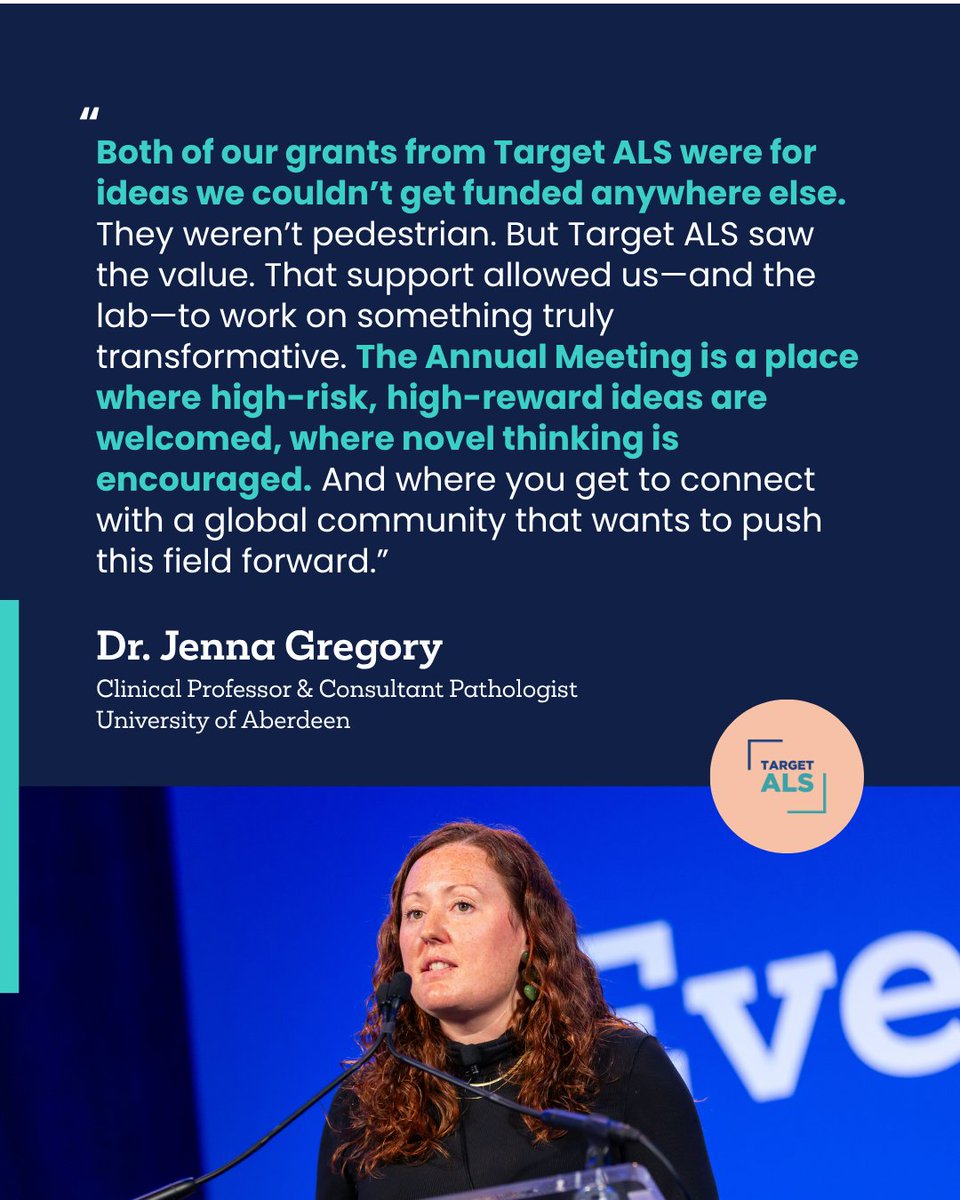
At our Annual Meeting, Dr. Jenna Gregory shared how her team is bringing oncology-style precision to ALS—studying how T cells behave differently with #ALS. Her findings, through research we fund, offer clues for better treatment. Sign up to learn more: https://t.co/cIsItEAG1S
#ENCALS2025 in Turin is over, but we’ve had an amazing time presenting our team’s (@GregoryLab7) work as posters and oral presentations. A wonderful demonstration of the excellent translational neuroscience research going on @aberdeenuni. Can’t wait for Madrid next year! ⭐️🤩⭐️
@GregoryLab7 will be in Turin next week for #ENCALS2025 🇮🇹⭐️🤓
Interested in biomarkers for early disease detection (precision prevention) and treatment stratification (precision medicine) in ALS/FTD? Come and find us in the session detailed below. @FergalWaldron@HollySneuro
In our new preprint we report improved detection of TDP-43 in non-CNS tissues prior to symptom onset in #ALS#MND, using an RNA aptamer– from peripheral organs including skin, GI tract and lymph node, between 1-14 years prior to clinical diagnosis.
https://t.co/cVRd6mO13B
There is still time to register for #BNA2025.
Be sure not to miss our symposium highlighting UK MND translational research.
Thanks to @MNDScotland, @MNDoddie5 & @mndassoc for organising a great session.
Take a look at our recent Lancet Neurology review. Amyotrophic lateral sclerosis caused by TARDBP mutations: https://t.co/yXkRg4ePPe
It’s been a huge privilege working with this incredible writing team and we hope you enjoy reading it.
⭐️🤩🤓🤩⭐️
Our team (@GregoryLab7, @HollySneuro & @FergalWaldron) is delighted to share some recent work from machine learning expert @MV_Research. It’s always a pleasure to contribute to collaborative projects especially with Marta and her incredible team.
https://t.co/DLVr5dhjlp.
MND Scotland expresses gratitude to the female researchers contributing to our understanding of MND and enhancing the quality of life for those affected. Some have received funding from us, while others are part of our Scientific Advisory Panel 💙 #WomenInScienceDay#WomenInSTEM
⭐️New preprint - Machine learning identifies predictors of cognitive dysfunction⭐
Population-level risk factors exist for dementia & related neurodegenerative diseases – how do these relate to individual risk? 🤔
⭐️New preprint - Machine learning identifies predictors of cognitive dysfunction⭐
(1/4) Population-level risk factors exist for dementia & related neurodegenerative diseases – how do these relate to individual risk? 🤔
https://t.co/O5LM5QD4x7
(4/4) Here, we demonstrate how routine, inexpensive medical testing & local authority initiatives could help to identify and protect at-risk individuals. This work was supported by generous funding from @NIH@CSO_Scotland@TargetALS_fdn@wellcometrust 🤓
https://t.co/O5LM5QD4x7
(3/4) The most predictive risk factors of individual cognitive dysfunction out of >450 features evaluated in our deeply phenotyped cohort were:
💭Low and high haemoglobin levels
💭Pollutants typical of vehicle emissions
💭Region specific brain volumes
https://t.co/O5LM5QD4x7
(2/4) Here, we use a machine learning approach to identify predictors of poor cognition in a deeply phenotyped @genscot cohort of 324 individuals – we assess >450 environmental, social, and biometric risk factors, and their impact on cognitive health.
https://t.co/O5LM5QD4x7
⭐️New preprint - Machine learning identifies predictors of cognitive dysfunction⭐
Population-level risk factors exist for dementia & related neurodegenerative diseases – how do these relate to individual risk? 🤔
⭐️New preprint - Machine learning identifies predictors of cognitive dysfunction⭐
(1/4) Population-level risk factors exist for dementia & related neurodegenerative diseases – how do these relate to individual risk? 🤔
https://t.co/O5LM5QD4x7
So lucky to work with such an amazing team of hard working scientists. Here’s a snapshot of our year in review from the Gregory Lab (and friends) - working hard towards our dream of a world where we can beat #ALS#MND
Research highlight for 2024: Dr Jenna Gregory's team found new ways to detect MND.
The TDP-43 aptamer can show early signs of the disease in brain tissue samples before the cells malfunction when standard symptoms would start to appear.
Read more here: https://t.co/ucyM8SmZ7D
#ALS/#MND Precision-prevention concepts:
💭Perspectives>Learning from cancer
💭Detection>Before motor symptoms arise
💭Precision>Understanding individual’s risk factors & heterogenous disease manifestations is key
💭Prevention>Safe interventions & early triage to clinical trials