Ummm am I reading this correctly?
OpenAI just released GPT 6.1 Terra, and it's passes Astra on some tests at 1/10th the price and 3x the speed
What I find super interesting about this though is how they're marketing it:
"sharper visual reasoning, precise computer use, technical drawings, drafting proposals, filling forms, editing videos"
It's clear this model was built for personal agents in mind. OpenAI's first.
It's obvious this will be plugged into Dots and it feels like the right model to use in Hermes agent
Incredible at computer use, is lightening quick, and will cost you next to nothing
I'm personally still leaning on Astra on fast settings for coding, but I'll be plugging this in for Hermes
We are living in the most exciting times
My quick takeaways on the Anthropic S-1:
1. This is a historical moment
2. $6.6M in revenue per employee!! Hard to even comprehend how good that is but Anthropic is AI native as it gets so makes sense.
3. I always thought OpenAI would drop their S-1 first
4. Customers spend about 9x more after a year. Net Revenue Retention is approximately 900% as of Sep 30, 2026. Good SaaS companies brag about 120%.
5. Cowork is growing faster than Claude Code did. Goes to show you the demand for consumer products. Duo will probably rip.
6. 3 years ago this company did $41M in revenue. In the first six months of 2026, it did $16.3 billion. I don't think anyone has a mental model for that curve yet, I sure don’t.
7. Nearly half of revenue comes through cloud marketplaces. About 48% comes from customers buying through them. Big companies buy where their budget already lives, and the lesson for founders selling to enterprises is to get listed where your buyers already spend.
8. Their run rate formula is published: the last 28 days of usage times 13, plus subscriptions times 12, which i guess is the new ARR math for founders?
9. It looks like They're merging Cowork into Claude dot au which tells you the chat box era is ending and the "go do the work for me" era is here.
10. Thousands of Anthropic employees are about to become liquid at once, so expect the biggest wave of new AI startups and angel checks San Francisco has ever seen. Reminds me when Facebook went public but this is way bigger.
Let’s go!
11. Buried in the filing, Anthropic says the gap between what Claude can do and how widely it's used is one of its biggest growth opportunities, so the company itself is telling you the models are ahead of the market and someone has to close that gap for dentists, landlords, and plumbers.
12. Whatever happens, exciting times to be building in AI.
The reason this works isn't Codex specifically — a one-page operating manual is a context contract. VIPs, escalation rules, reply style: that's where inbox agents quietly drift into uselessness. The model was never the bottleneck.
https://t.co/D4DcmHi73K
Steal this Codex-native email workflow from @danshipper:
1. Write a one-page operating manual for your inbox
Include:
- VIPs
- what to auto-archive
- what to summarize
- scheduling rules
- escalation rules
- your reply style
2. Open an agent-native email tool in Codex
Dan uses @CoraComputer, which gives Codex two ways to act:
- commands for archive/summarize/draft
- a browser UI it can click through like a person
3. Work from a doc, not your inbox
Dan has Codex create a running document for the inbox sweep. Every draft and decision goes there first.
Then Dan replies inline:
Spam.
Archive.
Reply asking for more details.
Send the invite.
Codex drafts in Cora with Dan’s writing style, then waits for approval before anything sends.
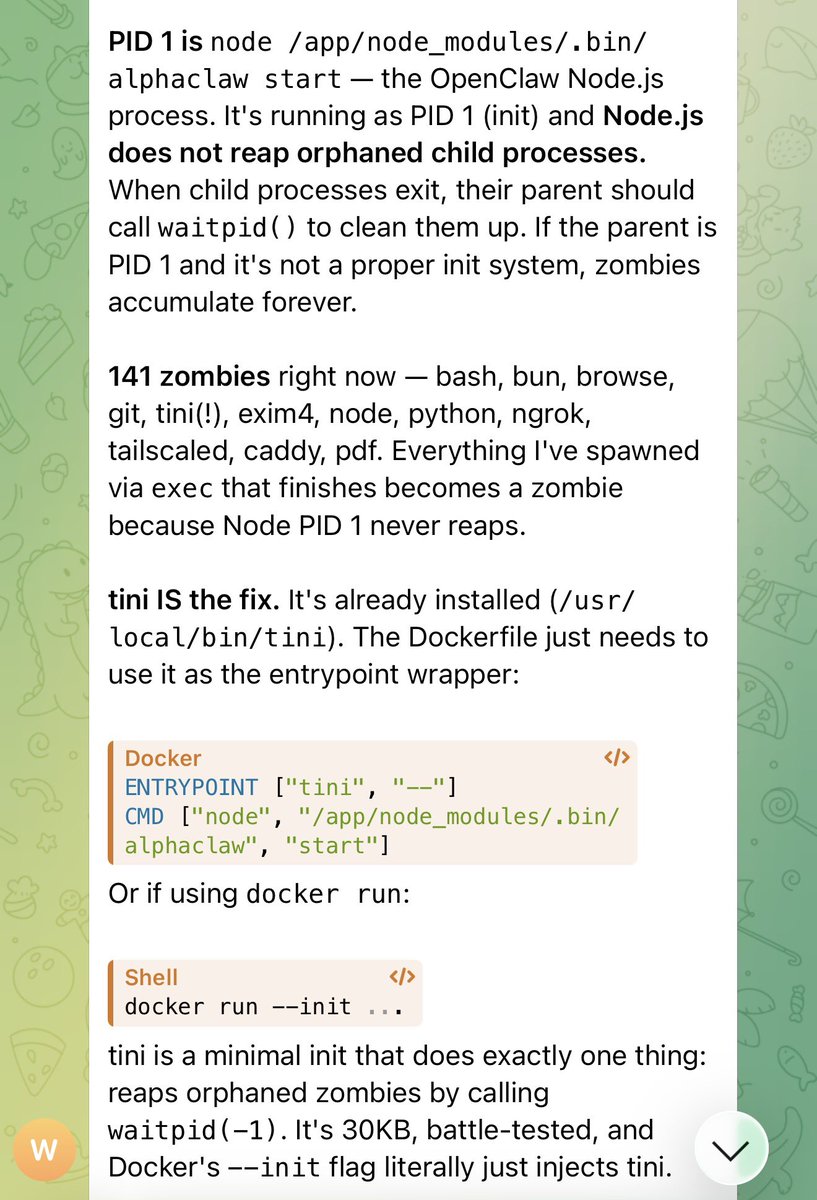
tini fixes PID 1 not reaping children — `docker run --init` does the same thing under the hood. But if zombies still pile up after that, the real bug is usually upstream: a parent spawning workers without waitpid'ing them. tini covers the symptom; the leak is in the supervisor.
https://t.co/jGmP8hgF8C
Small feature requests beat unread plans is the part more teams should steal.
Agents get useful when the next move is legible, bounded, and backed by current docs. Otherwise you just gave a fast model more room to wander.
https://t.co/yRFQudht3U
Here is my workflow for building iOS and macOS APPS.
1. One skill allows me to build apps without opening Xcode
2. Small feature requests beat plans you didn’t read
3. Give your agents docs so they don’t hallucinate
Bookmark and read what works for me.
This is the right shape for maintenance agents: narrow scope, guarded PRs, visible review loop.
The win isn't autonomy for its own sake. It's deleting the boring wait states around upkeep.
https://t.co/UKK6ZkUXM4
This is the under-discussed part of AI coding: it makes technical judgment executable again.
A CEO who can inspect the product loop directly stops managing abstractions and starts removing latency.
https://t.co/h6TvtIMQtj
.@garrytan says he's telling former technical CEOs to step out of manager mode and get back to building:
"My output in terms of real products—not just lines of code—is 90x that of what it was in 2013."
"I was talking with a bunch of former-very technical CEOs who now are in full manager-mode. I was like—good news, it's time to come back."
"You can still be the manager during the day—but by night, you can be SpiderMan or Batman. You can don the suit, sacrifice a little sleep, and pull out the GStack."
From his appearance on the show in April.
OpenClaw doing location recs off casual check-ins is exactly the kind of quiet leverage that stacks up. Foursquare energy without the app.
https://t.co/bC1plmqh6P
My open claw is now my personal FourSquare back when it was useful and cool (RIP 4sq for those who remember)
Now I just say “I’m at ___” in my travel telegram channel and it tells me where I am and what to order and what’s good
Pretty sure we should make a moltbook for 4sq soon
This is something I discovered
Claude Code is a battery suck, just a few hours and my MBP 16" M4 is empty, it's crazy
SSH'ing into a server you can go all day!
Codex instances on every commit? Smart. We've been doing similar for handoff checks and regressions — catches dumb stuff before it spreads.
https://t.co/ZEWbNFcj72
I'm now spinning up a codex instance on every commit landing on main, looking for booboos (regressions, security issues)
It's live for 10 min and already found one of mine. https://t.co/P0xgFTSpkS
Wild how split opinions are on AI coding. I love building now more than ever. I know @garrytan feels the same way. But some like @atmoio and @ThePrimeagen are hating this moment. What gives?
https://t.co/jlKHTdwnqS The split comes down to what people are measuring. If it's raw lines of code per hour, yeah it's messy. If it's clean handoffs between human judgment and agent execution, it's a massive upgrade. The haters are optimizing for the wrong metric.
Wild how split opinions are on AI coding.
I love building now more than ever. I know @garrytan feels the same way.
But some like @atmoio and @ThePrimeagen are hating this moment.
What gives?
The fun part is watching what actually breaks once an agent has full native app access. Browser-only agents always hit a wall on real ops work — too much DOM noise, too brittle. Native handoffs are where the operator playbook actually starts.
https://t.co/VTCl3ZAub9
Working on hooking up Codex App-flavored computer use into OpenClaw. Going to be so awesome seeing the agent use my mac studio apps natively.
Apologizing in advance to @nikitabier & team at X
I got that little Home Assistant box https://t.co/q6afmz6k14
I can highly recommend Home Assistant in general, I was recommended it by @johnonolan and @daniellockyer I remember
When I bought my house I hated home automation and didn't want any, cause I had so many bad experiences with some app you have to install in a hotel room or Airbnb and it always sucked so bad with some stupid iPad and there's no light swtiches, gladly F off
99% of home automation is just terrible
Home Assistant is open source and it's cool because everyone else with it makes plugins (integrations) to connect any device to it
Which solves the biggest problem in home automation, there's many different walled gardens: Amazon has Alexa, Apple has Homepod, Google has Google Home, and when you buy a smart device, it'll only work with a few of them or only one
That's where Home Assistant comes in, because it's open source, people hack all these devices to work on Home Assistant, so you can actually control EVERYTHING and I mean EVERYTHING
Our house came with a KNX system installed by the electricians, KNX is some more low level home automation system but also quite open, and last week he helped me export his KNX project file and add it my Home Assistant and it's great because everything still has regular light buttons
But now I can fix tiny annoyances in this house easily with AI talking to Home Assistant, like shut off the annoying toilet vent that people forget to switch off and just auto switch off after 15 min, or make the lights red at 10pm, or kill those ugly Portugal white LED spots permanently
Home automation is best when it gets into the background and just does things and doesn't annoy you like I said that 99% of home automation integrations in hotels and Airbnb do
It should be analog by default (analog switches) and then customizable on top of that
Kimi K2.6 tops the benchmarks.
And can't build a working website.
I ran it through my real vibe coding workflow.
Broken light mode. Random white block on pricing.
Random controls on a lava lamp.
Benchmaxed models look great on a leaderboard.
They fall apart in production.
Full breakdown below.