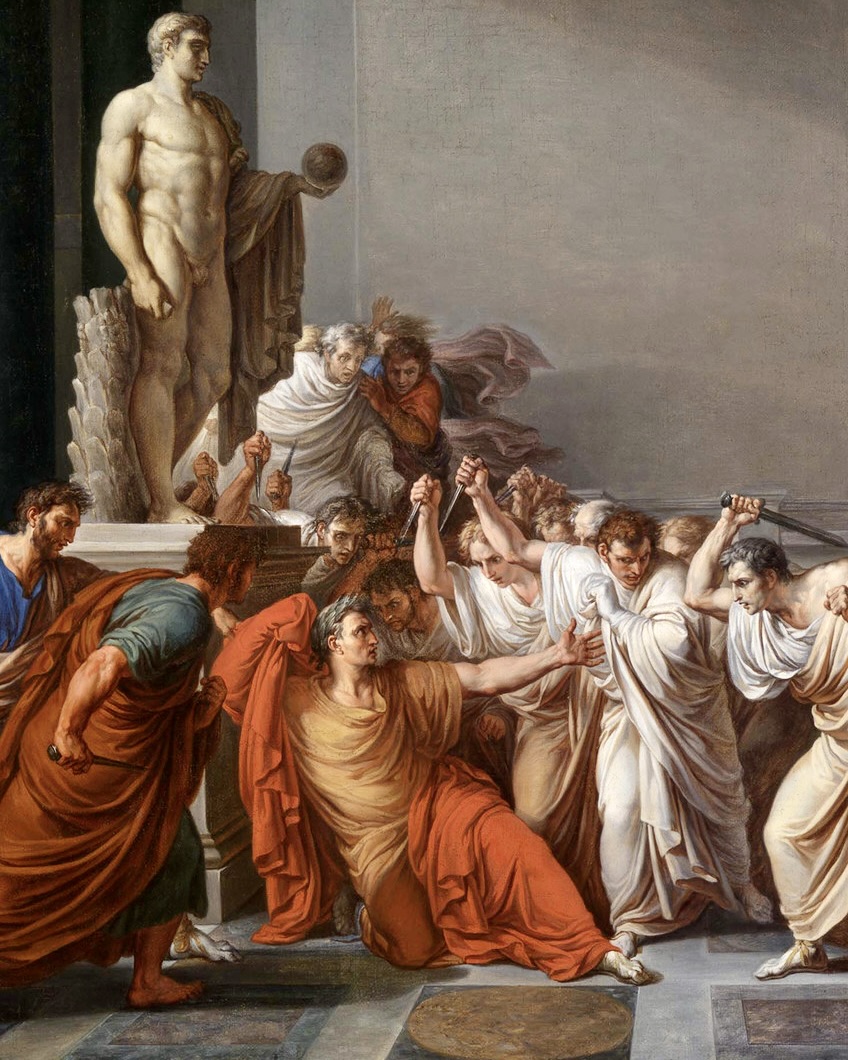
What did the Founders think of Caesar? That he was a tyrant and compared George III to him.
That’s why they idolized Cato and Cicero, Caesar’s political opponents.
In fact, George Washington’s favorite play was Joseph Addison’s “Cato,” and John Adams had a Cicero portrait.
When Julius Caesar was assassinated, it wasn't by a lone attacker — it was a group of his rivals in the Senate.
Why? Because they feared his growing popularity with the common people.
Here's how it unfolded on March 15, 44 BC... (thread) 🧵
Richard Henry Lee was an essential patriot, not well known by nearly enough Americans. Even those who know his name might be surprised to learn in 1759 he argued that Africans were “equally entitled to liberty and freedom by the great law of nature.”
More https://t.co/oMmgw6JKnm
𝗧𝗛𝗘 𝗠𝗢𝗧𝗜𝗢𝗡 𝗧𝗛𝗔𝗧 𝗖𝗥𝗘𝗔𝗧𝗘𝗗 𝗔 𝗡𝗔𝗧𝗜𝗢𝗡
In June 1776, Virginia delegate Richard Henry Lee introduced a resolution before the Continental Congress declaring that the American colonies “are, and of right ought to be, free and independent States.”
His bold suggestion transformed years of protest, political debate, and armed struggle into an official campaign for independence.
The resolution led to heated debates, and Congress created a committee to hammer out what would become the Declaration of Independence.
Though Thomas Jefferson would go on to write the document, Lee’s resolution formally put the separation from Great Britain before Congress and set the United States on the path to nationhood.
@HandlebarHist Exactly. The lack of scholarship on antislavery statements and actions prior to the Declaration was, frankly, shocking as I began looking into it.
Two hundred and fifty years ago today, Richard Henry Lee formally introduced a resolution into the 2nd Continental Congress calling for a Declaration of Independence.
Lee had been fighting British overreach for more than a decade & had seen enough.
More: https://t.co/6O0pAXILOd
@theoldworldshow One only has to drive though any of the neighborhoods in Silicon Valley to see this in action. Some of the ugliest most expensive houses on the planet.
A Great American. He blazed the Wilderness Road through the Cumberland Gap to found 2 of Kentucky's earliest settlements. During the Revolution, he defended towns against sustained native attacks, served 3 terms in the VA legislature & fought valiantly at the Battle of Blue Licks
🇺🇸TODAY IN AMERICAN HISTORY🇺🇸
Happy Daniel Boone Day!
On June 7, 1769 Daniel Boone and his small hunting party reached the top of Pilot Knob in Kentucky and got their first breathtaking look at the fertile Bluegrass region.
Standing on that high point, Boone and his companions gazed out over what looked like an endless sea of rich, rolling grassland dotted with trees. Boone later said the view filled him with wonder. That moment sparked his lifelong love for Kentucky and helped open the western frontier to American settlement.
For generations afterward, Kentuckians have celebrated June 7 as Daniel Boone Day to honor the legendary frontiersman who helped tame the wilderness.
During the Stamp Act Crisis, Richard Henry Lee led the way in estsblshing the Westmorland Associatio, via the Leedstown Resolves:
The Leedstown Resolves — or Leedstown Resolutions — is a document that organized the Westmoreland Association, for the purpose of resisting the Stamp Act and ensuring Virginians in Westmoreland County did not comply with the law. The document was written by Richard Henry Lee and signed at Leedstown, Virginia on February 27, 1766.
The Westmoreland Association is considered to be one of the first groups that were formally organized to resist British policies. Other groups, like the Sons of Liberty and Daughters of Liberty, were loose organizations that were not formally documented
The Leedstown Resolves and the Westmoreland Association were similar in nature to the Continental Association which was established by the First Continental Congress with the signing of the Articles of Association. The Westmoreland Association was successful in obstructing the enforcement of the Stamp Act and the use of stamped paper.
Read the history of the Leedstown Resolves and Westmoreland Association on AHC:
https://t.co/u5fm4y4l6v
Since before 1776, what became America has always been a “group Project.”
Different historians have different areas of focus. But Herman Husband, Thomas Young, Jonathan Mayhew, Samuel Davies, and Richard Allen were just as important to shaping the Project as RH Lee, S Adams, etc
And thats just part of the “heritage” that often gets lost in the “heritage” v. “Creedal” debate.
Both matter.
Yes, understanding the Creed is an important step. But those who built institutions, took risks, put their lives on the line, they actually LIVED the Creed.
@willmonknj Also not sure most Americans care about the British perspective, fwiw. They were trying to impose a new theory - parliamentary supremacy w/o representation - on the colonies. They had reasons for it. But it was foolish to think colonists would accept it.
“If you think the world is selfish and rotten, go to the cemetery at Colleville-sur-Mer overlooking Omaha Beach. See what one group of men did for another on D-Day, June 6th, 1944.” — Andy Rooney
🇺🇸 Most Badass Ballplayers: Combat Veteran Edition #4 Hoyt Wilhelm
Hoyt Wilhelm, Hall of Fame knuckleball pitcher who appeared in more games than any pitcher in history at the time of his retirement, was one badass ballplayer.
Born July 26, 1922, in Huntersville, North Carolina.
In 1942 he enlisted in the United States Army and was sent to Europe with the 395th Infantry Regiment, 99th Infantry Division.
He rose to Staff Sergeant and led a heavy machine gun section in combat.
He saw heavy action during the Battle of the Bulge.
During the fighting a German shell hit a tree near Wilhelm and three of his men.
Shrapnel sprayed everywhere.
“I thought I was a goner,” he later recalled.
That shrapnel remained lodged in his back and pitching hand for the rest of his life.
He was awarded the Purple Heart and two Bronze Stars.
After the war Wilhelm returned to baseball and made his major league debut with the New York Giants in 1952 at age 29.
What followed was one of the most remarkable pitching careers in baseball history.
Some who knew him believed his war injury actually helped his famous knuckleball by slightly altering his delivery and making the pitch even more unpredictable.
Over 21 seasons (1952–1972) he pitched for nine different teams, mostly as a reliever, and became the first pitcher in major league history to appear in 1,000 games.
He threw a no-hitter against the New York Yankees in 1958.
He was selected to multiple All-Star teams, led the National League in ERA in 1952, and won a World Series with the New York Giants in 1954.
He retired a week before his 50th birthday, being the last WWII veteran in MLB.
He was inducted into the Baseball Hall of Fame in 1985.
Thank you, Hoyt! 🫡🇺🇸⚾
We’ll start the war from right here.
—Brigadier General Theodore Roosevelt Jr., son of the former president, who landed with his troops in the wrong place on Utah Beach
https://t.co/yN0dZurNAq
@greggnunziata Everyone is entitled to their own views on this point, but your family certainly has done more to keep the nation free than someone who shows up today. They can serve too, of course.
But they’re “new on the job.” No one born on third base should think they’ve hit a triple.