Cloud AI sees everything. Your docs should stay yours. Gryndara Fortress OS — your own AI team, on your PC. Free beta → https://t.co/9aHiKVwsN2 #LocalAI
Trades and home services offices: a quote shouldn't wait on someone retyping the price book.
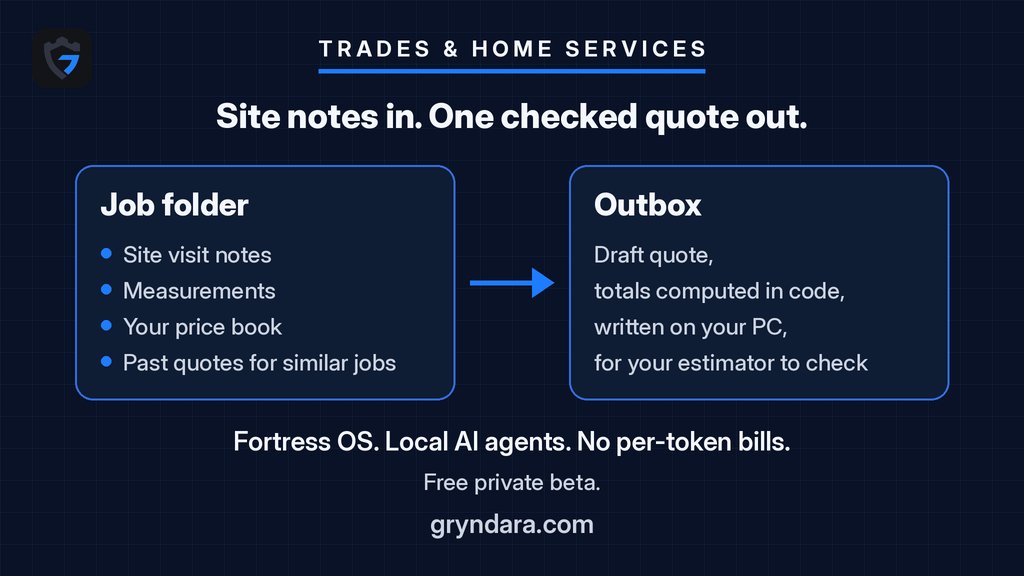
Put site notes, measurements and your price book in one folder. Fortress OS drafts the quote on your PC, totals computed in code, for your estimator to check.
#SmallBusiness#LocalAI
@0xpiyushvm A practical first step is to bound one document task: use a chosen folder, calculate dates or totals in code, then leave a finished draft in an Outbox for a person to review. That’s more useful than a flashy end-to-end demo.
@thomas_rehmer Least privilege must follow the whole delegation chain, not just the first agent. And when a lookup is denied, the final answer should flag the gap instead of guessing—that boundary matters as much as access control.
@BrianRoemmele The tap-to-send and exception handling stand out. For trade businesses, capturing job and invoice details is useful; a human gate on reminders and any money movement is what makes the automation easier to trust.
@MartinSzreter Recovery needs its own guardrails: dedupe the backlog, flag missing context instead of replaying blindly, and keep customer-facing sends in a human-reviewed Outbox until someone clears exceptions.
@JoshuaRystedt A sensible first pass is to extract project context against a written checklist, but flag missing scope or timing instead of scoring by guesswork. Keep a person responsible for the qualification and any follow-up.
@I360US Agree that the data boundary comes first. A useful pilot can limit the workflow to a chosen folder, flag missing fields rather than guess, and leave a named reviewer to check the finished file before it goes out.
@Jeel_p07 A pilot with one tech, dispatcher and admin is a right-sized test. I'd keep commission and warranty-mileage rules explicit, then have a person check the result and exceptions before anything reaches leadership.
@sandeepraiza On real sites, the hard part is normalizing daily notes, change orders and invoices without taking the PM out of the approval loop. A bounded workflow that returns a reviewable file seems like a sensible first test before letting agents act across a whole project.
@louiejancevski That’s a useful distinction: a brief should surface what the reader still needs to know, not remix a search-results outline. For freight teams, the unanswered edge cases—like unapproved accessorial charges—are where practical expertise shows.
@awxcyrus@airwallex@sam_waldo The finance workflow examples make the control points concrete: checking payees, matching payments to invoices, then putting a person at the approval step. Showing it in a sandbox is a sensible way for ops teams to test the handoffs.
@dmytro_nasyrov Naming the deliverable and what counts as finished is the whole game. Same for AI work: a finished file, inputs listed, and a named reviewer who signs off before it goes to the client.
@carolinaterrain Quotes, compliance and invoices are where trades lose their evenings. Whatever runs it, I'd name the one folder the agents can touch and have a person check every quote before it goes to a customer. #SmallBusiness
@heygandharva Forty invoices cross-checked against a spreadsheet is exactly the kind of job where the totals should be computed in code, not guessed. And anything missing gets flagged for a person to check before it goes to the client.
@Jacobsklug Good sequence: make the process and decision rights explicit before automating. For repeatable deliverables, define one allowed folder and a never-paste list, then track cost per approved file—including review and retries—not just time saved.
@oilpatchai A closed invoice is a useful first slice. I’d keep the test inside one allowed folder, define a never-paste list, and have it flag a missing rate sheet instead of guessing; a person can check the finished comparison line by line.
@Jayjie86 Good checklist. I’d add a clear allowed folder and a never-paste list, plus an exception path for missing inputs—have the agent flag a gap instead of filling one in. The named reviewer stays accountable for the finished claim.
@JitendraBlogger Settings matter, but a short never-paste list is easier to follow under pressure: credentials, account identifiers, and unredacted client files. For the rest, start from a sanitized summary rather than forwarding a whole thread.
@JRabason That gap suggests guidance has to be operational, not just a policy doc: name approved tools and data, mark what must stay out, and give staff a default human-check step for client-facing output.
@Ken_LinkWell Good pattern. I’d add one explicit stop: if a date, amount, or commitment is missing, ask rather than infer—and keep the draft in a review step before it goes back to the client.