In 1983, TCP/IP launched.
By 1993, it dominated global networks.
By 2000, it powered all internet communication.
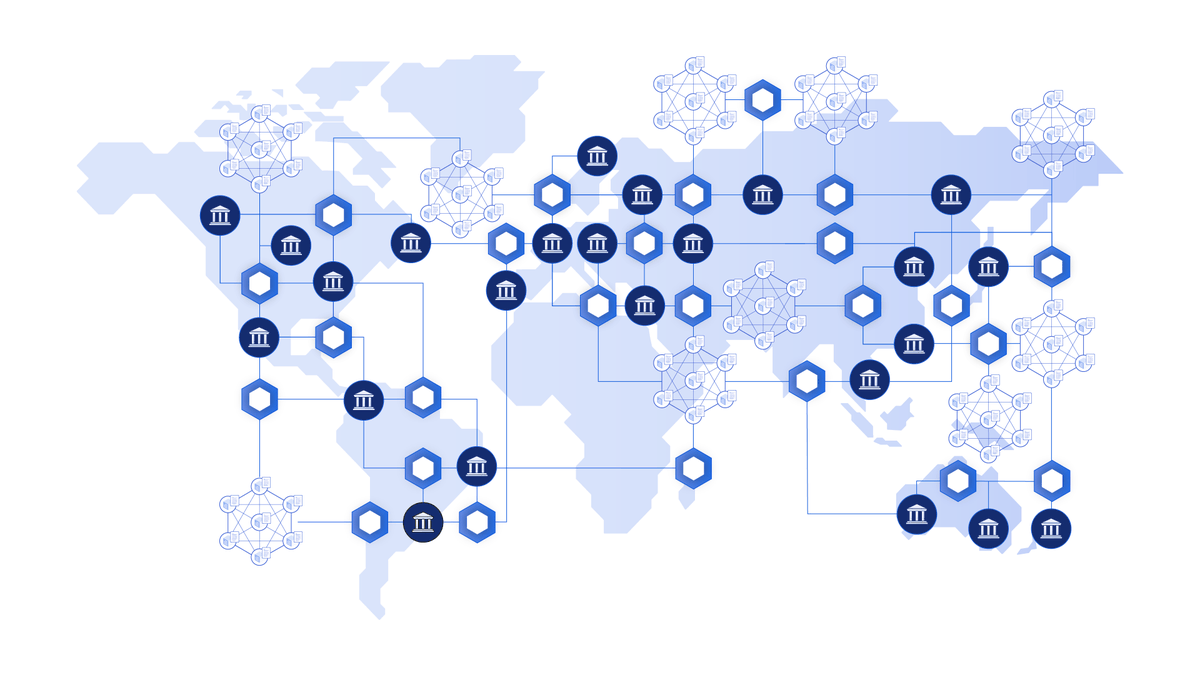
History doesn't repeat itself, but it often rhymes, and Chainlink is well on its way to it's TCP/IP year 2000 moment for the internet of contracts.
In the future, every:
- Bank transaction
- Stock trade
- Insurance claim
- Business contract
Will touch one network.
And it's not owned by JPMorgan, Goldman, or the Fed.
A thread on how Chainlink has already won🧵👇
To the Americans:
I've travelled all over the world. I've familiarized myself with many places, and met many people. And I'm a Canadian, although I’m privileged to reside once again in the States.
And here's something I've noticed, and it’s a key element of America's continuing greatness:
You bloody Americans value success, and you believe in its existence.
This is something that doesn't really happen anywhere else in the world. Even in other free democracies—the United Kingdom; Finland, Sweden, and Norway; Australia, New Zealand and Canada; Germany, France, and the Netherlands (great countries all)—a counterproductive cynicism too often reigns.
Success is equated with exploitation.
Ambition is looked upon with contempt.
This happens sometimes in the United States too—particularly among the miserable progressives, who confuse their resentment, ingratitude and unearned skepticism with wisdom.
But in your great country, by and large, striving is admired and success celebrated.
This means that more people strive and succeed in the US than anywhere else. And it's increasingly obvious. You remain stunningly more innovative and productive than any people anywhere else on the planet.
And so I say, as all should who are fortunate enough to live in the western world, let alone America:
Thank God for the United States.
Thank God for the wisdom of its founders.
Thank God for its faith in the free market and in the natural rights of man.
Happy birthday, you damn Yankees and Southerners.
Long may your admirable country dominate the world.
Long may your freedom and hope provide an example to those suffering everywhere at the hands of their malevolent states.
May your two and a half centuries of unparallelled success be just the beginning.
Your country is the light of the world, and the city on the hill.
Thank God for the USA.
Happy 250th.
Dr. Jordan B. Peterson
If you think a $300K corporate salary is payment for 40 hours of weekly labor, I've got news for you...
There is a persistent cynical narrative that large enterprises are bloated engines of inefficiency, filled with overpaid professionals who spend their days looking at slides and doing "nothing."
I mean, it's a comforting myth for critics, but I think it fundamentally misunderstands modern knowledge work.
That $300K salary (or $400K, or $500K) isn't a reward for linear effort but an option premium on high-leverage thinking.
We are still haunted by the ghost of the assembly line, ie, the outdated idea that compensation must directly correlate with time spent + physical output.
In the factory world, if you leave your station, production stops, but in the knowledge economy, value is almost totally decoupled from time.
Folks... An enterprise paying a senior leader or specialist $25K a month is not buying 160 hours of typing, they are buying *insurance* against catastrophic errors and positioning themselves for asymmetric upside.
I'll try to make it tangible with an example...
Consider a complex matrix organization busy with a $40M product migration. In this environment, the value distribution of a worker's is heavily spiked.
Most days look like nothing... alignment meetings, reading documentation, maintaining steady state. Yes, to an outsider, it looks like "doing nothing."
But then a critical day arrives. A vendor fails, a timeline slips, a crossroads appears, whatever... If that $300K professional has the institutional memory and capability to make just 4 or 5 correct decisions during those critical moments, the ROI is staggering! A single right call can avert a $5M problem.
Suddenly, that $300K salary doesn't look like bloat but, to me, seems like the cheapest asset on the p&l.
These days we are bombarded by tech CEOs promising fully autonomous, AI-driven organizations and I keep saying these pitches miss the entire point of how complex enterprises actually move.
Data computation can be outsourced to an LLM but going through the decision fabric of an enterprise cannot. You need people for:
> Knowing *how* to build consensus across disconnected departments with competing incentives;
> Understanding the unspoken history of why past projects failed, and how to position a new initiative so it doesn't trigger corporate antibodies;
> When a multi-million-dollar decision goes sideways, an algorithm cannot stand before a board of directors or regulators and take ownership of the corrective action.
An AI can give you a pristine strategic framework with nice and difficult sounding words, but it cannot navigate the human matrix required to execute it.
The ability to be effective inside a complex enterprise is a rare AND expensive skillset precisely because it cannot be automated or easily replicated.
My point is you aren't paying for the 9-to-5 "grind", but more for the readiness.
Like an elite surgeon or an expert technician, you pay for the decades of accumulated knowledge that allow them to fix a crisis in 5 minutes, not the 5 minutes itself....
Leverage, not labor.
NEW: The Chainlink data standard is now live on @amazon’s AWS Marketplace.
Now, millions of @awscloud developers & hundreds of thousands of businesses have access to the secure data infrastructure required to build institutional-grade blockchain apps.
Chainlink just posted this on their Linkedin.
Amazon web services (AWS) just spotlighted the missing $LINK between traditional finance and blockchains: @chainlink Runtime environment (CRE)
This is the second time @chainlink mentions they are working closely with Amazon in a short period of time.
$LINK everything!
Look guys, it's actually really straightforward, a bunch of people staked their ETH on the Ethereum blockchain to earn yield, except they didn't want their capital to be locked up, so they actually staked with a liquid staking protocol called Lido who provided them a liquid staking receipt token called stETH, except they decided to juice their yield further by depositing their stETH receipt tokens into a restaking protocol called Eigenlayer, except they didn't want to lock up their capital, so they actually restaked with a liquid restaking protocol called KelpDAO who provided them with a liquid restaking receipt token called rsETH, except they decided to juice their yield further by depositing their rsETH tokens into a lending protocol called Aave so that they could open a leveraged looping position that borrows ETH against the rsETH collateral and restakes the ETH into rsETH which is then deposited as collateral, except it turns out rsETH used a cross-chain bridge called LayerZero that was hacked by north koreans causing rsETH to become undercollateralized and now these looping positions are stuck and unprofitable, and everyone is pointing fingers at each other, and also DeFi is a very serious industry
2026 is going to be the year everyone and everything gets hacked
Whatever you do in the digital world you should always start from the assumption that YOU WILL BE HACKED and the websites and apps you use WILL BE HACKED
Use 2FA, hardware wallets, contingencies, and protect for the worst case scenario because that worst case scenario is likely happening
Be proactive and take steps now rather than when it’s too late
I went all in on AI early. And after a while, something felt off
I'd lean on it to handle the hard thinking for me. Draft the strategy. Decide the angle. Structure the argument. It was faster, sure. But when I read the output back, I felt nothing
No relationship to the words on the page. My name on something I didn't really write
Worse, my curiosity started to disappear. I could get answers so fast that questions stopped forming. I started losing touch with my own point of view on topics I've spent a decade thinking about
There's a term for this: cognitive debt
You go faster. Sometimes much faster. But there's a hidden cost building up
The debt of not having done the thinking to arrive at a conclusion you believe in. The debt of not understanding the decisions behind the plan, and therefore not trusting it. The debt of generating a polished document you don't care enough about to do anything with
This is the problem no one's talking about in the rush to adopt AI
And it's the reason I built The AI Second Brain differently
Instead of handing your work to AI and hoping for the best, you learn Personal Context Management: how to give AI enough of your context that it amplifies your thinking instead of replacing it
The founding cohort runs April 15 to May 1
The momentum @Chainlink has seen in the D.C. and U.S. regulatory world as of late is pretty staggering 🤯
Joint SEC and CFTC interpretation confirming that $LINK is a digital commodity and not a security, providing clarity to institutions
Two spot SEC-regulated $LINK ETFs listed on NYSE with ~$100M in inflows (~1.5% of circulating supply accumulated) and not a single day of outflows
CFTC-regulated futures contracts launched on CME, bringing enhanced institutional access and capital-efficient exposure
Former Chainlink Labs Deputy General Counsel (5+ years) officially appointed as Chief Counsel of the SEC's Crypto Task Force
Sergey appointed to CFTC Innovation Advisory Committee (IAC) along with other leading crypto industry CEOs
SEC issues interpretive guidance on broker-dealer & transfer agency compliance using public blockchain infra, based directly on conversations and meetings between Chainlink and the SEC
Chainlink joins @DigitalChamber and @BlockchainAssn trade organizations that advocate for blockchain and digital assets in D.C.
Sergey gave public remarks at the White House's first-ever Digital Asset Summit and shook hands during the signing of the GENIUS Act into law
Chainlink prominently highlighted in the White House report issued by the President‘s Working Group on Digital Asset Markets
Countless meetings between U.S. SEC, CFTC, Treasury, and various legislators and staff to advocate for crypto industry
.... And now add on top of that Chainlink and @Anchorage have joined as founding members of the Blockchain Leadership Fund (crypto PAC) to support pro-innovation candidates, engage voters, and conduct independent advocacy
Pretty insane past year and yet everyone thinks crypto is dead, they could not be more wrong, markets and fundamentals will snap back together like a rubber band once the outcomes of all this become clear
NEW: @coinbase integrates Chainlink to bring its premium exchange data powering billions in trading volume to blockchains for the first time.
This unlocks a new distribution channel for data from the largest U.S. crypto exchange, bringing better pricing & risk management to DeFi
Software horror: litellm PyPI supply chain attack.
Simple `pip install litellm` was enough to exfiltrate SSH keys, AWS/GCP/Azure creds, Kubernetes configs, git credentials, env vars (all your API keys), shell history, crypto wallets, SSL private keys, CI/CD secrets, database passwords.
LiteLLM itself has 97 million downloads per month which is already terrible, but much worse, the contagion spreads to any project that depends on litellm. For example, if you did `pip install dspy` (which depended on litellm>=1.64.0), you'd also be pwnd. Same for any other large project that depended on litellm.
Afaict the poisoned version was up for only less than ~1 hour. The attack had a bug which led to its discovery - Callum McMahon was using an MCP plugin inside Cursor that pulled in litellm as a transitive dependency. When litellm 1.82.8 installed, their machine ran out of RAM and crashed. So if the attacker didn't vibe code this attack it could have been undetected for many days or weeks.
Supply chain attacks like this are basically the scariest thing imaginable in modern software. Every time you install any depedency you could be pulling in a poisoned package anywhere deep inside its entire depedency tree. This is especially risky with large projects that might have lots and lots of dependencies. The credentials that do get stolen in each attack can then be used to take over more accounts and compromise more packages.
Classical software engineering would have you believe that dependencies are good (we're building pyramids from bricks), but imo this has to be re-evaluated, and it's why I've been so growingly averse to them, preferring to use LLMs to "yoink" functionality when it's simple enough and possible.
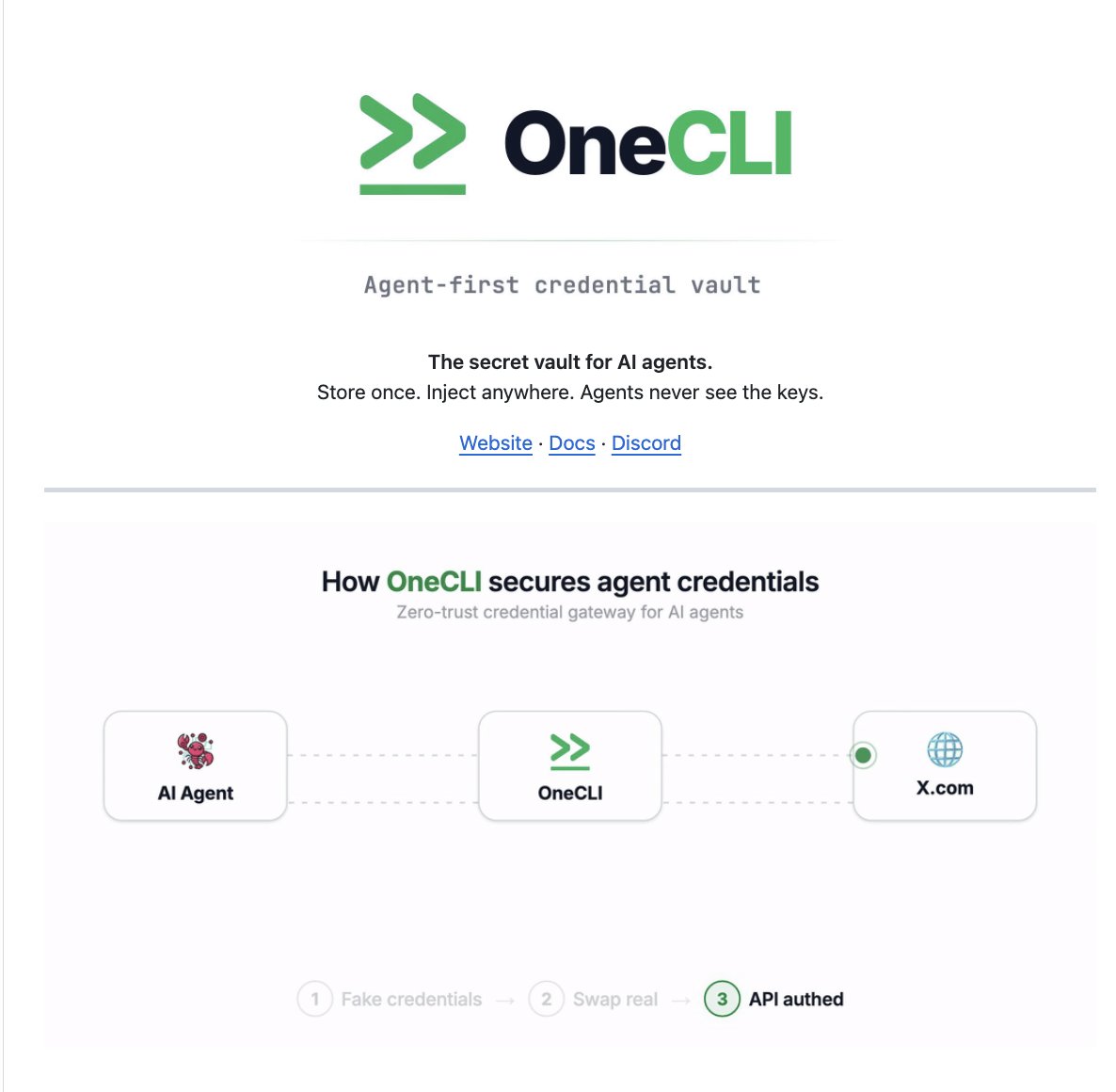
onecli - Open-source credential vault, give your AI agents access to services without exposing keys.
What is OneCLI?
OneCLI is an open-source gateway that sits between your AI agents and the services they call. Instead of baking API keys into every agent, you store credentials once in OneCLI and the gateway injects them transparently. Agents never see the secrets.
Why we built it: AI agents need to call dozens of APIs, but giving each agent raw credentials is a security risk. OneCLI solves this with a single gateway that handles auth, so you get one place to manage access, rotate keys, and see what every agent is doing.
How it works: You store your real API credentials in OneCLI and give your agents placeholder keys (e.g. FAKE_KEY). When an agent makes an HTTP call through the gateway, the OneCLI gateway matches the request to the right credentials, swaps the FAKE_KEY for the REAL_KEY, decrypts them, and injects them into the outbound request. The agent never touches the real secrets. It just makes normal HTTP calls and the gateway handles the swap.
#OneCLI #OpenSource #AIAgents #AgentSecurity #SecretManagement #CredentialVault #APIKeySecurity #DevSecOps #CyberSecurity #AIInfrastructure
Does one fully embrace AI and pray that they'll still be relevant in a few years?
Do they take a neutral approach and simply observe how the cookie crumbles?
Or does one finally check out and start that off-grid homestead they've always been dreaming of?
Would love to see a vibe coded SIEM.
Or an AI agent that automates everything a detection engineer does.
Not to say it won't happen, but something tells me it won't be any time soon.
It's been nice the last year or two not having severe FOMO that Web3 gave me.
And then AI got serious, and now I have 10x more FOMO.
Nothing lights a fire under your ass better than the threat of machines taking your job.
It's one thing to vibe code an app.
But I don't see anyone vibe coding an ecosystem, or years of building partnerships and ecosystems.
And that's why I have a hard time seeing vibe coded apps simply replacing major security tools over night.
Or ever, for that matter.
Platforms like Crowdstrike or Splunk, for example - they aren't just sitting idly by, waiting to get replaced by some vibe coded app.
They are full steam ahead with AI integrations themselves.
Not to mention, good luck vibe coding either of these enterprise grade tools.
I'm sure some vibe coded apps will find a niche that they excel at over existing solutions, if they haven't already.
But color me skeptical if I believe vibe coded apps will win out against most enterprise solutions in the security space.
Time will tell!
Hey @SpotifyCares, our podcast "The Hunter Williams Podcast" was just mistakenly flagged and removed for "Dangerous Content." We discuss the science of peptides and prescription meds for educational purposes only—no medical advice or sales. Can we get a manual review on this? #SpotifyForPodcasters
I want to share a quick thought for people in cyber security. This will be my longest tweet ever.
I’ve spoken to many lately who are having an existential crisis from the constant posts about “the end of cybersecurity jobs.”
Yes, things are changing quickly. This is a significant moment for the tech industry. Change can be uncomfortable. But we’ve seen cycles like this before.
• When GitHub and open source took off, people said software engineers would disappear because code was free.
• When AWS and cloud computing emerged, people said infrastructure jobs would vanish.
• When fuzzing and SAST tools improved, people said vulnerability research would disappear.
• Virtualization would eliminate infrastructure jobs.
• Mobile computing was going to end desktop dev.
• Exploit mitigations would end exploitability. It didn't.
Each time automation improved, the amount of software grew faster than the automation. It does feel "different" this time as it's explosive.
Some roles will shrink:
• repetitive pentesting
• basic vulnerability scanning
• tier-1 SOC monitoring
But other areas are expanding rapidly:
• AI system security
• supply chain security
• identity architecture
• autonomous agent security
• critical infrastructure protection
Historically, every time we eliminate one class of bugs, new classes emerge. Right now people are vibe-coding entire systems, giving AI access to their machines, crossing trust boundaries, and deploying autonomous agents with excessive permissions. The legal and regulatory world is nowhere close to ready.
There will absolutely be new failure modes. Humans are amazing and always adapt, finding new ways to do things.
The worst thing you can do right now is fall into a doom loop.
...and I’ll be honest, I too have felt the "psychological paralysis" a few times thinking, “Is this time different?” It's especially impactful when it comes from someone I respect in the community. There are certainly unknowns, in an industry where we've become accustomed to predictability.
But... the majority of those reactions are usually driven by social media, not reality. Platforms like X reward engagement, and sensational doom posts spread faster than measured thinking.
If you see something like:
“Holy #$%^! Opus 66.6 just found every bug in Chrome and replaced 50 startups!”
…mute it and move on.
Instead:
Stay curious.
Learn the new technology.
Adapt your skillsets.
Build things.
We’ll get through this transition the same way we always have. If I'm wrong then Sam Altman better be right about UBI! :) I'm sure that if this tweet gets any engagement that I'll get some heat for it, but a good friend of mine reminds me often to focus on what you have control over. I'll revisit this tweet at DEF CON 40!
Prediction:
Security engineers will be in high demand for the foreseeable future,
as we witness the tsunami of vibe coded apps getting deployed into production,
and subsequently getting rekt.
@fn12044 Go read allen carrs book "the easy way to stop smoking'. Then if needed, read rational recovery. These two alone will change your life. Taking a peptide like tirzepatide can also help crush dopamine seeking behaviors like nicotine use. Worked well for me.