New Carbohydrate Dosing on CRITICAL POWER:
0g vs 60g vs 120g carbs/hour.
Endurance athletes did 3 hours of cycling at a set sustained pace to induce fatigue. THEN...they did a 3-min test of critical power.
A couple of fascinating findings if you look deeper....
Looks like the placebo group was within the hypoglycemia threshold (mean+/-variability) for circulating glucose levels (exercise-induced hypoglycemia)...so we expect any carbohydrate to improve performance in this setting.
THEY DO: All carbohydrate groups improved critical power metrics in this 3-minute testing window. This is EXPECTED when hypoglycemia occurs.
Note there is no inter-individual variability....every. single. athlete. improved....that is how powerful preventing hypoglycemia is during exercise as we discuss here: https://t.co/r1QMbLIeo8
HOWEVER, when looking at a dose-response between 60g/hr v 120g CHO/hr we see that 120g results in ~1.9% absolute improvement in critical power watts over 60g/hr. However, there was no significant difference between 60 v 120g for work done ABOVE critical power after this 3-hour ride...
...which is important since the end-of-race sprint is typically ABOVE critical power.
Looking deeper....while every single athlete improved if they prevented hypoglycemia with carbs. However, at an individual level, some athletes did better on 60g v 120g and vice versa.
Why is this important...because it always comes down to the individual athlete. ALL OF YOU are likely to perform better if you prevent hypoglycemia...however...only some of you are likely to benefit from very high vs high CHO intake, while others will see a DROP in performance.
We have seen previously that pushing CHO intake to up 120g/hour can deteriorate performance in some studies. It is critical to use trial and error, don't just follow blanket guidelines.
See study here: https://t.co/p5mLzXZRou
🚨 Anthropic just showed a 24-minute workshop on how to actually do prompts for Claude.
Taught by the people who built it.
Free. No registration. No paywall.
I've seen $300 courses that don't cover what they teach in the first 8 minutes.
Watch it and bookmark it now.
What your VO2 max actually looks like:
<15 ml/kg/min → Daily function and movement are limited. Difficulties getting dressed, standing up, and walking without assistance.
15–25 → Very limited fitness. Stairs are difficult, running is nearly impossible.
26–35 → Out of shape territory. You get winded carrying groceries or climbing stairs. Short jogs feel brutal.
36–45 → Functional, but still below true fitness. You can exercise, but endurance is limited. Cooper Test: ~2300m.
46–55 → Fit and healthy. Good energy, decent endurance, and fitness. Cooper Test: ~2700m.
56–65 → Extremely fit. The fittest person in a normal friend group. Running feels easy. Cooper Test: ~3200m.
66–75 → Elite amateur athlete territory. Most people can’t keep up with you. Fast recovery.
76+ → World-class athlete physiology. Most people can't comprehend your endurance. You can run laps around 99% of people.
"Any fool can make something complicated. It is hard to keep things simple.”Richard Branson
I’ve always loved that line. But this one from Rutger Bregman might be even more relevant to endurance training:
“It’s easy to make things hard, but hard to make things easy.”
I think this principle applies perfectly to both training and how we analyse training.
In this week’s analysis, I looked for simple, effective answers to two key questions:
1. Is there a simple way to measure someone’s running fitness?
2. Is there a simple training approach that actually works?
To answer question 1. I looked at a very simple approach: track the pace an athlete runs at specific heart rates across multiple sessions and plot the curve. If that curve shifts right over time, fitness is improving. Then identify which training methods create the biggest positive shifts.
I’ll be diving deeper into this in future posts using a novel approach for standardised performance testing.
What’s your take? Do we overcomplicate endurance training?
Full research in the comments below
@TerraAPI
#RunningScience #Simplicity
@suunto hey guys, I bought a watch, it was defective, returned it, bought another and this is also not working 😣 I’m fighting not to go back to Garmin (it’s been a few years!) but this is not helping. Can you give me a contact in UAE for Suunto?
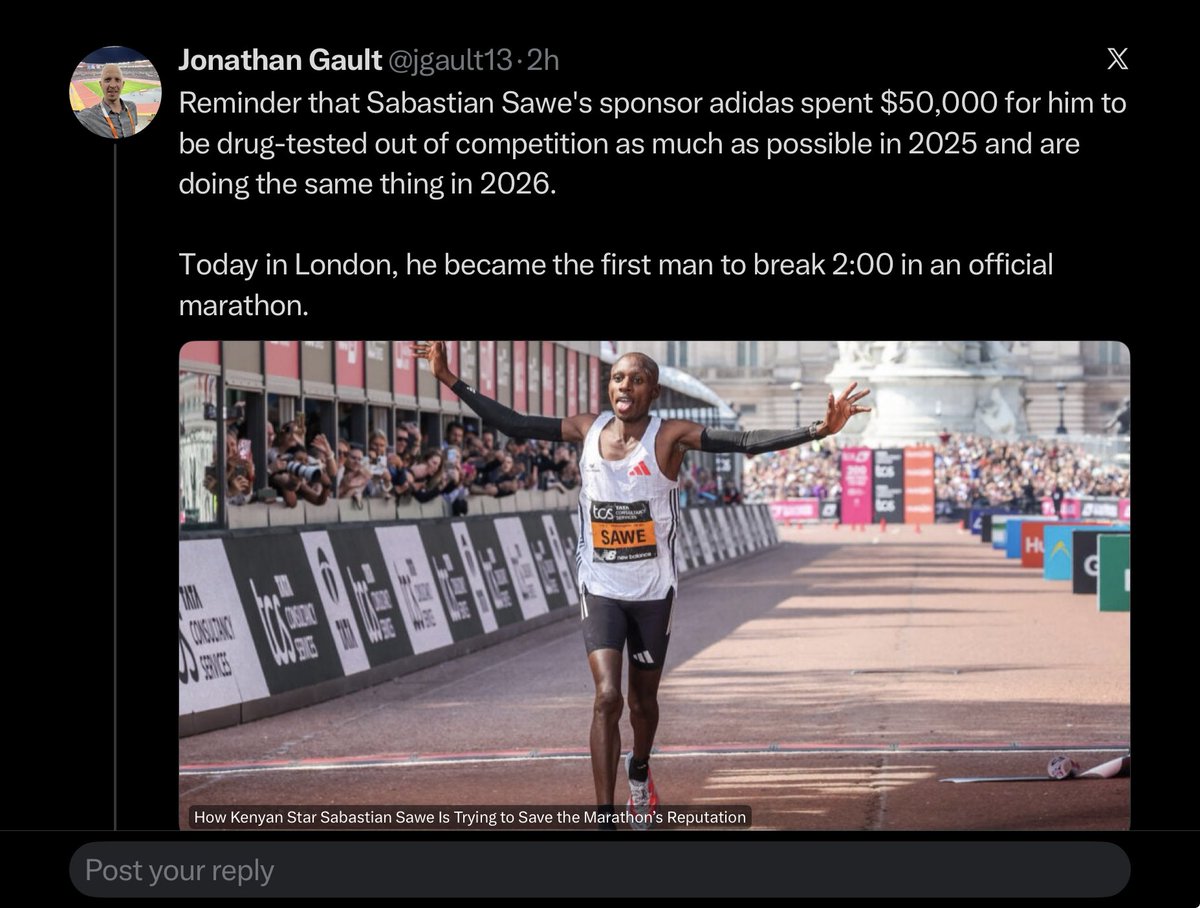
@mrOLEZZ@ORION_coaching Unfortunately that’s not true. It’s not a 1:1 ratio of effect. The percentage effect on performance from any type of running economy increase is not 1:1. It makes a runner more efficient in things like percentage of Vo2max being used at a given speed for example.
@mrOLEZZ@ORION_coaching It does make a difference, but he’s just pointing out at the 1.6% (a figure claimed by Adidas with currently no papers/evidence) improvement in economy doesn’t equate to a 1.6% in performance.
Disingenuous by Gault - and he well knows it. 2025 testing was limited to a 2-month window.
Anyone believe it’s silly to think a ‘micro-dosing works’ verification was carried out before this testing PR stunt (among other shotgun blast holes in its process)?
Emergency pod is up. #Sawe runs 1:59:30 in London. We break down the eye-watering splits behind the performance, and offer insights on credibility & the future of a redefined sport, with hints that both Sawe, Kejelcha (1:59:41 debut) & others can improve: https://t.co/2RLOmWsGWO
Is Exogenous Lactate the "Holy Grail" of sports fuelling?
For years, we’ve been focused on >120g/h CHO intake. But how can we explore new limits?
Lactate is not a waste. It´s the most efficient and preferential fuel in the human body.
A thread on the next metabolic frontier🧵
There is simply no exercise physiology podcast with the level of rigor, breadth and depth and practical applications as PERFORM with @DrAndyGalpin This is listen asap and archive to keep coming back to stuff.
@JamieAdStories@CostaCoffee At least you posted it though. I assume you posted lots about your good experiences there yes? Your first comment “love Costa” would suggest you did. Surely you wouldn’t only wait until you had a “disappointing” experience to post online. . .
Stanford just made a $200,000 AI degree free.
No application.
No tuition.
No “elite access”.
Stanford released its actual AI/ML curriculum on YouTube.
Not a PR-friendly intro.
Not “AI for the public”.
This is the real thing.
The same lectures shaping people working on frontier models.
What just became public:
Deep Learning (CS230)
→ https://t.co/DUtL9MO6Y7
Transformers & LLMs (CME295)
→ https://t.co/gN57biwLsE
Language Models from Scratch (CS336)
→ https://t.co/GnH11pPBdW
ML from Human Feedback (CS329H)
→ https://t.co/X9nxEX6PNg
Computer Vision (CS231N)
→ https://t.co/oBxKKWZP22
LLM Evaluation & Scaling
→ https://t.co/1tDpw9ArTq
The uncomfortable truth:
The degree isn’t the scarce asset anymore.
Execution speed is.
Top schools know this.
That’s why they’re publishing the playbook.
👉 Bookmark this.
Comment the first lecture you’ll actually watch.
Tofig Aliyev from Azerbaijan just landed the world’s first full-full-full at the World Games in China. A full-full-full is a triple backflip with a 360° twist in each somersault
The USA men's 1-2-3 sweep in the 100m was one of the most famous moments of the 2022 World Championships in Eugene.
Three years later, gold medalist Fred Kerley is provisionally suspended and off to the Enhanced Games. Now silver medalist Marvin Bracy is banned for 45 months.