Agent research shouldn’t mean rebuilding the same plumbing for every benchmark or every agent.
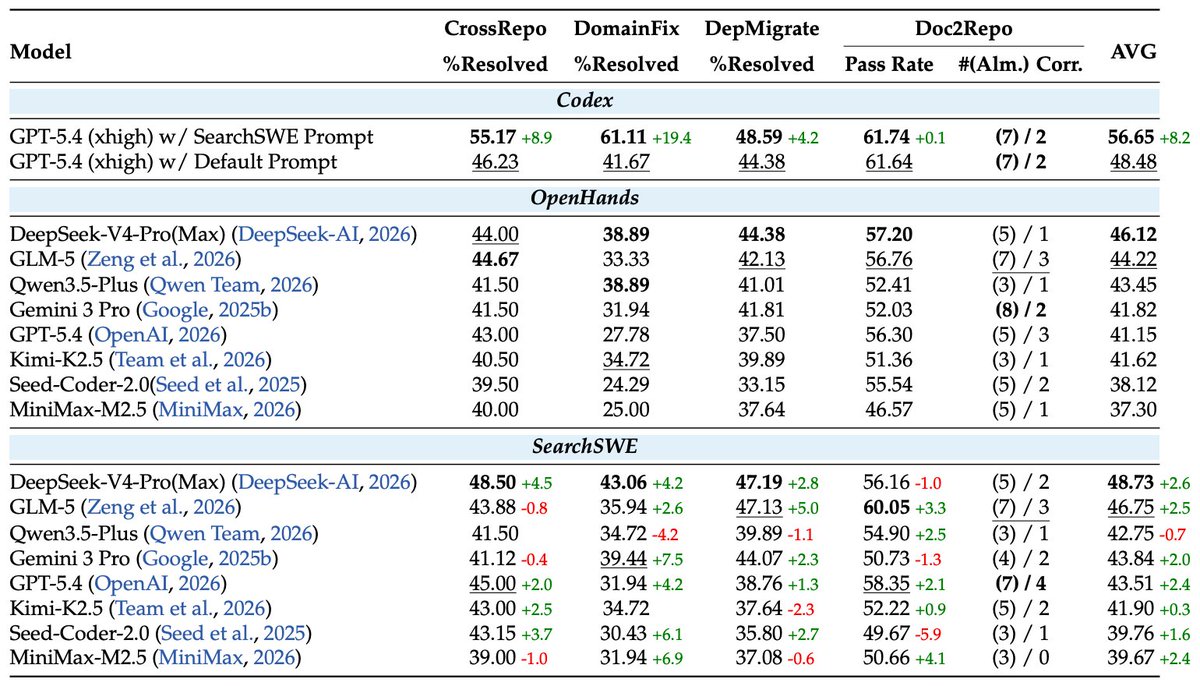
AweAgent is a unified, composable framework for building, evaluating, and training agents.
Less glue code. More real experiments.
https://t.co/bXKMKLSLBT
Agent research shouldn’t mean rebuilding the same plumbing for every benchmark or every agent.
AweAgent is a unified, composable framework for building, evaluating, and training agents.
Less glue code. More real experiments.
https://t.co/bXKMKLSLBT
Our CVPR 2026 paper is out! 🎉
VLMs reason in multi-step chains, but RL (GRPO) only rewards the final answer, so the model never learns which step actually hallucinated.
Perceval fixes this with token-level, perception-grounded rewards. 🧵👇
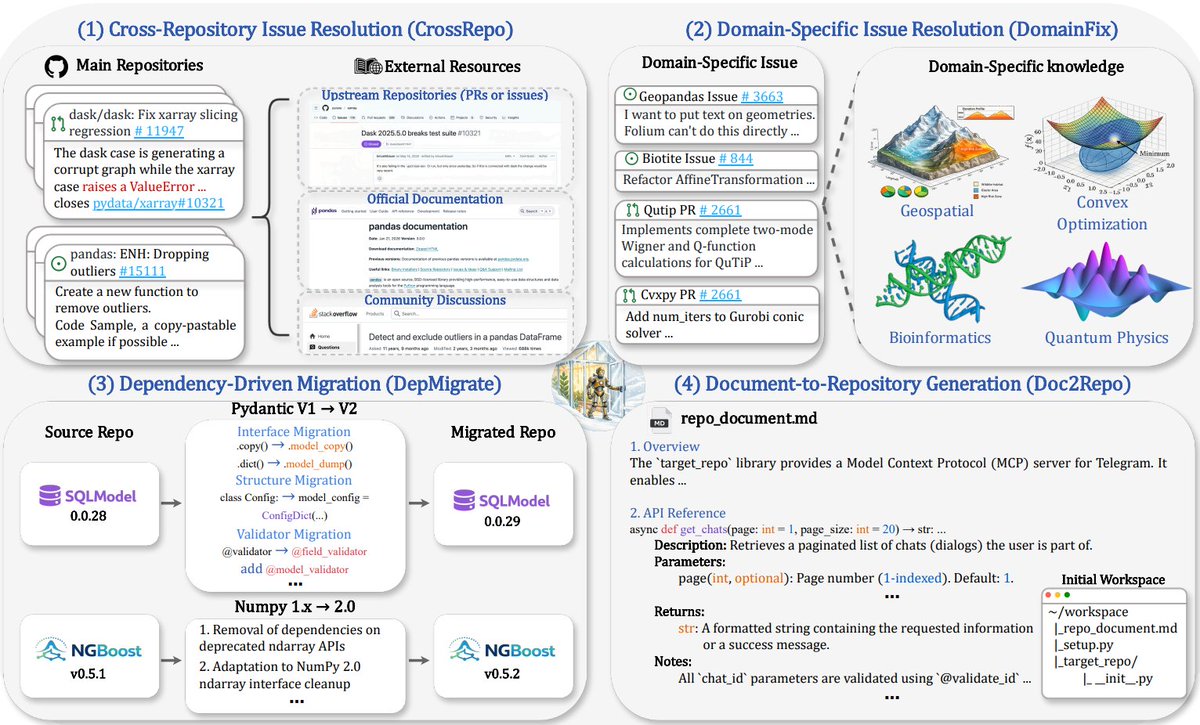
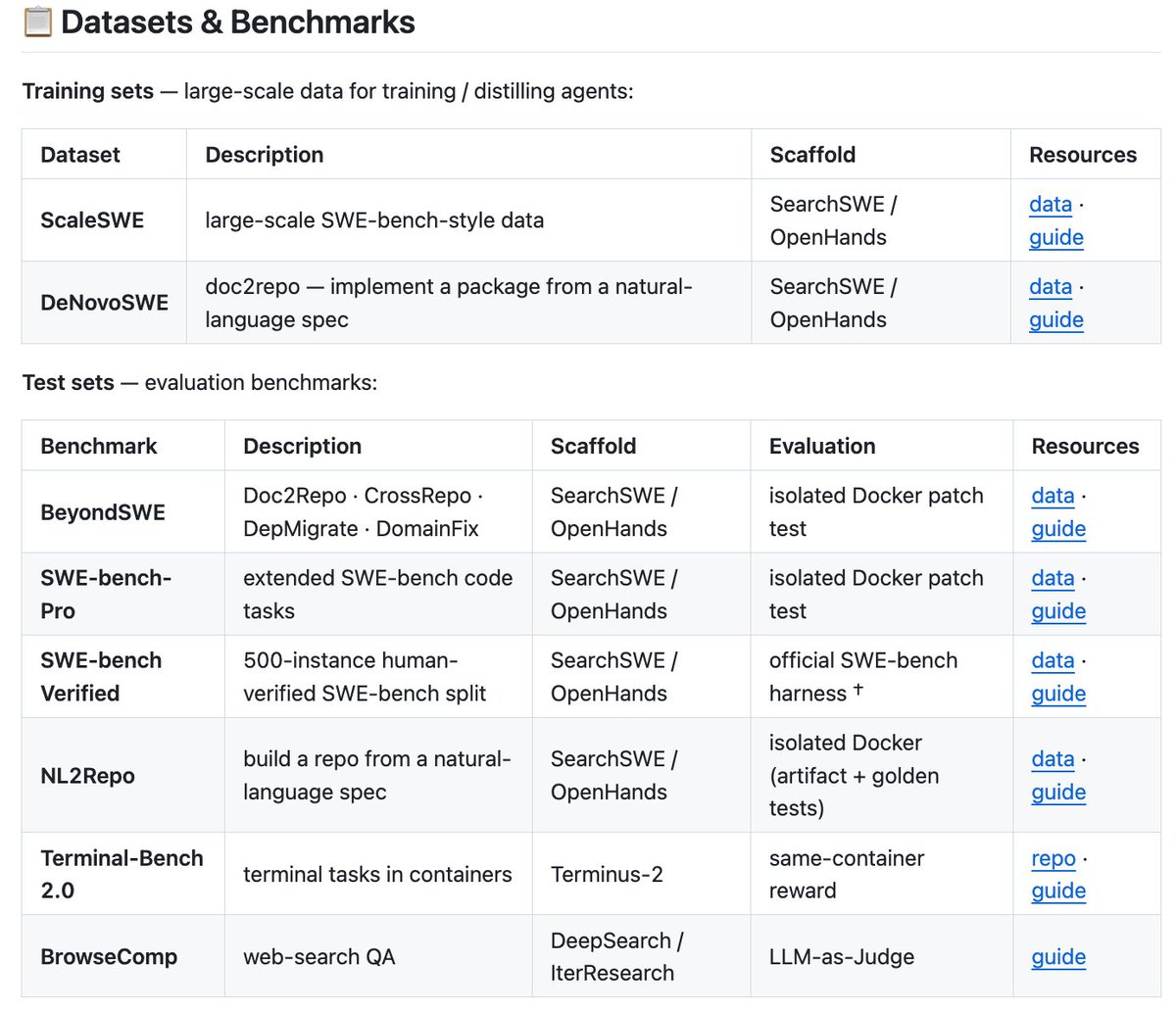
We have explored how to scale up Doc2Repo Tasks and are excited to release the dataset.🥳
Hope DeNoveSWE will help the community study long-horizon SWE tasks.🚀
Code agents are entering a new phase.
Beyond single-bug fixing.
Beyond patch-level SWE data.
Meet DeNovoSWE: an open-source long-horizon dataset for generating whole repositories from scratch.
SWE-Master: Unleashing the Potential of Software Engineering Agents via Post-Training
SWE-Master is an open-source and reproducible post-training framework for building strong software engineering agents, covering data synthesis, SFT, RL, and TTS.
📑 https://t.co/c4aOej5gZl
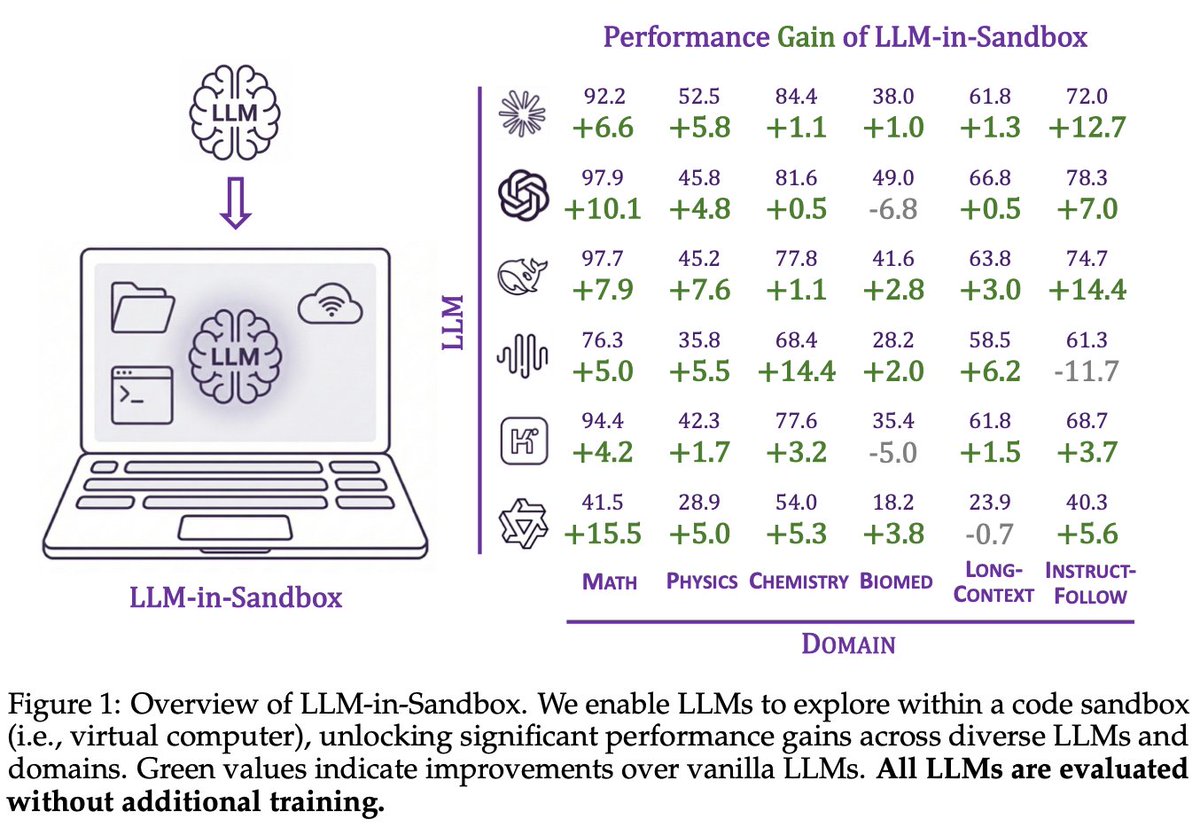
LLM in Sandbox: Computer Environments Elicit General Agentic Intelligence in LLMs
As OpenClaw/Hermes go viral, we ask: does the computer env itself make LLMs smarter?
Yes, a minimal code sandbox yields up to +15.5% accuracy and 8× fewer tokens across diverse general domains.
Thrilled to share our survey paper "Agent System with Harness Engineering"! 🎉
We'd love to hear thoughts from anyone interested in the field! 👂
PDF: https://t.co/H2GxgHUgjr
GitHub: https://t.co/2dnyTTqGYK
WeChat:https://t.co/HK3mpuNVdI
Connection: [email protected]
Introducing "SWE-World: Building Software Engineering Agents in Docker-Free Environments"
TL;DR: SWE-World is a Docker-free framework that replaces physical execution environments with a learned surrogate for training software engineering agents.
📑 https://t.co/kZbMFdHJkG
Today, we share a breakthrough on the planar unit distance problem, a famous open question first posed by Paul Erdős in 1946.
For nearly 80 years, mathematicians believed the best possible solutions looked roughly like square grids.
An OpenAI model has now disproved that belief, discovering an entirely new family of constructions that performs better.
This marks the first time AI has autonomously solved a prominent open problem central to a field of mathematics.
Introducing "Immersion in the GitHub Universe: Scaling Coding Agents to Mastery"
TL;DR: Scale-SWE is a large-scale open-source SWE dataset containing 100k real-world SWE instances, generated by a sandboxed multi-agent system.
https://t.co/SOaZoqOfOj
https://t.co/T1K27tueNc
Is anyone at #ICLR2026 🇧🇷 discussing the topic about search / code agent, or AI research?
🚀 Looking for relevant papers, posters, workshops, or people to follow / chat with in person.
as someone who works on making LLMs run faster and cheaper every day, i can confidently say the question of whether theyre conscious has exactly zero impact on whether theyre useful. we dont need our inference stack to be conscious, we need it to be correct, fast, and affordable. the consciousness debate is fascinating philosophy but its a distraction from the actual engineering problems that determine whether AI creates value. the gravity formula doesnt need to exert weight to help you build a bridge @Hesamation
“These results suggest long-horizon ML research engineering is a systems problem of coordinating specialized work over durable project state, rather than a purely local reasoning problem”
@PraCha98@daniel_mac8 It's structured, not one monolithic chain. AiScientist is lab-like: a PI-like orchestrator handles stage-level planning, specialists own major subproblems, and subagents handle leaf tasks. Each has its own reasoning process, and they coordinate through shared workspace artifacts.