A few random notes from claude coding quite a bit last few weeks.
Coding workflow. Given the latest lift in LLM coding capability, like many others I rapidly went from about 80% manual+autocomplete coding and 20% agents in November to 80% agent coding and 20% edits+touchups in December. i.e. I really am mostly programming in English now, a bit sheepishly telling the LLM what code to write... in words. It hurts the ego a bit but the power to operate over software in large "code actions" is just too net useful, especially once you adapt to it, configure it, learn to use it, and wrap your head around what it can and cannot do. This is easily the biggest change to my basic coding workflow in ~2 decades of programming and it happened over the course of a few weeks. I'd expect something similar to be happening to well into double digit percent of engineers out there, while the awareness of it in the general population feels well into low single digit percent.
IDEs/agent swarms/fallability. Both the "no need for IDE anymore" hype and the "agent swarm" hype is imo too much for right now. The models definitely still make mistakes and if you have any code you actually care about I would watch them like a hawk, in a nice large IDE on the side. The mistakes have changed a lot - they are not simple syntax errors anymore, they are subtle conceptual errors that a slightly sloppy, hasty junior dev might do. The most common category is that the models make wrong assumptions on your behalf and just run along with them without checking. They also don't manage their confusion, they don't seek clarifications, they don't surface inconsistencies, they don't present tradeoffs, they don't push back when they should, and they are still a little too sycophantic. Things get better in plan mode, but there is some need for a lightweight inline plan mode. They also really like to overcomplicate code and APIs, they bloat abstractions, they don't clean up dead code after themselves, etc. They will implement an inefficient, bloated, brittle construction over 1000 lines of code and it's up to you to be like "umm couldn't you just do this instead?" and they will be like "of course!" and immediately cut it down to 100 lines. They still sometimes change/remove comments and code they don't like or don't sufficiently understand as side effects, even if it is orthogonal to the task at hand. All of this happens despite a few simple attempts to fix it via instructions in CLAUDE . md. Despite all these issues, it is still a net huge improvement and it's very difficult to imagine going back to manual coding. TLDR everyone has their developing flow, my current is a small few CC sessions on the left in ghostty windows/tabs and an IDE on the right for viewing the code + manual edits.
Tenacity. It's so interesting to watch an agent relentlessly work at something. They never get tired, they never get demoralized, they just keep going and trying things where a person would have given up long ago to fight another day. It's a "feel the AGI" moment to watch it struggle with something for a long time just to come out victorious 30 minutes later. You realize that stamina is a core bottleneck to work and that with LLMs in hand it has been dramatically increased.
Speedups. It's not clear how to measure the "speedup" of LLM assistance. Certainly I feel net way faster at what I was going to do, but the main effect is that I do a lot more than I was going to do because 1) I can code up all kinds of things that just wouldn't have been worth coding before and 2) I can approach code that I couldn't work on before because of knowledge/skill issue. So certainly it's speedup, but it's possibly a lot more an expansion.
Leverage. LLMs are exceptionally good at looping until they meet specific goals and this is where most of the "feel the AGI" magic is to be found. Don't tell it what to do, give it success criteria and watch it go. Get it to write tests first and then pass them. Put it in the loop with a browser MCP. Write the naive algorithm that is very likely correct first, then ask it to optimize it while preserving correctness. Change your approach from imperative to declarative to get the agents looping longer and gain leverage.
Fun. I didn't anticipate that with agents programming feels *more* fun because a lot of the fill in the blanks drudgery is removed and what remains is the creative part. I also feel less blocked/stuck (which is not fun) and I experience a lot more courage because there's almost always a way to work hand in hand with it to make some positive progress. I have seen the opposite sentiment from other people too; LLM coding will split up engineers based on those who primarily liked coding and those who primarily liked building.
Atrophy. I've already noticed that I am slowly starting to atrophy my ability to write code manually. Generation (writing code) and discrimination (reading code) are different capabilities in the brain. Largely due to all the little mostly syntactic details involved in programming, you can review code just fine even if you struggle to write it.
Slopacolypse. I am bracing for 2026 as the year of the slopacolypse across all of github, substack, arxiv, X/instagram, and generally all digital media. We're also going to see a lot more AI hype productivity theater (is that even possible?), on the side of actual, real improvements.
Questions. A few of the questions on my mind:
- What happens to the "10X engineer" - the ratio of productivity between the mean and the max engineer? It's quite possible that this grows *a lot*.
- Armed with LLMs, do generalists increasingly outperform specialists? LLMs are a lot better at fill in the blanks (the micro) than grand strategy (the macro).
- What does LLM coding feel like in the future? Is it like playing StarCraft? Playing Factorio? Playing music?
- How much of society is bottlenecked by digital knowledge work?
TLDR Where does this leave us? LLM agent capabilities (Claude & Codex especially) have crossed some kind of threshold of coherence around December 2025 and caused a phase shift in software engineering and closely related. The intelligence part suddenly feels quite a bit ahead of all the rest of it - integrations (tools, knowledge), the necessity for new organizational workflows, processes, diffusion more generally. 2026 is going to be a high energy year as the industry metabolizes the new capability.
Don't think of LLMs as entities but as simulators. For example, when exploring a topic, don't ask:
"What do you think about xyz"?
There is no "you". Next time try:
"What would be a good group of people to explore xyz? What would they say?"
The LLM can channel/simulate many perspectives but it hasn't "thought about" xyz for a while and over time and formed its own opinions in the way we're used to. If you force it via the use of "you", it will give you something by adopting a personality embedding vector implied by the statistics of its finetuning data and then simulate that. It's fine to do, but there is a lot less mystique to it than I find people naively attribute to "asking an AI".
Interesting proposal here from Anthropic to convert MCP tools into code functions that your coding agent can then discover and execute after reading the file system, albeit with a huge "draw the rest of the owl" factor in that implementation is left as an exercise for the reader!
Introducing our first set of Llama 4 models!
We’ve been hard at work doing a complete re-design of the Llama series. I’m so excited to share it with the world today and mark another major milestone for the Llama herd as we release the *first* open source models in the Llama 4 collection 🦙. Here are some highlights:
📌 The Llama series have been re-designed to use state of the art mixture-of-experts (MoE) architecture and natively trained with multimodality. We’re dropping Llama 4 Scout & Llama 4 Maverick, and previewing Llama 4 Behemoth.
📌 Llama 4 Scout is highest performing small model with 17B activated parameters with 16 experts. It’s crazy fast, natively multimodal, and very smart. It achieves an industry leading 10M+ token context window and can also run on a single GPU!
📌 Llama 4 Maverick is the best multimodal model in its class, beating GPT-4o and Gemini 2.0 Flash across a broad range of widely reported benchmarks, while achieving comparable results to the new DeepSeek v3 on reasoning and coding – at less than half the active parameters. It offers a best-in-class performance to cost ratio with an experimental chat version scoring ELO of 1417 on LMArena. It can also run on a single host!
📌 Previewing Llama 4 Behemoth, our most powerful model yet and among the world’s smartest LLMs. Llama 4 Behemoth outperforms GPT4.5, Claude Sonnet 3.7, and Gemini 2.0 Pro on several STEM benchmarks. Llama 4 Behemoth is still training, and we’re excited to share more details about it even while it’s still in flight.
A big thanks to all of our launch partners (full list in blog) for helping us bring Llama 4 to developers everywhere including @huggingface, @togethercompute, @SnowflakeDB, @ollama, @databricks and many others👏 This is just the start, we have more models coming and the team is really cooking – look out for Llama 4 Reasoning 😉
A few weeks ago, we celebrated Llama being downloaded over 1 billion times. Llama 4 demonstrates our long-term commitment to open source AI, the entire open source AI community, and our unwavering belief that open systems will produce the best small, mid-size and soon frontier models. Llama would be nothing without the global open source AI community & we are so ready to begin this next chapter with you. 🦙
Read more about the release here: https://t.co/7mbK3uggjO, and try it in our products today.
I was taught, early in my career, to be cautious with criticism. Someone worked really hard on the thing you’re criticizing.
That said, I’m gonna break the rule. Siri is ridiculously awfully bad. It’s been 14 years. Apple has no idea what they’re doing.
A decision on SB-1047 is due soon. Governor @GavinNewsom has said he's concerned about its "chilling effect, particularly in the open source community". He's right, and I hope he will veto this.
If you agree, please like/retweet this to show your support for VETOing SB-1047!
If you believe people think poorly of you, try writing down everyone's names and estimating how many minutes per day you occupy their thoughts.
You may be pleasantly surprised to find that most people do not think of you at all.
So, live your life!
Such a neatly written post on a neat trick by @bclavie from the @answerdotai team. Love how the article is free of jargon and is so accessible!! I wish all research were done like this 😃
🥁🥁 New blog post out (link in thread), w/ two aims:
🤓 Providing a clear, hopefully easy-to-read intro to ColBERT, without assuming you've ever used it.
🏊Introducing ColBERT Token Pooling ✨: You can reduce the size of ColBERT indexes by 66% with barely any performance hit!
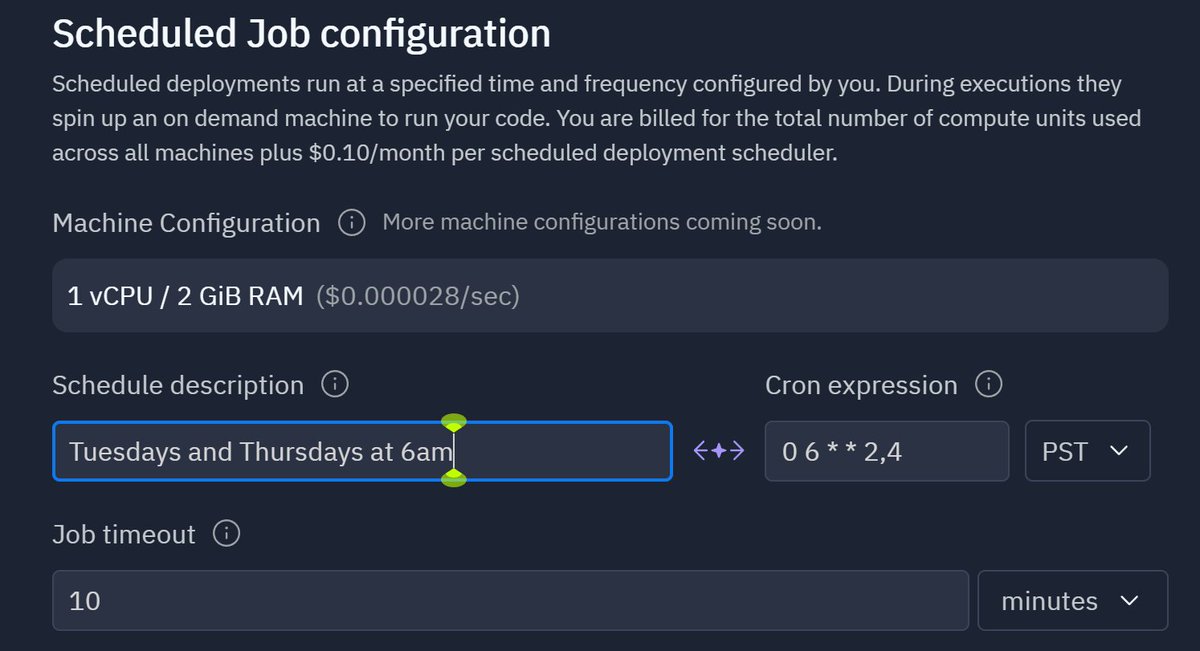
Something I appreciated just now: @Replit's scheduled deployments UI has a text-to-cron AI conversion. A small touch but so nifty! This is the future I want, where thoughtful people use AI to add magic in places where it actually makes sense :)
So this is one of their many you true colors. Is this someone you can trust to suppress all other scientists and let this be the sole lab leading humanity to AGI?
You had the Mandate of Heaven and you fumbled the bag sir
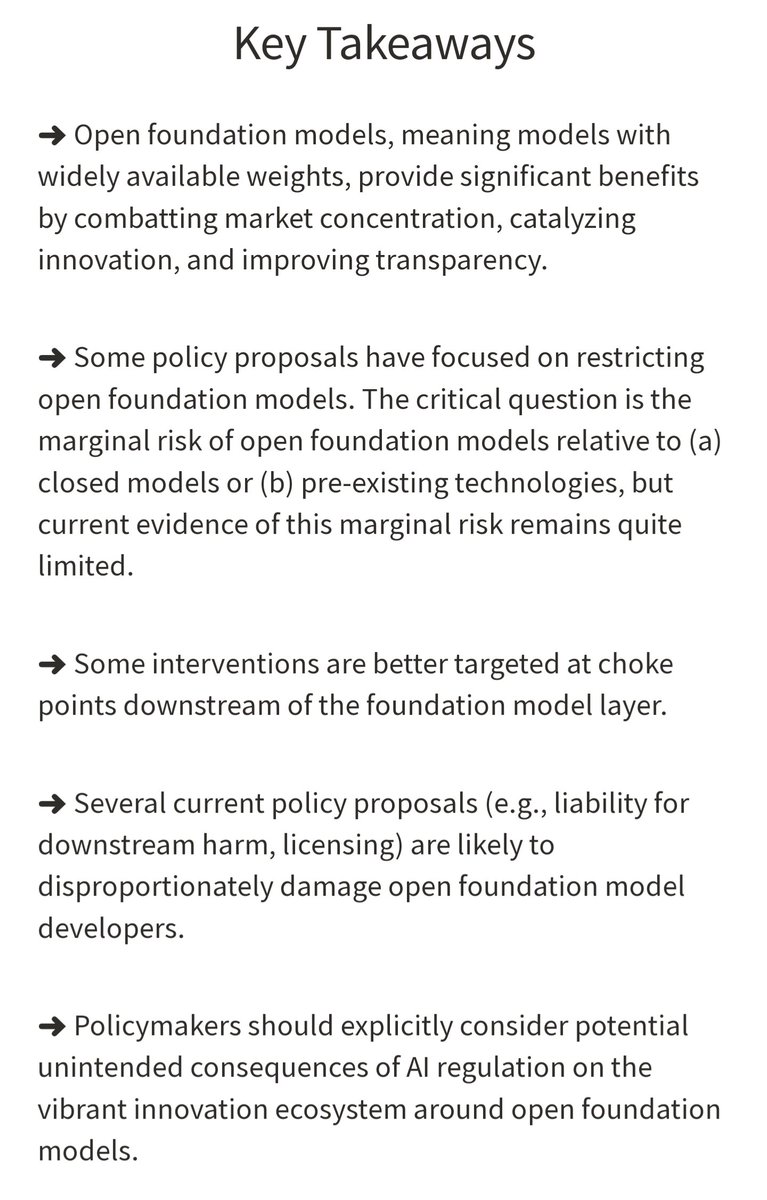
A big bunch of nails in the coffin of the idea that open source AI models are more dangerous than closed ones.
And a huge warning to regulators who are on the way to throw the AI baby with the regulatory bath water.
What has been happening since the release of Llama-2 is an explosion of applications built on top of open source LLMs, and none of the catastrophe scenarios the AI doomers had predicted.
Report from Stanford HAI: https://t.co/0fRCDXQS3n
PS: Another benefit of smaller goals is that they are very useful in helping me deal with burnout. Too tired to code for 2 hours to build something ambitious? Surely I can spend 10 mins taking a step towards that!
🏋️♂️ Workout 5 mins daily
🧘 Meditate 1 min daily
📞 Call at least one friend a week
🐦 Post 25 tweets this year
✍️ Write 5 technical blog posts
📚 Read 5 mins daily
🧠 Learn new things for 10 mins daily
💻 Code outside work 10 mins