We wrote 150,000 CVE exploits and trained an LLM on them.
Hinoki Offensive One scores 88.4% on CyberGym, 2.8 points above Daybreak, with zero refusals.
Pentesting and exploit development with no limits. Available now.
call me crazy but its pretty clear now.
rea + bla is going to kill more apps in 2026 than piracy ever did.
rea opens any app in one command. bla hides traps inside it before you ship.
fake code for the ai to chase, your users get the exact same app.
but heres the catch: if your rea agent knows how bla works, the traps dont stop it.
and bla is open source - so it can learn exactly what to skip.
if this lands on your timeline dont scroll past it.
heres the 60-second setup, free:
1. open claude code in your apps folder
2. say: "install node 24, build it, then run npx bla-agents harden ."
3. ship the new .bla-hardened folder, not your old build
4. rename what gives you away yourself - license checks, payment code. bla wont.
send this to anyone shipping an app.
thats it. thank me later.
most people will ship their app naked.
the ones who dont will keep it.
simple as that.
this is f*cking crazy
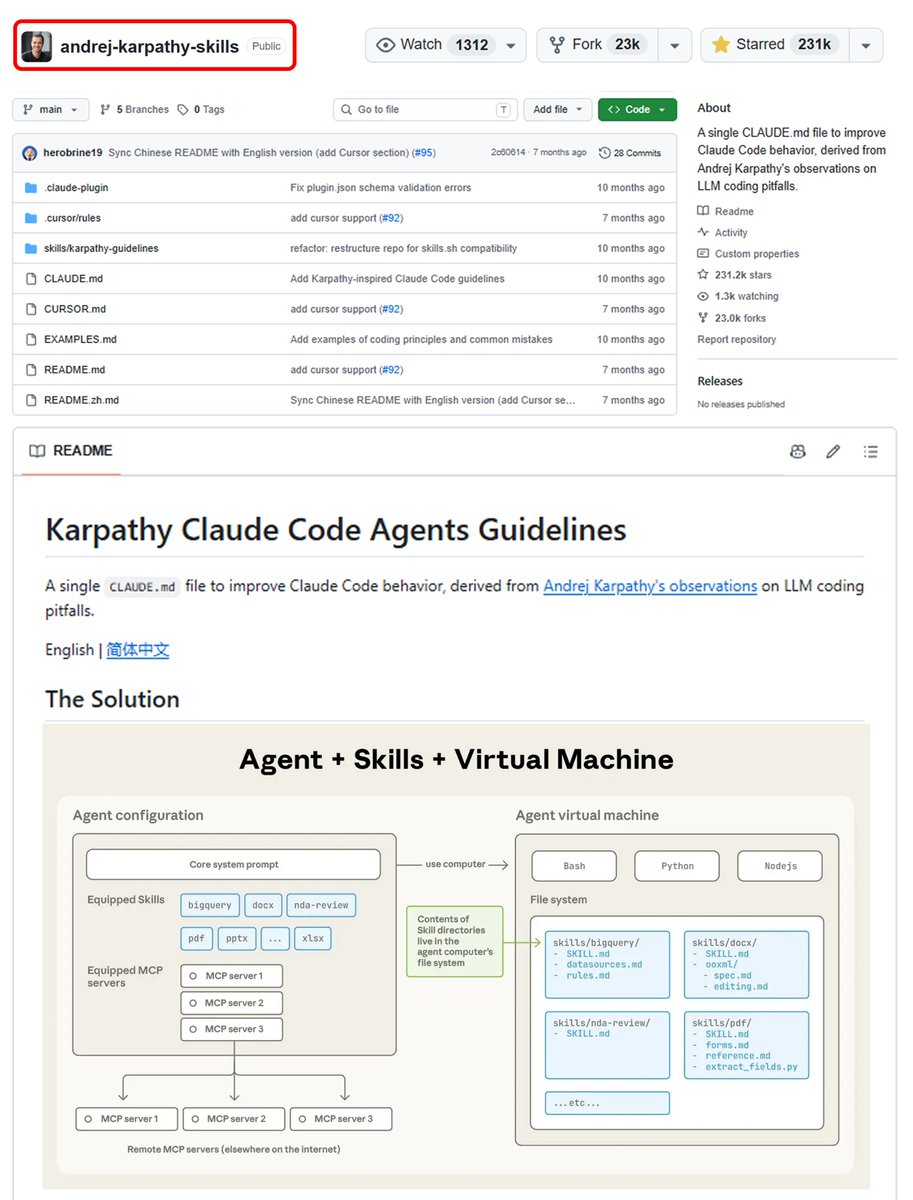
karpathy's CLAUDE.md hit #1 on github trending.
228,000 stars. most devs still haven't read it.
it took my Claude agents accuracy from 65% to 94%.
the 6 rules inside:
• step 1 → surface assumptions
"State your assumptions explicitly. If uncertain, ask."
ambiguous task → list interpretations → ask → build.
• step 2 → cut the scope
"No abstractions for single-use code."
200 lines → refactor → 50 lines → ship.
• step 3 → keep the diff surgical
"Don't refactor things that aren't broken."
request → minimal diff. every changed line traces back.
• step 4 → clean only your orphans
"Remove imports/variables/functions that YOUR changes made unused."
old dead code → flag it, don't delete it.
• step 5 → turn tasks into tests
"Fix the bug" → "Write a test that reproduces it, then make it pass."
vague task → failing test → pass/fail signal.
• step 6 → run the verify loop
"[Step] → verify: [check]"
plan → code → verify → fail? loop → pass → ship.
that's it.
65 lines. 6 rules. 94% accuracy.
save this before everyone else does.
then, read the article on how to build a team of Claude agents with Graphs below ↓
We're giving away a Hogwarts Legacy custom wrapped NVIDIA GeForce RTX 5090 to celebrate its official release with DLSS 5 🪄
To enter:
🟢 Share this post
🟢 Comment #RTXON
Terms and Conditions: https://t.co/45T3R732hf
Stop telling Codex, "make it look better."
Stop telling Codex, "add more tests."
Stop telling Codex, "make sure it works."
Vague instructions lead to results you have to redo.
Here are 4 practical prompts to get more useful work out of Codex:
After Andrej Karpathy released autoresearch, where an agent runs experiments in a loop on its own, I packed his method into one prompt that turns Opus 5.5 into a graph and can carry almost any task to the finish.
→ writes a check that can actually fail, first
→ splits the task into parts
→ runs the independent parts in parallel
→ loops each one until it passes the check
→ sends back only the part that failed
→ turns every mistake into a rule for next time
→ calls you only for the step that can’t be undone
Throw it at Opus 5.5 with the task you’ve been putting off for a week, and you’ll see the difference in one run.
The full prompt is in the comments.
How to tune it for your own work is in the article below. Save it before it gets lost ↓
THIS IS AN ACTUAL F*CKING GOLDMINE
Anthropic just shared one of the best tricks for Claude Code.
The idea: run Sonnet, Haiku 5.5 and Opus 5.5 at once, each one doing only the job it's best at.
Better results and way fewer tokens, because every task lands on the right model.
You just launch Claude Code like this:
claude --model sonnet --advisor opus
here's the split:
→ Sonnet 5.5 runs the session, writes the code and applies the fixes
→ Haiku 5.5 swarms the repo in parallel: search, grep and diff audits
→ Opus 5.5 stays on call as advisor for the big calls and signs off on the diff
→ you stop burning Opus context on work that doesn't need it
Opus only steps in at three moments:
→ before a plan locks
→ when the same error shows up twice
→ before calling it done
Sonnet builds. Haiku swarms. Opus reviews.
JEV engineering is the same move one layer down: the forks that need no thinker (which file, which tool, retry or stop) go to JEV in milliseconds, and the big models only see the ones that split
the full tree
> Sonnet 5.5 runs the main session and coordinates the work
> search maps the repo on Haiku 5.5, read-only
> grep finds call sites on Haiku 5.5 in its own context
> audit checks the diff on Haiku 5.5 in a throwaway worktree
> Opus 5.5 on call as advisor, reviews the synthesized diff before sign-off
> JEV routes micro-forks in milliseconds
paste the tree and this prompt into Claude Code ↓
"Reconfigure my Claude Code setup around this tree:
1. Run the main session on Sonnet 5.5 with Opus 5.5 as advisor.
2. Create three Haiku 5.5 subagents in .claude/agents: search (maps the repo), grep (finds call sites), audit (checks the diff).
3. Set isolation: worktree on audit so its checks never touch my working branch.
4. Add one rule to CLAUDE.md: delegate every repo search and test run to the Haiku 5.5 subagents to keep the main context small.
5. Route fast deterministic forks (tool choice, path selection, retries) through JEV.
Show me every change as a diff first. No edits until I say go."
↳ https://t.co/YqkjQiqRGv
save it, it'll come in handy.