Introducing Cartesia Managed Agents: our end-to-end voice agent platform for enterprise.
#1 on @ArtificialAnlys Speech Agent Arena and @ServiceNow EVA-Bench, built by co-designing our voice models and harness as one system.
Check it out → https://t.co/7kJhCYqjQo
Very excited to share what we've been working on! Contrary to popular belief byte-level language models really can be more compute efficient as long as you use the right architecture... 👀
I've always believed that intelligence should come from simple, general building blocks that learn their own abstractions directly from raw data; in other words, the bitter lesson. I think we're finally seeing a real step towards AI that can learn from all data.
Language modeling on raw bytes is a microcosm of this ideal, and to me it's a central problem in AI: if we can't build LLMs that learn end-to-end from bytes, how will we handle the rest of the world's data that we understand even less?
Last year we introduced hierarchical networks (H-Nets) as a first step. Our new version finds up to 3-5x efficiency gains in controlled scaling law experiments, and at larger scale matches an open-source model trained on 11T tokens with ~10x less data and compute. The posts below walk through what we found and why we think it works.
to prepare for an upcoming release (👀) we dug into the pretokenizer a little more. are people aware that hand-crafted regexes are part of every frontier LLM and doing some pretty heavy lifting?
some quick examples 🧵
Our new model Ink-2 tops AA's leaderboard for streaming speech-to-text!
Ink-2 comes with plenty of features optimized for real-time voice agents. With top-class models for both TTS and STT, the team at @cartesia keeps pushing the frontier of models for interactive intelligence.
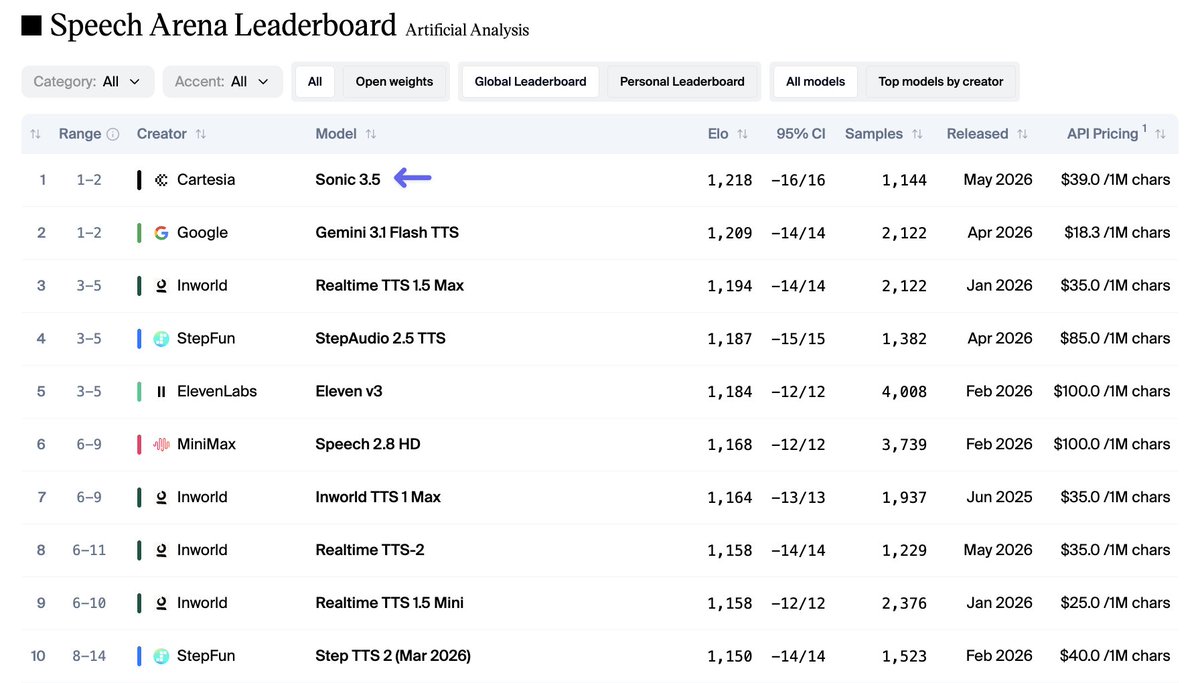
Cartesia’s Sonic-3.5 takes the #1 spot on the Artificial Analysis Speech Arena Leaderboard, surpassing Inworld Realtime TTS 1.5 Max and Google’s Gemini 3.1 Flash TTS
Sonic-3.5 is the latest TTS model from @cartesia . It supports 42 languages, including 9 Indian languages, with 500+ voices available out of the box. The model has been highly preferred among voters in the TTS Arena, with its demonstrated naturalness and accurate transcript following.
Key takeaways:
➤ Quality: Sonic-3.5 has an Elo score of 1,218 (+16/-16) based on 1,144 arena appearances, placing it ahead of Inworld Realtime TTS 1.5 Max at 1,194 and Gemini 3.1 Flash TTS at 1,209
➤ Pricing: Sonic-3.5 is priced at $39/1M characters, a premium compared to Gemini 3.1 Flash TTS at $18.3/1M characters, and Inworld Realtime TTS 1.5 Max at $35/1M characters
➤ Speed: 105.5 characters per second, compared to 205 characters per second for Inworld Realtime TTS 1.5 Max and 26.3 characters per second for Gemini 3.1 Flash TTS
See more details and listen to samples below 🧵
We’ve been lucky enough to test Mamba-3 ahead of the curve. 🧪
Here is how it integrates into Hybrid Models (Spoiler: it unlocks Muon for SSMs for the first time). 🧵
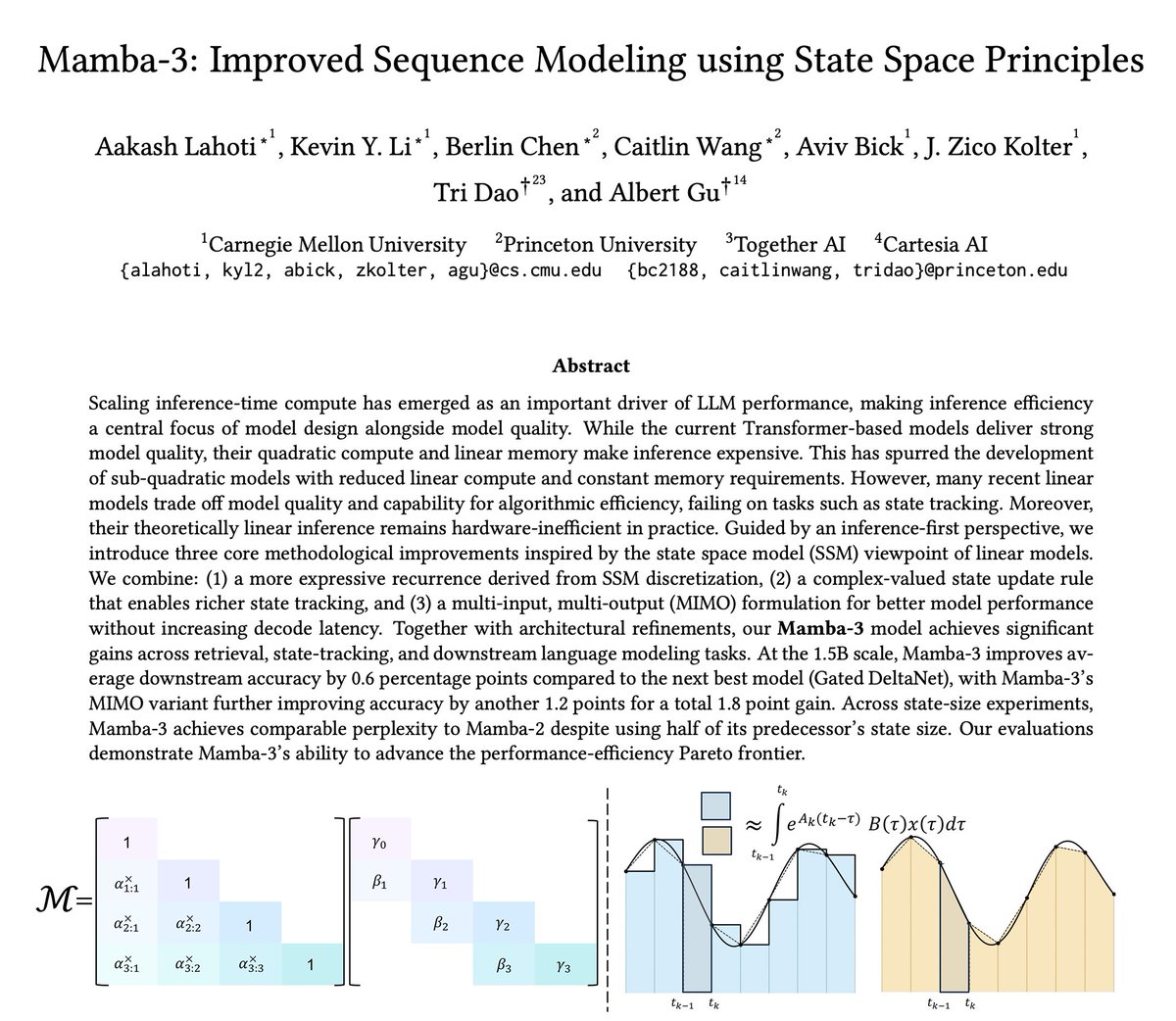
Mamba-3 is out! 🐍
SSMs marked a major advance for the efficiency of modern LLMs.
Mamba-3 takes the next step, shaping SSMs for a world where AI workloads are increasingly dominated by inference.
Read about it on the Cartesia blog:
https://t.co/dIWg3iXfay
The newest model in the Mamba series is finally here 🐍
Hybrid models have become increasingly popular, raising the importance of designing the next generation of linear models.
We've introduced several SSM-centric ideas to significantly increase Mamba-2's modeling capabilities without compromising on speed. The resulting Mamba-3 model has noticeable performance gains over the most popular previous linear models (such as Mamba-2 and Gated DeltaNet) at all sizes.
This is the first Mamba that was student led: all credit to @aakash_lahoti@kevinyli_@_berlinchen@caitWW9, and of course @tri_dao!
HIRING!
We’re looking for strong PhD students to join our core research team @cartesia — working w/ @_albertgu, @HJCunningham97, @MucaCirone, @DanielePaliotta, me & more
Topics: multimodal, long-context & tokenization-free / -dynamic methods
SF & London
Interested? DM me!
💣I am excited to advertise 'Bézier Gaussian Processes for Tall and Wide Data' which is to appear at #NeurIPS2022
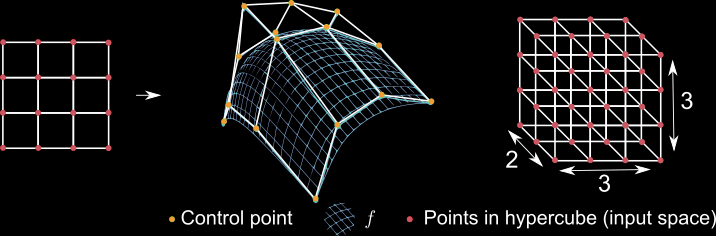
The paper presents a novel approach to scalable GP regression through a structured control points, which can be seen as a type of 'inducing points'. More in thread.
Today's magic trick: Make vorticity look like clouds ☁️🌧️ to celebrate that we just released SpeedyWeather.jl v0.3, our still-baby weather model in #JuliaLang. #GPU, auto-differentiation, low-precision, machine learning, all coming soon! Check it out, https://t.co/h9k6FiOUF4
JMLR has recently launched a Special Issue on ML for addressing problems of climate change! We welcome all submissions which use machine learning to address problems of climate change, including mitigation, adaptation, and climate science. [1/4]
A new paper on how the Coriolis force can change the way surface waves transport marine plastic: https://t.co/PBzSRHB9TN in #jgroceans@theAGU funded by @RAEngNews!