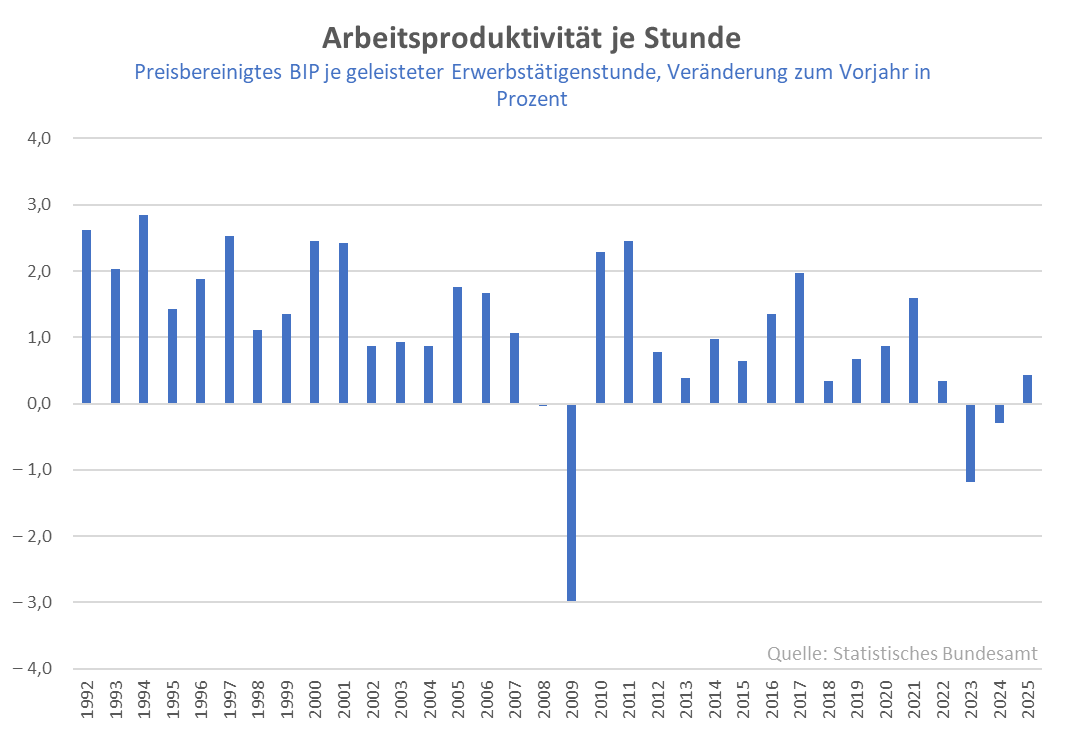
@WeckWorschdWoi Ein Produktivitätsgewinn ergibt sich halt nur, wenn eine Technologie auch angewandt wird. Sonst hat man nur eine Ruine wie den Transrapid.
Ist schon möglich, dass alles noch vor uns liegt - aber bislang ist von einem Produktivitätsschub durch neue arbeitssparende Technologien wenig zu sehen.
Selbst unter Annahme leicht sinkender Arbeitslosigkeit und von moderatem Wachstum kommt die Arbeitslosenversicherung ohne Reform des Leistungskatalogs mittelfristig nicht aus dem Minus.
@Tobias_B Die Unterführung Reichstagsufer am Bahnhof Friedrichstr. Hier brüten Menschen und Tauben die nächste tödliche Seuche aus, die die Menschheit dahinrafft.
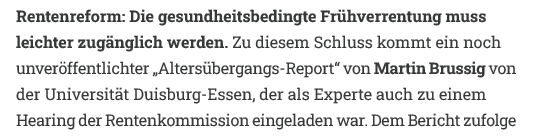
@HogrefeJens@diw_jgeyer Dem Dachdecker verdanken wir ja auch die Rente für besonders langjährig Versicherte, die vorrangig nicht von Dachdeckern, sondern von gut verdienenden Facharbeitern in Anspruch genommen wird. Ich verstehe die Intention, glaube aber nicht dass das funktioniert.
@HogrefeJens@diw_jgeyer Wenn der Renteneintritt nach der Lebenserwartung differenziert werden soll, machen wir aber ein großes Fass auf (Männer, Raucher, Motorradfahrer usw.).
@HogrefeJens@diw_jgeyer Bei dem Konzept geht es um eine „Berufsunfähigkeit im höheren Erwerbsalter“. Das fällt hinter m.E. die Grundidee der Erwerbsminderungsrente zurück, dass man ggf. den Beruf wechseln muss, wenn man den alten gesundheitlich bedingt nicht mehr ausüben kann.
@derspiegel Die Aussage ist sinnlos, weil in der Nettozuwanderung die Abwanderung bereits berücksichtigt ist. Besser steht es im Artikel selbst: 1,48 Mio Menschen wandern ein, 1,25 Mio ziehen fort. "Immer weniger" ist auch Quatsch, die Anzahl der Zuzüge ist höher als in den ganzen 1990ern
On August 7, 1942, a 28-year-old German oil executive stood outside a Jewish orphanage in Nazi-occupied Poland and watched SS soldiers throw babies out of windows.
That moment changed his life forever.
His name was Berthold Beitz.
At the time, he wasn’t a resistance fighter. He wasn’t a politician. He wasn’t part of an underground movement.
He was a businessman working for the German oil industry in Boryslaw, a town in occupied Poland where Hitler’s war machine depended heavily on oil production.
Beitz had a wife at home.
A small daughter.
A comfortable position.
And after witnessing what the SS were doing to Jewish families, he went home and told his wife Else:
“We have to do something.”
Most people in occupied Europe survived by looking away.
Berthold and Else refused.
Over the next several years, they would save around 800 Jewish lives.
Not with weapons.
Not with speeches.
With forged papers.
False job titles.
Hidden rooms.
And unimaginable courage.
Beitz discovered that Jews officially classified as “essential oil workers” were temporarily protected from deportation.
So he started expanding the definition.
Tailors became “petroleum technicians.”
Hairdressers became “oil specialists.”
Rabbis and scholars suddenly had paperwork claiming they were critical to Germany’s fuel production.
He signed the papers himself.
When deportation trains arrived, Beitz sometimes walked directly up to the cattle cars and demanded prisoners back, claiming they were essential workers needed for the war effort.
And astonishingly, it often worked.
While Berthold rescued people publicly, Else turned their home into a sanctuary.
Jewish children hid in the cellar while Nazi officers sat upstairs eating dinner.
Parents who knew they were about to be murdered entrusted their children to her arms.
If the Gestapo had searched the house thoroughly, the Beitz family would have been executed.
They did it anyway.
In 1943, the Gestapo finally investigated Berthold after forged work permits were discovered.
He denied everything.
Somehow, he escaped arrest.
By the end of the war, approximately 800 people were alive because the Beitz family refused to accept evil as normal.
After the war, Berthold rebuilt his life quietly.
He became one of the most powerful industrialists in Germany, eventually helping lead the massive Krupp steel empire and later ThyssenKrupp.
He advised world leaders.
Helped strengthen postwar Germany.
Worked behind the scenes during the Cold War.
But he almost never spoke publicly about what he had done during the Holocaust.
His own grandson later admitted the family learned many details only by reading newspapers.
When people called him a hero, Berthold rejected the word.
He said:
“I was just a human being who saw what was happening.”
In 1973, Israel honored Berthold and Else Beitz as Yad Vashem “Righteous Among the Nations,” one of the highest recognitions given to non-Jews who risked their lives to save Jews during the Holocaust.
Berthold Beitz died in 2013 at age 99.
Else died the following year.
The children they saved went on to have children of their own.
Today, thousands of people exist because one German couple refused to look away while others did.
Berthold Beitz spent the rest of his life believing he had simply done what any human being should do.
History tells us otherwise.
Because when cruelty becomes ordinary, the people who choose compassion become extraordinary.