@Harvard Professor of MCB & Physics and Director of Swartz Program in Theoretical Neuroscience;
@HebrewU Professor of Physics and Neuroscience (Emeritus)
בגאווה ישראלית גדולה בירכתי היום את פרופסור חיים סומפולינסקי מהאוניברסיטה העברית בירושלים על זכייתו בפרס Lundbeck היוקרתי - הפרס החשוב ביותר בעול�� בתחום חקר המוח. מדובר בהישג ישראלי פורץ דרך, שמשקף את מצוינות האקדמיה הישראלית במחקר ובכלל.
אני סמוך ובטוח כי בעקבותיו יבואו עוד אותות ופרסים שיוקירו את תרומתם של ישראליות וישראלים לקהילה המדעית העולמית, ומקווה ופועל לכך שנדע להכיר תודה - כחברה וכמדינה - לענקי האקדמיה והמחקר שלנו.
Topics include principles of early sensory processing; unsupervised and supervised learning; attractors, memory, and spatial functions in cortical circuits; noise, chaos, and neural coding; learning, representations, and cognition in deep neural networks in brains and AI. 3/3
My Harvard/Neuro 231, 2024 Edition begins soon. It explores contemporary brain theory spanning local neuronal circuits as well as deep neural networks. It examines the relationship between network structure, dynamics, and computation. 1/3
The course introduces analytical and numerical tools from information theory, dynamical systems, statistics, statistical physics, AI, and machine learning for the study of neural computation. 2/3
The theory unites NTK and NNGP as two limits of the same underlying process. We introduce the Neural Dynamical Kernel (NDK), derive equations for the dynamics of the mean predictor of the network, and discuss implications for the problem of representational drift in neuroscience.
I am excited to announce a recent work by Yehonatan Avidan and Qianyi Li https://t.co/1MuVcdooL9
presenting an analytical theory for learning dynamics in infinitely wide neural network.
Jet Blue just entered the Book of Guinness for World Record on Greediness. It cancelled my flight due to weather conditions but refused to fully refund me. They charged me cancellation fee! Never underestimate the creative way companies such as Jet Blue chase your money! advice?
@ylecun When DCNNs said 'cat' in response to an image, or when VAEs drew an image of cat they met with all but praise. Nobody said 'they make stuff up'. ChatGPT is a milestone in AI and big cos should swallow their pride and start working, otherwise they will be sidelined.
Our model proposes a novel scheme for associative memory of temporal sequence. In contrast to using sequence attractors (Sompolinsky and Kanter, 1988),
here entire sequences are stored holistically as fixed points-a scheme that is robust to overlap between sequences.
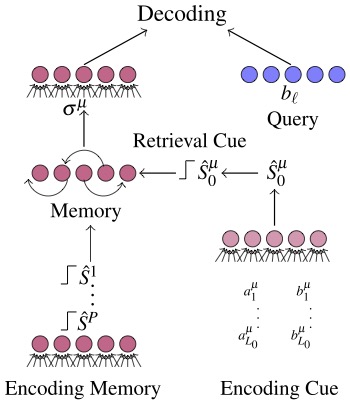
I am excited to announce the publication of the wonderful paper of Julia Steinberg on Associative memory of structured knowledge in scientific reports
https://t.co/15tRsFtnCI. Most neural models of associative memory store structureless knowledge as simple random patterns in RNNs
and then store multiple compressed vectors as fixed points in RNN. Retrieved fixed points is followed by decoding individual linked components. Thus, model consists of two memory systems: 'dictionary' for items and 'episodic' for their linked structures.
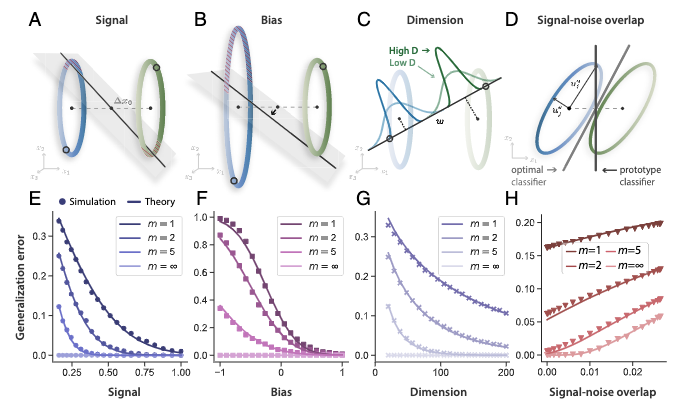
We highlight a study by Ben Sorscher, @SuryaGanguli and @HSompolinsky in which they explore a quantitative theory of neural geometry and few shot learning in deep neural networks and in macaque inferotemporal cortex (https://t.co/fjD7unOkyV). https://t.co/RJyjabBOoK
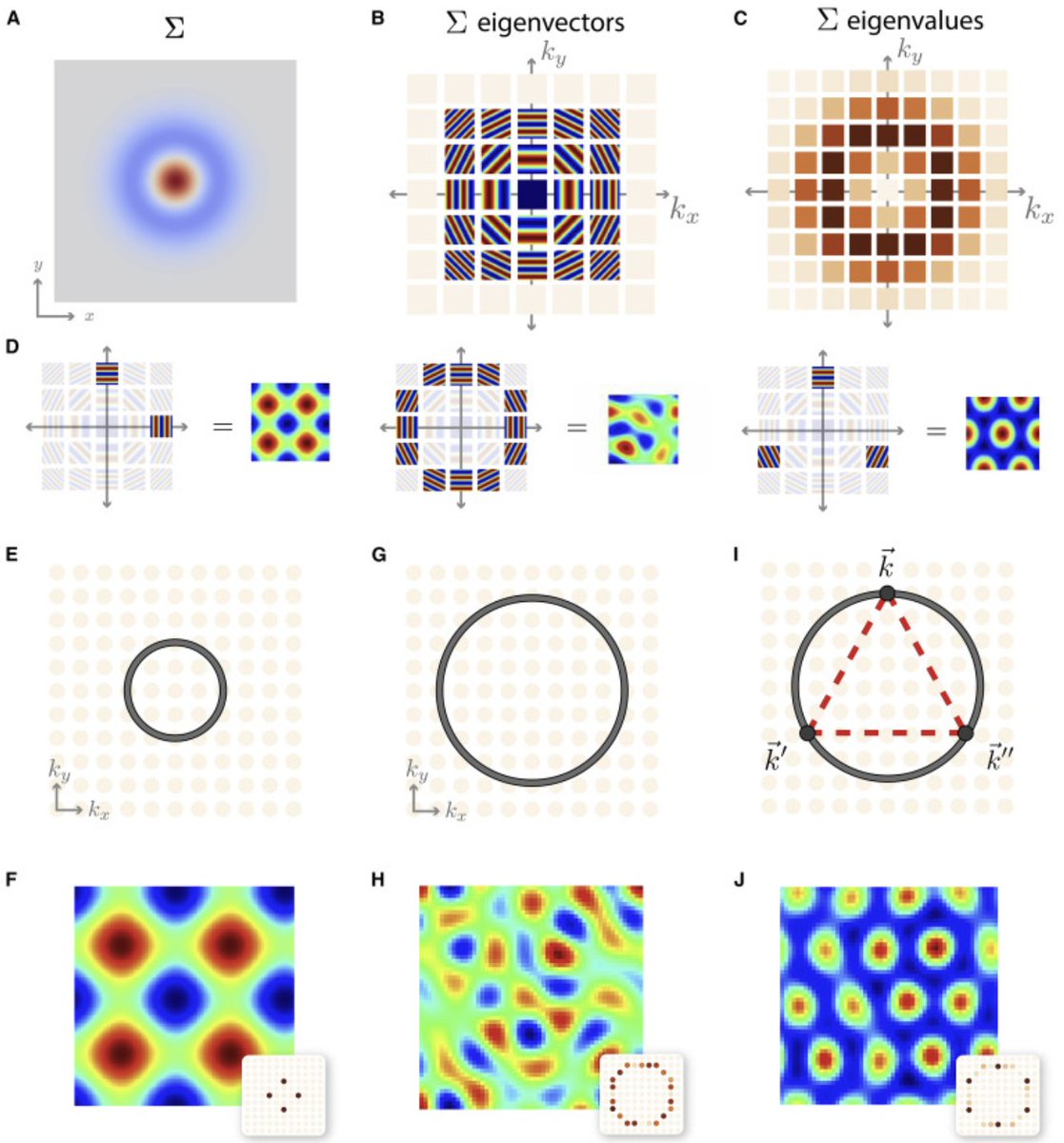
Our new paper @NeuroCellPress "A unified theory for the computational and mechanistic origins of grid cells" lead by Ben Sorscher & @meldefon w/@SamOcko & @lisa_giocomo explains when & why grid cells appear (or don't) in trained neural path-integrators and
https://t.co/SqoNv5AW00
Our new paper in @PNASNews: "Neural representation representation geometry underlies few shot concept learning'' lead by Ben Sorscher and @HSompolinsky: a quantitative theory of neural geometry & few shot learning, tested in both deep networks & monkey IT https://t.co/TCzfp1sS9T
Remarkably, we find that object manifolds in DNN visual feature layers also support zero shot learning of concepts from linguistic descriptors revealing geometric alignment of semantic features in Word2Vec and high level visual features of the same concepts.
Our work on manifold geometric theory underlying fast learning of novel concepts led by Ben Sorcher of the Ganguli Lab is out. https://t.co/DfEJ5SXNE7 We apply our theory to object manifold representations in deep neural network (DNN) and in macaque IT cortex.
And show that that they support highly accurate few-shot learning of novel visual concepts
and that and that variability in performance across concepts follow closely the predictions of our manifold geometric theory.