Now out in @NatureBiotech ! Do lncRNAs commonly bind 1000s of genomic sites? Maybe they do, but the dozens of studies that report genomic binding maps of lncRNAs are deeply flawed, with probes binding suprious DNA sites rather than RNA-bound ones. https://t.co/01NroM67dK
🍟 Ultra-processed and unhealthy diet exposure, combined with abnormal gut host and microbial signals, persists despite effective treatments in #CrohnsDisease. Addressing these gaps could improve patient health.
🔗 https://t.co/jw7KeT5ro3
Rewarding to see our @HabermanLab study featured on the cover, laying the conceptual framework to underlying mechanism of escape from AT remission (=flare) d/t persistent dietary-metabolic gut perturbances. Hence the need for combined AT-nutrition trials
@HelmsleyTrust
📣 The May issue of #Gastroenterology is now online! This issue includes:
✅ The biography of the incoming AGA president
✅ A study on the role of APC mosaicism in #colorectaladenomas
✅ An article on a novel screening method for #ALD
✅ ...and more!
🔗 https://t.co/6NwxVRy9dC
2/2 We use IBD proof-of-concept model for prioritizing epithelial-targeted metabolite interventions, showing: 1) IBD fecal contents disturb epithelial functions. 2) This was linked with metabolite levels, which 3) guided prioritizing metabolites that reversed IBD negative effects
1/2 Congratulations, Haya, Lubna, @HabermanLab, on the publication in Gut Microbes:
https://t.co/UtrRlLwK98, where we try to address the related IBD epithelial dysfunction, which we also noted in this just-published paper in Gastroenterology
https://t.co/HIKAy1rJsg
2/2
We show that Crohn’s Disease advanced therapies address only one side of the disease: the immune response, while perturbations in diet, the microbiome, metabolites, and epithelial barrier function remain largely untouched during remission.
https://t.co/HIKAy1rJsg
1/2
Congratulations to Tzipi Braun, @HabermanLab, @ShomronH, IIRN CORE study on the publication in Gastroenterology @AGA_Gastro.
https://t.co/HIKAy1rJsg
We thank @HelmsleyTrust for their support and funding
The Rosen lab at @StanfordMed identified a lipid-related metabolic dysfunction as a key feature of the #UlcerativeColitis epithelium.
They show the potential of patient-derived colonoids as a preclinical model to evaluate epithelial-targeted therapies: https://t.co/vBWtbuFzCd
גיוס סגל אקדמי לפקולטה למדעי הרפואה והבריאות באוניברסיטת תל אביב לשנת הלימודים תשפ"ו . בית הספר לרפואה באוניברסיטת תל אביב מחפש מועמדות ומועמדים בכל הדרגות האקדמיות.
המשרה היא תקנית ועשויה להוביל למעמד של קביעות בתום תקופת הניסיון.
https://t.co/eDrJ4XPWKj
The School of Medicine @TelAvivUni seeks outstanding candidates to fill tenure-track faculty positions at level of Senior Lecturer/Assistant Professor & Associate Professor for fall of 2025. Deadline Oct 13, 2024. More info at: https://t.co/PlLUmJvgKT
Study in @NatureComms by @HabermanLab on the Urban-Rural diet-omic roots of IBD in China/Israel (our SOURCE @HelmsleyTrust consortium). Shows a gradient of IBD-like microbiome change correlating with time in city spent by villagers.
https://t.co/bKm944uXrr
@sheba_medical
1/6
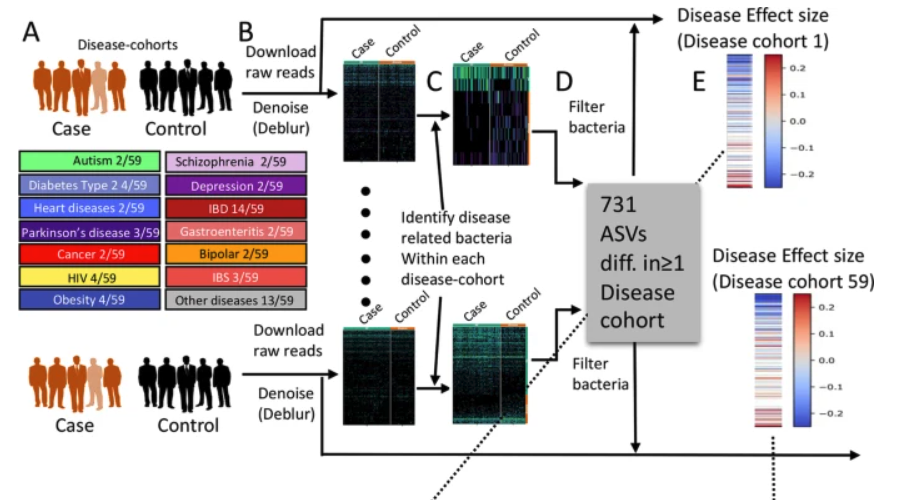
In a new paper, we show that different diseases such as Alzheimer, Bipolar Disorder, Crohns' Disease, Chrohic Fatigue Syndrome, Lupus and Pancreatitis all share a similar microbial response:
https://t.co/uEVwLnqUnn
3/6
To overcome the cohort/experimental pipeline differences, we performed a case-control comparison within each disease cohort, identifying the ASVs changing in each disease, and combined the per-bacteria change across all cohorts.
4/6
We observed that ASVs that are significantly higher/lower in cases compared to controls in one disease cohort, tend to show the same direction of change in many other disease cohorts.
5/6
Using a random forest classifier trained on one disease, we can in many cases identify cases/controls in a different disease with high AUC, thus raising the concern of using microbial signatures to identify a specific disease without taking into account additional diseases.
6/6
In addition we identify a small subset of bacteria that are specific only to Inflammatory Bowel Disease. These bacteria may be more directly associated to gut inflammation, and potentially may be used as biomarkers and as future targets for interventions.