𝗪𝗵𝗼 𝗠𝗼𝘃𝗲𝗱 𝗠𝘆 𝗘𝗱𝗴𝗲?
Most investors spend 95% of their time analyzing numbers.
Revenue growth.
Margins.
Guidance.
Valuation.
The problem is that everyone can see the same numbers.
Twenty years ago, investors like Warren Buffett could build an edge by reading financial statements better than almost everyone else.
Information moved slowly. Data was expensive. Analysis was limited.
Ten years ago, investors like Bill Ackman were still generating outsized returns through deep fundamental research, activism, and understanding businesses better than the market.
Today, every filing is instantly available to everyone.
Hedge funds, analysts, retail investors, and now AI systems can process the same information within minutes.
The market evolved.
Information evolved.
AI evolved.
Investors who didn’t evolve underperformed.
Even Bill Ackman’s most famous trade wasn’t finding a hidden line item in a balance sheet. It was recognizing a risk the market was largely ignoring and buying protection before COVID.
The edge moved.
I haven’t used Excel or a calculator in over 10 years.
Yet during that time I have outperformed the market by thousands of percentage points.
Not because numbers don’t matter.
But because numbers alone rarely provide an edge anymore.
If you’re only chasing valuations, you’re chasing information everybody already knows.
You can scroll through X all day and see endless posts saying:
“Bitcoin is so cheap.”
“PayPal is so cheap.”
And my personal favorite:
“This is the cheapest valuation in the company’s history.”
I probably see 10 posts like that every day.
So what?
Everybody can see the same valuation metrics.
Everybody knows the stock is trading at 8x earnings, 1x sales, or whatever ratio is being promoted that day.
If the opportunity is obvious to everyone, why would that be an edge?
In fact, some of the cheapest stocks get even cheaper.
The question isn’t whether something looks cheap.
The question is: what does the market believe that makes it cheap, and what is the market getting wrong?
One of my favorite edges is understanding the actions of the people who know a business best.
Not blindly following them.
Understanding why they’re doing what they’re doing.
In my latest three recommendations, $STAA, $WGS, and $IMDX, the numbers weren’t particularly attractive. Analysts were negative, and the last quarters weren’t great.
Yet within a few months, all three were up between 50% and 100%.
Almost nobody was talking about them.
You couldn’t scroll through X and find endless threads about how cheap they were.
At the same time, some of the people who knew these businesses best were buying aggressively.
That’s where I started paying attention.
Not because someone bought.
Because I wanted to understand why they bought.
There are entire funds and ETFs built around insider buying.
They scan thousands of companies, track insider transactions, apply statistical models, and buy based on those signals.
And they’re not wrong.
But that’s still only one piece of the puzzle.
Insider buying is not the thesis.
It’s one facet of the diamond.
It’s a clue.
The real work starts after you see the purchase, not before.
Who is buying?
How much are they buying?
What do they know?
What are their incentives?
Why are they acting now instead of six months ago?
Those are the questions that matter.
If you read the hedge fund letters on $STAA, you understood the thesis.
If you listened to the conference calls on $WGS and paid attention after insiders committed roughly $100 million of their own capital, you understood where the opportunity was.
Same thing with $IMDX.
The market is very good at pricing today’s numbers.
It’s much less efficient at pricing human behavior, incentives, and conviction.
$QQQ at the lows today sold off -5.06% from the open
In the last 10~ years this has only happened 5 times (but plenty of times in the post-2000 dotcom bear market)
With the exception of 2018 they were the lows for that correction
What's notable this time is that $QQQ is only 5% off all time highs
Extremely volatility and wide ranges usually mark turning points... did we just bottom?
SpaceX IPO Friday.🧵
3% float initially. 75B raise. No price history.
Here are the details you need, and how I'm actually trading it, not as a fan, not as a hater but as someone who respects the auction.
My conversation with Alex Sacerdote, founder of Whale Rock Capital Management.
Alex runs more than $17B and has been one of the best performing tech investors for years, though he keeps a low public profile.
As you'll hear, he is singular in how he thinks about investing through technology cycles.
For over 25 years, he has built his entire investment framework around a single idea, the S-curve.
We discuss:
- The AI L-Curve
- When to buy into an S-curve and when to sell out
- The de-commoditization of data center hardware
- Why he went net short software
- His two models for tech adoption
- Finding alpha
Enjoy!
Timestamps
0:00 Intro
9:55 AI's L-Curve
19:31 Whale Rock's S-Curve Playbook
26:14 Spotting Inflection Points
32:02 Finding AI Winners
40:04 AI vs Software
48:13 The Hardware Renaissance
58:04 Why Investors Miss AI
1:05:18 Whale Rock's Research Machine
$SPY $QQQ
If you see posts of people comparing this to 2009 or DotCom
Immediately unfollow or block them
Comparing a systemic collapse of the biggest banks in the world going under to a bull market pullback led by earnings growth that is outpacing the gains in the indexes and the moves in the charts is mathematically incorrect and literally retarded
Comparing companies that weren’t making that much money that had 200 and 500 forward P/E’s to companies that literally print more money than the FED ALL TRADING BELOW 30 forward P/E’s is mathematically incorrect and literally retarded
Buffett on being broke:
"It's a huge structural advantage not to have a lot of money. I think I could make you 50% a year on $1 million. No, I know I could. I guarantee that"
The entire Leopold story is marketing BS. And you fell for it.
Dwarkesh Patel's assistant is the brother of Leopold's fiancée's boss, who is Anthropic's chief of staff.
Every investor he "attracted" had a pre-existing, years-old personal relationship with him built inside the EA and Stripe social graph before his essay existed.
Every dollar was raised from billionaires he already knew who were behind the deals he "picked".
Carl Shulman, who actually heads research, is 45 years old, formerly at Peter Thiel's macro hedge fund Clarium Capital, and has deep roots in AI forecasting and the EA safety world.
Clarium was itself a concentrated macro fund built around a single big thesis (peak oil, dollar collapse). It blew up spectacularly in 2008–2010, losing roughly 90% of AUM.
You didn't watch a prodigy go viral. You watched a controlled fund launch.
$SNDK may be the best example of this entire bull run.
A 7-week consolidation from 11/10 to 1/2.
Then a 9-week consolidation from 1/30 to 4/7.
Those two periods of sideways action weren't bugs in the process—they were the process.
The stock didn't make its biggest advances by going vertical nonstop. It paused, tightened up, digested prior gains, and allowed new entry points to develop before moving higher again.
Yet many traders see a stock stop going up for a few weeks and immediately lose interest. The reality is that some of the strongest leaders spend a surprising amount of time doing absolutely nothing.
Consolidation isn't weakness. More often than not, it's the foundation for the next leg higher.
Ultra High Net Worth Individuals (UHNWI) do own yachts for tax reasons, but not because they are a modern replacement for palaces.
Most of the world runs residency-based taxation. As in, if you stay over 183 days somewhere you become a taxable base. The US is the outlier, as it taxes you regardless of where you live, based on citizenship.
That difference produces two entirely distinct wealth architectures.
European UHNWI have a structural incentive to stay mobile. Not being in one place too long is itself a tax strategy. Yachts happen to serve that lifestyle perfectly - flag-registered in favourable jurisdictions, moving between anchorages, never accumulating residency days (and benefiting from things like Cypriot 2 month stay non-dom status). The tax regime does not cause yacht ownership, but it makes yachts a remarkably efficient asset class for people whose wealth depends on being nowhere in particular.
This is why European UHNWI do a yearly circuit - Wimbledon one week, Cannes another, the WEF, the Biennale. The social calendar is not separate from the tax strategy. They are the same thing. This also mirrors the itinerant courts of the past, where the aristocracy would move around from one part of the kingdom to another throughout the year, according to king's mood.
American UHNWI face the opposite constraint. Citizenship-based taxation means mobility cannot solve the problem. So they optimise differently - dynasty trusts, LLCs, state domicile arbitrage. They are not less sophisticated. The same economic incentive just produces a completely different behavioural output when the underlying regime changes.
The Earnings Trap
One of the most misunderstood metrics in investing is the P/E ratio. That does not mean it is bad or useless. It simply means that many investors stop their analysis at the number itself without asking where those earnings actually came from. Two companies can report identical earnings and deserve dramatically different valuations because the source of those earnings is completely different.
Take $TOST as an example. Last year it generated $305 million of operating income, which represents the profit produced by the actual business. Yet pretax income was $346 million. So where did the extra $41 million of earnings come from?
Most of it came from intrest income. $TOST has a large cash balance and virtually no debt, allowing it to earn roughly $51 million simply by holding cash on its balance sheet. After accounting for a few smaller one time items, pretax income ended up $41 million higher than operating income.
There is absolutely nothing wrong with this, and in fact it is a positive. The company is generating additional profit from an asset it already owns. The important point, however, is that these earnings are fundamentally different from operating earnings because they are not being produced by the core business itself.
If $TOST spent a significant portion of its cash on an acquisition, interest income would decline. If management launched a large share repurchase program, interest income would decline. If interest rates moved materially lower, interest income would decline as well, even if the underlying business continued performing exactly as before.
This creates a fascinating problem for investors because accounting treats all earnings equally while economics often does not. Imagine two companies that each earn $100 million. The first company generates every dollar by serving customers and selling products. The second company generates $70 million from operations and $30 million from interest earned on excess cash.
The income statement treats those earnings as identical, but should investors? Most people spend countless hours debating whether a stock trades at 20x earnings or 25x earnings. Far fewer stop to ask whether those earnings deserve the same multiple in the first place.
The quality of earnings is often far more important than the quantity of earnings. This is why great investors spend so much time studying the source of earnings rather than simply accepting the headline number. Some earnings are generated by durable competitive advantages. Some come from excess cash. Some come from investment gains. Others come from accounting adjustments, tax benefits, or one-time events. The income statement combines them together, but the investor should still understand where every dollar originated.
The broader lesson has very little to do with $TOST. $TOST is simply the example for a business I have been studying recently. The real lesson is that not all earnings are created equal, and understanding that fact can completely change how you think about valuation. A dollar earned from a durable competitive advantage is often worth far more than a dollar earned from temporary circumstances.
Most investors treat earnings as a destination. The best investors treat earnings as the beginning of an investigation. They understand that the number itself is rarely the story because the story is where the number came from. The greatest investors do not simply ask how much a company earned. They ask how it earned it, and that question often makes all the difference.
🌹
$btc - htf data analysis
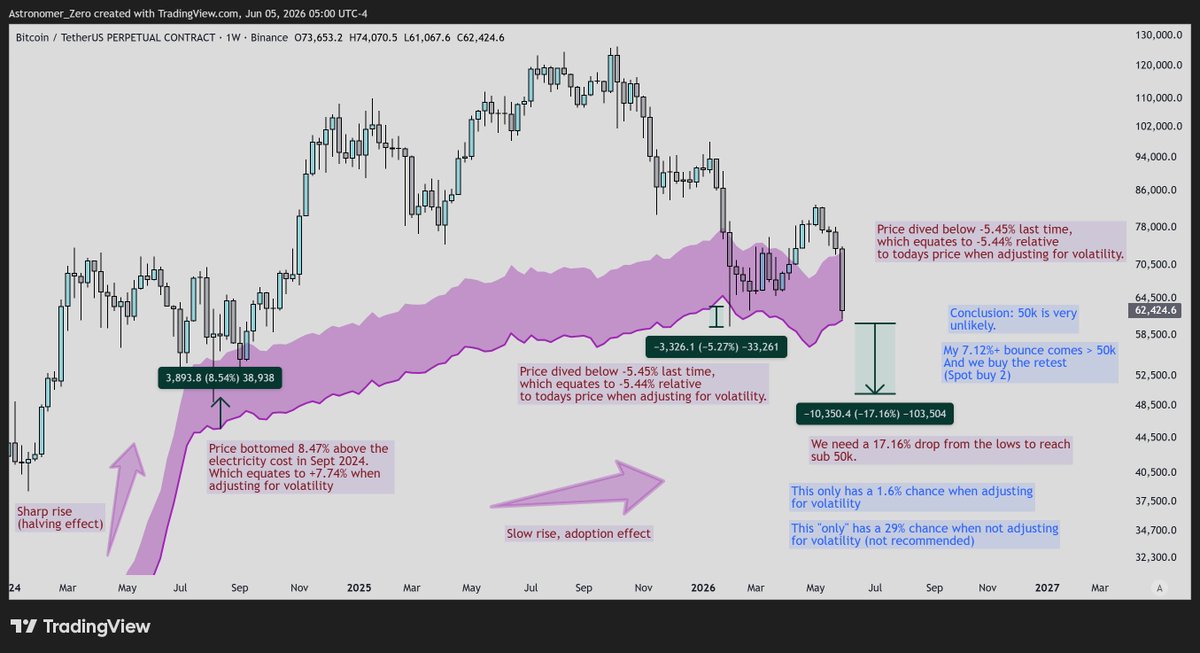
There is a 98.4% chance bitcoin does not go below 50k on a volatility adjusted basis.
In the light of our last post on #bitcoin's infamous electricity cost metric, where we called the bottom once again before a whopping 37% move all the way to 83k from the very bottom of 60k, called out live, all due to one of our most important signals passing by, I decided to go deeper into the analysis.
With all the random numbers thrown around, vague calls and loud celebrations of how the bears "called" this entire move proudly, and with that same conviction, expecting 50k and below, I think what people need the most right now, is at least one solid metric + data shared, describing how that happening, is a highly unlikely chance.
Good data and strong data in general is hard to dispute, but I still give the kind disclaimer that this is just my lens applied to that strong data. There are multiple ways to interpret data. With this one though, no matter the lens, interpretations are quite narrow and I think that's the very way to approach data analysis in trading.
I always find it quite funny when someone posts a chart of 3 data points, then concludes that the 4th one is a guarantee, whilst anyone who followed high-school statistics, knows otherwise, how 3 times 100% chance, doesn't mean 4th time, in a probabilistic world.
So with this post, I like to offer strong data, as well as explaining the logic behind the data (to remove the black box data-only effect), of why I am so confident we don't go below 50k.
Thank you in advance for this more extensive read. I am sure you will enjoy and some of you may feel some nostalgia every time I share a post like this given my historic reputation on these.
Without any time wasting further, let's get to it.
The logic
This one is about the miners electricity cost to produce 1 $btc. This is a vital metric. Now I know there is a lot of controverse around miners and their impact, but there is still an inflation of 0.84 per year on $btc to date since the last halving (about 164,000 BTC per year). Seems negligible but at the current price of Bitcoin (61k), that still equates to 10.7 billion dollars per year. So every year, 1/6th of the entire supply of @MicroStrategy 's entire holdings gets released into the hands of the miners, and with $btc's thin liquidity existing to this date, you wouldn't want to see that dumped on the market, certainly not every year. So yes, the miners still have a very important impact that can't be underestimated.
Put differently, that equates to @MicroStrategy's entire holdings being sold every 6 years (1.5 cycles long). If that doesn't put a different swing on the significance of Saylor's actual influence on the market, I don't know what will. And I believe I have convinced you now how impactful and in control the miners still are today. (In fact, I don't need to convince you, the production cost floor speaks for itself, still until today.)
So you don't want the miners to sell (which they mostly do, slowly, to keep their business running). But due to the current situation, they can't do that anymore, because the market has hit rare conditions, only happening a few times every cycle.
That is, the price has dropped below the average weighted electricity cost to produce one bitcoin:native per kWh.
Significant? Maybe. Let's put some logic behind it: Not only does that mean that the miners can't sell their $btc for a profit. It also means that it is simply cheaper to just log into a CEX (large funds: OTC) and buy 1 Bitcoin, instead of going through the pain of mining 1 Bitcoin. So not only does this make the miners (the people controlling $btc) not want to sell, it also makes them want to buy, because it is cheaper to just buy instead of mine them. And although I am not saying that is what they do, it is a large pressure and narrative on the market, which has driven price north without any deeper revisiting each and every time in history.
That is the logic behind why this works. Should we believe it blindly? Never. Successful trading and analysis is always a combination of data + logic and cross verifying two., never of just one or the other. But let's call it an assumption (assumption 1).
I could not write on one slate the amount of charts and videos and posts I see on X every day, only covering aspects of just one of the two, in mere lazy manner too, just throwing numbers around, or using complex risk metrics or equations without any logic behind it. It hurts the seeing eye.
All power to them however. Many are learning, many are adapting and many don't even trade, they just DCA and draw some charts telling everyone how they are "mostly right".
Short rant aside, logic by itself is strong and often missing, but we need data to verify logic (hypothesis) correctly.
Collecting data
How to do this? It's very simple. To compare how price compares against the continuous band of production/electricity cost, all it takes is simply mapping it out on a price-time chart on tradingview, which is the purple band represented below, starting with the production cost and the electricity cost as the floor. The production cost is higher due to mining equipment, and that cost also varies since mining rigs are tuned to performance, therefore cost, that is why a wide band appears. The electricity cost is the floor because that is disregarding capex into mining equipment, and electricity cost per kWh (worlds average) doesn't vary much over time.
What we also notice is how the elec/prod cost rises over time, due to two drivers:
➡️The halving (every halving, it becomes more difficult to mine 1 BTC, giving a large jump)
➡️ General competition (adoption driven, more miners = more competition for blocks).
Both feed the eternal adoption cycle of bitcoin and rising floor price (unless abandonment, the opposite of adoption happens, let's hope not, but there are clear signs it's not happening).
So, mapping out the elec/prod cost and simply comparing how far price bottom above or below each time it visited, gives us a statistical reference to where price will bottom now (or where it is unlikely to go now).
It is indeed a mere statistic, because volatility is somewhat statistically driven, intertwined with cycles.
One key note: volatility adjustment is important.
On that note, collecting how far the wick goes below the band each time in absolute sense, is not sensible enough. It is to its simplicity elegant, but price also needs to be adjusted for volatility because for example daily 40% up and down moves Today are far less likely than back when $btc was priced 1$ per coin. Anyone who ever traded microcaps or penny stocks, knows what I mean. So since we are using the entire population as back test data, we must adjust price for volatility.
How to do this? By price law books, the relation depends on liquidity (how thin it is), the operators controlling the markets and the time in the year, day, week. But in general terms, liquidity thickness is linearly proportional to volatility and volatility scales inversely with the fourth root of price.
What does the latter mean? If price doubles, it means volatility decreases with the fourth root of 2, which is 1.1892...
So when price wicks below the band in say 2015 for 20%, that means today, when adjusted for volatility, that difference should be 61k/whatever the price was in 2015. E.g. $61000/$250 = 244. Fourth root of 244: 3.95. Which means the 20% wick should be accounted for as a 5.06% wick in the data.
Keep in mind, this is a relatively rough assumption (assumption 2), but one backed by price-liquidity-volatility laws.
So throughout the entire history, we collect these data points of how far below or above the wick went relative to the electricity cost at that time, and compare that to the chances of reaching 50k now, by comparing how much further price has to go below the current low, which is 61.1k, conveniently aligning with the exact electricity cost of 1 $btc today.
Using 61.1k as the in-real-time of writing this post, that puts 50k: about -18% below that.
That sums up how to collect the data.
With assumptions again renamed below...
➡️ Assumption 1: the logic of miners' impact
➡️ Assumption 2: volatility decreases with the fourth root of price (market cap).
➡️ Assumption 3: normal distribution of random volatility differences around a given price point...
... we are ready to collect the data.
Data Analysis
Next, let's look at the data, let's look at the history, where I will be taking every single data point which has reached inside the production cost band as a high timeframe bottom data-point. Because frankly, as it speaks for itself, it has been a high timeframe bottom every single time.
Below, are all the data points, sorted by date (Monday starting the weekly candle), % wicked below (-) or above (+) the lower edge of the band, and its normalized %, normalized by the square root of volatility (assumption 2).
Date │ % wick (-) or (+) lower band │ Normalized %
➡️12 Jan 2015 │ -12.46% │ -2.83%
➡️17 Aug 2015 │ -26.41% │ -5.99%
➡️1 Aug 2016 │ +1.54% │ +0.45%
➡️9 Jan 2017 │ - 12.44% │ -4.30%
➡️20 Mar 2017 │ - 7.21% │ -2.56%
➡️10 April 2017 │ -11.26% │ -4.42%
➡️10 Dec 2018 │ -26.80% │ - 13.81%
➡️9 Mar 2020 │-26.45% │ -14.38%
➡️9 Sept 2020 │ - 9.22% │ -5.98%
➡️ 7 Nov 2022 │ -0.67% │ -0.47%
➡️10 Dec 2024 │ +8.47% │ +7.74%
➡️2 Feb 2026 │-5.45% │ -5.44%
Using the volatility-liquidity adjusted %'s into a mean and assuming they are normally distributed, which, in argument with a Poisson distribution, is acceptable. Both distributions lead to similar results, but a normal distribution is more lenient towards random events revolving around a centreline (here, the bottom line of the production cost band), hence my choice.
The mean is -4.33%. The sample standard deviation is 5.99%. However, we chose every single low so we opt for the population sdev, since we do indeed have a sample of the entire population. This sdev is 5.74%.
Within this population, the z-score of 17.16%, which is the excursion needed from the current low of 61.1k (which also aligns with the perfect bottom of the band), to reach 50k, is -2.14. This equates by law of statistics: to 1.6% chance of reaching 50k, a low chance.
What if we use the non-price adjusted volatility %'s?
Then the mean is −10.70% and the sdev is 11.69%. In this case, a -17.16% lower excursion from the current low of 61.1k, to 50k, has a z-score of -0.55. This aligns with 29%.
Conclusion
The chances of never reaching 50k or below are 71% when not adjusting for price-volatility and only 98.4% when adjusting for price-volatility. Let's be realistic, and choose the exact middle between both chances, which is 84.7%. Still a very high chance, more than enough to look for aggressive involvement.
So personally, regardless of whether my assumptions are correct (98.4% chance of no 50k), or are not (71% chance). I personally believe expecting lower than 50k is hopeful and wishful thinking to its peak. And this valley is just a mere opportunity for the bears to be loud and proud again, before absolutely missing the chance of lifetime opportune buying prices once again.
We take a look at the timeline, we take a look who is clearly and loudly bearish, who is loudly bullish, we mark them on the chart, and realize when extrapolated to the entire world, both are majority disfavouring proper data, in my humble view.
We look some months down the line, and see where we will be, and whether talking generally bullishly, or generally bearishly was the smartest move to flourish in the world of crypto finance.
$btc
Still no 7.12% so I'm still not bought spot + a small rant.
Alright, ever since I talked about "we need a 7.12% bounce" before we can think about buying spot, seems to be my most disliked statement now.
I don't know why, I don't know how. In the end, I am just here to think out loud and help you bring clarity, preserve capital, make money, and buy and sell at the right time.
And there's no more clarity possible than my exact statement, giving exact numbers, and seeing it play out in live time, of how we need a 7.12% bounce first, before thinking about buying. And if we do not receive a 7.12% bounce, it leads to new lows time and time again.
Yes, I had "ideas" and "promises" 70k might hold, 60k likely holds, and now with more conviction than ever, that we very likely not go below 50k, and I still stand by the latter two (don't quote me on high timeframe ideas on a couple % when momentum is sharp).
I would be untruthful if I said I would know exactly when and where price bottoms. I know you're used to seeing me catching those tops and bottoms, but with a sharp and macro momentum downtrend in mind, that's just not realistic.
And no one is doing it either. Some are presenting zones repeatedly failing, and yes, they will filter out the quoted tweet and tell you in hindsight they did it (with no money to show for it).
By now, most are just bulls being quiet/ they have given up, and bears being loud and saying the words "told you, bear market". Repeatedly.
In my humble view, that's just not helpful, which is why I decided to share some very key and very relevant back testing information with you, of how to not get caught in it. Which is where my 7.12% bounce mechanic comes in.
I have written an extensive post, of why, before we can even think about a bottom confirming, we need that bounce, why we need such a move before a higher low, holds and doesn't lead to new lows.
So far, that exact mechanic has saved us, not once, not twice but three times so far.
So, regardless of how I don't understand how quite a few can just not accept how this absolutely simple, straight forward, highly specified and easy to follow metric, is "inherently bad", and "shame on me for drawing out a box that doesn't hold", I will just keep using it, for exactly those reasons to protect myself, and you.
Again, I'm here to share my thoughts, and whether you call it goal post moving, or being bad at analysis, all that matters is when I buy, where my money goes in and where it goes out, and how I do it.
Unlike all the chartist out there, I aim for clarity, precision and clear statements.
The 7.12% bounce is a very clear example, and I am very proud of this piece of data, saving us day in and day out now from buying a falling knife.
Instead, we get to buy a retest after a 7.12%+ bounce first, which is almost the same as bottom prices. The golden ticket to all your fomo problems, given here for free.
Accept it, understand it deeply, or quite frankly, probably never understand these markets in your time on this earth.
The rant ends. My job will be done. On how to buy the bottom at a perfect time.
‘You don’t short the strongest asset’
Well you do when it’s at a key distributive inflection point and the asymmetry is there… not the confirmation
The ones giving bad trading advice probably can’t short…. Maybe…
Once again…. This goes back towards buying a stack of spot hype and into cold storage when I’ve finished…
When do you buy Bitcoin again?
When the bid ask spread blows out wide enough to fly a 747 through it.
Bottoms start as events, then cool into a death of vol.
*BROADCOM SHARES EXTEND DECLINE TO 12% DURING EARNINGS CALL
Hock Tan accidentally started the $AVGO call reading the Q2 2025 prepared remarks.
Rough start. $AVGO down 12% now
This account was just recognized as a top online bankruptcy resource on Turnarounds & Workouts, alongside other publications like Bloomberg and Westlaw
If you aren’t following them, you are missing out. Must follow if you are interested in restructurings and distressed debt.
Easily one of my favorite reads.
These are the four most important things to track in crypto rn. If you arent, then you shouldnt be touching it.
-STRC continues to fall below $100 with an unsustainable dividend mechanism that has the potential to form a doom loop in the asset itself
-MSTR is at 1.2 mNAV. I expect it to fall BELOW NAV...that will be closer to a bottom
-ETFs continue massive outflow to the tune of billions
-Coinbase premium remains STRONGLY negative
Meanwhile, equities/tech are ripping as liquidity leaves crypto due to all of the above in favor of AI/Robotics
I warned about this last month when we were at 83k and the replies were incredibly toxic.
Bill Perkins went from a nobody to running his own hedge fund.
He started on the exchange floor as a clerk's trainee in 1991. Bad grades, cut from the football team, an electrical engineering degree.
Today he runs a 500 million dollar energy hedge fund. And plays poker at a professional level on the side.
He was once fired from his own friend's fund. He once came close to going to zero.
WSJ asks him about the strategy he calls the
lazy guy strategy.
The youngest Managing Director in Citadel history just gave his first interview
95% of people don't last a month there
He explains how Ken Griffin actually makes decisions, how he talks to traders, what a normal Monday looks like inside the fund
This is the clearest window into how the machine operates that I've seen publicly
The AI pipeline in the article below is what that machine runs on now
Watch it, then read the article