I wrote for @MiddleEastInst about Syria’s new investment law.
The new law should worry anyone interested in Syria’s long-term economic future: sweeping tax exemptions may constrain state revenues, while centralized licensing preserves a system in which market access remains mediated through the state, as it has since the 1990s.
Reforming the law should be among the new parliament’s early priorities.
https://t.co/VwR16k0hBI
Yesterday, I was out with friends watching the World Cup at a café in the Malki neighbourhood when several men arrived. One of them, wearing a mask & a hat, spoke to a waiter, who then came to our table & told my friend, Hassan Akkad, that someone wanted to speak with him.
"The Collapse of #ISIS in #Syria"
My latest for @MiddleEastInst takes a look at #ISIS's dramatic decline & the role played by #Assad's departure; the #SDF's military defeat; & the withdrawal of US forces.
Important lessons to be learned, here.
https://t.co/xnp91Jlne4
Syria: A Modern History - “rich in detail, free of reductionism, and notably free of partisan bias”
I'm immensely grateful to @Yassinhs for this generous and serious engagement with my book for @aljumhuriya_eng.
https://t.co/iZRTu4zWxQ
يشرفنا أن نقدم زميلنا جاد بغدادي (@jadbaghdadi98)، وهو طالب دكتوراه وحاصل على منحة رودس في جامعة أكسفورد حيث يبحث في علاقات الدولة ورأس المال، والديناميات الطبقية، والطائفية، والتراكم الرأسمالي في المنطقة. يتناول عمله معنا الاقتصاد السياسي في لبنان وسوريا.
https://t.co/ieamyqztOb
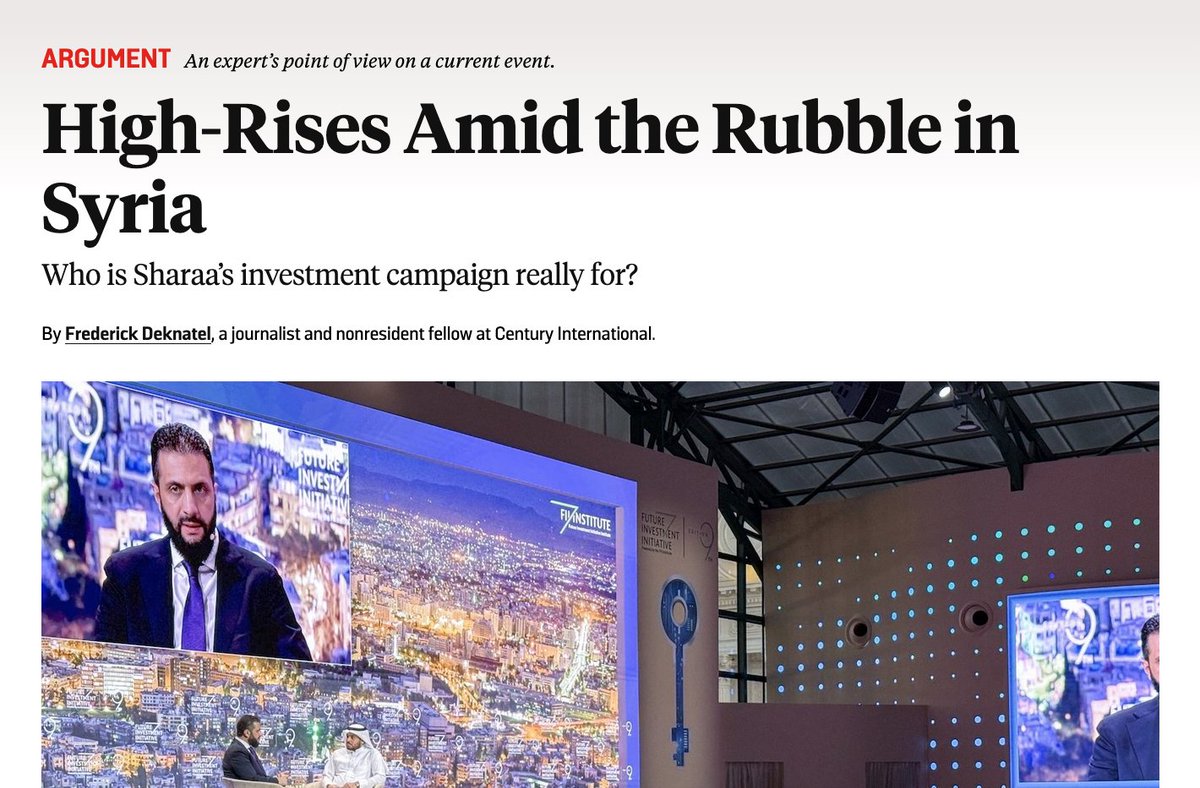
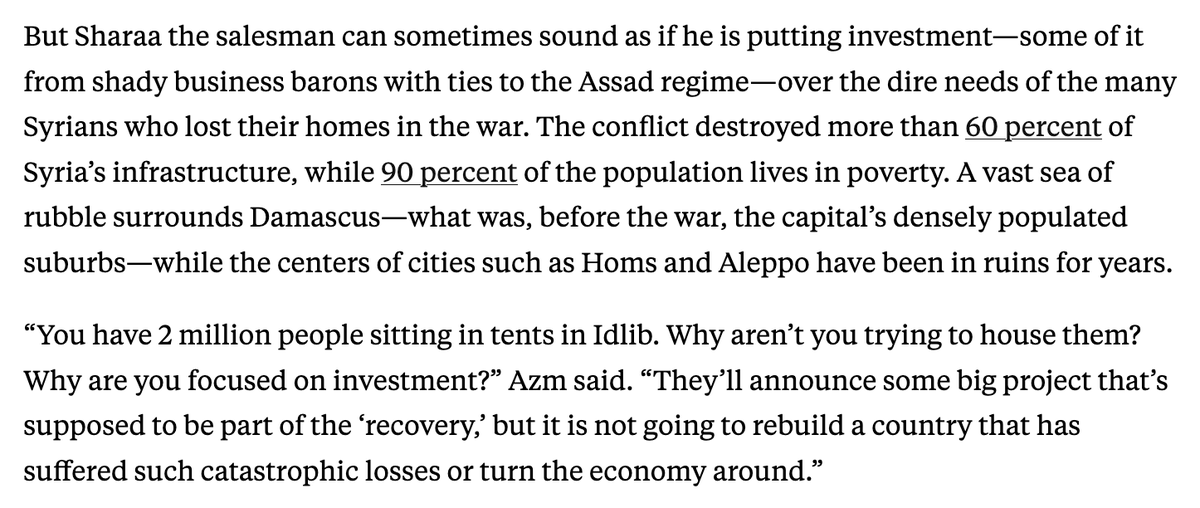
An excellent piece on the rhetoric and promises of Syria’s new investment campaign.
“‘The risk of an exclusive and elite-led reconstruction process will only reproduce social inequalities, impoverishment, a concentration of wealth in the hands of a minority, and the absence of productive development,’ @JosephDaher19, a Syrian political economist, has argued.”
On the risks of Sharaa's reconstruction agenda in Syria fueling a new kind of crony capitalism — my recent piece for @ForeignPolicy:
https://t.co/9gPqUmTH1h
Syria’s New Investment Law
By @HaddonBarth
It gives more favorable terms to foreign investors than laws enacted under Assad, but gives the new president even more control than the previous president had. It gives him say over who gets permits, who gets government land, and who gets tax wavers, raising the danger of a future of crony capitalism.
At the heart of the law is a bargain: foreign investors can get a massive stake in Syria’s postwar economy in exchange for political alignment with the authorities who govern it.
I have picked out few important passages below, but recommend reading the entire article.
"Analysts and commentators often criticize the new Syrian authorities for reproducing elements of Assad-era rule. In the case of Syria’s investment law, however, the continuity is unusually literal. The decision to merely amend the existing investment framework reflects a choice to preserve centralized control over market entry. Though the pitfalls of Syria’s earlier investment regimes may be mitigated under better leadership, frameworks built around executive discretion inevitably concentrate economic opportunity among those closest to political power. With time, systems of state-mediated access can devolve into crony capitalism."
"Projects approved today could retain preferential tax treatment indefinitely.
"The law applies formally to Syrian and foreign investors alike, the scale of capital required means that foreign firms are likely to dominate the projects that qualify for these incentives. Future Syrian entrants into the market would then face an unequal playing field, while the state’s fiscal base would remain constrained.
"It will open the country’s fiscal future to private capital on such advantageous terms, inviting investors to shape the contours of the postwar economy.
"Foreign investors are permitted full ownership rights, renewable residence permits, and unrestricted profit repatriation.
Projects are additionally shielded from future financial burdens introduced after licensing, and investors are guaranteed fair compensation in the event of expropriation.
This combination of generous incentives and state-controlled access became the defining feature of Syria’s later investment frameworks. Under Law No. 7 of 2000 and Legislative Decree No. 8 of 2007, the investment regime remained centralized and license-based.
The 2025 investment law is formally an amendment of the 2021 statute, and many of its core provisions remain unchanged. Some even date back to 1991.
But the new law centralizes authority even more than the investment laws enacted under Assad did.
Through the creation of two powerful institutions: a Supreme Council for Economic Development and a strengthened SIA. The Council oversees the allocation of state-owned land, Syria’s most valuable public asset, while the SIA determines who receives investment licenses. Whereas in 2021 these functions were distributed across ministerial structures, the new framework places both bodies under the presidency, concentrating control over market access and economic direction within the executive.
"Reconstruction inevitably requires outside capital. Yet while investment laws are key in attracting that capital, they also set the terms of its entry, determining who will control the postwar economy. Syria’s new investment law thus embodies a fundamental choice facing Damascus: the authorities can either approach reconstruction as a centrally mediated process in which economic opportunity remains conditioned on political proximity, or they can gradually normalize investment through predictable rules, limited executive discretion, and broader market access. Which path Syria takes will depend, in no small part, on whether that law gets reformed."
https://t.co/MWuoofPbch
Syria’s indirect elections have occurred in Hasakah, Qamishli, and Kobane today. Furthering the integration process with the NE. Once the ballots are counted, the People’s Assembly will finally be seated following a process that began last fall.
Good piece on the new investment law in Syria. Unfortunately, those in charge of designing the economy are basically 'Gulfbrained', think + want Syria to become some kind of tax-free investor destination like Dubai. Fundamentally unserious.
"#Syria’s New Investment Law and the Return of State-Mediated Market Access"
- Great & important analysis here, by @HaddonBarth for @MiddleEastInst.
https://t.co/duWTwcgUgP
#Syria's province of #Suwayda has emerged as a narco state, run by remnants of #Assad's regime & organized crime leaders -- and protected by #Israel.
My latest for @newlinesmag contains *a lot* of exclusive information.
https://t.co/Tz1uXWwGkw
I'm delighted to announce publication of my novel The Resurrected.
The book is available for purchase from any bookshop or online retailers around the world, or via: https://t.co/7zruDWNyKa
"Having emptied out the party—the great commons of a mass-media audience—how do you start it up again?"
Best thing I've read this week. Captures much of the intimacy and collective melancholia that suffused Bieber's performance, now rendered with even greater texture.
A great journalist who cares deeply about the #MiddleEast & its people has just been kidnapped in #Baghdad, #Iraq.
Shelly Kittleson (@shellykittleson) was taken by #Iran’s proxies within #Iraq’s state security apparatus.
#Iraq’s government must immediately secure her release.
The Syrian President said yesterday that the country’s GDP grew by 30-35% last year. I am not sure who provides him with these numbers, and there is no functioning statistical body on which we could rely. But all proxy data indicate that this number is largely disconnected from reality.
Let's try to untangle this.
As of now, the World Bank is the only local, regional or international institution to have provided any estimate for GDP growth last year (+1%). But that was in the middle of 2025, and they did not provide any recent update. An official at the Ministry of Finance told @TheSyriaReport in February that the Ministry estimated last year's GDP growth at 5%. Other than that, nothing.
The only solution we have is to use any data that could serve as a proxy.
Let’s look at Syria's main business sectors: agriculture, industry, and wholesale and retail trade. I will add to this construction.
The agricultural sector witnessed a catastrophic performance in 2025 due to very low raining levels, and this was confirmed to us by the Ministry of Agriculture (we are publishing an interview with him in the next edition of @TheSyriaReport). There is no single number for the agricultural sector, but we know that wheat production for example declined by around 50 percent. (agriculture represented around 40 percent of GDP in 2022, a very inflated share compared with 2010, due to the faster collapse of other sectors and likely poor data collection methodology from the Central Bureau of Statistics).
With regards to the industrial sector the numbers are mixed. In Syria, under the heading "industries" we include mining (oil, gas, phosphate, etc), electricity production and manufacturing. (Manufacturing per se is a small contributor to GDP contrary to what most Syrians think). When it comes to oil and gas, production does not seem to have changed much, while electricity production increased a bit towards the end of the year. The performance of the manufacturing sector is not very clear, but it likely declined in view of the flow of imports (there are some investments in the sector, but many have yet to start production).
As to wholesale and retail trade, activity appears to have increased markedly. However, this was largely driven by a surge in imports (they more than doubled). And imports are deducted from GDP (the more a country imports, the more the impact on GDP is negative).
The construction sector had a good year. Many people have started rebuilding their homes across the country. This week @TheSyriaReport published an article about the cement sector, which is a good proxy to estimate the performance of the construction sector. Syria's only private sector cement company, Al-Badia, said that its sales of cement last year almost tripled. Of course, it doesn't mean that the construction sector as a whole performed that well (state-owned cement companies which have a much bigger market share did not perform that well) and we don't know what the status of imports of cement is yet.
As you can note I mostly talk of the "increases" and "decreases" in the production of different sectors, I do not provide numbers because they simply do not exist. In other words, it is very difficult to provide any clear estimates based on this, but what we can say for sure is that the picture is mixed enough to know that the grow rate of 30-35% is totally unrealistic and that we are probably looking at modest growth in the single digit numbers.
One thing that misleads many analysts, and possibly the Syrian President, is the level of activity in Damascus: the number of cars on the streets, the strong increase in rent prices, the many companies being established. But production, which GDP measures, is something else. On top of this, Damascus is very far from being representative of Syria as a whole.
When it comes to 2026, the prospects are much better. The very good raining season so far suggests a surge from the very low numbers of last year, which automatically translate into positive contribution to GDP growth. The industrial and construction sectors should also perform very well. The only negative point is the regional war which will likely postpone or even delete some major investments from the Gulf. The large dependency on investment from these countries, particularly for the energy sector and infrastructure, is a major weakness.
In the next edition of @TheSyriaReport we will try to provide more details on all that.