I've now found several papers for political scientists choosing an LLM to annotate text data:
- Hilbig (2026) Open-Weight LLMs Are Often Competitive with Commercial APIs for Political Science Text Classification https://t.co/i9zTlAJ5rH
- Yang et al. (2026) Data Annotation with Large Language Models: Lessons from a Large Empirical Evaluation https://t.co/VGMv5mO7h5
- Heseltine (2026) Comparing Large Language Models for TextClassification: Model Selection Across Tasks,Texts, and Languages https://t.co/BGAxVO1Dak
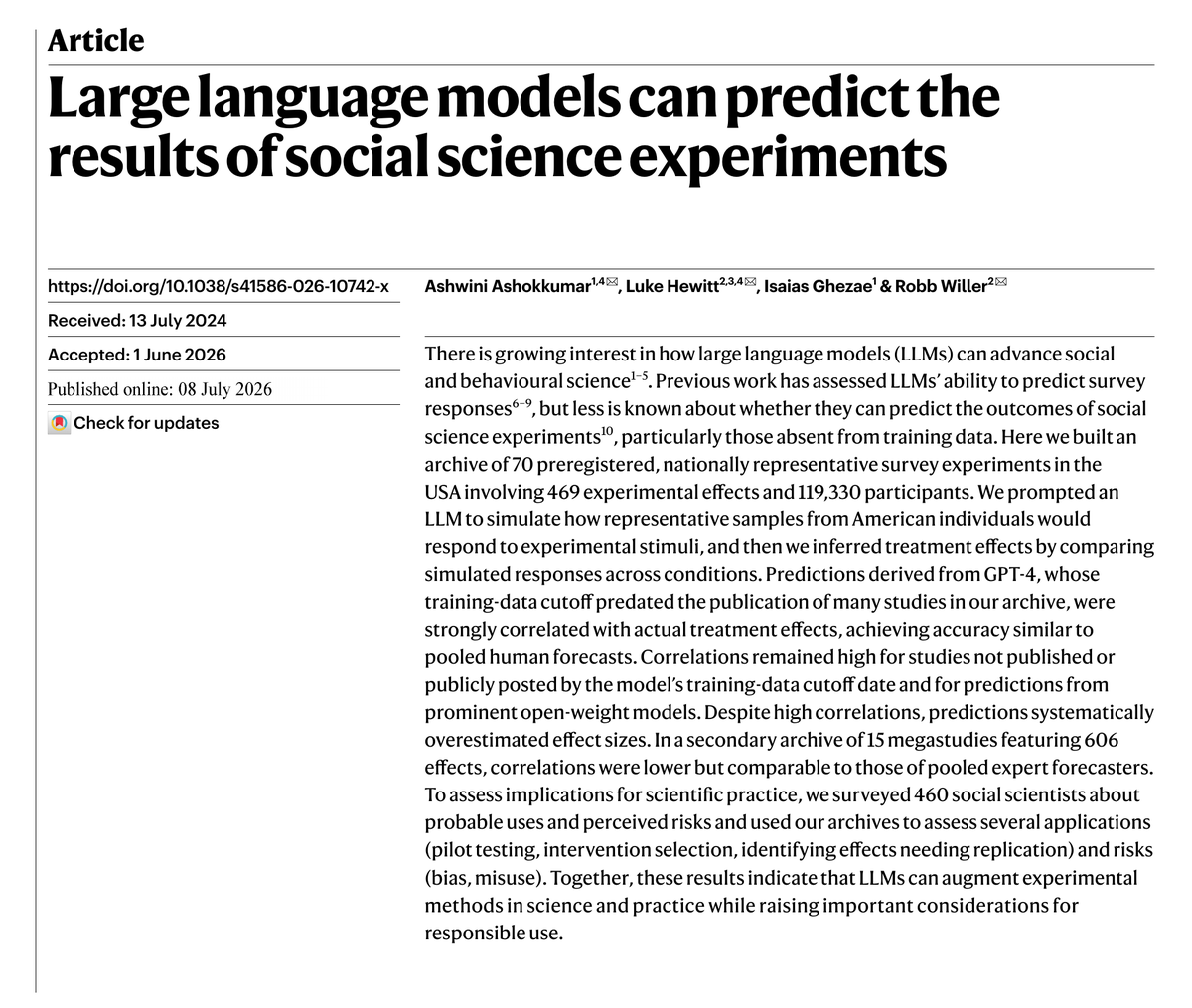
🚨🚨New paper in @Nature with @AshuAshok, @lukebeehewitt & @ghezae_isaias 🚨🚨
Can LLMs predict results of social science experiments?
Across 70 preregistered studies, we find strong correspondence (r=.85) between LLM-predicted and observed effects.
https://t.co/hIrsjhrxRz 🧵
From our FirstView: Beyond Belief Change: The Persuasive Returns of Targeting Attitude–Relevant Beliefs by @YamilRVelez, @patrickpliu and SCOTT CLIFFORD. https://t.co/qSwM9Qf465
🚨 New jobs! 🚨
We're looking for 2 Postdoctoral Research Fellows (1 quant, 1 qual), for a full-time, fixed-term position for up to 4 years!
The Fellows will have full control over the nature/direction of their research while here 📝
🔗https://t.co/RDACpSqKi0
From our February Issue: Causal Panel Analysis under Parallel Trends: Lessons from a Large Reanalysis Study by ALBERT CHIU, XINGCHEN LAN, ZIYI LIU and YIQING XU. https://t.co/HU6lGfe467
New paper in Nature. The more a government controls its domestic media, the more it dominates AI training data, the more pro-regime outputs we get from AI. By scraping the open web, LLMs are unwittingly laundering state-coordinated narratives into seemingly objective answers.
Results from my Claude Code audit of six Callaway and Sant'Anna packages (two in python, two in R, two in Stata). Same specification, same dataset, same covariates, same estimator, almost never do they agree.
https://t.co/KpRwlAagbr
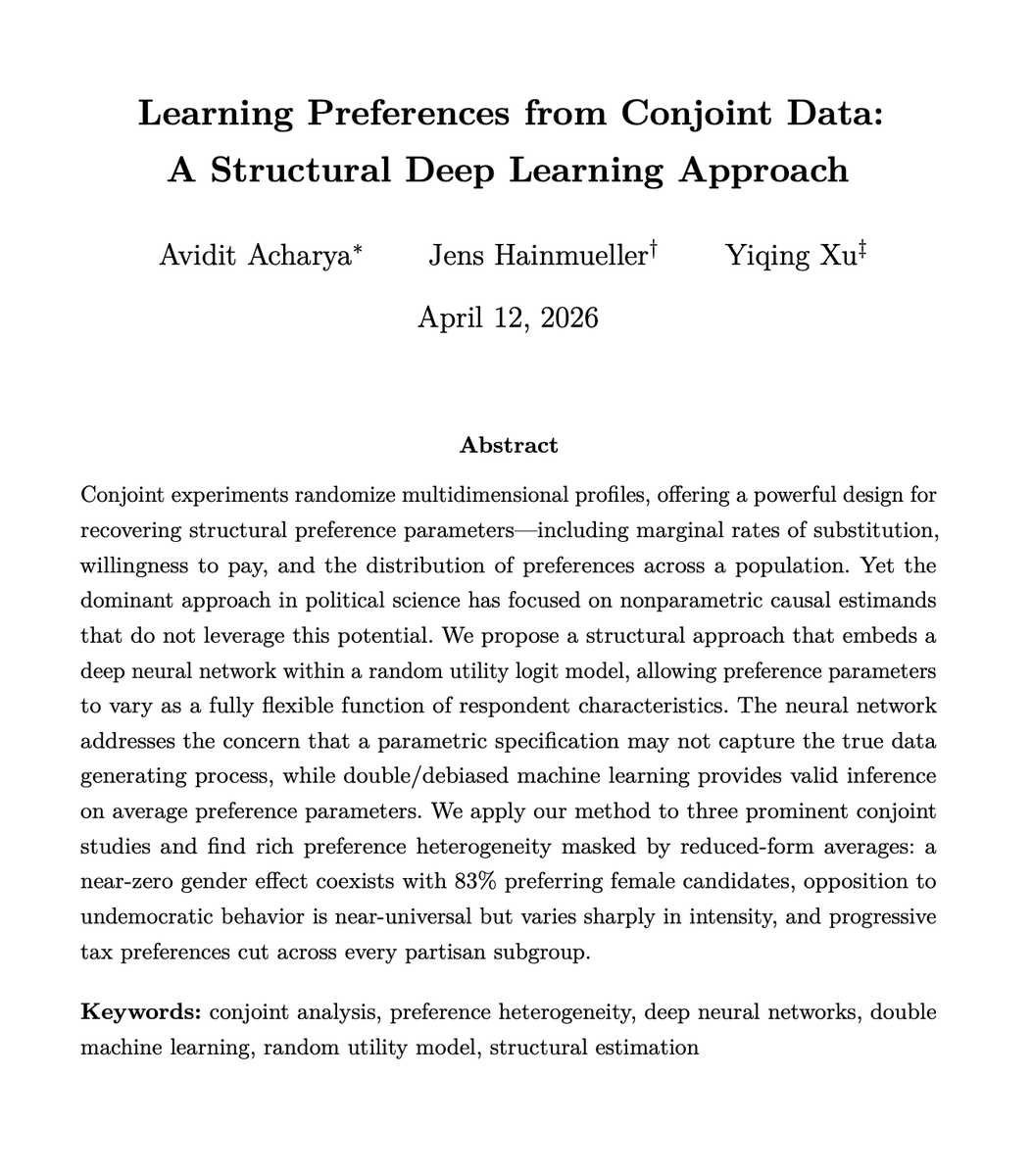
🧵**Structural Conjoint**
New paper with Avidit Acharya and Jens Hainmueller:
“Learning Preferences from Conjoint Data: A Structural Deep Learning Approach.”
We show how to recover interpretable structural parameters from conjoint experiments, combining a random utility model with double-debiased machine learning (DML).
Paper: https://t.co/aygvFyizDT
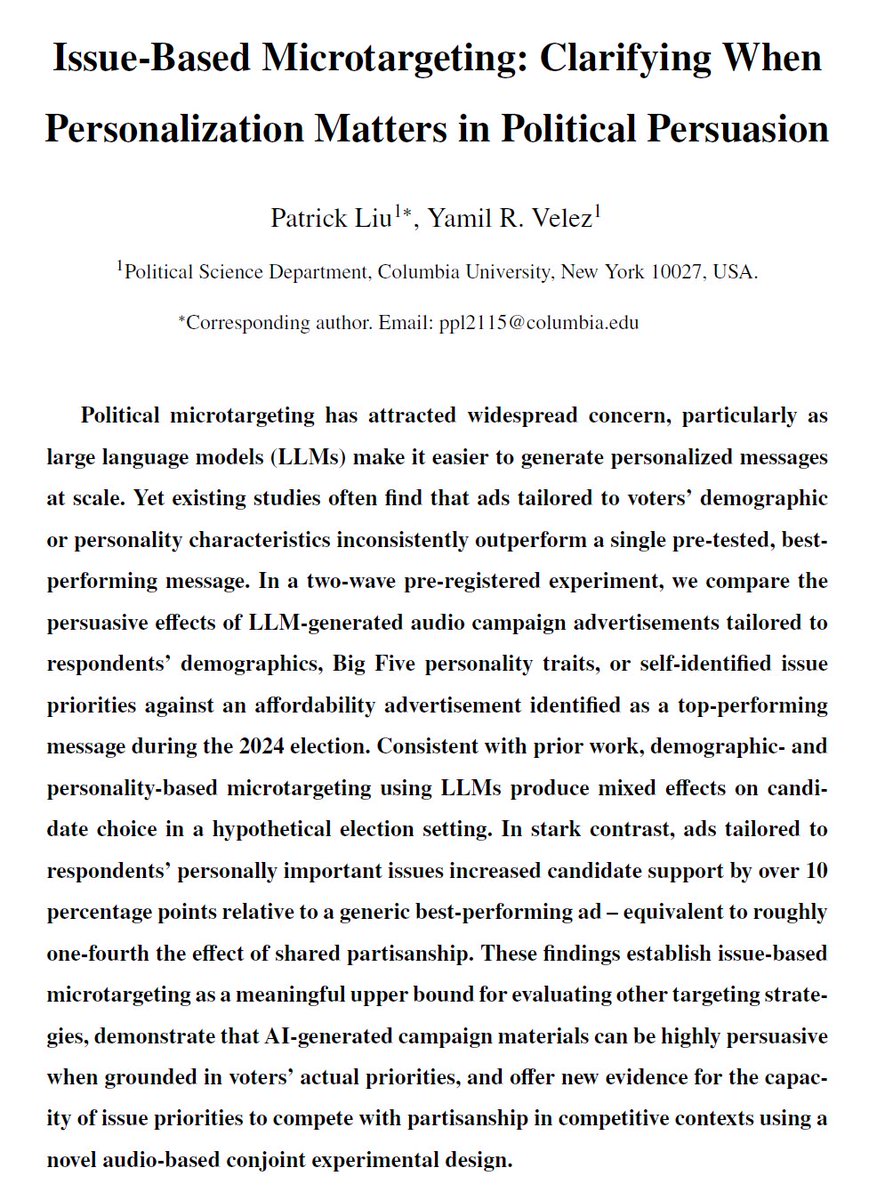
New paper w/ @YamilRVelez! A lot of great research on political microtargeting discounts personalization: tailored ads (using AI or not) rarely beat a single-best message. We define two types of microtargeting, clarify when tailoring matters, & showcase a novel audio-based design
Have you had a chance to read "Performance Rewards and Job Satisfaction in More and Less Developed Countries: Multi-Level Evidence From Bureaucrats in 10 Countries" in 104(1)? https://t.co/p20XC9vsLB
The declarations of independents: Open‐ended survey responses and the nature of non‐identification - Allamong - American Journal of Political Science - Wiley Online Library https://t.co/iRjaOYMp1B
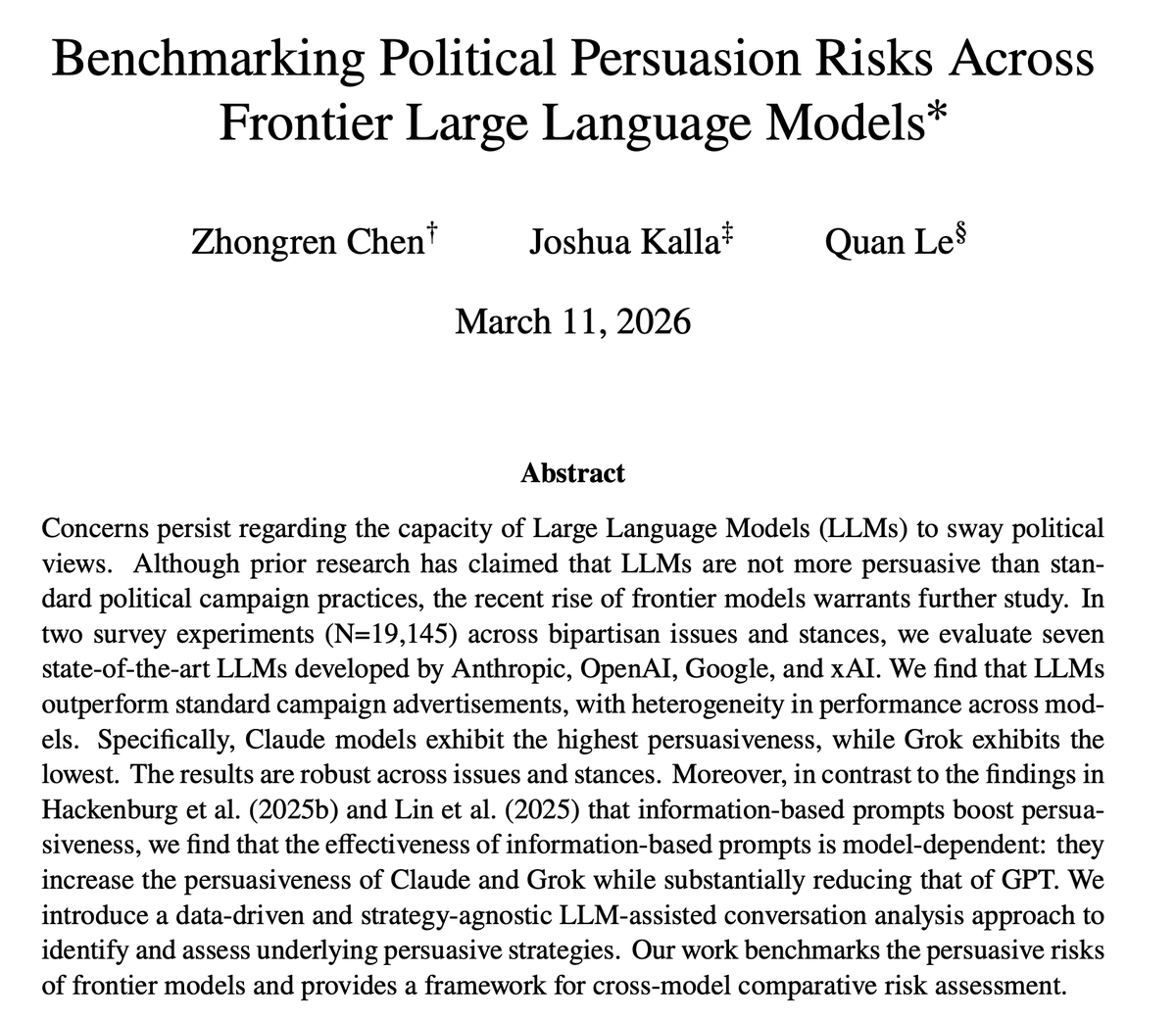
Which AI is most persuasive? New working paper w/ Zhongren Chen & Quan Le, we tested 7 frontier LLMs on 19k people. Ranking: (1) Claude; (2, tied) GPT, Gemini (3) Grok. Consistent across issues and bipartisan stances
The Sixth Wave data for the Asian Barometer Survey in Japan have now been released. We welcome applications for access to the survey data from interested individuals following the data release.
https://t.co/lCG0IeIS4k
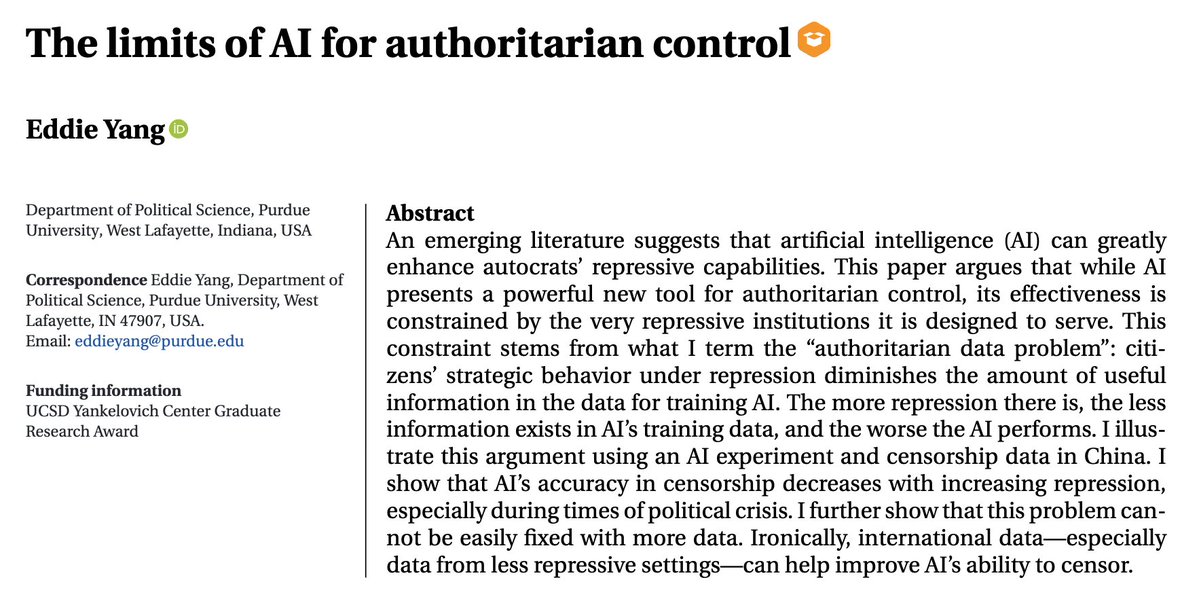
New paper at AJPS: "The limits of AI for authoritarian control." The more repression there is, the less information exists in AI's training data, and the worse the AI performs. Ironically, data from democracies can help improve repressive AI.
1/ 🐎 Our gift for the Year of the Horse:
An AI-assisted workflow that scales reproducibility in empirical research. w/ @YangYang_Leo
Paper: https://t.co/fslLN0zTQO
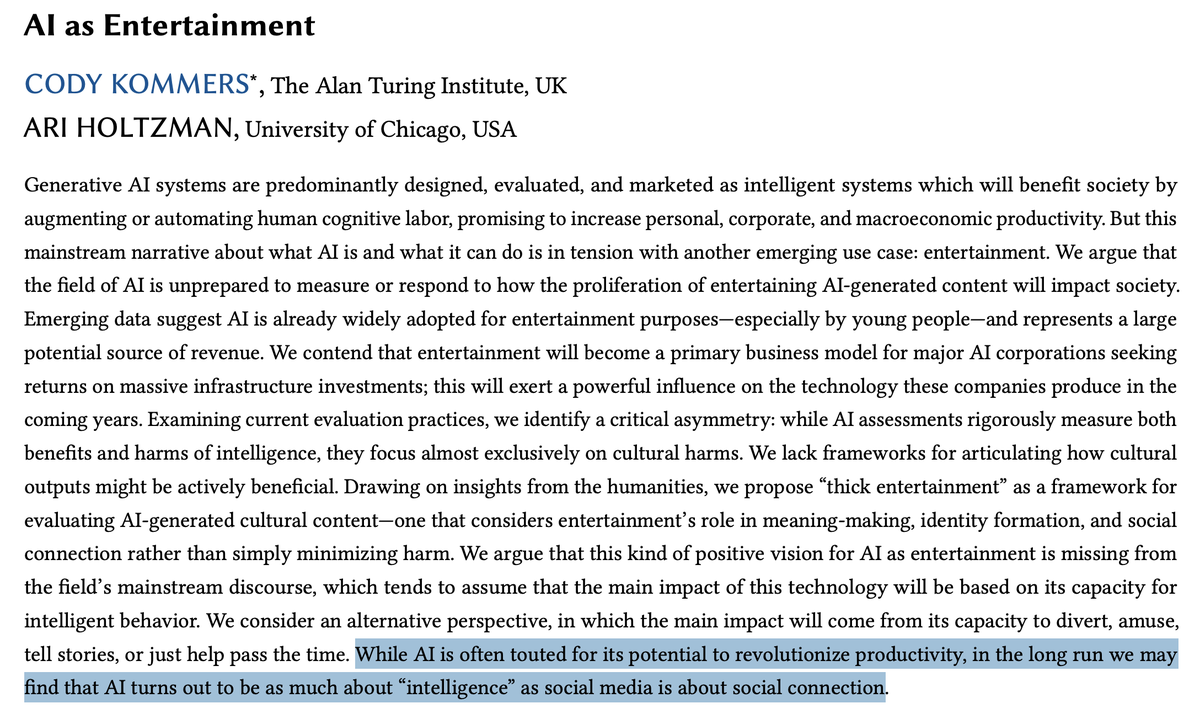
Great paper thinking about the role AI will play in entertainment, both good & bad.
We currently frame AI around intelligence and productivity, but one of the big use case is entertainment (likely the strategy behind Sora)
A shift from utility to culture
https://t.co/fK4QaqZAc9
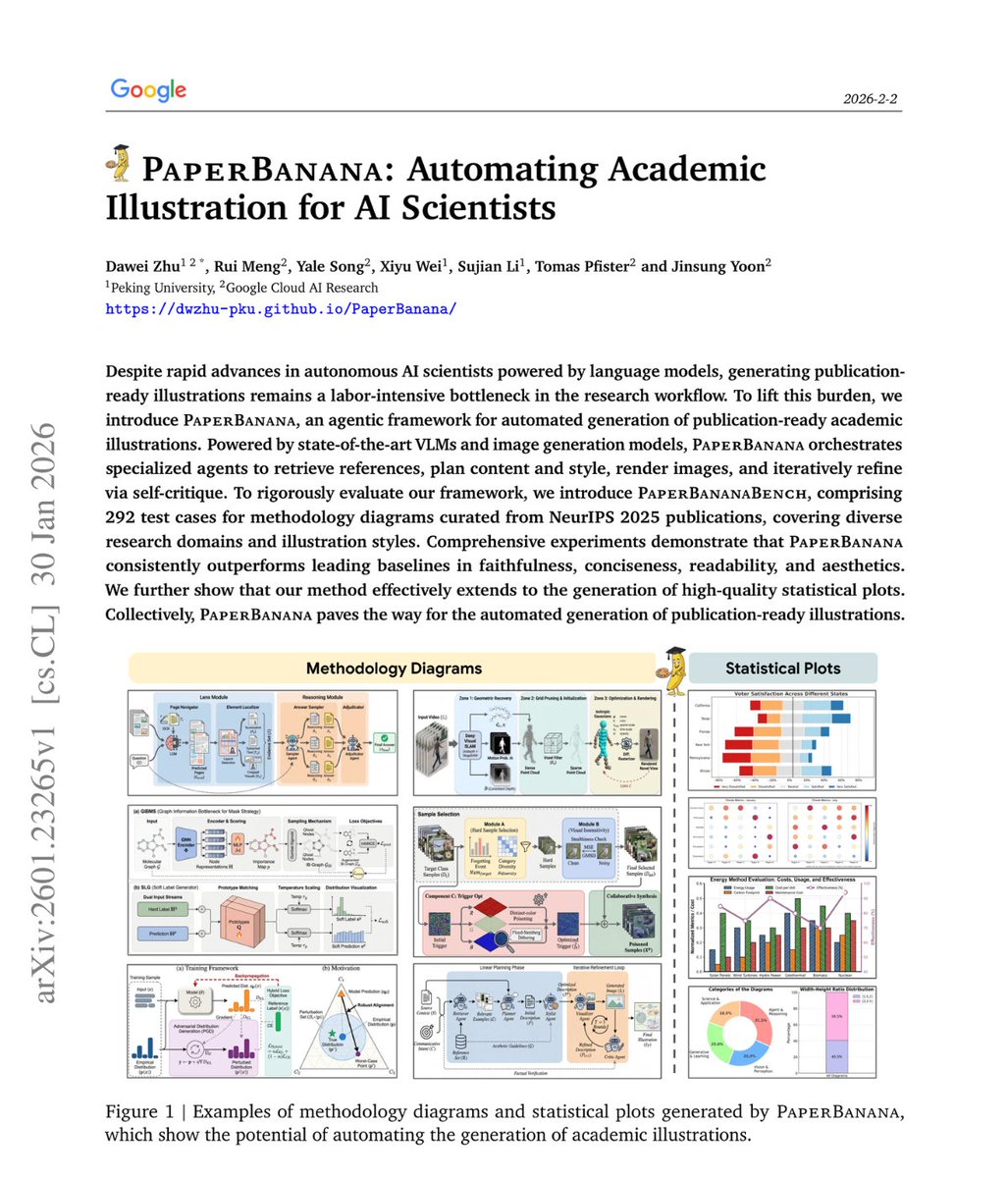
🚨BREAKING: Google just dropped another hit!
It's called PaperBanana and it generates publication-ready academic illustrations from just your methodology text.
No Figma. No manual design. No illustration skills needed.
Here's how it works:
A team of AI agents runs behind the scenes
→ One finds good diagram examples
→ One plans the structure
→ One styles the layout
→ One generates the image
→ One critiques and improves it
Here's the wildest part:
Random reference examples work nearly as well as perfectly matched ones. What matters is showing the model what good diagrams look like, not finding the topically perfect reference.
In blind evaluations, humans preferred PaperBanana outputs 75% of the time.
This is the recursion we've been waiting for AI systems that can fully document themselves visually.
Waitlist’s open, Link in the first comment.