The biggest mistake in thinking about the impact of AI on jobs is to imagine the world as doing exactly what it does today, but with AI automating away some of our work.
In practice, what happens is every company gets a capability expansion, which then leads to downstream positive gains in jobs as a result. You can see how this will show up meaningfully just by taking a look at the historical gap between small and large companies.
It’s traditionally been the case that only the largest companies have access to all the specialization necessary to solve most problems that come up. They have the engineers to stay ahead on features, various marketing functions to reach customers in more ways, supply chain teams, compliance teams and lawyers to help with regulations, and so on.
Any other company in the world just starting out has none of this. This not only is an immediate barrier to starting a new company or trying out a new idea, it’s an inevitable point of friction in being able to grow rapidly as a small company.
The impact of AI Agents is that every company in the world will eventually have the kind of resources that only the world’s largest companies have today. As a result, small companies will be able to grow way faster or generally do more.
A new small business can generate the marketing campaigns, do market research, ship features, do outbound selling, or handle customer support in ways that would have been cost prohibitive before. In some cases they would hire for these functions, but most of the time the work just never gets done to the level that is desirable, or never gets done at all.
And as a consequence of this growth, these smaller firms will naturally need to keep hiring people to do the work that AI can’t do in all the surrounding functions. Which is precisely where you’ll see AI be a driver of net job growth.
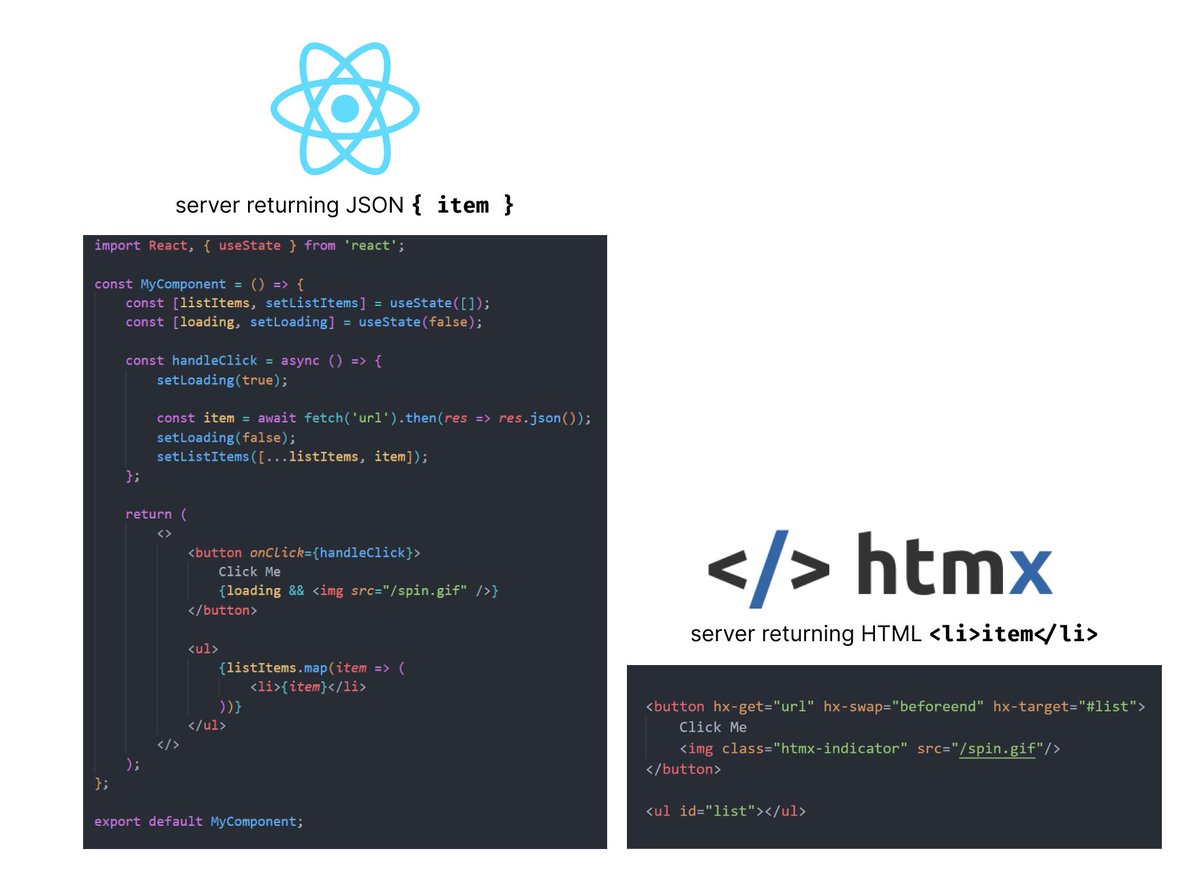
I'm not trying to shitpost about React
But htmx can really streamline client-side data fetching and mutations
Great option if you hate JS frameworks, but there are many tradeoffs ofc.
@AdiSeredinschi Terra also had an CosmWasm academy, but I believe it hasn’t been updated in over a year. Still a great resource for core concepts though
https://t.co/Hz5vFfCZDU
@9yytA@proofstake Yup it’s proof of authority. Basically means the validator set is permissioned. In Noble’s case there is admin functionality used by a 5/7 multi sig.
There are some great docs here that go into more detail https://t.co/spaQYXgeda
Great day for the Cosmos!
It’s not a decentralized blockchain and isn’t supposed to be. Really cool multisig feature and IBC drawbridge as well!
Amazing work @strangelovelabs
Dear @Cosmos: Noble is officially live and producing blocks... ✨✨✨
Immense gratitude to the Noble validator set for a smooth, elegant & productive launch! 🌱
#CosmoSzn
Validator agreements can be very powerful when done correctly, but they can ruin the integrity of a blockchain when done incorrectly.
Curated validator sets restricted by invasive agreements on public “decentralized” networks are a larp
My recent decision to release the agreement to join Kyve feels like one of the riskiest that we have made yet.
I'd like to explain why I released it, given that I understood that it could be misunderstood. We actually negotiated with kyve for some time. During that time, I explained to them the risks of subordinating their validator set, to them, and to their user community. You see, validator sets (on public chains) are supposed to be independent. And this is really important.
If you want to claim to be decentralized, I believe personally that you have to mean it.
In this case what I could see is a situation that could harm notional, as a business, our delegators, because we may not be able to express every point of view fully due to the poorly constructed agreement that was distributed by Kyve.
I also want to say very clearly that I'm not trying to attack the ICF or chorus one.
With that said, it is a fact that I am being critical of both organizations. What I would like to see happen, is some meaningful change.
Validators should read and understand the agreements that are given to them by chain teams, and it's most likely that for a public blockchain, all agreements between parties should actually be on the public blockchain. Otherwise, the trope that we are just a cabal, could become true.
Additionally, faking decentralization poses risks to very legitimate projects that very legitimately will not be fully decentralized but will use the cosmos SDK stack.
I am enthusiastic about permissioned coming to Cosmos.
There is absolutely nothing intrinsically wrong with permissioned blockchain systems.
I hope that I'm not overdoing the message, and that I have measured the risks correctly. Public chains should mean public discourse.
@gadikian@cosmos@KYVENetwork Yea it’d be pretty difficult to quantify outside of typical evidence collection. Constitutions that outline expected behavior could be a good place to start though
@gadikian@cosmos@KYVENetwork I can imagine a world where enterprise chains separate voting power from tokens (or remove tokens completely) and perform financial slashing via contract infringements
@gadikian@cosmos@KYVENetwork I agree, this contract is not appropriate for a chain claiming decentralization. Have you seen any validator agreements that are more validator friendly / less restrictive? And do you think validator agreements are inherent a bad idea?