My sense is that one of the problems with some assessments of Iran’s post-war strategy is that they tend to focus mainly on Iran's intentions and motivations, rather than on its capabilities, constraints, and priorities.
There is no doubt that Iran’s motivation to rebuild its missile capabilities, preserve and strengthen the “Axis of Resistance,” and perhaps even pursue nuclear weapons has increased following the lessons of the recent war.
There is also no doubt that the war once again demonstrated that it is impossible to completely eliminate Iran’s missile capabilities, nuclear program, and regional network.
Nevertheless, after the war, the new leadership in Tehran will be required to reassess its strategy—just as it did following the ceasefire between Hezbollah and Israel in 2024, the collapse of the Assad regime, and the lessons of the 12-day war. In this reassessment process, several considerations will come into play:
A. Iran’s ability to continue investing billions in rebuilding its capabilities and supporting its regional allies. This will depend on its economic condition, given the high cost of the war as well as on the possibility of sanctions relief, the unfreezing of assets, potential gains from an arrangement in the Strait of Hormuz, and national priorities.
B. The evolving reality in the Middle East, for example, in Lebanon, taking into account the war, negotiations with Israel, and increasing pressure for more substantial progress in disarming Hezbollah.
C. A reassessment of the relative value of investing in each of Iran’s three main deterrence pillars: its missile program (where reconstruction capacity exists but is likely more limited than before due to damage to production and military industries); the nuclear program (in light of the possibility of an agreement with the United States that could further constrain its capabilities); and the “Axis of Resistance,” given regional circumstances and constraints.
1 The defining deliberations of this war aren't between the US and Iran, but Trump and himself. He’s vacillated between walking away and promising to bomb Iran to the Stone Age. Iran has been consistent: Its ideology is resistance, its strategy is chaos, its endgame is survival.
What happens the day after in Iran?
If the regime survives the current campaign, and that increasingly appears likely, it will portray the outcome as a “divine victory” against both Israel and the United States.
At the same time, even within the regime there is clear recognition: survival does not solve the fundamental challenges of the day after. Iran’s economic situation was already severe before the war and has only deteriorated further, despite significant oil revenues.
In this sense, the end of the war is not an endpoint, it is the beginning of a renewed internal challenge for a more radical, more isolated regime, whose relations with Gulf states are at a low point.
None of this, however, guarantees regime change.
So what is Iran likely to do next?
A. Seek to generate stable revenue by leveraging control or influence over maritime traffic in the Strait of Hormuz.
B. Attempt to break the economic pressure of U.S. sanctions by using Hormuz as a coercive tool — pressuring countries to engage economically with Iran despite sanctions.
C. Deepen economic and military ties with China and Russia, and potentially expand cooperation with North Korea and Pakistan.
D. Significantly expand internal repression, especially through the Basij, to prevent renewed protests, including tighter control over society and increased internet surveillance.
E. Paradoxically, we may see some easing of religious enforcement domestically, as the IRGC consolidates power and the clerical establishment becomes less dominant — even as Iran maintains a hardline posture externally.
F. Reach out to Gulf states in an try to rebuild relations, based on a shared perception that reliance on the United States is uncertain.
G. Intensify efforts to increase oil exports and related revenues.
And still — this may not be enough.
The new leadership could face a fundamental dilemma: prioritizing military buildup or addressing the deep economic needs of the Iranian population.
In other words, the end of the war does not guarantee stability for the regime, but it would be a mistake to underestimate its ability to survive, even under severe economic pressure.
#iran
An Iran-aligned militant network has claimed responsibility for the arson attack on Jewish ambulances in north London early Monday, a monitoring organisation said, linking the incident to a string of similar fires across Europe.
https://t.co/psRyH950sB
همچون تمام دهه های اخیر پس از انقلاب ۵۷، اعدام در ایران از برجسته ترین جلوه های نقض حقوق بشر محسوب میشود. بر اساس گزارش جامع مرکز آمار مجموعه فعالان حقوق بشر در ایران در سال ۱۴۰۴، دست کم ۲٬۴۸۸ شهروند از جمله ۶۳ زن و ۲ کودک-مجرم اعدام شدند. از این میزان حکم ۱۳ نفر در ملاعام به اجرا درآمد.
همچنین طی این تاریخ، ۱۳۰ تن دیگر از جمله ۱۰ زن و ۱ کودک-مجرم به #اعدام محکوم شدند. از این میزان ۴ نفر به اعدام در ملا عام محکوم شد. لازم به ذکر است، در همین دوره احکام بدوی ۴۵ نفر دیگر نیز به تایید دیوان عالی کشور رسیده است.
🟢 برای مطالعه گزارش آماری ویژه سال ۱۴۰۴ هرانا از نقض حقوق بشر در ایران، کلیک کنید
https://t.co/d1vXGwwHX6
🟢 دانلود مستقیم فایل پی دی اف این گزارش
https://t.co/PeghSU9aal
🟢 Read the English Version
https://t.co/1fHuBSSL22
The tone of al-Jazeera's coverage this war is fundamentally different from the 12 Day War. During that war, the Qatari-run network glorified & hyped up Iran's achievements in the war, and downplayed its losses. For example, their reporter in Tehran, Nour a-Deen Dgheir, claimed that the US was able to carry out operation Midnight Hammer without any aircraft lost because the US sent drones to keep Iranian air defenses busy...
Now that Qatar is getting attacked, the tone is different. In response to Iranian threats to occupy lands of Arab Gulf countries if the US occupies the Kharg Island, AJ's top commentator Dr. Liqaa' Makki, simply points out Iran doesn't have the ability to do so.
https://t.co/fCGDXO3Jfk
In the current war, as can be seen in the clip attached, the coverage is critical of Iranian attacks on the Gulf, presenting them as serving Israel's interests in getting Gulf countries involved in the war against Iran. AJ, which for decades reported, without question, the claims of the entire Iranian Axis that it does not target civilians, now calls out Iranian lies, saying civilian infrastructure and civilians are being harmed in the Gulf.
Since its establishment, AJ served as an amplifier for the propaganda pushed by Islamist groups and regimes, whether Sunni groups like AQ and Hamas or regimes like the new Syrian one or Turkey, or Shia militias backed by Iran and the Iranian regime itself. AJ staffed its roster of commentators with supporters of the Iranian Axis, like Palestinian Saeed Ziad and Jordanian Fatema a-Sumadi. These two commentators and others have disappeared from the screen and social media, and at least Ziad has been arrested by Qatari intelligence, likely ahead of deportation back to Turkey.
More on Ziad, who aroused fury among Gazans for saying they have no choice but to keep resisting with the "flesh of their children"
https://t.co/FlvkVO7NHG
More on a-Sumadi https://t.co/TKy5fMNQdU
AJ's shift is a reflection of Qatar's repositioning after it became the target of Iranian attacks, but this change in tone matters in the wider Middle East. AJ is the most widely watched news channel in the Middle East. AJ is particularly watched by supporters of "resistance," and over the past 2 years, served as a source of comfort and wishful analysis for supporters of this Axis, as it suffered a blow after blow.
You'd think Iranian-Americans overwhelmingly support the war from news coverage.
In fact, they're evenly divided.
The anti-war Iranian-Americans have been deliberately erased.
(via @NIACouncil)
You'd think Iranian-Americans overwhelmingly support the war from news coverage.
In fact, they're evenly divided.
The anti-war Iranian-Americans have been deliberately erased.
(via @NIACouncil)
Iran Notes: Missiles, missiles, missiles.
If you want to understand modern Iran, you have to understand one thing: missiles.
Today’s nerdy Iran post is about how Iran built one of the largest missile and drone arsenals in the world.
Today we'll do the historical part.
In the next post we'll talk about what it actually means for the current war, where this is going, and possibly the meaning of life.
Shall we begin?
Like almost everything in modern Iran, the origin story starts with the Iran-Iraq War.
Toward the end of the war Saddam Hussein launched dozens of Scud missiles at Iranian cities in what became known as the War of the Cities. Tehran absorbed repeated hits. People who lived there at the time still remember the explosions and the constant fear of where the next missile would land.
Hundreds of thousands fled the capital. Civilian pressure was one of the factors that pushed Ayatollah Khomeini to “drink the poisoned chalice” and accept the ceasefire.
But the Persians, like Persians, do not forget.
They learned something important:
missiles hitting major cities can shape the psychology of an entire nation.
And ever since, they’ve been making sure others learn that lesson too.
There was another problem. After the revolution Iran could no longer build a modern air force. Maintaining one requires access to advanced technology, spare parts and training.
But after the revolution the United States effectively shut off the supply line to the American aircraft Iran had bought under the Shah. Developing dependence on another superpower would have been expensive and risky.
So Iran turned to the next best thing: a field where it could become largely self-sufficient while still producing significant deterrence and damage.
Ballistic missiles.
To shorten the range (no pun intended), Iran turned to a country that has always been happy to help proliferate forbidden technology: North Korea.
It started with the purchase of Scud missiles. But in the 1990s Iran decided it needed its own production capability and began developing its first “authentically Persian” missile family: the Shahabs.
Shahab-3, based on the North Korean Nodong missile, already had a range of about 1,300 km, enough to threaten Israel from launch sites in western Iran.
A small moment of national pride.
But Shahab had another purpose.
In the early 2000s Western intelligence agencies obtained a laptop containing troubling designs for fitting a compact payload into the re-entry vehicle of a Shahab-3 missile. The design included a hemispherical re-entry vehicle that looked suspiciously well suited for a nuclear warhead.
Today we know that this missile was intended to carry the nuclear weapon developed under Iran’s Amad Plan, in a project known as Project 111, which focused on adapting a nuclear warhead for a ballistic missile.
Fun times.
In any case, Iran’s missiles are here to stay, and the country has been steadily building its arsenal.
The main body responsible for missile development is the Aerospace Industries Organization (AIO). Inside it are two key groups.
Shahid Hemmat Industrial Group (SHIG) develops liquid-fuel missiles.
Shahid Bagheri Industrial Group (SBIG) focuses on solid-fuel missiles.
What’s the difference?
Liquid fuel missiles are easier to develop, but they must be fueled before launch, sometimes up to an hour in advance, while the missile is already standing upright. That makes them vulnerable.
Solid fuel missiles are harder to develop, but launch is basically push-the-button-and-go.
We could go much deeper into the technical details, but I’ll spare you.
Why does Iran develop both types?
Good question.
It reflects something broader about the Iranian approach to development. I like to call it the Iranian fractal: every system branches into multiple parallel paths.
Iran develops both kinds of missiles, builds several variants of each, buys technology through multiple procurement channels and introduces redundancy at every stage.
There may even be a cultural element here. I once heard an analysis linking this mindset to Shia theology. I’m not qualified to judge whether that’s true.
But what I do know is this:
where Western engineering tends to focus and specialize, Iran tends to spread risk.
Then came 2015.
The JCPOA nuclear agreement limited Iran’s nuclear program, but it also brought sanctions relief.
So what did Iran do with the money?
Invest in civilian infrastructure?
You must be joking.
They poured it into the defense industry.
In practice, this is the moment when Iran’s missile program evolved from just another military capability into a national strategic project.
The decade between 2015 and 2025 became a golden age for Iran’s missile industry.
Dozens of missile types were developed, and Iran expanded into a field that used to be associated mainly with cruise missiles but today we mostly encounter as drones.
To simplify:
A ballistic missile is like throwing a rock.
A cruise missile or drone is more like flying a model airplane.
Iranian systems spread across the Middle East, from the Houthis in Yemen to Hezbollah in Lebanon.
Hundreds of thousands of rockets and missiles were distributed to Iranian proxies, creating not only a massive arsenal but a massively decentralized one.
I’ll spare you the long list of models, but one system is worth mentioning: the Shahed drones.
They proved particularly successful and became a central operational tool for Russia in the war in Ukraine.
Shahed drones, which Iran can produce in industrial quantities, can fly hundreds, even over a thousand kilometers, and deliver an explosive payload to a distant target at very low cost.
So effective that according to recent reports, the United States has asked Ukraine to share lessons learned from defending against them.
Another major area of Iranian investment has been accuracy.
Some missiles were designed as precision systems from the start. Others received upgrade kits that convert “dumb” rockets into precision weapons.
A significant part of what Israel called the “campaign between wars” against Hezbollah focused on exactly this issue: preventing Hezbollah from acquiring a large arsenal of missiles capable of hitting targets anywhere in Israel with accuracy measured in tens of meters.
That system began to turn against Israel after October 7.
Who would have guessed that the first “space battle” in human history would be between Israel and Yemen, when Israel’s Arrow interceptor shot down a Houthi ballistic missile outside the atmosphere?
And of course we all remember the long months of Hezbollah rocket fire and the deserted towns of northern Israel.
But all of that was just the opening act.
In April and October 2024 Iran launched hundreds of missiles and drones directly at Israel. In June 2025 it escalated further during the 12-Day War, when we saw what even a single missile strike could do, whether at the Weizmann Institute or Soroka Hospital.
So are Iranian missiles actually an existential threat?
Well…
It’s complicated.
That’s it for the historical overview. Seems like a good place to pause.
In the next post we’ll talk about the questions that really matter:
How do you defend against this threat?
What does it mean for the current war?
Where are the real bottlenecks in Iran’s missile capability?
How many missiles do they actually have?
And does that number even matter?
Questions and comments, as always, welcome below.
Very concerned about the escalation of hostilities in Lebanon. The Lebanese people deserve peace and security.
Sweden applauds Lebanon’s efforts to ensure stability, including the decision to ban Hezbollah’s military activities.
Iran Notes: A Short Story About Centrifuges and Fear
Today’s deep dive is a bit different. A short story.
Many years ago, in an underground Iranian nuclear facility, centrifuges began falling apart for no apparent reason.
Computers stopped working. Controllers went haywire. Gauges kept showing that everything was perfectly fine.
And the Iranians couldn’t figure out why.
We were sure they would understand the source of the malfunctions immediately. They’re not idiots, right? These were serious engineers, graduates of the country’s top universities. The very elite of Persian technical education. Surely they would run a proper investigation, keep careful records, and use the scientific method to isolate the problem and overcome it.
After all, only a few years earlier they had managed to identify similar malfunctions that an unseen hand had introduced into their enrichment facility. The capability was there.
But to our surprise, for months the Iranians couldn’t identify what was causing the crashes. They called them “the big failures.”
Every now and then the centrifuges would speed up, slow down, and then simply disintegrate.
Sometimes they spun at speeds that no engineer would ever dare configure in a system.
The only thing the Iranians did was try to replace the destroyed centrifuges as quickly as possible, hoping no one would notice what was happening.
What is going on here? we asked ourselves.
Why don’t they stop, investigate like normal human beings, find the fault, and continue expanding the facility according to their original plans?
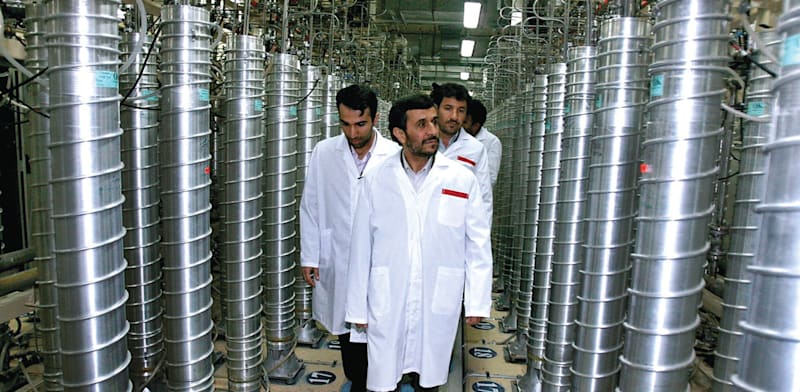
This was during Ahmadinejad’s presidency. It quickly became clear that the scientific and technological leadership was simply afraid to report to him and to the Supreme Leader that things were not progressing according to plan.
In 2007 he declared April 9 a national holiday, “Nuclear Day,” and made a habit of visiting facilities and posing for photos in a white lab coat.
The fear trickled downward.
It got to the point where even shift reports at the facility avoided describing the real situation. Anyone reporting a malfunction would immediately be blamed for it and labeled responsible.
We once heard firsthand from an engineer who worked there (don’t ask how, because I won’t tell) that people were so afraid they avoided going near the computers at all. If a centrifuge crashed and the cameras showed you in the area, you would immediately become the prime suspect.
A system that once knew how to conduct real scientific investigations turned into one that reported only what the leadership wanted to hear.
People suspected of opposing the regime, and there were quite a few of them, or even, heaven forbid, merely supporters of reformists, were immediately treated as potential traitors. Meanwhile regime loyalists received leniency.
As another engineer once told us about one of the workers at the facility:
“That guy is very religious, with a beard. No one will suspect him. No one will touch him.”
Investigations and independent review committees: out.
Corruption and favoritism: in.
Over the years Iran transformed from a country that valued technological excellence and scientific truth into a kakistocracy, a system where scientific outcomes are judged by your proximity to the regime.
And this didn’t stop with the nuclear program or the missile projects.
Over the past two decades the Revolutionary Guards, once a fairly professional force during the Iran Iraq War, turned into a bloated and corrupt institution sitting on enormous budgets and primarily serving insiders and their families.
The middle class was hollowed out. Prostitution and drugs spread across the country (if you want to know where to get opium in Tehran, the DMs are open). Public services and education visibly deteriorated. And the collapsing economy, combined with the understanding that advancement requires corruption, also made recruiting agents to betray the regime much easier.
Now, it’s not that the state failed to advance its military technologies.
Determination and massive resource diversion allowed Iran to make real progress. It accumulated enough fissile material for 11 nuclear weapons and built a huge military industrial complex of missiles and drones.
But all of this came at a price.
By the late 2000s a massive wave of middle class emigration had begun. Large Iranian communities formed in Toronto and Los Angeles, or “Tehrangeles” as Iranians like to call it.
Every Persian mother’s dream was simple. That her son would go study engineering abroad, and not come back.
The decline in living standards didn’t happen overnight.
It took years and decades of slow decay. In the past year there was barely a single day with continuous electricity in Tehran. The country faces a severe water crisis. Literally, in some places there is no water in the taps.
There is no gas to heat homes during the freezing winter, and in the summer, when temperatures reach 50°C, the air conditioning doesn’t work.
The Iranian rial has completely collapsed, and anyone not connected to the regime finds himself moving closer to poverty.
Yesterday I saw someone ask how a country with so much potential managed to turn into such a backward and isolated state.
The answer?
Like this.
It was years of gradual decline, where little by little people stopped telling the truth and started saying only what the regime wanted to hear.
Any resemblance to other countries is the reader’s responsibility.
Shabbat shalom.
Tomorrow I’ll go back to digging into Iran’s missiles, drones, and defense industries.
Questions and comments as usual in the replies.
During the last Israel-Hezbollah war, Syrians opened their doors to Shia civilians fleeing South Lebanon, only to be rewarded for that kindness by Hezbollah murdering them and destroying their homes.
Now, those doors are shut, and Hezbollah have nobody to blame but themselves.
I read every word from @NicoleGrajewski 's assessment and reports. 100% informed opinion. Highly recommend subscribing to her work. This is her latest
"Three Days into the #Iran War: Targets and Objectives"
https://t.co/puRE5OQPF5
The activity of Iranian Kurdish groups can harass, disrupt, and tie down some Iranian security forces, particularly in the western part of the country. On the other hand, there is significant concern among many Iranians (including regime opponents) about the possibility of territorial disintegration, chaos, and civil war, as occurred in the 20th century during periods of weak central rule.
Therefore, although the activity of Kurdish groups may form part of a broader effort to weaken the Iranian regime and its security forces, the Kurds alone will not be able to bring about regime change, nor will they necessarily lead to the mobilization of additional actors and may, to some extent, even backfire by discouraging broader participation.
EXCLUSIVE: The strike that destroyed a school in Minab, Iran was larger than has been previously reported.
A nearby clinic was also hit. The evidence suggests a precision strike against an IRGC base that was adjacent to the school.
https://t.co/JZ6yYVYYgR
@UriksFredrik@Nrk ganske mange analytikere som mener at intensjonen var å nå terskelen til atomvåpen, i påvente av endelig beslutning fra Khamenei. Ikke en veldig drøy slutning gitt at 60% er våpengrad og godt over sivilt bruksområde.
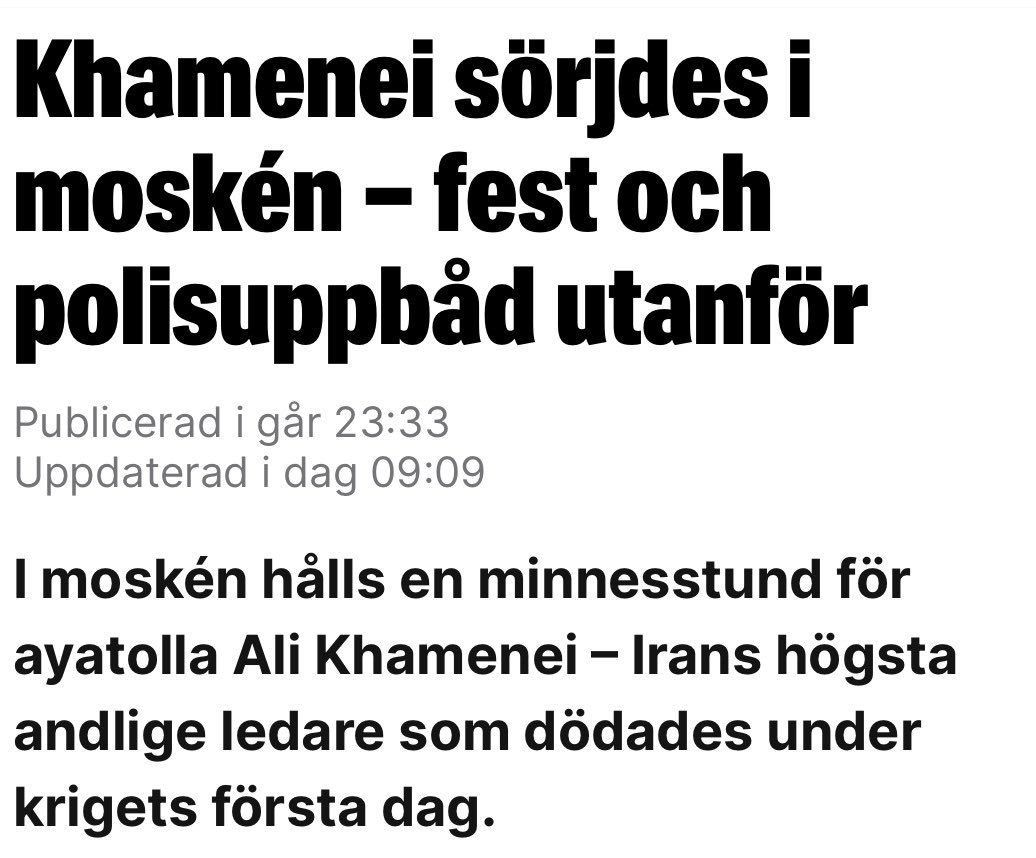
Att det på allvar samlas människor i Sverige som sörjer Ali Khamenei är ett tydligt bevis på att deras övergripande mål är att sprida radikal islamism i Europa. Varför bosätter man sig annars i ett land som älskar bögar och fria kvinnor? För mig som liberal är det obegripligt.
Every word. This is what the war is actually about.
It's an American attempt to prevent China from disastrously outflanking it in the Middle East.
This understanding has consequences. For example, America may well stop the war before the Israelis have achieved their narrower, more localized goals -- when the US determines that Iran is no longer capable or willing to serve Chinese interests as it has up to now.
It also explains what Trump means by "regime change." It's not a call for democracy, only for geopolitical neutrality. Like Venezuela.
Folks, if you want to understand what's happening better than most of the pundits currently trying to explain the war to you, read this post.