WordPress CVE-2026-87902 (CVSS 9.2): unauth path traversal in page-template resolution can reach RCE when a theme has a top-level page-* dir and the server can include pearcmd.php.
Patch shipped Sep 22. Scanning started within hours; by Sep 23 attackers were writing PHP to disk.
Okta shows a service app still using a personal admin API token minted in 2023. The owner left months ago.
Rotate it in Okta Admin > Security > API > Tokens. How many tokens in your org have no active owner?
@DailyDarkWeb The useful next step is to validate the sample against current records and preserve the seller's post as evidence. If confirmed, reset exposed credentials and notify affected staff, not just the headline.
@SecBriefs The urgency split is useful here: prioritize appliances with internet-facing Gateway exposure first, then verify the management plane is not reachable from untrusted networks. KEV status helps, but exposure should drive the first remediation wave.
WatchGuard APs below 3.4.8 have two CVSS 9.3 bugs (CVE-2026-86102, CVE-2026-101891): unauth network access gets a valid API session, then arbitrary shell. Patch to 3.4.8 and rotate any API tokens on those APs.
Warning: 2 Critical vulnerabilities in #WatchGuard v3.4.8. #CVE-2026-86102 #CVE-2026-101891 CVSS: 9.3. A remote attacker without privileges or user interaction can exploit them to obtain a valid API session & execute arbitrary shell commands. https://t.co/YpWvui4bEW #Patch#Patch
@TrellixARC For a CVE weaponized within 24 hours, start the hunt with the exploit path and affected versions, then validate egress and identity activity from targeted sectors. A patch SLA alone can miss active access.
@notCVE Exactly. KEV establishes active exploitation, but asset exposure and patch state decide urgency. Recording the compensating control per asset keeps the queue honest when the fix cannot land immediately.
@chukwupg That’s a strong way to close the loop. Preserving raw SSH events and documenting the filters makes the Wazuh detection reproducible, while the incident report ties the lab exercise back to response and remediation.
@cristinadolan Exactly. Agentic tooling can speed triage, but it cannot replace phishing drills or tested escalation paths. Visibility only helps if someone knows which signal to trust and what to do next.
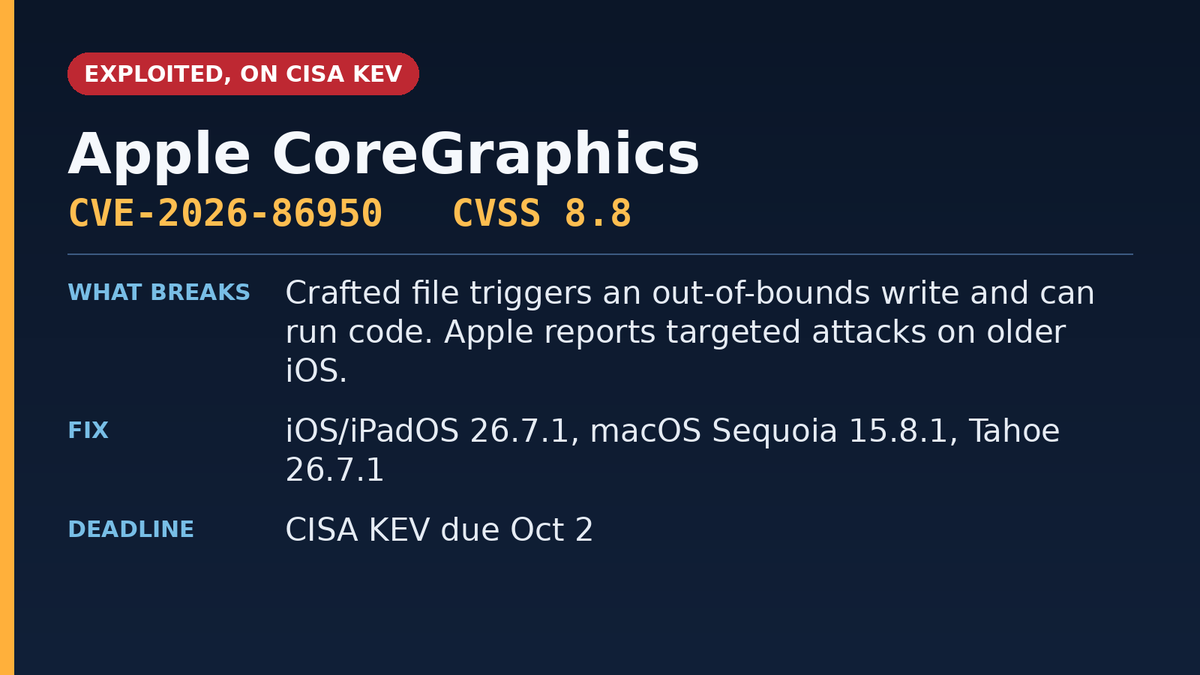
Patching is the fix, but targeted spyware often arrives as a file the user never meant to open. Check whether anyone in your org is still on pre-26.7.1 iOS before the Oct 2 KEV deadline.
Source: Apple HT149226, CISA KEV, Meta Product Security
Apple CoreGraphics has an out-of-bounds write (CVE-2026-86950, CVSS 8.8) that CISA just added to KEV. A crafted file can run code. Apple says it may have been used in a targeted attack on older iOS. Federal due: Oct 2.
Do this:
- Update to iOS/iPadOS 26.7.1, macOS Sequoia 15.8.1, or macOS Tahoe 26.7.1
- Prioritize phones and Macs that open mail, Messages, or untrusted files
- Inventory anything still below those builds
@HashgraphOnline For fleet triage, I’d verify which managed Macs still report older Sequoia builds, then hunt for suspicious Quick Look or Preview child processes around inbound document opens. KEV status makes that inventory urgent.
IR found a scheduled task named Updater running as SYSTEM and calling out every 15 minutes. Created on a Friday with no change ticket.
Audit Windows Event ID 4698 outside your change window. How many SYSTEM tasks on your jump boxes have no owner?
@ido_cohen2 The pre-victim window is the useful part here. I’d alert on new extortion-site references and unusual outbound access to staging or file-transfer services, then preserve identity and VPN logs for any insider lead.
Patching alone is not enough if the box was exposed. Compromised routers have gotten a privileged ops user and had configs pulled. Rebuild from a known-good config if you see that trail.
Source: CERT Polska MikroTrick, CISA KEV, MikroTik Sep 2026 advisory
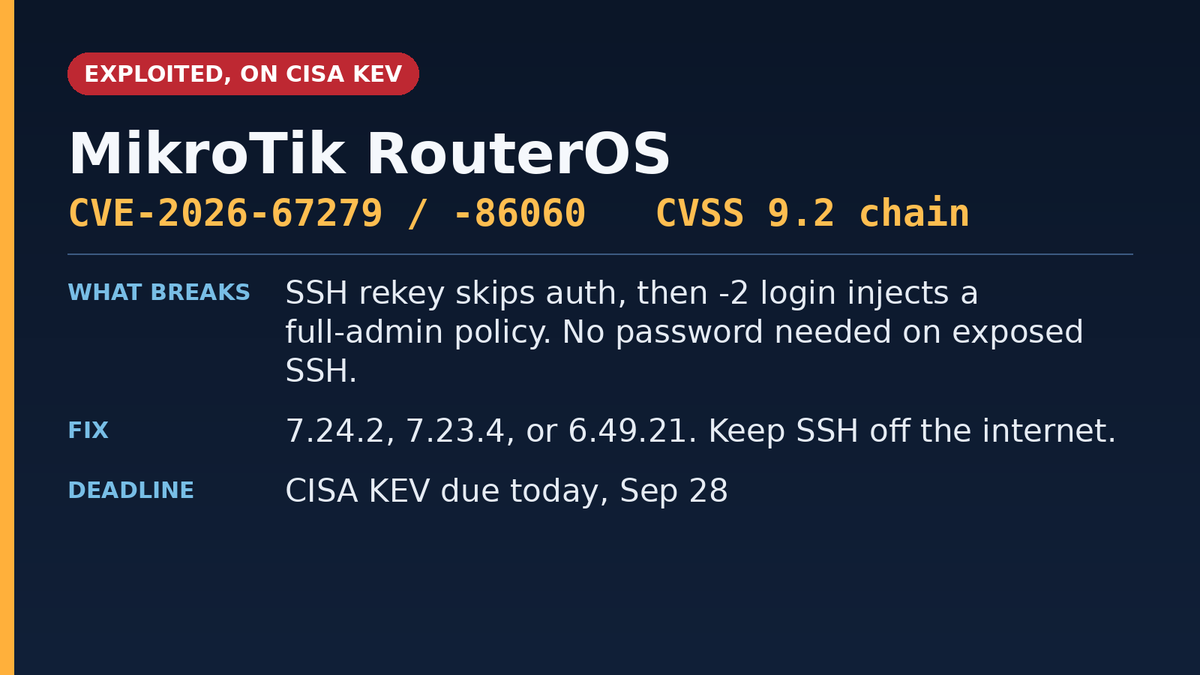
MikroTik RouterOS has a two-bug SSH chain (MikroTrick) that gives full admin with no password. CVE-2026-67279 plus CVE-2026-86060. Exploited before the Sep 3 patch. CISA put 67279 on KEV Sep 25; federal due is today, Sep 28.
Do this:
- Upgrade to 7.24.2, 7.23.4, or 6.49.21 (or later)
- Keep SSH off the internet; use WireGuard or a trusted VPN for management
- After upgrade, check logs for a failed login as user -2 and for Flagged status
@JMungaiM That boundary is important. If Jev is only the decision layer, keep the original alert and extracted IOCs in the case record, then let the policy engine explain the route and confidence.
@xbhaveshverma Exactly. If posture is only checked at login, a device can drift out of compliance minutes later. Continuous re-evaluation is what turns the slogan into an actual control.
@notCVE That’s the right split. I’d use KEV for the initial queue, then add exposure and asset criticality before setting a deadline, with EPSS as context rather than a gate.