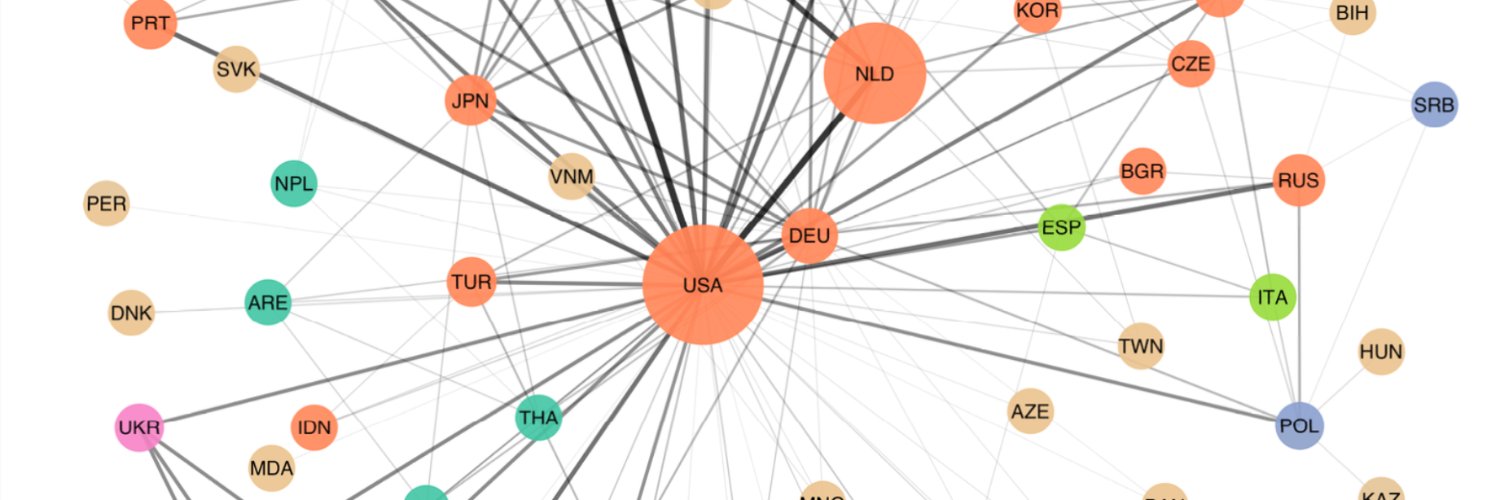
I’m both shocked and thrilled to learn that my dissertation “Essays on Digital Interdependence and Globalization” has received the 2024 Best Dissertation Award from the @APSAtweets International Collaboration Section
#OpenAccess from July 2025 -
Digital Interdependence and Power Politics - https://t.co/3PuhQsf4oL
"international conflict generates cybersecurity externalities as state and non-state actors directly weaponize digital interdependence"
- @HarryOppy
NEW -
Digital Interdependence and Power Politics - https://t.co/oZPpRMkPda
"I theorize that international conflict generates cybersecurity externalities as state and non-state actors directly weaponize digital interdependence."
- @HarryOppy#OpenAccess
We have a tenure-track search in cybersecurity policy (broadly defined) @sppgatech@GeorgiaTech. Deadline is January 30. I'm on the search committee and happy to answer questions! https://t.co/fSBD32Mwdk
Next up is a policy-focused version of the paper that gets into the nitty-gritty of what we can do to remove barriers to digital access in some of the most digitally repressive states.
Geoblocking happens across media platforms like Spotify, communications channels like Zoom, Webex, or Mailchimp, or basic digital utilities like winzip and unity. Part of what I loved about the project was the combination of political science and computer engineering.
In the paper, we discuss firm de-risking, sanctions, and avenues to reduce risk. It’s published at the top CS conference, but it’s readable for a political scientist or policy expert. It starts a conversation about risk in the digital economy https://t.co/TTtBNPsVHF
Most evidence was anecdotal - our study is the first comprehensive study of geoblocking in sanctioned states. We find widespread blocking, even by free and open platforms that don’t require accounts.
We wanted to address fundamental issues of digital equity and internet fragmentation. Usually, when we think about internet inaccessibility we think 1. bad infrastructure, or 2. censorship. It turns out there's a third thing - platforms blocking users from certain countries.
Very proud to announce our paper “Digital Discrimination of Users in Sanctioned States: The Case of the Cuba Embargo” from @USENIXSecurity with @AnnaAblove, @royaensafi and her team at Michigan was given a Distinguished Paper Award. Thread.
@bcburden Always been curious - using nominate, should we distinguish between "most liberal" versus "least like a Republican"? Are those the same? Maybe?
@JStein_WaPo @federicacocco Would be happy to chat about new research on geoblocking in Cuba with @royaensafi, accepted @USENIXSecurity. Instead of government censorship, we find many websites (spotify, zoom, webex, gallup, codeacademy, hola) voluntarily block Cubans due to sanctions.
Check out this important advance in the measurement of digital trade…
Note the enormous spatial concentration, a politically relevant feature of digital globalization @dataglobalized
I’m both shocked and thrilled to learn that my dissertation “Essays on Digital Interdependence and Globalization” has received the 2024 Best Dissertation Award from the @APSAtweets International Collaboration Section