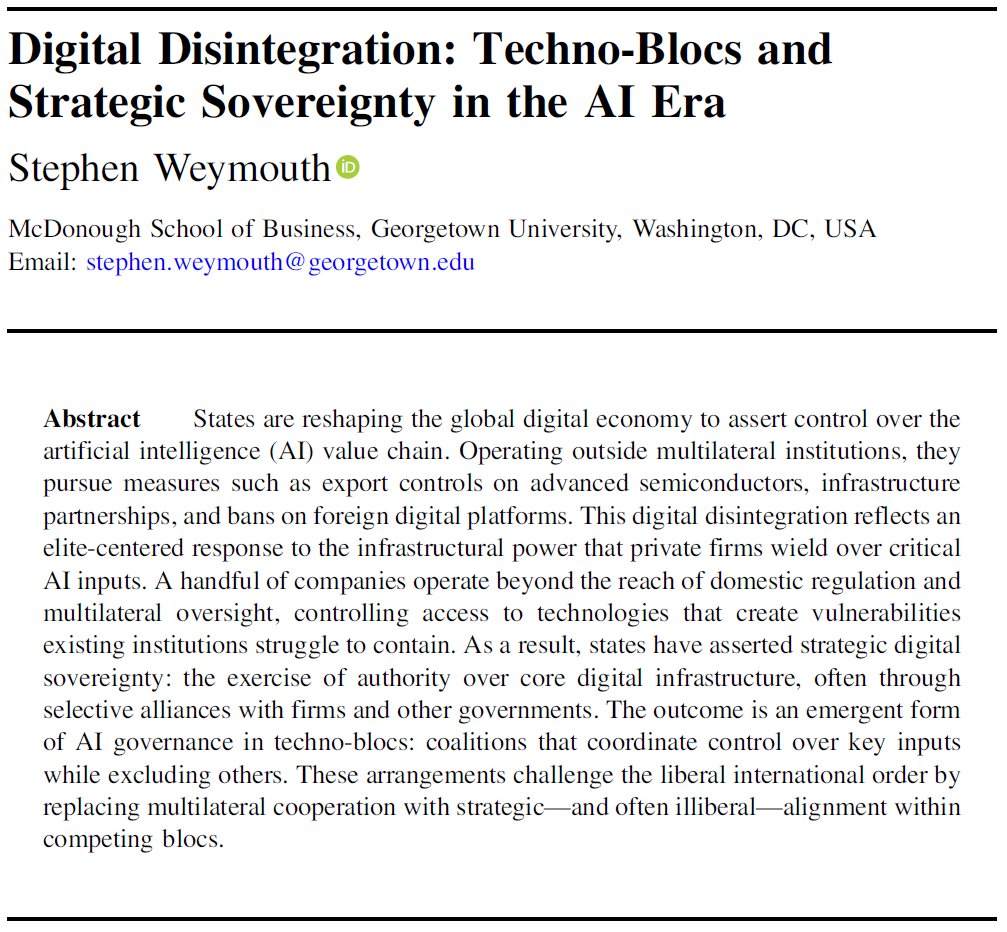
📢 Call for Papers | New Power Brokers in an Age of Technological and Geopolitical Upheaval
Submissions are invited to the #CambridgeForum on Technology and Global Affairs.
🗓️ Due: 22 Sept 2025
🔗 Info: https://t.co/82ev8MtCCp
#CallForPapers#TechAndGeopolitics#GlobalAffairs
The US AI Action Plan aims for full-stack dominance, and bundling Nvidia AI chips with American cloud services could become a powerful coercive tool. Such a move would deal a major blow to the EU’s tech sovereignty ambitions.
https://t.co/Y8cxqu4qLN
This Friday (23rd, at 13h), we are very excited to have our colleague Zoe Xincheng Ge present at our seminar series.
Zoe will present a paper entitled "Can International Organizations Shape Technology Development?".
Here's my theory connecting the TikTok sale-or-ban law, cars, AI, and more: The National Security Internet. How the national security turn for digital regulation threatens free expression, economic development, and efforts to combat climate change. Will post on @SSRN soon.
I think the most interesting intellectual work now is in finding a new path for AI governance that assumes fierce nationalism.
Despite a reflex to the contrary, we have strong models for stability in these environments. Figures like Metternich becoming extremely interesting.
The AI Summit ends in rupture. AI accelerationists want pure expansion—more capital, energy, private infrastructure, no guard rails. Public interest camp supports labor, sustainability, shared data. safety, and oversight. The gap never looked wider. AI is in its empire era.
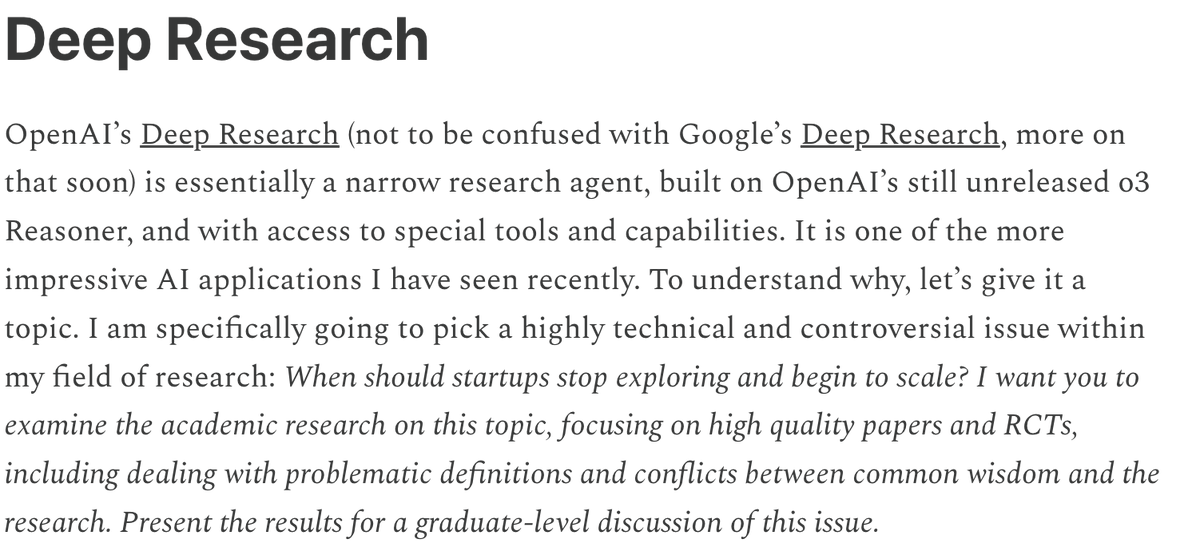
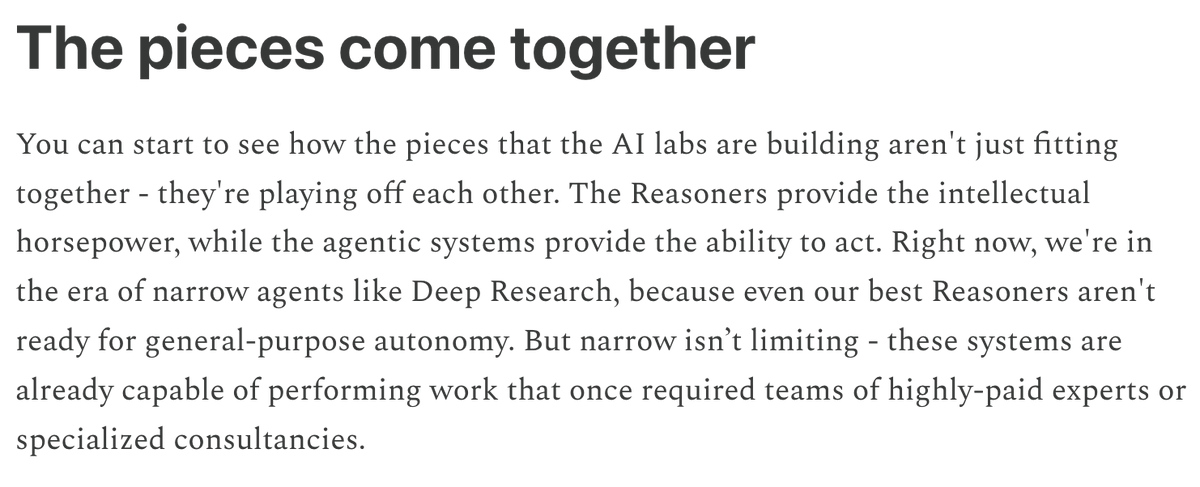
Too many things happening right now, but there's a decent chance the most important announcement in the last 48 hours is confirmation that the frontier AI labs have taken significant steps toward building autonomous digital workers that can "navigate the web, process information across all modalities, and take meaningful action in the world" (@emollick).
So, a disembodied silicon brain that can accomplish complex multi-hour, or multi-day research projects—search on the Internet, read, synthesize, write, and even PowerPoints—in a matter of minutes.
If you're still on team "AI is a waste of time," I genuinely don't know what you think the white-collar economy is.
I spoke with the Washington Post on the global fragmentation of platform content regulation -- a key impediment to Digital Globalization @dataglobalized -- and the implications for U.S. tech companies
https://t.co/pI8Fu6hH6v
Fantastic thread, recommending antitrust, privacy, and tax reform to guard against Big Tech dominance.
See also “Digital Globalization” @dataglobalized.
"activation of national identity can generate opposition to policies favorable to multinational technology firms and undermine the exercise of platform power"
Cool new research by @TylerPoliSci
https://t.co/BgwEx6lI1K
📣@swatisrivast, @JFredericMorin and I are inviting applications to take part in a workshop on "Emerging technologies and global governance". Deadline to apply: December 1st, 2024. For more information: https://t.co/sTjLphbEj7 👈
Thrilled to announce “From Click to Boom: The Political Economy of E-Commerce in China” is released! (amazon: https://t.co/B6QKFNE2yM or 30%off with code P327 at https://t.co/IpLcGkpob8 via @PrincetonUPress)
A decade in the making, my book presents how the world’s largest e-commerce market unveils a digital path to development—and what it means for China’s growth trajectory and institutional evolution worldwide.
Research built on extensive fieldwork across 6 provinces, hundreds of interviews, two original surveys, 27 million data of proprietary transactions, and a rare, large-scale field experiment spanning 3 Chinese provinces…
A thread about the book below: (1/n)
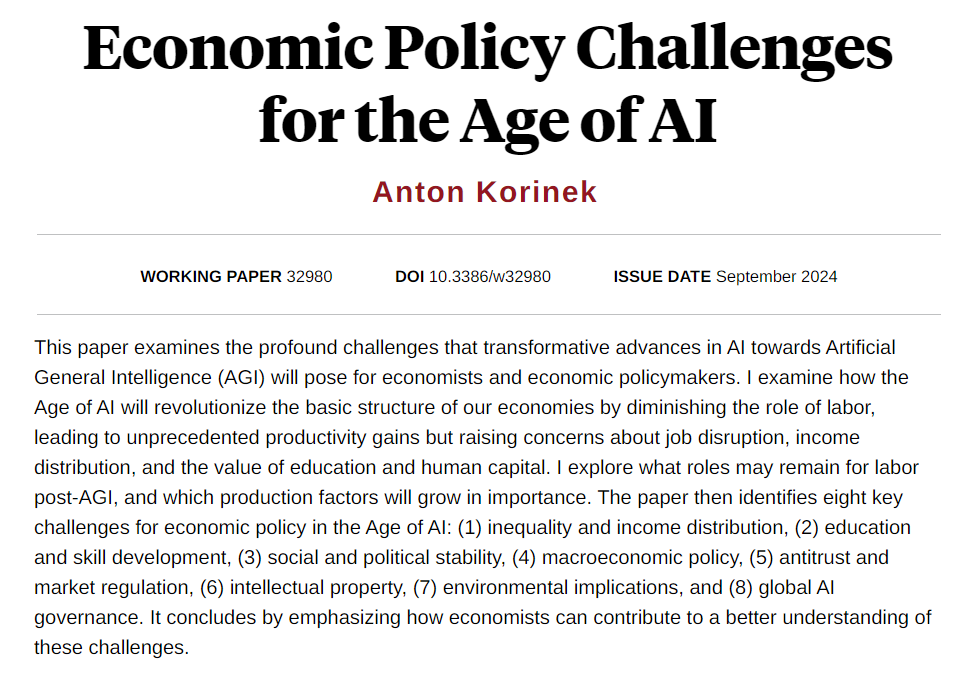
1/ 📊 New @NBERpubs paper alert! 🚨 𝗙𝗿𝗼𝗺 𝘁𝗵𝗲 𝗜𝗻𝗱𝘂𝘀𝘁𝗿𝗶𝗮𝗹 𝗔𝗴𝗲 𝘁𝗼 𝘁𝗵𝗲 𝗔𝗴𝗲 𝗼𝗳 𝗔𝗜: How will Artificial General Intelligence reshape our economic paradigm? Exploring the next big shift in factors of production. #AGIEconomics at https://t.co/6XcNfs355K
Hey look, my first collaboration w/ @mikarv on governance in the AI model hosting ecosystem - presented at FAccT, floating around for a while as a preprint - is officially now out #LIT 🚨
Super proud of this work, stay tuned for more soon…
https://t.co/YWPaJipkb0?
Mario Draghi's new report on EU competitiveness doesn't mince words.
"Across different metrics, a wide gap in GDP has opened up between the EU and the US, driven mainly by a more pronounced slowdown in productivity growth in Europe. Europe’s households have paid the price in foregone living standards. On a per capita basis, real disposable income has grown almost twice as much in the US as in the EU since 2000."
"First – and most importantly – Europe must profoundly refocus its collective efforts on closing the innovation gap with the US and China, especially in advanced technologies. Europe is stuck in a static industrial structure with few new companies rising up to disrupt existing industries or develop new growth engines. In fact, there is no EU company with a market capitalisation over EUR 100 billion that has been set up from scratch in the last fifty years, while all six US companies with a valuation above EUR 1 trillion have been created in this period. This lack of dynamism is self-fulfilling."
"There are not enough academic institutions achieving top levels of excellence and the pipeline from innovation into commercialisation is weak. [...] However, while the EU boasts a strong university system on average, not enough universities and research institutions are at the top. Using volume of publications in top academic science journals as an indicative metric, the EU has only three research institutions ranked among the top 50 globally, whereas the US has 21 and China 15."
"Regulatory barriers to scaling up are particularly onerous in the tech sector, especially for young companies. Regulatory barriers constrain growth in several ways. First, complex and costly procedures across fragmented national systems discourage inventors from filing Intellectual Property Rights (IPRs), hindering young companies from leveraging the Single Market. Second, the EU’s regulatory stance towards tech companies hampers innovation: the EU now has around 100 tech-focused laws and over 270 regulators active in digital networks across all Member States. Many EU laws take a precautionary approach, dictating specific business practices ex ante to avert potential risks ex post. For example, the AI Act imposes additional regulatory requirements on general purpose AI models that exceed a pre-defined threshold of computational power – a threshold which some state-of-the-art models already exceed. Third, digital companies are deterred from doing business across the EU via subsidiaries, as they face heterogeneous requirements, a proliferation of regulatory agencies and “gold plating” of EU legislation by national authorities. Fourth, limitations on data storing and processing create high compliance costs and hinder the creation of large, integrated data sets for training AI models. This fragmentation puts EU companies at a disadvantage relative to the US, which relies on the private sector to build vast data sets, and China, which can leverage its central institutions for data aggregation. This problem is compounded by EU competition enforcement possibly inhibiting intra-industry cooperation. Finally, multiple different national rules in public procurement generate high ongoing costs for cloud providers. The net effect of this burden of regulation is that only larger companies – which are often non-EU based – have the financial capacity and incentive to bear the costs of complying. Young innovative tech companies may choose not to operate in the EU at all."
More: https://t.co/x1d1ApvG2Z.