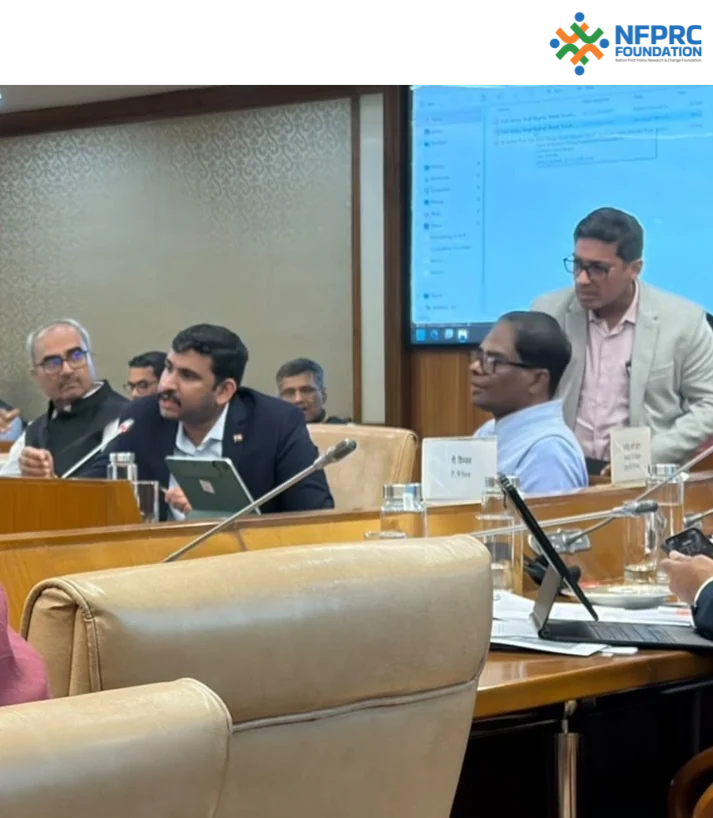
We are pleased to share that the NFPRC Foundation presented its views before the Joint Parliamentary Committee, chaired by Dr. Sanjay Jaiswal (@sanjayjaiswalMP), on the Foreign Contribution (Regulation) Amendment Bill, 2026.
The interaction covered key provisions of the Bill, including proposed regulatory changes, institutional processes, asset management and mechanisms for effective implementation.
Our delegation comprised Sahil Deo (@DeoSahil), Director; Ananth Krishna (@Ananth_KrishnaS), Research Director; Monalisa Nanda (@VasundhraAravit), Team Manager; and Harsh Anmol (@HarshAnmol_), Consultant.
We are grateful to the Committee for the opportunity to share our perspectives and contribute to the ongoing parliamentary deliberations.
#NFPRCFoundation #FCRA #PolicyResearch #Governance
As a part of @NFPRC_Ind, will be presenting at the FCRA joint parliamentary committee tomorrow alongside @Ananth_Krishna_, Monalisa & Harsh!
Excited & super grateful for this opportunity 😊
🇮🇳
"Gandhi recalls crying..."
IN AN INTERVIEW TO THE GUARDIAN SONIA GANDHI DESCRIBES HER REACTION TO THE BABRI MASJID DEMOLITION.
Here is an excerpt from the interview to The Guardian.
"Gandhi recalls crying as she witnessed the demolition on television. She says she knew then that they faced “a long battle for the secular nation that Mahatma Gandhi, Nehru and their colleagues had strived to build”. She accepts that failures of her own party in part contributed to the rise of the BJP and its hardline Hindutva politics. “I think we have been too complacent in many ways. There was a laissez-faire kind of an attitude,” she says. In 2024, Modi delivered on the BJP’s longstanding promise and inaugurated a vast Hindu temple in the place where the mosque had once stood."
In the last 14 years, India has executed only 7 individuals (including 4 from Nirbhaya). USA executed 47 just in 2025.
We can debate the methods of execution and demand for speedy trial, but it needs to start with the acceptance that some convicts are incorrigible.
The moment HM offered for a discussion, I told a colleague that I could bet the Oppn would never submit its letter to the Speaker. Their priority was only tomfoolery.
Now, I hope the Govt does not dilute crucial laws like FCRA in the name of building consensus.
L Opposition.
इस मानसून सत्र में ये 4 बिल नहीं आ पाए, जो कि विपक्ष की बड़ी उपलब्धि है।
• One Nation, One Election Bill
• Viksit Bharat Shiksha Adhishthan Bill
• Constitution (130th Amendment) Bill
• FCRA Bill
हमारी एक और बड़ी उपलब्धि ये है कि-
BJP ने दो तिहाई बहुमत के लिए बहुत कोशिश की, पार्टियों को भी तोड़ा लेकिन वो इसमें सफल नहीं हो पाए और Delimitation Bill पास नहीं हो पाया।
: कांग्रेस महासचिव (संचार) व राज्य सभा सांसद @Jairam_Ramesh जी
In 2012 Manmohan Singh gave an interview to prestigious Science magazine where he clearly blamed America based funding to Christian Churches stopping India's growth.
It is believed this interview made Sonia so angry she decided to get rid of Manmohan. She asked all ministers to stop listening to the PM altogether. For the last 2 years of his tenure, Manmohan had zero control over the state he ran on paper.
It's not #FCRA, its our very freedom!
BIG: West Bengal State Government under the BJP has decided to provide land for border fencing to the BSF. The call was taken in the first cabinet meeting. Land will be transferred within 45 days. Excellent.
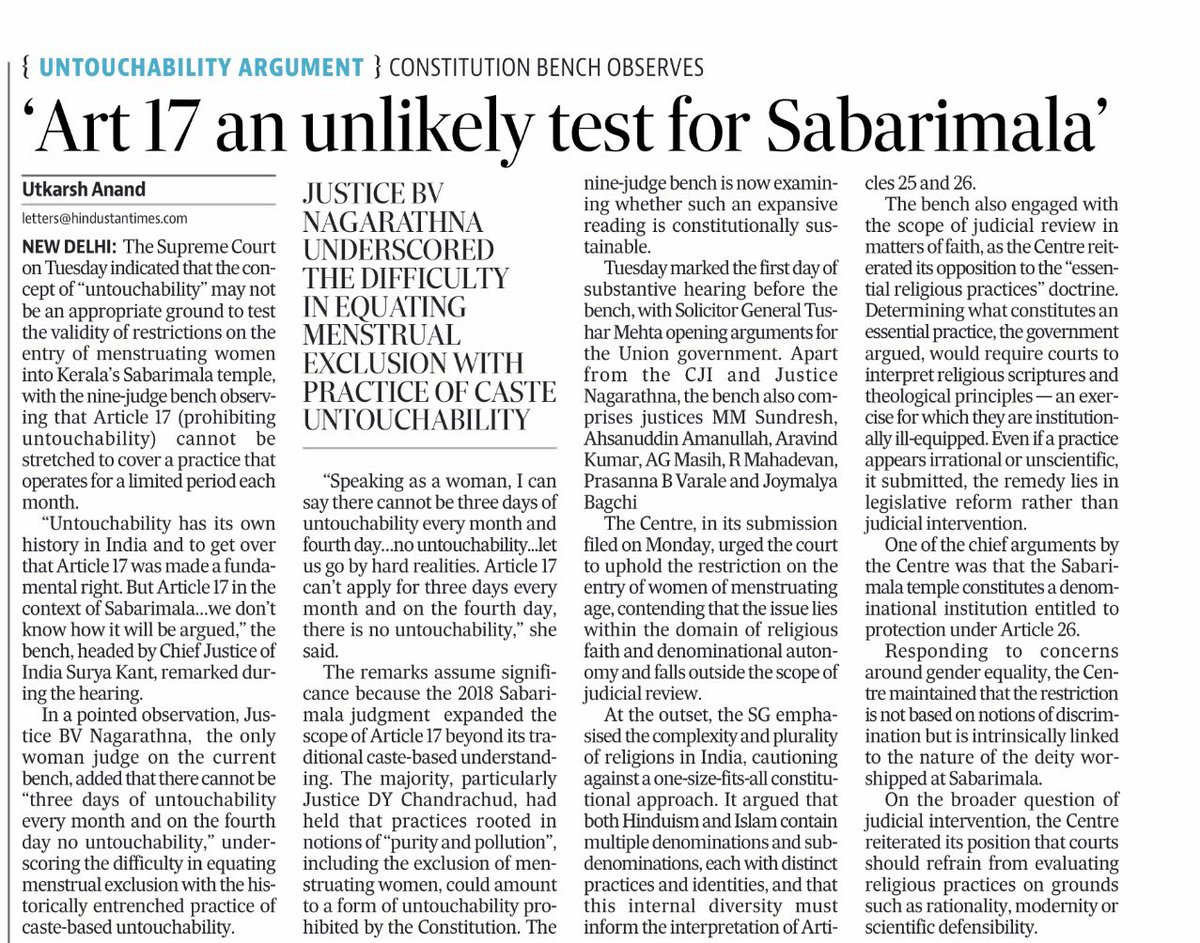
Important: SC observation during Sabarimala hearing: restrictions on entry or menstruating women can’t be likened to untouchability.
Justice Nagarathna observed: speaking as a woman I can say there can’t be 4 days of untouchability every month, and it ends the 5th day.
This is contrary to what the SC had said in its 2018 judgment
"...And as for this notion that India, under the BJP, has somehow become an authoritarian state - that's total BS. No country with free and fair elections and a robustly independent judiciary is in serious danger of dictatorship."
- Tony Abbott
(Former PM, Australia)
There’s been a Raisina Dialogue in Delhi every March since 2016. It’s the brainchild of Subrahmanyam Jaishankar, Narendra Modi’s long-serving foreign minister. Like other global gatherings, it brings together political leaders, senior military commanders, prominent business people, leading journalists, and think tank chiefs to discuss key issues; but it’s better than Davos because it’s not so dominated by politically correct plutocrats; and better than the longer-running Chinese Boao Forum, because it not essentially an exercise in homage to the host government.
I started attending virtually, during the pandemic, and have been there in person since 2022.
My reflections on Raisina, Modi, and why India matters more than ever in my latest at The Tony Abbott Newsletter: https://t.co/fsro4QFrI9
We just finished paying off a ₹3.23 Lakh Crore credit card bill for petrol that was consumed 15 years ago.
For years, the political discourse around petrol prices has been dominated by surface-level comparisons. We audited the historical ledger. The data reveals a masterclass in 'Fiscal Illusion', the art of hiding the true cost of governance from the public.
Here is the economic autopsy of India's Oil Bonds.
1. The Explainer: What is an Oil Bond?
For the normies: Imagine filling your tank and the true market cost of petrol is ₹60/litre, but the government caps the retail price at ₹40/litre to keep voters happy.
Who pays the ₹20 difference? The Oil Marketing Companies (OMCs).
To prevent the OMCs from going bankrupt, the government has to compensate them. But paying them in cash would instantly blow up the national Fiscal Deficit.
So, the government gave them an IOU (an Oil Bond).
The promise: 'We won't pay you today, but we will pay you 15-20 years from now, along with 8% annual interest.'
It is a financial time machine that transfers the cost of today’s artificially cheap fuel to tomorrow’s taxpayers.
2. The Scale of the Illusion (2005–2009)
Look at the red zones in the spreadsheet. When global crude spiked (hitting $96/bbl in 2008), the government flooded the system with IOUs rather than taking the political hit of raising prices.
• Total Principal Issued: ₹1,53,423 Crore.
• The Trap: These bonds carried brutal interest rates, ranging from 7.00% to 8.40%, with maturity dates locked deep into the 2020s.
3. The Final Bill
You cannot subsidise your way out of global commodity prices; you can only delay the pain.
By the time these bonds fully mature in 2026, the Government of India will have paid:
₹3,23,923 Crore in total (Principal + Interest).
That means the Indian taxpayer paid over ₹1.7 Lakh Crore purely in interest, money that could have built thousands of schools, hospitals, or kilometres of high-speed rail.
4. The Structural Cleanup
By 2010, the math broke. The mounting high-interest debt became an unsustainable sovereign burden.
The UPA government was forced to halt the issuance of Oil Bonds and initiate the deregulation of petrol prices - a policy the NDA government had to aggressively continue to stop the bleeding.
Since 2014, current taxpayers have been quietly servicing this inherited debt.
🔷NFPRC’s Union Budget 2026–27 Budget Explainer Booklet is now available.
The booklet offers a thematic overview of Budget priorities, including public CapEx, infrastructure expansion, welfare delivery, and sectoral reforms.
Designed as a concise reference for understanding both context and provisions.
📊Read the full document below.
To download PDF - https://t.co/Zdq95uWSYP
#NFPRC #Budget2026 #YuvaBudget
> be India, 1951
CJI Kania dies
Nehru tries to skip the senior-most judge Patanjali Sastri and selected BK Mukharjee as next CJI
Mukherjea is an absolute unit refuses to Nehru and told him "If you skip him to pick me, you'll ruin the court's integrity. I'll resign if you try it."
Nehru had to back down
Convention established: Senior-most judge always becomes CJI.
> fast forward to 1973
Justice Sikri delivered the Kesavananda Bharati judgment with 7-6 verdict which established "Parliament cannot touch the Basic Structure of the Constitution."
Sikri retires the next day
Indira Gandhi was fuming
Next 3 judges in line (Shelat, Hegde, Grover) all voted for Basic Structure
Indira's minister Kumaramangalam: "We need a Committed Judiciary." aka "Judges who do what we tell them."
Gov skips the top 3
Picks A.N. Ray, Judge who voted in favor of the government
Ray accepts (zero Mukherjea energy)
Top 3 judges resign immediately
> 1975, Emergency declared
CJI Ray tries to assemble a 13-judge bench to kill the Basic Structure doctrine
Nani Palkhivala enters the chat
Argues for two days straight with pure fire
Literally makes judges cry with his speech on liberty
CJI Ray panic-dissolves the bench on day 3
Constitution survives by 1 HP
> 1976, ADM Jabalpur (Habeas Corpus case)
"Can the gov detain anyone without trial during Emergency?"
4 judges (A.N. Ray, H. Beg, YV Chandrachud, PN Bhagwati) say YES
Justice H.R. Khanna as the sole dissenter said NO.
Writes his own career obituary to save the soul of the judiciary
> 1977, AN Ray retires
H. R. Khanna is next in line
Gov remembers he has a spine
Skips him, appoints M. Hammidullah Beg
H.R. Khanna resigns same day
Absolute Legend, No ?
> 1978, Emergency is over,
Janata Party in power
Beg retires
Next in line is Y.V. Chandrachud
The same guy who voted with the dictator dadi Indira in the Habeas Corpus case
Public pressure: "Skip him! Punish him!"
New Gov faces dilemma
"If we skip him, we are no better than Indira."
Decides to restore the system instead of taking revenge
Appoints Chandrachud based on seniority
The "Committed Judiciary" era ends
Seniority convention is back on the menu
mf when they're in power wanted committed Judiciary, today in opposition they expect judiciary to bend the knee to them.
Ease of Doing Business in India still suffers from overcriminalised compliances. The Centre’s Jan Vishwas Bills were a start, but states must now lead the charge.
@NFPRC_LR 's Lead for Decriminalisation & Deregulation, Kartikey Agarwal, explains 👇
https://t.co/G9cBfD7SUc
In my latest piece for @SwarajyaMag, I write on the Supreme Court's recent interim order on the Waqf (Amendment) Act, 2025. The order stands as a judicial affirmation of the Union Government's legislative intent regarding the reformed governance of waqf properties.
Supreme Court Refuses Blanket Stay: Why Waqf Order Is A Win For Govt (https://t.co/NWX9NK3w23)
By refusing to halt the Waqf (Amendment) Act, the Supreme Court has reinforced the Government’s reform agenda.
The partial stays are procedural pauses, not substantive defeats, and the judgment validates the push for accountability and transparency in waqf governance.
@HarshAnmol_
Stray Dogs, SIR, And More: Is The Supreme Court Cosplaying As A Supra-Constitutional Entity? (https://t.co/8CEt2zRh6J)
Recent cases on stray dogs and electoral rolls show how the Court has gone far beyond its role, turning into a supra-constitutional body that second-guesses executive policy and weakens other institutions, while being accountable only to itself.
@Ananth_Krishna_@HarshAnmol_