#BookReview | "Semiconductors not only serve as the backbone of the current-age economy but are also a means of achieving geopolitical supremacy. Kumar, a professor of Engineering at the University of Illinois Urbana-Champaign with a strong understanding of geopolitics, provides a holistic picture of the semiconductor industry."
Reviewing 'The Chip Age' by Rakesh Kumar, @HarshTantla writes, "Kumar has interestingly challenged the popular narrative of semiconductors as enablers of renewable energy and efficiency by bringing the impacts on the environment and communities into the limelight as the hidden cost."
From the latest issue of India's World- Back From The Brink: The India-Canada Reset
Read the full review: https://t.co/Gmt0i40wDq
Presenting my work on G4C2 RNA G-quadruplex dynamics, small-molecule binding, and 8-oxoguanine modification at the CECAM workshop, Faculty of Pharmacy, Université Paris Cité!
A great opportunity to share research, exchange ideas, and connect with the scientific community.
Mark Your Calendars!
CSDR and India's World are organising the launch of our Editor @HappymonJacob's latest book, 'India after Nonalignment'.
Register now to get your invite: https://t.co/r2W71G1BPG
Delighted to announce the launch of my book, India After Nonalignment, on November 4 in New Delhi!
Join me & this exceptional panel for an engaging discussion on India’s grand strategy.
@IndiasWorld_mag@CSDR_India
Trump talks about annihilating Iran.
But he knows Iran is not defenseless.
Since we informed they have recently been watching Bollywood instead of Hollywood.
New Delhi Declaration 2026: BRICS backs Global South representation, UN/UNSC & financial governance reform, WTO reform, opposition to unilateral sanctions, and cooperation on AI, health, food, energy and resilient supply chains.
#BRICS2026#BRICS
India is a very interesting country. The Prime Minister was in Israel just days before the Israelis and the Americans launched their war on #Iran. And Iran's President is in India, more than six months into that war, at a time when the Iranians are "blowing the hell out of" American bases in the region and their allies in #Yemen are taking over the Red Sea coast.
When Modi meets Xi.
Napoleon is supposed to have said that an army marches on its stomach.
But the entire state marches on its economy. And wealth has to be built through structural reforms, competitiveness, and rapid tech adoption.
Unlike hard but rigid military capability, or diplomatic power which is more agile but limited in its ability to produce major outcomes of its own, economic strength is uniquely fungible.
While defense and diplomacy get the glory, they are merely derivative assets that cannot sustain themselves. In reality, they are entirely dependent on the hard, unglamorous foundations of material wealth.
So to understand where national security actually begins,we need to look past the glory of parade grounds and the charm of embassies.
It starts at home, in the boring but foundaitonal mechanics of factories, ports, capital, skills, energy.
So when Modi meets Xi, the third party in the room will be economic power, not America.
At the invitation of Prime Minister of the Republic of India Narendra Modi, President Xi Jinping will attend the 18th BRICS Summit in New Delhi from September 12 to 13.
Raksha Mantri Shri @rajnathsingh released the landmark ‘RAKSHA’ document on defence diplomacy in New Delhi on September 03, 2026, setting a 10-year roadmap to strengthen global security partnerships. Aligning national security with proactive international cooperation, this comprehensive framework aims to position India as a key defence manufacturing hub and an anchor of regional stability. Built on core pillars of strategic partnerships, capacity building, indigenous exports under #MakeInIndia, and #maritimesecurity, the initiative reinforces India’s role as a Net Security Provider and First Responder in the #IndianOceanRegion.
Read here: https://t.co/E2D8VoQxus
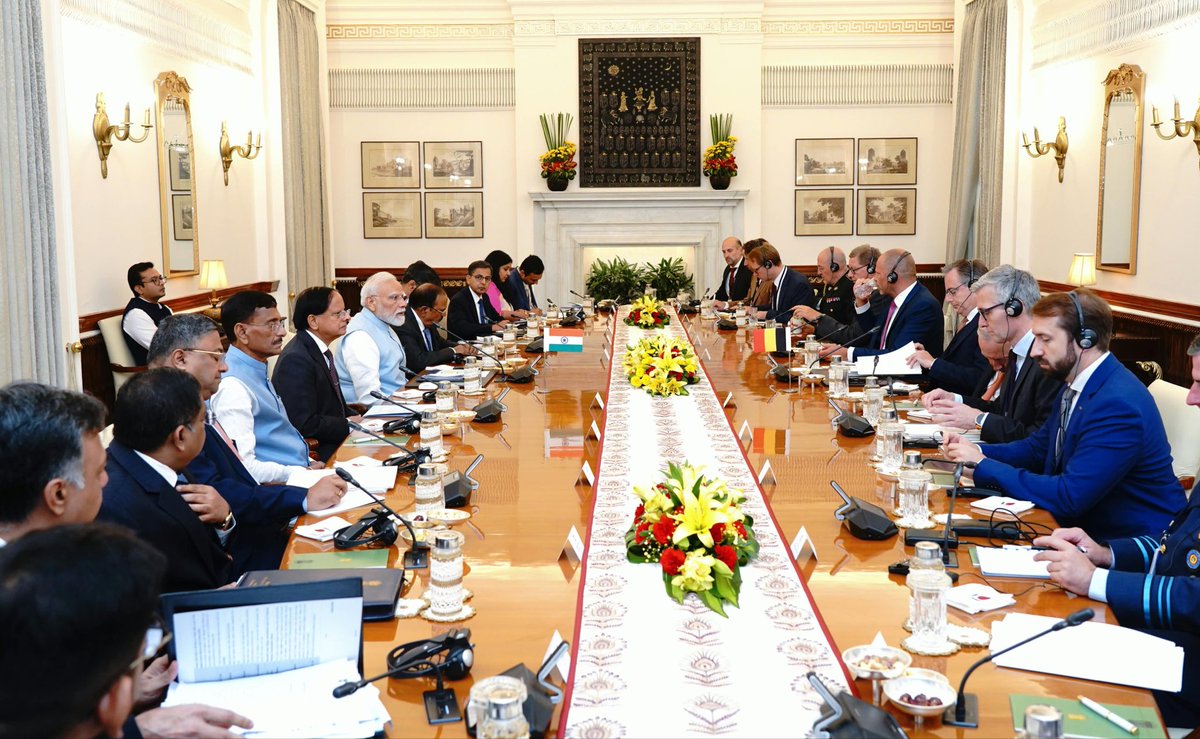
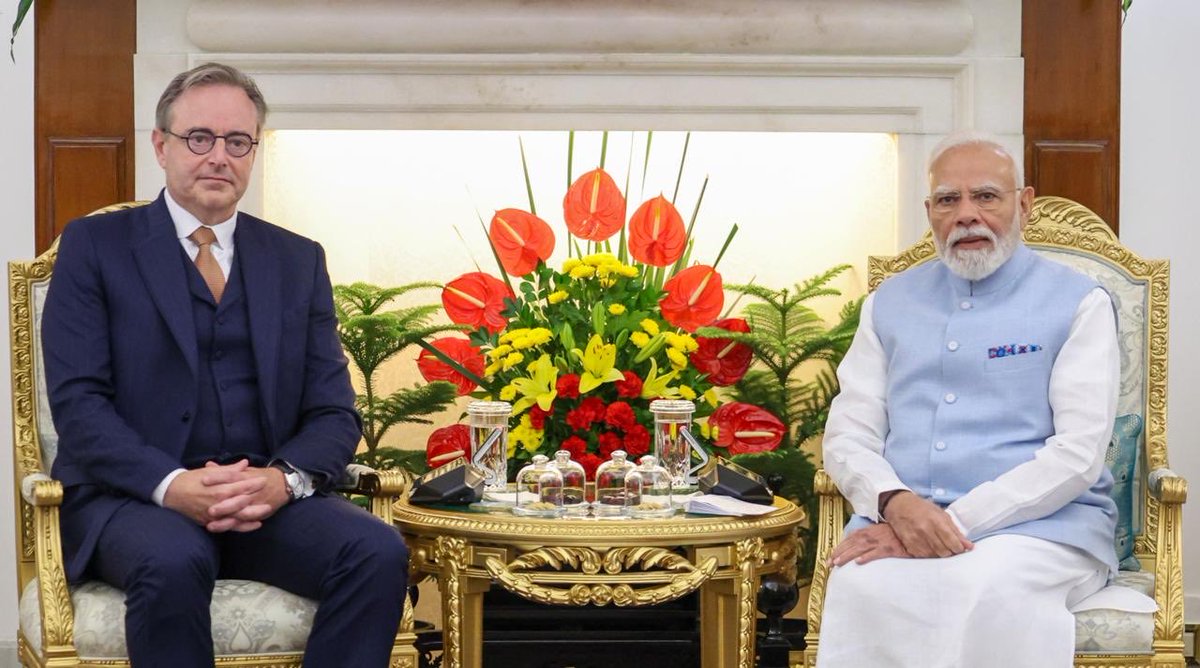
India–Belgium| Key outcomes:
• Strategic Dialogue institutionalised
• Belgium backs India for permanent UNSC seat
• Doubling Trade in 5 years
• Investment Fast-Track launched
• Defence & counter-terrorism ties deepened
• Green hydrogen, semiconductors & AI cooperation
Prime Minister @narendramodi held bilateral talks with Prime Minister Bart De Wever @Bart_DeWever of Belgium in New Delhi today.
The two leaders reviewed the full spectrum of bilateral relations, with a focus on defence, trade, investment, innovation, semiconductor, fintech, critical minerals, people-to-people ties, and academic and research cooperation.
They also exchanged views on regional and global issues of mutual interest and reaffirmed their commitment to further deepen the close and multifaceted India-Belgium partnership.
Both sides agreed to double the bilateral trade in next five years, establish a business forum, an investment forum and a consular dialogue. Both leaders witnessed the exchange of MoUs in the field of defence, renewable energy, combating crime and establishing diplomatic training between two countries.
We warmly invite you to the launch of our book Living the Vivekananda Way: Practical Spirituality for Modern India.
We feel blessed to have with us Hon’ble Shri Dharmendra Pradhan Ji (@dpradhanbjp ), Union Minister of Education, Government of India, as our Chief Guest, and Professor Yogesh Singh (@YeDesHaiMera ), Vice Chancellor, University of Delhi, as our Guest of Honour.
📖 Event Details
📅 Date: 25th September 2025
🕒 Time: 3:00–4:15 PM
📍 Venue: Shankar Lal Hall, University of Delhi
We look forward to welcoming you and sharing this memorable moment together! @AnanyaAvasthi
I initially thought India should continue talks with the US without publicly hitting back, while at the same time pursuing its relations with other powers. But with the Americans attacking India publicly on a daily basis, I think India should act like a power it is — or it wants to be. Trump officials might take India’s silence for weakness.
Coming soon: Volume 1, Issue 5 – Cultivating Europe
India and Europe need each other more than ever. As geopolitical upheavals reshape the world, this issue explores how the two are turning crisis into opportunity and stepping into a larger role together.
Our most ambitious issue yet, with more than 30 essays and conversations on geopolitics, strategy, history, art, and culture. From NATO and China to space diplomacy, from artisans and haute couture to the future of Indo-European relations, this edition captures a world in transition.
Stay tuned for the new release!
#IndiasWorld #CultivatingEurope #ComingSoon #India #Europe #Geopolitics
Delhi’s Grand Strategy: VOL 1 ISSUE 1: Reporting India-Pakistan – Smoke, Mirrors, and the Power of Narratives by @BDUTT
“The structural dissonance in Pakistan around the civil–military relationship makes both diplomacy and reporting the story a challenge. There are always as many saboteurs in the room as there are advocates of dialogue.” — Barkha Dutt
This observation cuts to the heart of why India–Pakistan engagement so often collapses. Dutt shows how Pakistan’s fractured power structure—where elected leaders and the military pull in different directions—creates a built-in volatility. Even gestures like Nawaz Sharif’s softened line on Kashmir risk being undercut by the deep state, or distorted by media narratives that fuel mistrust.
Her analysis underscores a sobering reality: India’s Pakistan policy does not just negotiate with Islamabad’s civilian leaders but with an opaque and competing set of actors. The challenge, then, is not merely initiating dialogue but sustaining it against structural sabotage.
From The Print — bringing you insight from India’s World.
Read the full article here: https://t.co/poJ3re1PbZ
#IndiaPakistan #ForeignPolicy #Media #Narratives #IndiasWorld
As if China’s covert military aid to Pakistan in the recent conflict with India were not bad enough, Trump’s 50% tariffs make Modi’s PRC visit look worse still — like a wounded statesman extending an olive branch to the very power that has sharpened the knife against his country.
Article: Made in India: The Story of Indian Tractors and Foreign Technology by Dr. Vani Swarupa Murali (@VaniSMurali)
Dr. Vani Swarupa Murali traces how tractors became a symbol of India’s relationship with foreign technology—from colonial surpluses to global exports.
What started in the late 1940s, when “54 tractors, including 30 bulldozers, were acquired by the department from army surpluses and hired out for ploughing, bunding and levelling operations at concessional rates,” has now matured into an industry that exports to the U.S., Germany, and Mexico.
Once dependent on imports from Britain, the USSR, and the U.S., India has turned the tables: Mahindra, Escorts, and Sonalika today dominate global tractor markets. This journey reflects India’s broader economic arc—learning from foreign innovation, adapting it to local conditions, and eventually creating world-class products of its own.
The tractor is more than farm equipment. It’s a marker of India’s resilience, self-reliance, and technological confidence—a story of borrowing, building, and finally leading.
Read the full article here: https://t.co/PpyQXc0e7b
#MadeInIndia #Agriculture #Technology #EconomicHistory #IndiaStory #Tractors
Rethinking the Middle-East | VOL 1 ISSUE 3: The India-Middle East-Europe Economic Corridor (IMEC) in a Transforming Middle East by Dr. Oshrit Birvadker (@birvadker)
“Integrating Gaza into the India-Middle East-Europe Economic Corridor (IMEC) can significantly contribute to the reconstruction of the Gaza Strip, linking the Israeli-Palestinian conflict to a strategy centred on engineering and international trade. This approach can amplify global interest in stabilising the region and pursuing a sustainable resolution to the protracted conflict. Amidst this landscape of uncertainty, the IMEC emerges as a viable pathway towards fostering constructive engagement and forging a more stable Middle East.” — Dr. Oshrit Birvadker
By situating Gaza within a framework of trade and connectivity, Dr. Birvadker argues, IMEC could transform the politics of conflict into an agenda of development.
In a region plagued by volatility, uncertainty, complexity, and ambiguity (VUCA), this approach reimagines economic corridors as instruments of peacebuilding.
Beyond reducing transport costs and enhancing connectivity, IMEC becomes a vehicle for embedding Gaza’s reconstruction into regional cooperation—shifting global interest from humanitarian aid to long-term stability and integration.
Read the full analysis on India’s World Website.
Visit: https://t.co/PpyQXc0e7b
#IMEC #MiddleEast #IndiaForeignPolicy #Geoeconomics #Connectivity
From the Archives: India’s Climate Diplomacy At The United Nations By #ArchnaNegi
Archna Negi traces India’s active presence across UN platforms in recent times—from the UNGA and ICJ to COP29 in Baku. At every forum, New Delhi pressed a consistent line: climate action must be human-centric, equitable, and finance-linked.
Its rejection of the COP29 outcome—$300 billion annually by 2035 against a Global South demand of $1.3 trillion—was not obstruction but a warning. For India, the deal was an “optical illusion,” betraying decades of commitments on finance and technology transfer.
This stance echoed at the ICJ, where India underscored historic responsibility; at the UNSC, where it resisted securitizing climate change; and at the UNGA, where EAM S. Jaishankar lamented a fractured multilateralism.
For New Delhi—and much of the Global South—the climate fight is about justice as much as carbon. Without credible finance, lofty pledges risk undermining development. India’s stance reflects a wider Global South argument: no climate transition without climate finance.
Read the full article here: https://t.co/yb70OG4Dfn
#ClimateDiplomacy #GlobalSouth #ClimateFinance #IndiaUN #Geopolitics #Equity #IndiasWorld