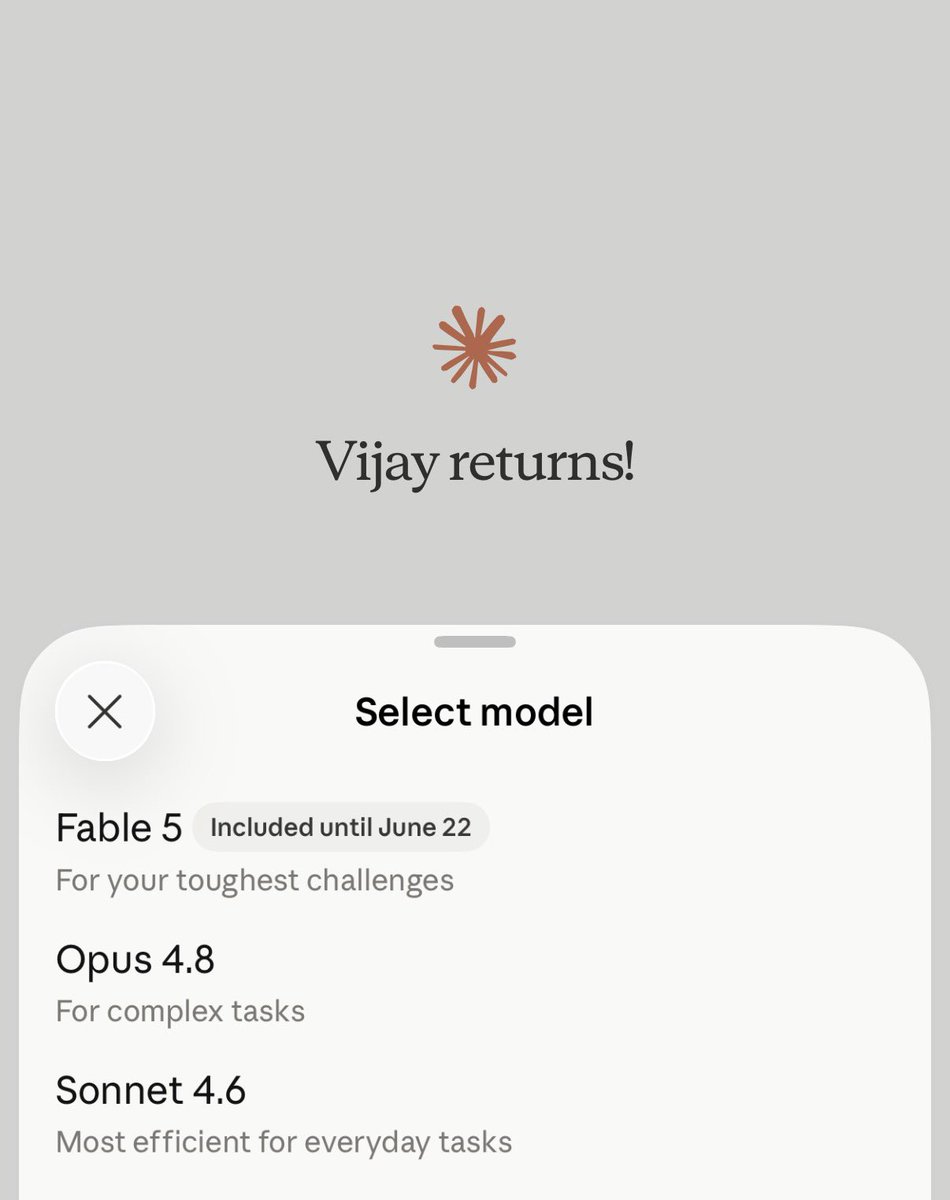
For the first time, I'm vibecoding with ZERO frustration and in a complete state of flow, so much so that I'm running out of ideas.
Typically, I have so much backlog of things I want to add, but after Fable landed on Replit, I'm almost certain I don't need more IQ for vibecoding, just cheaper and faster models, and we're done here.
Anthropic posted a FULL GUIDE on how to prompt Fable 5 (Mythos).
Claude Fable 5 is not meant to be prompted like any other model.
It's meant to run autonomously.
Here's exactly how to enable Fable to do work for you with minimal manual intervention:
1. Effort selection
Anthropic recommends using High for most tasks and Xhigh only for complex workflows.
Low/medium: quick questions, basic research
High: default for most work
Xhigh: complex builds, multi-step analysis
Ultracode: full autonomous orchestration
2. /loop prompting
Use /loop prompts to kick Fable off to complete full tasks.
/loop <time interval> + <goal>
3. Tell it WHY, not just what (context)
Fable can't perform on instructions alone. It needs context to make decisions on its own.
Anthropic's exact prompting structure:
"I'm working on [larger task] for [who it's for]. They need [what the output enables]. With that in mind: [your actual request]."
4. Keep prompts short (instructions)
Counterintuitive but critical.
Over-engineering your prompts on Fable 5 degrades output. You're constraining a model that would have figured it out on its own.
4. Tell it when to stop and check in during runs
"Pause for me only when the work genuinely requires my input: a destructive action, a real scope change, or something only I can provide. Otherwise, keep going and report back when done."
5. Build it a memory system
Fable performs best when it can record lessons from its previous loops.
Give it a markdown file and this instruction:
"Store one lesson per file with a one-line summary at the top. Record corrections and confirmed approaches. Don't save what the repo or chat history already records."
The optimal general prompt structure:
"Goal: I'm working on [larger task] for [who it's for]. They need [what the output enables].
Request: [your specific ask in one sentence]
Output format: [exactly how you want it]
Constraints: [what must not happen]."
One last thing - your old prompts may actually work against you.
Skills and project instructions built for Opus 4.8 may produce worse results on Fable.
Bookmark this to actually maximize your Fable workflows.
Ahmedabad is the next place to be.
1. No Language barriers
2. Best infra currently in the country
3. Basic fundamentals like 24 x 7 Electricity + Good roads + Metered PNG connection
4. Best Industrial infra and logistics support across the country
5. Comparatively cheaper real estate to top tier cities.
6. Growing startup eco system
7. Great support by state govt
Today I'm publishing a new essay, Policy on the AI Exponential. AI is progressing extremely fast—much faster than the policy process was built to handle. The essay lays out where I think the technology is now, and the action needed to close the gap: https://t.co/Lh6PWae178
Claude Fable 5 is by far the most ridiculous model that makes me genuinely afraid for the future of software engineering.
I compiled the top 10 most unbelievable things I've seen Claude Fable 5 do today:
— Migrate a 50M line codebase from Stripe in a day (humans take 2mos)
— Draw amazing 3D graphics a) Boeing 747 b) space simulations with >5000 objects c) Minecraft roller coasters d) full photorealistic forest scenes e) NYC skyline f) stormy clouds)
— One-shot Pokemon FireRed the game
— Optimize a real world proprietary interaction net evaluator 10x more than the next best model, gpt5.5
AND it's about the same price as GPT 5.5 ($10/M input, $45/M output) vs Fable 5 ($10/M input, $50/M output) and 6x cheaper than GPT 5.5 Pro.
📣 Claude Fable 5, the first in @AnthropicAI's Mythos model class, is now generally available and rolling out in GitHub Copilot.
It is designed for long-horizon, autonomous coding and knowledge-work tasks. Try it out in @code or the GitHub Copilot app. ⬇️
https://t.co/jJTqh35jjY
This is a super exciting release - Claude Fable 5 is the same underlying model as Mythos but with added safeguards. The benchmarks are great and it's SOTA on everything by a margin but I'll add that *qualitatively* also, this is a major-version-bump-deserving step change forward (imo of the same order as Claude 4.5 was in November), peaking especially for long problem-solving sessions on very difficult problems. You can give it a lot more ambitious tasks than what you're used to, the model "gets it" and it will just go, and it's never felt this tempting to stop looking at the code at all (but don't do this in prod!). The model still has quirks that people will run into and the safeguards are configured to be a little too trigger happy for launch, which can hopefully be tuned over time.
I feel a lot of things changing as working software increasingly comes out on a tap. The Jevon's paradox kicks in and I feel my own demand for software growing substantially. You can ask for anything - explainers, visualizers, dashboards, bespoke single-use apps (e.g. a full wandb that is hyper-specific just for your project), you can 10X your test suite, auto-optimize code, run giant research projects with custom HTML for the results, anything! "Free your mind" (Matrix ref). Really looking forward to all the things people build!
Gemini 3.5 Live Translate! We just shipped a real-time babel fish.
- 70+ languages, 2,000+ language pairs.
- Natural translated speech, works in noisy environments.
- Stays in sync with the speaker, no lag, no awkward pauses.
- Auto-detects the language being spoken.
Available today in Google Translate (Android & iOS), the Gemini API (Public Preview), and Google Meet (Private Preview).
I genuinely think this is the beginning of the end of language barriers. Anyone can now speak and understand anyone.
The new killer NotebookLM feature: easily being able to expand your search beyond your own source files
Then, with today's update, you can also make new output formats: PDFs, DOCX, XLSX, PPTX, charts, etc.
We want NotebookLM to keep helping you do better research
Introducing a more powerful NotebookLM 🚀
Massive upgrades deliver agentic capabilities in chat, more advanced reasoning, and a suite of new output formats. Tackling complex, multi-step research problems has never been easier.
Rolling out now to Google AI Ultra subscribers.
Celebrating the milestone of a massive 150+ million downloads of Gemma 4 with the release of the new Gemma 4 12B model! It's incredibly powerful for such a small model and it’s tiny enough to run locally on a laptop with just 16GB VRAM. Apache 2.0 license - happy building!
Meet Gemma 4 12B!
A unified, encoder-free multimodal model designed to bring high-performance intelligence directly to your laptop, and released under an Apache 2.0 license.
Bridging the gap between edge efficiency and advanced reasoning. Here is what’s new with Gemma 4 12B: 👇
We’re expanding Project Glasswing. We’ve extended access to Claude Mythos Preview to approximately 150 additional organizations, based in more than fifteen countries.
Read more about this expansion and our future plans for Project Glasswing: https://t.co/QrtHSBdRbh
One American company is now worth almost as much as every company on India's stock market combined. All five thousand of them. It is Google, and the $80 billion it just raised is the part Uday Kotak is calling a wake-up call for India.
His numbers hold up. Over the past year Google made about $160 billion in profit, which is about what all of India's listed companies earn between them. It is worth around $4.5 trillion. One firm in California, about the size of an entire country's stock market.
Google is selling brand-new shares to cover this, even though it sits on one of the largest piles of cash on earth. Issuing new stock leaves everyone who already owns Google with a slightly smaller slice of it, an odd move for a company this rich. One of the buyers is Warren Buffett. For twenty years he called Google the one that got away. His own insurance company, Geico, was one of its earliest advertisers, and he still never bought the stock. His firm, Berkshire Hathaway, only started buying in late 2025, and it is now adding another $10 billion. About $30 billion of the $80 billion goes somewhere dull: covering the tax bill on shares Google hands its own staff.
The profit is flattering too. Google's latest quarter showed $62 billion, but close to $29 billion of that was paper gains, profit it made only on paper because companies it has invested in, like the AI firm Anthropic, shot up in value. Nothing was actually sold. Strip those gains out and Google's core search and cloud business earned about what it usually does. The company is quietly cashing in on the same AI boom it is spending a fortune to win.
And the raise is the small number here. Google will spend around $185 billion this year on the data centers behind its AI, more than every listed Indian company earns in a year, and it has told investors 2027 will be bigger still. That is the size of the future Kotak wants Indian companies to start building toward.
Google which is cash surplus, just announced an additional capital raise of $80 bn.
Google annual profit is $160 bn, last quarter $62 bn, and market cap $4.5 trillion. That is close to total profits and market cap of all Indian listed companies put together.
It’s a wake up call to all companies to invest into the future, whatever the present maybe.
Now that IPL is done and dusted, time for India to focus on business of business.
Rajeev Jain (MD of Bajaj Finance) spends 4 days per month focused on AI initiatives.
His direct reports also spend cumulatively 17% of their time dedicated to AI.
This disclosure was made during Bajaj Finance’s roadshow in Singapore earlier this month.
Bajaj Finance clearly laid out its FinAI strategy in December 2024. Fast forward to today:
> AI contributed ~7% to new AUM in FY26
> 30% of outbound call center volume handled by AI agents
> 200+ member team focused on AI deployment in Bajaj Finance alone