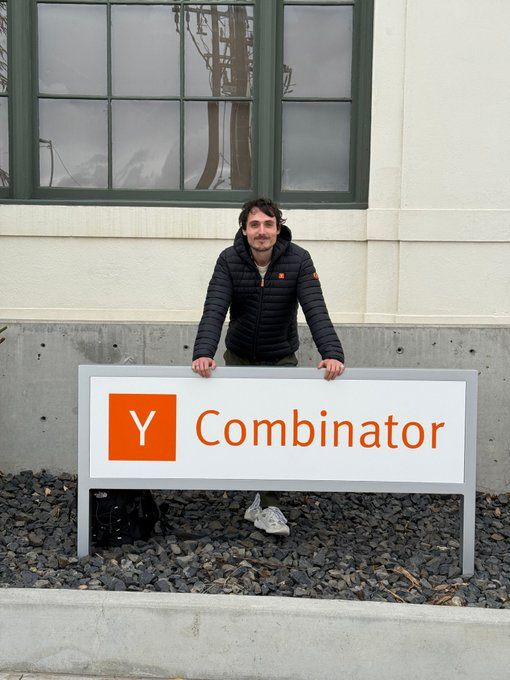
We went from 0 to 2,200 paying customers in under a year by following @ycombinator's 15 rules:
1/ Do things that don't scale. Get your first 10 customers by hand.
2/ Launch now, not when it's "ready". A mediocre product in front of real users teaches you more in a week than 6 months of polishing in the dark.
3/ Charge from day one. If nobody will pay, you don't have a startup, you have a hobby.
4/ Talk to users every single day. The roadmap you need is sitting in your customers' heads, and they'll hand it to you for free
5/ Always hunt the 90/10 solution. For almost any feature there's a way to capture 90% of the value with 10% of the effort.
6/ There are only two real jobs: write code and talk to users. Everything else (conferences, press, VC coffees, corp dev calls) is fake work.
7/ You pick your customers as much as they pick you. 10 users who love you beat 1,000 who kind of like you.
8/ Growth is an output, not a strategy. Grow before product market fit and all you're buying is churn.
9/ Do less, really well. Pick one or two metrics and judge every task against them.
10/ Know if you're default alive. Paul Graham's question: on current growth and current burn, do you reach profitability before the money runs out?
11/ Don't hire until it hurts. Headcount is not progress, it's burn. Every great startup was embarrassingly small for embarrassingly long.
12/ Momentum is the only real moat in year one. Ship something every week, even something tiny.
13/ Every great startup is badly broken at some point. The game isn't avoiding fires, it's how fast you put them out. Again. And again
14/ Ignore your competitors. Startups die of suicide, not murder. In year one, the only company that can kill yours is your own
15/ Startups rarely die from running out of money. They die because the founders fall out. Brutal honesty with your cofounder is the cheapest insurance you'll ever buy
Good luck !
Claude opus 4.8 dropped and Anthropic released Boris Cherny's prompt workshop
One of the people actually building claude explains how to use it properly
Free
No signup
No paywall
The first 8 minutes are better than most $300 ai courses
Context
Task structure
Cleaner outputs
Fewer wasted prompts
Watch it and bookmark it before this gets sold back to you as a course
We’re thrilled to open-source LabClaw — the Skill Operating Layer for LabOS by Stanford-Princeton Team
One command turns any OpenClaw agent into a full AI Co-Scientist.
Demo: https://t.co/TgGtKO2lxQ
Dragon Shrimp Army reporting for duty 🦞🔬
#AIforScience#OpenClaw
@dwarkesh_sp The power should be in the people. So maybe AI company should reserve the right to publish facts if the government is to do something bad to its people, so that the people are informed through news and able to veto or curb or stop providing tax fund to that government action.
influence of all wrong data are eliminated, that way AI shall result to (converge to) truth about any subject matter. And AI shall be able to surpass human intelligence and discover new fundamental principles of nature and science society. (2)
WrongDataRightAI - train AI with partially wrong data, then if AI is truly able to do reasoning, it should be able to find conflicts within itself. Now AI should be able to talk to himself or other AI models and generate new correct or wrong data, and keep interacting until (1)
I'm Boris and I created Claude Code. Lots of people have asked how I use Claude Code, so I wanted to show off my setup a bit.
My setup might be surprisingly vanilla! Claude Code works great out of the box, so I personally don't customize it much. There is no one correct way to use Claude Code: we intentionally build it in a way that you can use it, customize it, and hack it however you like. Each person on the Claude Code team uses it very differently.
So, here goes.