Songwriter, former columnist for the Guardian, President, European Composer & Songwriter Alliance (ECSA). Founder #PaySongwriters. Views my own. 🇸🇪🇬🇧🇪🇺
Hey OpenAI, when are you going to do what @sama told Congress was the right thing to do three years ago—to only use creative works to train AI models pursuant to freely & openly negotiated consent & fair compensation? How can an unfairly trained model ever be safe?
@GaryMarcus
I feel very uncomfortable about the AI Security Institute, and this article by its creator, ex-PM Rishi Sunak, encapsulates why:
He frames it as a way of avoiding regulating AI.
He says this categorically. “If politicians are blithe about the risks [of AI], they will vote for those who favour regulation.” And he makes it clear he thinks regulation would be bad: “western governments shouldn’t restrict innovation in the race against China.”
This is a man who now works for both Anthropic and Microsoft (not disclosed in the article).
Evaluating the safety of AI models is good. But not in place of regulating the technology itself, and the companies behind it.
Besides, as he points out, companies only give the AI Security Institute access to their models voluntarily. This means the UK government relies on good relations with big tech, which in turn makes it even less likely to regulate.
It is far from clear how much the AI Security Institute has actually achieved with its astronomical public funding. What *is* clear, though, is that the people who set it up see it as a way of ensuring *less* regulation of AI companies, not more. This is very bad news.
Reading the Papal Encyclical again, it strikes me that not only is there no mention of the theft of creative work behind AI - there is no acknowledgement that pre-training data includes people’s creative work at all.
This is an unfortunate omission.
It mentions data several times, but mostly referring to things like health data and personal data. There is no recognition that the pre-training data on which much of the AI industry is built is people’s books, music and art.
This reinforces a common misunderstanding of ‘training data’ as something anonymous, technical and obscure, when in fact it is people’s life’s work - their novels, their paintings, their songs. Readers of the encyclical who are new to AI will, I think, misunderstand what ‘training data’ actually is.
This is a coup for the AI industry, which greatly benefits from rebranding ‘people’s creative work’ to ‘training data’, since the rebranding makes it less likely that governments will protect creators’ rights.
It is hard to reconcile this omission with a letter that elsewhere, admirably, reiterates the need to “promote the dignity of every person”, and that says “justice concerns every phase of economic activity, [including] resource acquisition”.
We must remember that training data is not ‘data’ in the sense most people understand it. It is the work of people - often highly creative work.
Let me trace the timeline here because nobody's connecting it.
Step 1: Scrape the entire internet. Every book, every article, every conversation, every piece of art, every forum post. Do it without asking. Do it without paying.
Step 2: Train a model on all of it. Call it "artificial intelligence."
Step 3: Go to BlackRock's Infrastructure Summit and announce: "We see a future where intelligence is a utility, like electricity or water, and people buy it from us on a meter."
Step 3 is where you sell people's own knowledge back to them. On a meter.
They took the collective output of human thought, compressed it into a model, and now they want to charge you by the token to access a version of what you and everyone you know already created.
One Reddit user put it perfectly: "They stole all this data from us, the people, our life's work, creativity, art, by devouring the internet and blowing through all copyright laws. Now they want to sell it back to us in the form of a utility."
Imagine if someone photocopied every book in the public library, burned the library down, and then opened a subscription service for the copies.
That's the metered intelligence business model.
And they're pitching it to infrastructure investors as though they invented water.
Scraping websites and having AI summarize them, so that no one visits the websites, is theft.
Training AI on videos, so that it can make new videos that compete with them, is theft.
We are witnessing the largest theft of creative work in history.
Politicians who boost AI do not represent the views of their constituents.
New polling in the UK shows:
- Most people think AI will destroy more jobs than it creates (57% v 17%)
- 7 in 10 are worried about the economic impact of AI-driven job losses (3 in 10 very worried)
- 1 in 5 think this will cause civil unrest (and 1 in 3 students)
- Most people think companies will use savings to invest in more AI, not more people (59% v 15%)
- 65% think AI’s economic benefits will flow mainly to wealthy investors and large companies (vs 13% who don’t)
Full research from King’s College London here: https://t.co/jFutwB7nt4
@neilturkewitz This is anecdotal, but I work in music and I talk to loads of younger and older songwriters and artists - and I find that the majority of the younger ones don’t like AI. They want authenticity.
If you want to support an artist who took the fight to AI companies, consider supporting Kelly McKernan.
They lost a ton of income after AI companies trained on their work without permission. So they fought back, filing a class action lawsuit against Stability AI, Midjourney & DeviantArt, along with Sarah Andersen and Karla Ortiz.
Now they are raising money to move across the country to take up a place on the MFA program at Pacific Northwest College of Art. And a donation gets you some of their amazing art :)
https://t.co/B5afmiSj34
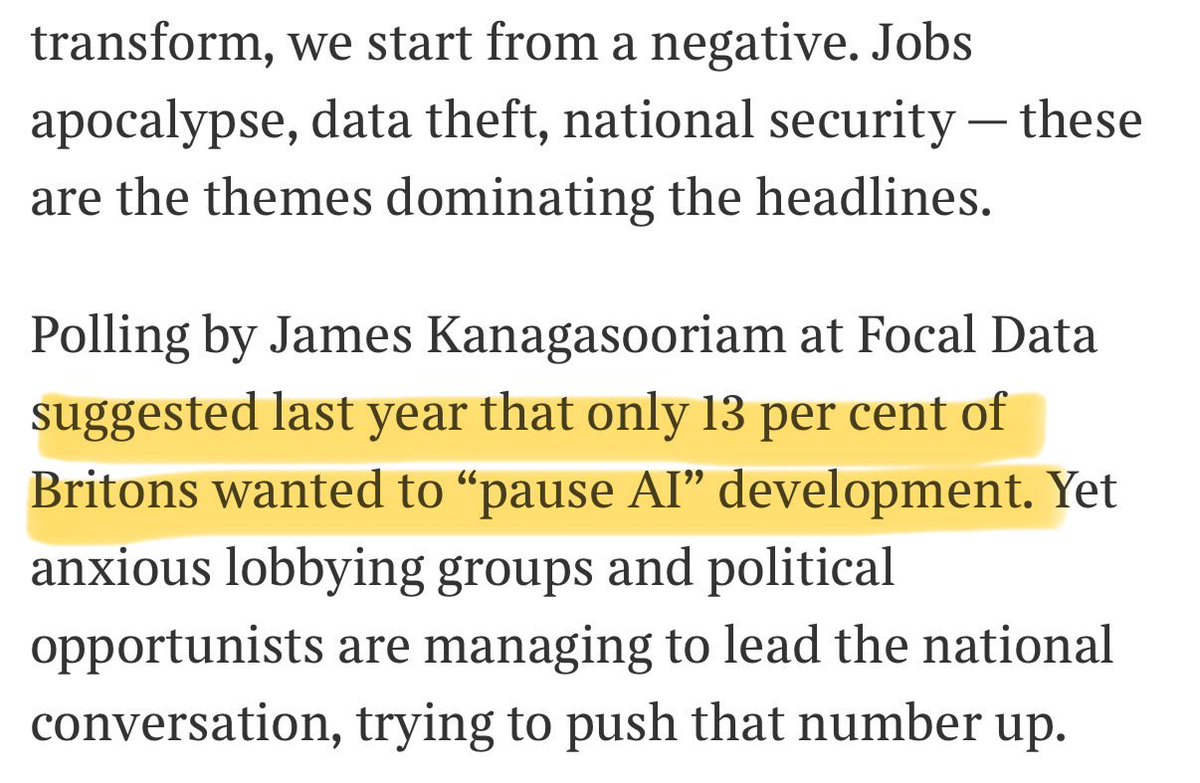
The Chair of the UK’s Sovereign AI Fund, writing in The Times yesterday, misrepresented polling data on AI - a mistake I think is significant enough to flag.
Arguing that ‘Britain must embrace AI’, he said a poll last year suggested ‘only 13% of Britons wanted to “pause AI” development’. But this is false: the poll in question didn’t ask about pausing AI development at all.
I’ve read the poll. The 13% figure he cites seems to be the pollsters’ own segmentation of a group they called ‘Tech Sceptics’ - which they created based on people’s answers to a range of questions, none of which asked about pausing AI. These included asking the extent to which people agreed with statements like “Britain needs to move fast in adopting new technologies".
This was an op-ed in a leading national paper. It is obvious that polling showing low public appetite for pausing AI might be an attractive thing to include if you're making the argument he was making. But only if that polling actually exists.
People will rightly believe the stats they read in The Times are true. So it is important they are - particularly when the author chairs a £500M taxpayer-funded unit, and is writing about questions of national AI policy.
Her full name - according to her - is not Suzanne Ashman. It’s Suzanne Ashman Blair. She’s just been appointed head of UK govt-funded Sovereign AI & her father-in-law - Tony - has a ton of skin in…you’ve guessed it, the sovereign AI game.
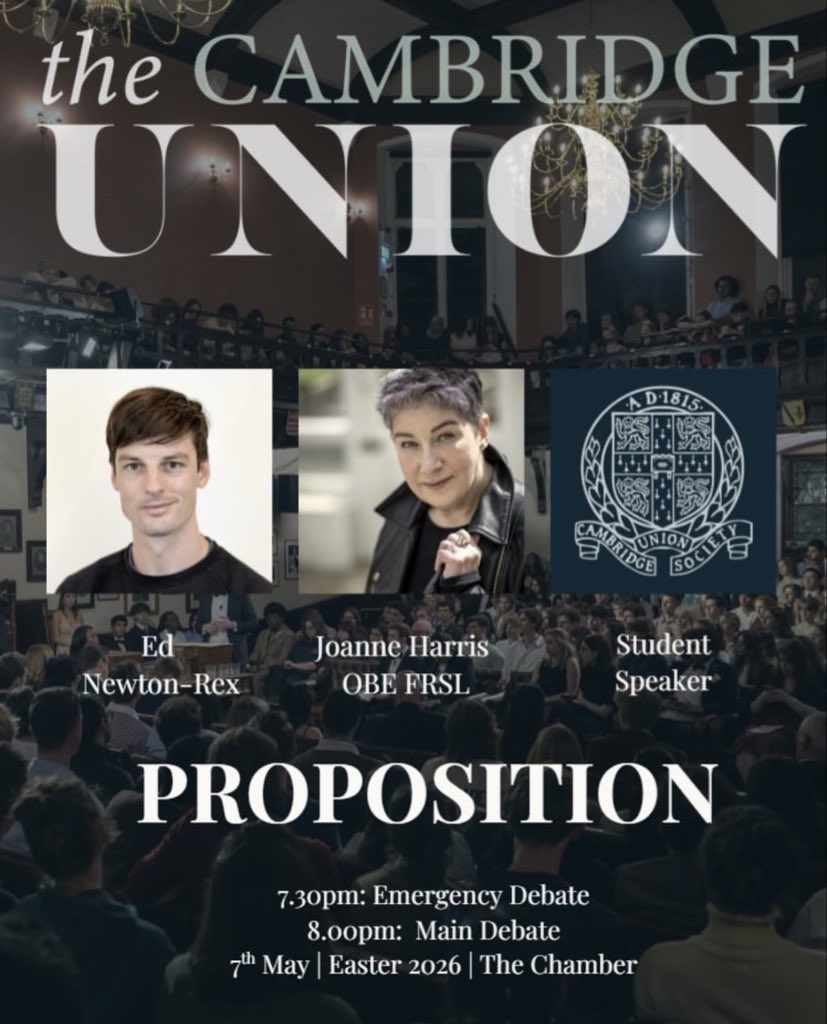
It’s hard to think of a more important question in the arts today than how we respond to the threat of AI.
Very pleased that the Cambridge Union is having this debate, and to be taking part.
“This house believes AI will kill the artist.”
8pm tonight.
Here are the facts as laid down by Derbyshire:
1) Farage says he won’t run
2) crypto billionaire pays him £5mill
3) Farage U-turns and runs
4) Farage hides the donation
5) Farage announces if he wins the election he will slash capital gains tax for crypto firms
Same old same old
“GenAI doesn’t show objectively any gain in productivity, any gain in scientific discovery or any gain in employee performance—but we’re told we have to implement them in such an aggressive manner. What are we afraid of missing out on, exactly?”
—@nataliyakosmyna
@ednewtonrex I think YouTube’s CEO meant “the only company allowed to scrape audio from YouTube for training is YouTube”, considering they now provide a button to replace music that’s been flagged for copyright infringement with AI music
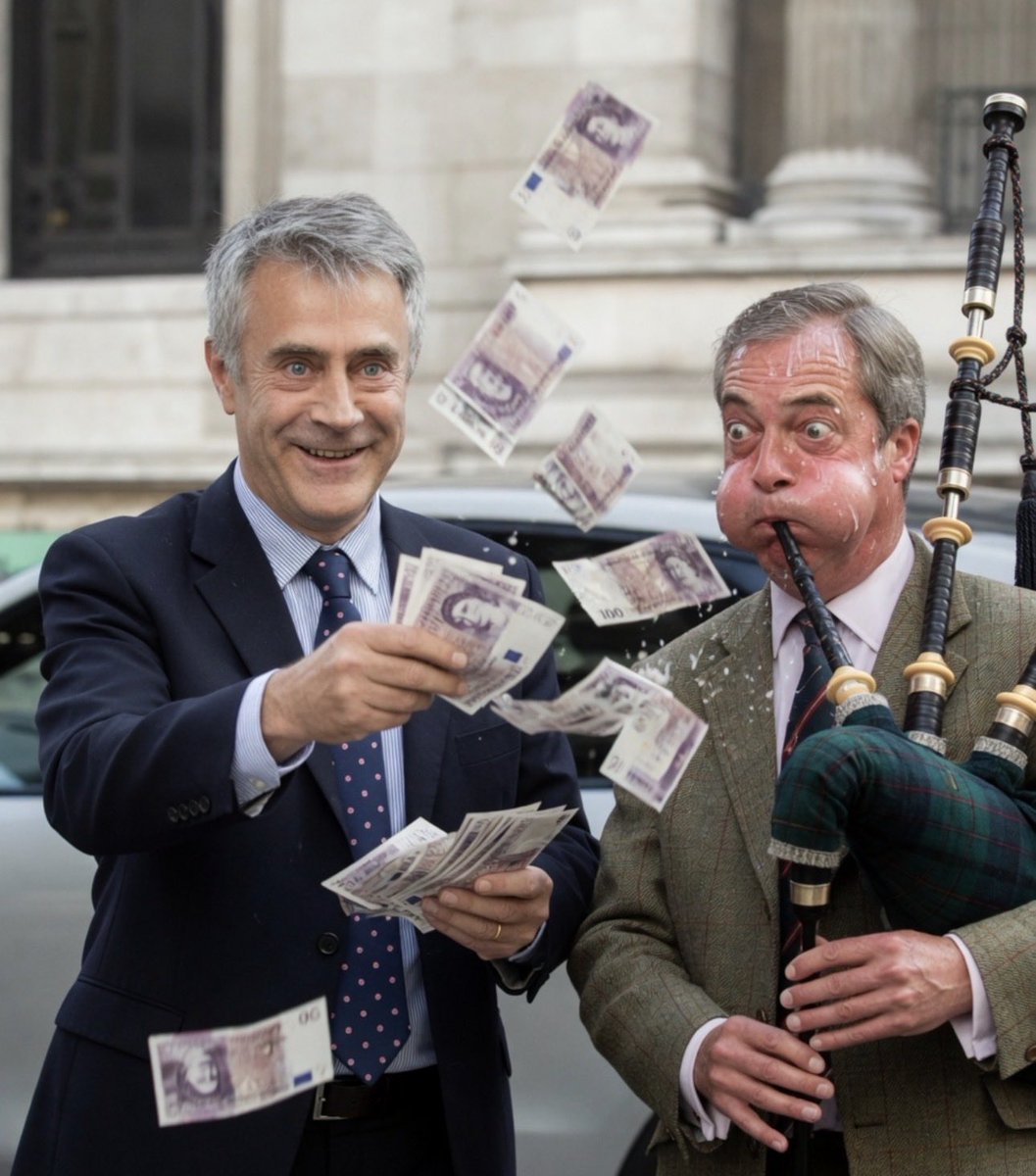
As Tom Burgis points out @LBC@lewis_goodall - Farage’s sugar daddy has actually given the Brexit/Reform party (they are essentially the same) £27 million since 2019. What does Harborne get for his money? “He who pays the piper calls the tune”





![ednewtonrex's tweet photo. I feel very uncomfortable about the AI Security Institute, and this article by its creator, ex-PM Rishi Sunak, encapsulates why:
He frames it as a way of avoiding regulating AI.
He says this categorically. “If politicians are blithe about the risks [of AI], they will vote for those who favour regulation.” And he makes it clear he thinks regulation would be bad: “western governments shouldn’t restrict innovation in the race against China.”
This is a man who now works for both Anthropic and Microsoft (not disclosed in the article).
Evaluating the safety of AI models is good. But not in place of regulating the technology itself, and the companies behind it.
Besides, as he points out, companies only give the AI Security Institute access to their models voluntarily. This means the UK government relies on good relations with big tech, which in turn makes it even less likely to regulate.
It is far from clear how much the AI Security Institute has actually achieved with its astronomical public funding. What *is* clear, though, is that the people who set it up see it as a way of ensuring *less* regulation of AI companies, not more. This is very bad news.](https://pbs.twimg.com/media/HJoj-gdWoAE6ou5.jpg)