Nick Fuentes: Despite the fact that he and Charlie Kirk didn't see eye to eye, after Charlie was murdered Nick filled the void he left, which aided in boosting Nick's generational run and mainstreaming him.
I think there is no doubt that he is one of the most accurate political commentators today, and filling this void isn't to take away from his skills as a pundit, I think it just accelerated his timeline; he was always going to see success if he maintained accuracy in his analysis while maintaining and growing a diehard audience while also talking about subjects others refused to. The end of cancel culture and wokeism also aided in his generational run, it was the perfect storm for him, and that doesn't even include the flooding of the United States with foreigners, forcing White men (especially young white men) to embrace who they are as a group.
I think Nick Fuentes is the voice of more Generation Z and Millennials than National Review Conservatives would like to admit, and there's no way to stop him when he is proven right more frequently than others.
@owenthcarey You said this before but getting Christian men into a dead job isn’t the answer. We need Christian AI product engineers and product managers. Look towards the future.
American-made products are not impossible. Stories about iPhones costing $37,000 or laptops costing $100,000 are psy-ops, sometimes pushed by foreign adversaries but more commonly by American corporations that want anything but an upset to the status quo.
🟠 "I was fired at the height of my career."
That's Palmer Luckey on 60 Minutes.
60 Minutes asked him why.
"It boils down to I gave $9,000 to a political group that was for Donald Trump and against Hillary Clinton."
It was 2016 in Silicon Valley.
"A lot of people thought back then that you could just fire a Trump supporter."
He didn't disappear.
"I really wanted to prove that I was somebody, that I was not a one-hit wonder."
He went on to build Anduril.
OPINION: Best thing that ever happened to him was getting fired.
I'm the absolute WORST when it comes to promoting our products and services, which is sad because I'm the CEO.
I really need to change that, but I also don't like to brag and I don't talk about 90% of the things that I'm involved in.
Earlier this week, though, we quietly launched a new intelligence platform called Community S2.
Our Watchfloor platform is for national + global intelligence.
Community S2 is just like it sounds: a real-time intelligence platform for the local/tactical level.
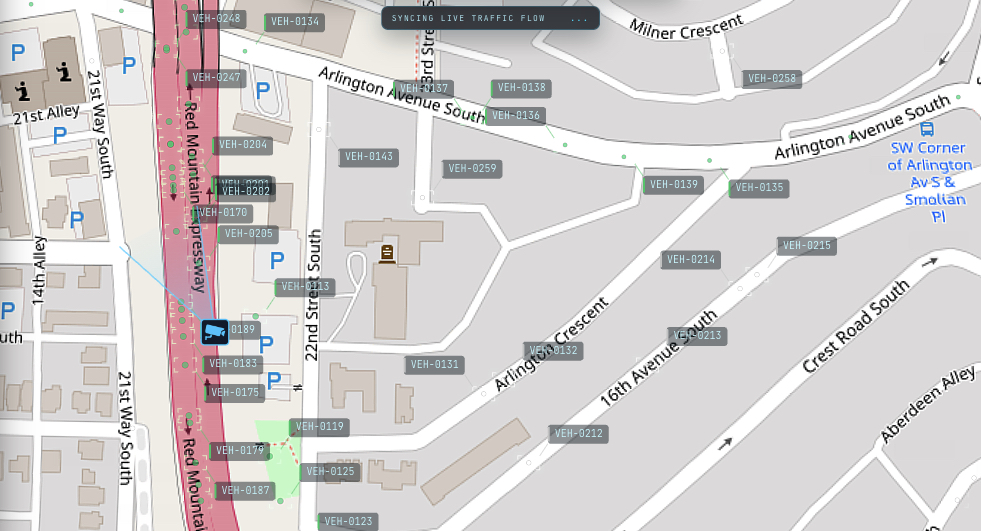
This morning, I was checking out the latest real-time traffic feature.
Each of those dots is a vehicle that's being tracked in real time as they drive down the road.
So imagine this: there's a protest or a riot, or a chemical spill, or some emergency.
You log on, bring up the live map, add in a few data layers along with real-time news and social media, get the gist of what's what's happening and how it affects you, and you now have actionable, real-time intelligence on the situation.
We just opened up to the first 150 seats this week. As of this morning there are 22 left.
I'm not saying that you should go right now and sign up because you'll get a free copy of the *new* Area Intelligence Handbook (ebook) included...
... but if you go sign up right now you'll get a free copy of the *new* Area Intelligence Handbook (ebook).
I'm about to upload it now and send it out later today. The special edition is also going out to pre-orders, so thank you for the patience 🙏
Link in next post.
Dave Kennedy notes that most AI security products are just wrappers for existing models like Anthropic or OpenAI. True advancement lies in fine-tuning your own models with proprietary data and expertise, not just adding a seasoned persona. #AISecurity#Cybersecurity#AI
The best thing with a non-technical client who vibe codes: having them do the front end ‘identical’ to what they want. Saves lots of discussions, you know exactly what they want and then you make it a reality. Basically in the category of wireframes and saving lots of time.
L’industrie de la robotique humanoïde se bat entre deux approches
Et il est extrêmement important de les connaître
1. Main à tendons (tendon-driven)
Les moteurs sont dans l'avant-bras. Des câbles tirent les doigts, comme nos tendons.
+ Doigts légers, très dextres, souplesse proche de l'humain
- Fabrication et calibration complexes. Pour réparer, il faut souvent démonter le poignet.
Exemples : Tesla Optimus V3, 1X NEO, Agibot Omnihand Pro.
2. Actionneurs dans les doigts (in-finger)
Chaque moteur est dans la paume ou la phalange qu'il bouge
+ Contrôle simple, assemblage simple, maintenance facile
- Doigts plus lourds, moins de dextérité, chaleur difficile à évacuer
Exemples : Figure 03, Unitree Dex5-1, Sharpa Wave, Robotis HX5
Aucune des deux n'a vraiment gagné
C'est la question ouverte du hardware humanoïde en 2026
in the past month, we've catalogued over 16k protests across 3,600 geo-tagged locations.
@fowatchfloor is building the local intelligence picture for you ahead of 2028.
when i say that no other outlet can provide better local intelligence than we can, brother, i mean it.