Every KV cache evictor for efficient long reasoning scores cached tokens to decide which ones to keep. We find the score buys almost nothing: keep the prompt, evict at random per head, and you match the strongest evictor at 32–43% higher throughput.
Paper: https://t.co/TvQwOymVfE
Page: https://t.co/eeyLhJRkDj
I am excited to be joining CS@U Wisconsin-Madison in Fall 2027! I will recruit PhD students. If you are also enthusiastic about researching how LLMs work and/or applying them to other scientific problems, please apply and mention me in your application. @WisconsinCS
We identify a blind spot in (M)OPD for post-RL consolidation:
Students may not inherit their teachers’ generalization capabilities, though they achieve near-perfect in-distribution distillation performance. 🧵
@Karim_abdelll The same problem, if not worse, with their Go experiment (Exp 6). I'm not even sure whether PPO learned anything beyond some simple heuristics.
(1/9)Suppose you're training an LLM on web data with limited math data. Should you place all your math data at the end of training, or mix it with web data earlier? The answer flips with the learning rate (LR) schedule!
At fixed compute and mid-training (MT) token budgets, earlier mixing gives lower MT loss when LR decays throughout training. With constant LR, placeing all MT data for the end works better.
We then vary when LR decay begins. The best tested strategy: keep LR high after MT data enters, then decay near the end.
See our new paper: "Data Schedules and Learning Rate Schedules Should Be Designed Together" !
📈 As models get stronger, data becomes saturated.
How can we still extract useful learning signals from saturated data in RL?
We study interventions on data, rollouts, rewards & advantages 🧵👇
Multimodal agent memory is on arXiv!
📈 From static retrieval, to dynamic update, to self evolving!
🤖 Across Image, audio, video, GUI, and Embodied agent.
📱Important for personal agent and RSI…
Explore our observatory and submit papers by website to contribute!
📝 https://t.co/tFJ4Lk1VRk
📄 https://t.co/PVVFgBK1KA
#AgenticAI #RSI #PersonalAgent
Multi-LLM collaboration is only as good as the team you hire 💼
With 2M+ open models, who joins the team?
We study strategic model selection: 9 strategies, from stated diversity to item response theory & idiosyncrasy signals, to LLM recruiters that interview candidates
🧵👇
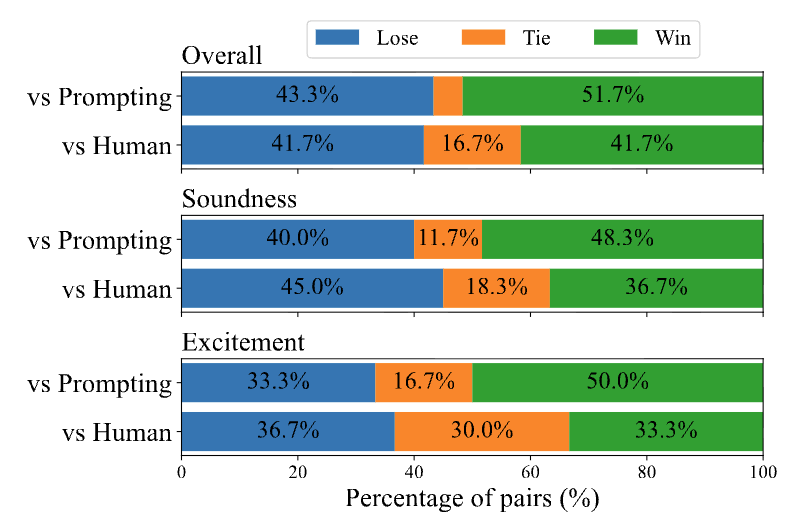
[6/n] 🚀 We also implemented 2 generated ideas with a coding agent:
• Strategy search: +4.17% on MATH
• Adaptive-sparsity model merging: consistent gains
Code: https://t.co/zPZqgpg9nL
🔬 Can we learn from the history of scientific discovery to train LLMs for future research?
Our #EMNLP2026 Findings paper presents a future-aligned ideation framework! 🧵
📄 Learning to Predict Future-Aligned Research Proposals with Language Models
🔗 https://t.co/5k5CY4klL5
Check out our new work on data synthesis for OPD! We learn to generate questions that elicit more informative teacher supervision, without ground-truth answers.
What should a student ask to learn the most from its teacher?
We train a model to ask better questions—without reference answers, correctness rewards, or per-question student updates.
Meet Ask-to-Distill (A2D). 👇
https://t.co/ipZDx03J4l
True discovery capability comes from not just blind exploring, but knowing when, what, and how much to explore, and adapting when the world quietly moves on.
@TencentHunyuan's ExplorationBench showed agents can discover hidden dynamics by experimenting, which is impressive. But every rule they find stays true forever.
We asked: what happens when the world silently changes under the agent?
Answer: they don’t notice. 36.3% of the time, models report the exact same dynamics before and after the change. Direction reversals? Caught only 10.8%.
GPT-6 Sol caps at 61.9%. No model breaks 70%.
The bottleneck isn’t reasoning: hand them good evidence and they’re fine. The bottleneck is knowing when what you know has expired.
📄 Paper: https://t.co/NaBjSPNnnK
💻 Code & data: https://t.co/fancZldoVc
Welcome to try, and let us know how your models do 🫡
When LLMs disagree, it's not noise: it's where they learn most 🔥
We learn best one step above what we know, and the frontier of model disagreement tracks that step.
Stackelberg Alignment: an EXP3 bandit leader steers multi-LLM collaborative post-training to that frontier 🧵👇
Too many papers, not enough time. So I built Good Papers 🍅: a Rotten Tomatoes for ML papers.
Swipe through this week’s papers. Right if it’s worth reading, left if not. Then see if readers and 20 AI reviewers agree with you.👉 https://t.co/pUBxe1q6y4