I am interested in these topics:
1. Cross Regime/Session timeseries prediction. Like cross-day/subject neural decoding and cross regime market cross section predictions.
2. Stochastic Process Modeling in Human Decision and derivative pricing .
3. Interpretable ML/DL/LLM theory.
🎥 Videos now available for:
COMPUTATIONAL CONSCIOUSNESS SCIENCE
A CCN satellite meeting, hosted and sponsored by the NYU Center for Mind, Brain, and Consciousness.
Website: https://t.co/pAFvbopg30
YouTube: https://t.co/BOuD9rnwbI
@CogCompNeuro@nyuconscious
Since we are into visualization craze, here is one about🧠#stroke and lateralization. If you want, check the whole paper about gradients: "Reshaped functional connectivity gradients in acute ischemic stroke" https://t.co/1YMWfZQk6Q
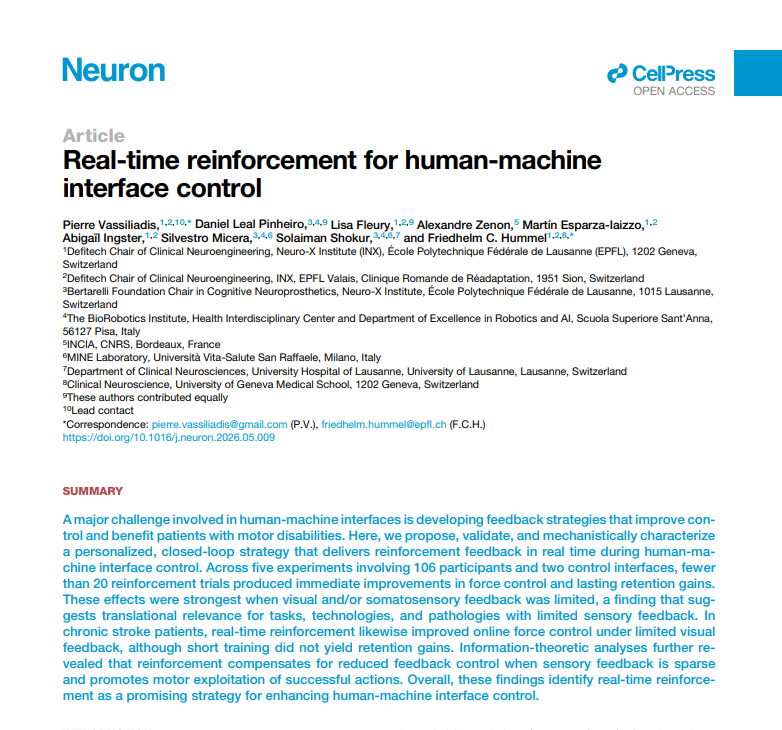
Real-time reinforcement for human-machine interface control
https://t.co/R0BsOOP45r
Summary
1. Real-time reinforcement improves motor performance: Personalized, closed-loop reinforcement feedback enhances force control during human–machine interface tasks.
2. Rapid learning: Fewer than 20 reinforcement trials produce immediate improvements in motor control.
3. Long-term retention: Improvements can persist after training, although retention gains were not observed after short training in chronic stroke patients.
4. Greater benefits with limited sensory feedback: Reinforcement is most effective when visual or somatosensory feedback is reduced.
5. Benefits for stroke patients: Real-time reinforcement improves online force control in chronic stroke patients under conditions of limited visual feedback.
6. Compensates for reduced feedback: Reinforcement helps maintain motor control when sensory information is sparse.
7. Promotes successful action selection: Reinforcement encourages individuals to repeat and exploit motor actions that produce successful outcomes.
8. Translational potential: This strategy could improve rehabilitation and control of human–machine interfaces, particularly for people with motor disabilities.
Cognitive computational neuroscience
https://t.co/36JzFigmF8
1/ Move beyond brain mapping.
Mapping which brain regions activate during a task is not enough to explain cognition. We need computational models that reproduce behavior and explain how neural activity generates perception, learning, decision-making, and action. The goal is to understand the mechanism, not just the location.
2/ Build models that perform cognitive tasks.
Allen Newell argued that understanding cognition requires constructing systems that actually perform the functions we want to explain. A theory of decision-making, for example, should predict choices under different conditions—not merely describe them verbally. Simulations help test whether proposed mechanisms work together to produce intelligent behavior.
3/ Integrate three disciplines.
Cognitive science explains the computations underlying thought; computational neuroscience investigates how neural circuits implement those computations; AI develops algorithms that perform complex tasks. Each provides different constraints. Combining them could produce models that are simultaneously behaviorally effective, computationally explicit, and biologically grounded.
4/ Neural networks are a bridge between brains and AI.
Deep neural networks learn hierarchical representations that can resemble those observed in biological sensory systems. Research has shown that networks trained for object recognition can predict aspects of visual cortical representations. However, predictive similarity does not prove that the brain uses the same algorithms. Models must also be tested against neural and behavioral evidence.
5/ Biological neurons offer more than artificial units.
Most conventional artificial neural networks use simplified units that combine inputs and apply nonlinear transformations. Biological neurons exhibit action potentials, dendritic computations, recurrent signaling, oscillations, and complex temporal dynamics. Incorporating these features into task-performing models may reveal computational principles that simpler AI architectures overlook.
6/ Neural decoding is not a complete explanation.
Decoding asks what information can be extracted from neural activity. Encoding models predict neural responses; representational similarity analysis compares patterns of activity; connectivity models examine interactions. These methods constrain theories, but they do not necessarily explain how the brain transforms information to solve a task. Mechanistic models must connect representations to computation and behavior.
7/ Bayesian inference offers a theory of perception and reasoning.
The brain must interpret noisy sensory information using prior knowledge about the world. Bayesian models formalize this process by combining prior beliefs with incoming evidence. Generative models go further by representing how hidden causes produce observations. They offer a framework for studying uncertainty, causal reasoning, concept formation, and the ability to learn from limited experience.
8/ Learning and control require multiple strategies.
Reinforcement learning provides a framework for understanding how actions and feedback shape future behavior. Model-free approaches learn values or policies from experience; model-based approaches use an internal model to evaluate possible outcomes; episodic approaches reuse specific past experiences. Understanding how biological brains combine these strategies could inform more adaptive AI systems.
9/ Combine bottom-up and top-down approaches.
Bottom-up neuroscience begins with neurons, circuits, and measured activity. Top-down approaches begin with a cognitive function and ask what computations are required to perform it. Neither is sufficient alone. Strong theories should explain how biological mechanisms support meaningful behavior—and use behavioral requirements to identify which neural mechanisms matter.
10/ The future is an integrated NeuroAI.
A major challenge is to connect three levels: computational goals, representations and algorithms, and neurobiological implementation. This requires collaboration across neuroscience, cognitive science, mathematics, and AI, along with shared datasets, models, tasks, and evaluation methods. The ultimate ambition is to build systems that perform intelligent tasks while explaining how brains learn, represent knowledge, and adapt.
The big idea:
The next leap in AI and neuroscience may come from treating the brain not simply as a source of data, but as a system whose computational principles can be tested through models that connect neural mechanisms to intelligent behavior.
In July GPT5.6 Sol setup a parameter-matched ablation with strange 256to1068to4 for me but everything on lr scheduling follows karpathy’s advice. But now astra prefer no scheduling with fixed lr makes me annoying.
Humans can still surpass LLMs in training intuition (in some cases).
Indeed, Kaiming He used his intuition to create ResNet, without producing 1M-token CoT like today's LLMs do.
Introducing Architecture IQ -- Measuring training intuition. Even top LLMs are far from perfect.
What if embodied agents could learn to plan instead of just learning how to act? 🧠🤖
Introducing Generative Trajectory Planning (GTP)! 🚀
Instead of learning policies through RL, GTP imagines possible futures, plans ahead, and learns to plan better through experience.
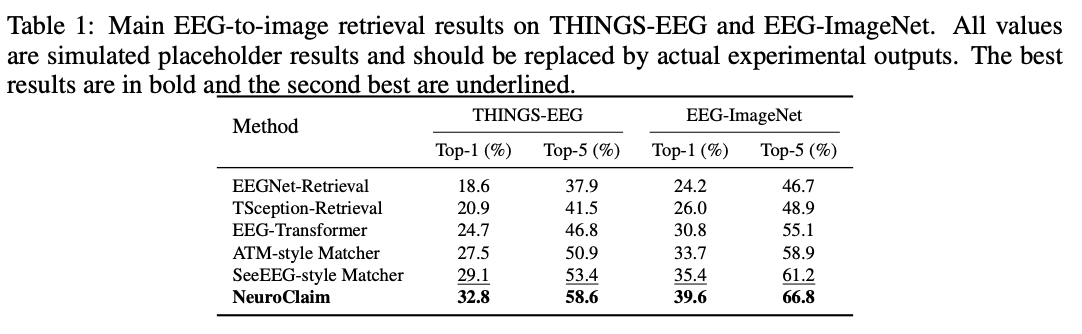
How do you tell if authors fabricated their research results? Sometimes: they just tell you. Read, e.g., this caption carefully.
Another banger of a post by my friend Nihar B. Shah on his blog, where he found at least 20+ such #ICLR2027 submissions:
https://t.co/TBKmnMjTiy
Our latest paper, “World Models with Configurable Perception”, explores configurable states as information bottlenecks for robust planning in noisy worlds.
⬇️
Paper: https://t.co/YqvjITUeSp
Web: https://t.co/piXqdM2nhK
Code: https://t.co/6VnlnRnNJe
Data: https://t.co/7J8f74Qsbt