🎥 Videos now available for:
COMPUTATIONAL CONSCIOUSNESS SCIENCE
A CCN satellite meeting, hosted and sponsored by the NYU Center for Mind, Brain, and Consciousness.
Website: https://t.co/pAFvbopg30
YouTube: https://t.co/BOuD9rnwbI
@CogCompNeuro@nyuconscious
The video is lovely. And I could not express in a tweet what David Hubel means to me. But I also believe systems neuroscience needs, for its life, to escape the curse of this Sydney Brenner quote, which may be the dark side of the legacy of Hubel and Wiesel. We will not understand the brain just by listening to neurons (even lots of them), showing random stimuli, and hoping for the best. It's not 1962 anymore. We need new ideas, we need a conceptual framework to go after how the brain works as a whole, and we need to intentionally pursue a research program to test these ideas.
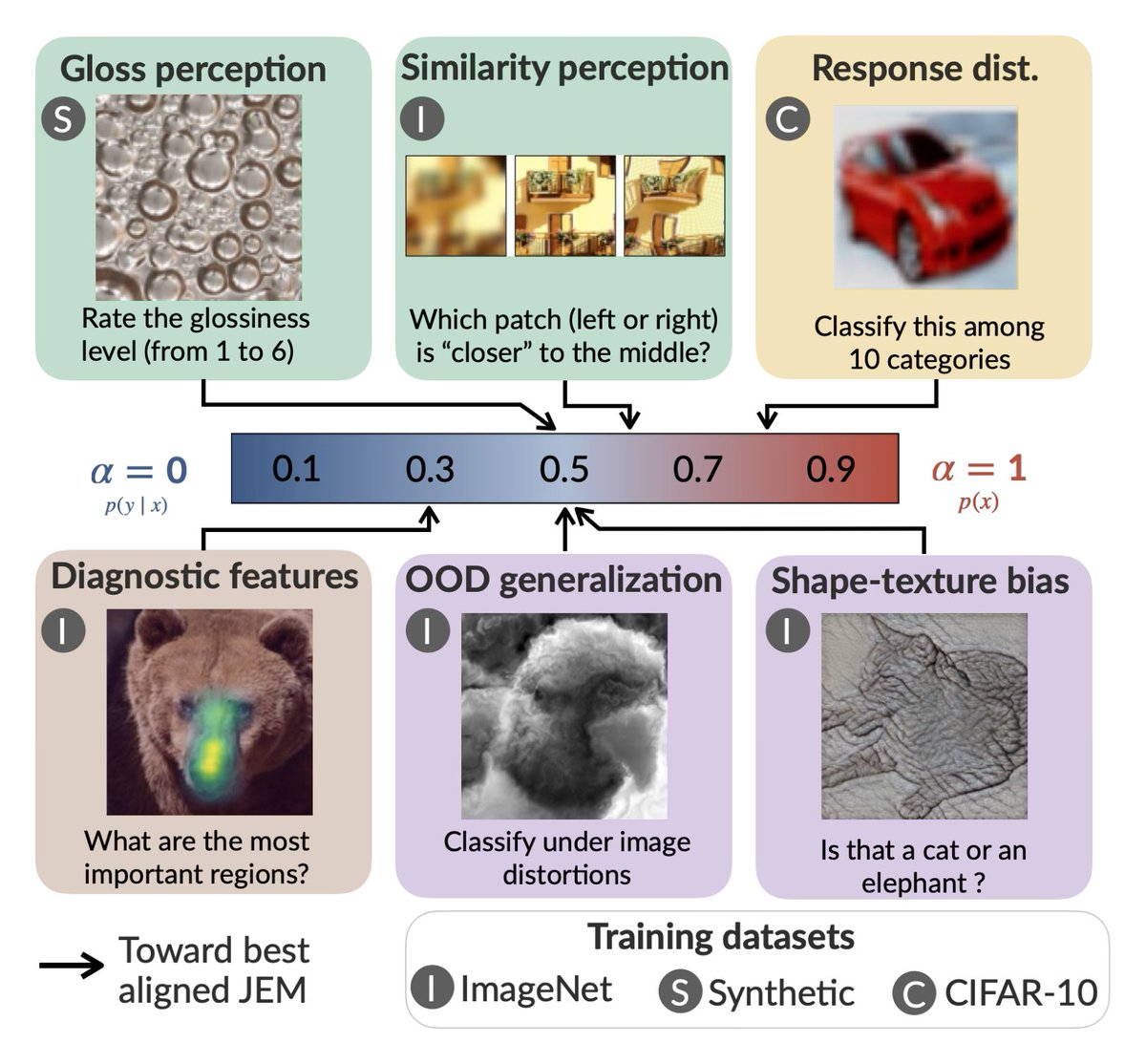
Is vision better explained by generative or discriminative learning ? 🧠👁️
Our #NeurIPS2026 paper says: neither!
With Joint Energy-based Models (JEMs), we trained one network across the generative↔discriminative continuum. Human alignment peaks in between. 🧵
I've been slow to post, but @benbenbrubaker wrote a very nice article in @QuantaMagazine on AI "introspection", that focuses on the surprising and weird "thought injection" paradigm due to @Jack_W_Lindsey.
If you don't know about this paradigm, it's really interesting! The article is a great introduction to some of the issues it raises. Also, @kmahowald and I make an appearance!
I've been a huge Quanta fan for a long time, but I never thought I'd actually appear there!
https://t.co/1mK4zDWo1J
Attendees of #SfN26: this is happening tomorrow! Sun Nov 15, 9:30 AM–noon EST (WCC Ballroom B), join us for MIN08: Neural Population Geometry and Dynamics in Flexible Cognition.
How does matter become bright inside? I am deeply excited to share our vision @AsteraNeuro for understanding and engineering consciousness.
We believe that perception and thought are constructed from fundamental building blocks, and that by understanding these blocks and how the brain combines them, we can explain the whole mystery of consciousness.
Writing this vision statement helped me think more clearly about questions that have long bothered me: Why did consciousness evolve? What are we actually conscious of? What is the self? How do different parts of the brain work together? How can we tell whether an AI is conscious? What scientific path can lead to real answers?
Part 1 presents a new theory. I propose that conscious experience arises from a coherent internal model of the world and the self built from 'persistent symbols.' I describe the neural representations and dynamics through which the brain could implement such symbols.
Part 2 lays out a roadmap to systematically discover the basic building blocks of perception, cognition, and the self-model, and to build the neural read/write technologies and org culture we need to get there.
Part 3 presents a dream: What will become possible once we acquire the ability to read and write experience--to truly engineer consciousness?
If you are a systems neuroscientist who feels something fundamental is missing from our field, I share this feeling. Understanding the phenomenon that compelled many of us to become neuroscientists in the first place should be a central organizing goal of our field. This vision statement lays out a research program to reach this goal.
If you read the vision statement and recognize that this is the mission you have been longing for, please get in touch, wherever in life you are right now.
I made this stone soup for you.
https://t.co/z8CRrEESce
🧵 Mech interp and NeuroAI are hard enough without you (and your agents) also having to fight the “plumbing” of inspecting and intervening on DNN internals. Introducing TorchLens 3.0, which aims to eliminate these plumbing problems once and for all, for any model. 1/
We are quite lucky at Columbia's Zuckerman Institute to have a Theory Center (10 PIs and ~100 grad students and postdocs) embedded in the same building with us experimentalists.
What is Theoretical Neuroscience? https://t.co/AiIy5NJ3Da
Excited to announce, with Anne Sereno and an amazing lineup of contributing authors—
The Binding Problem in the 21st Century: Perspectives across Mind, Brain, and Machine
Cambridge University Press, 2027
Stay tuned.
Some more AI-assisted teaching. This week, I gave our @bengurionu Cognitive and Brain Sciences sophomores a primer in multivariable calculus to help them develop an intuitive understanding of gradient descent, building on a smart lecture plan originally developed by @OrenShriki.
I used Codex to develop an interactive, fully client-side @plotlygraphs demo that visualizes how fixing all but one variable collapses a multivariable function into a function of a single variable—and how partial derivatives are simply ordinary derivatives of these one-variable functions.
Because the demo runs entirely in the browser, students can open it themselves and interactively explore the surfaces, slices, and derivatives.
The demo is available online and for download here:
https://t.co/7mGxSgwqLN
Cognitive Science at Dartmouth is recruiting PhD students to work collaboratively with me, Steven Frankland, Fred Callaway, and Emily Cooper. Come study the principles and mechanisms enabling us to perceive, understand, and plan! More info: https://t.co/QR69geEkWA
💯 fMRI is an extremely useful tool and in some cases the best way to test a hypothesis. It is nevertheless often dismissed by the rest of systems neuroscience. I find it crazy. People are hampering themselves by ignoring the largest (and sometimes best) source of evidence.
Every year, we look for top students to join our team as interns. If you are interested in building the future of XR experiences and interactions, send your portfolio here: https://t.co/MrJV8jrnQE 🦆
🎥 Videos now available for:
COMPUTATIONAL CONSCIOUSNESS SCIENCE
A CCN satellite meeting, hosted and sponsored by the NYU Center for Mind, Brain, and Consciousness.
Website: https://t.co/pAFvbopg30
YouTube: https://t.co/BOuD9rnwbI
@CogCompNeuro@nyuconscious
1/ Can brain inspired self-supervised objectives lead to more robust visual representations in DNNs?
Excited to share our preprint with @adeli_hossein, Tian Zeng, @KriegeskorteLab, Ning Qian
https://t.co/yXGKLWGMM4
A talk I gave at NYU about what I think is the most pressing problem for the science of consciousness right now. If I am correct, a significant part of the past ~30+ years of research on consciousness might be wrong. I explain how we can try to mitigate that problem.