Vision, neural networks, and open brain science. RT means "This may deserve more attention". Like means "I have read this (e.g. paper) and think it's solid."
To learn how brains compute, we need to experimentally adjudicate among competing computational hypotheses. How do we do this in the age of complex neural network models? New review paper: “Making models disagree to learn how brains compute” with @TalGolanNeuro, @SchuettHeiko
@andrewthesmart@vineettiruvadi@davidchalmers42 Neural network models are both engineered and trained, and their training is engineered. The "growing" metaphor is good in a number of ways, but that does not mean that consciousness and personhood inevitably emerge. That's exactly the conflation we need to overcome.
Our challenge is to overcome the intuitive conflation of intelligence, consciousness, and personhood. These are three different things that we struggle to distinguish because they covary in our pre-AI experience. @davidchalmers42 makes good points below, but we have to remember that AI is not an alien species descending upon us. It is a technology we are building. We can build AI without personhood. It will take philosophers to define personhood and engineers to ensure models stay clear of it.
If present AI systems were conscious like us, they would still be ghosts living in arbitrary dreams that we set up for them, and can be copied, modified, suspended and restarted. We cannot give ghosts the same rights as we give to the living, even if they are conscious.
This piece by Helene Landemore @landemore and Audrey Tang @audreyt may be more important than anything else I read this year. Implementing this proposal would be a giant step for democracy and could address the collective action problem of AI takeoff...
https://t.co/7cV9bEwvFg
Our paper on how the brain represents meaning across languages is out in @NatureNeuro (led by @devarda_a with @saima_mm@ev_fedorenko)!
https://t.co/O9HQ58V5aL
Original thread linked below 🧠
I'm excited to share that I'll be starting as a Group Leader at HHMI's Janelia Research Campus in the AI & Theory divisions next week! 🎉
I'll be building a lab at the intersection of generative AI and neuroscience, with a scientific mission: Understanding the brain through AI, and understanding AI through science.
I'm recruiting PhD students and postdocs to join as founding members of the lab!
Prospective PhD students can apply through the Johns Hopkins–Janelia joint graduate programs in Neuroscience and XDBio (Dec 1 deadline!).
Our research vision and how to join 🧵👇
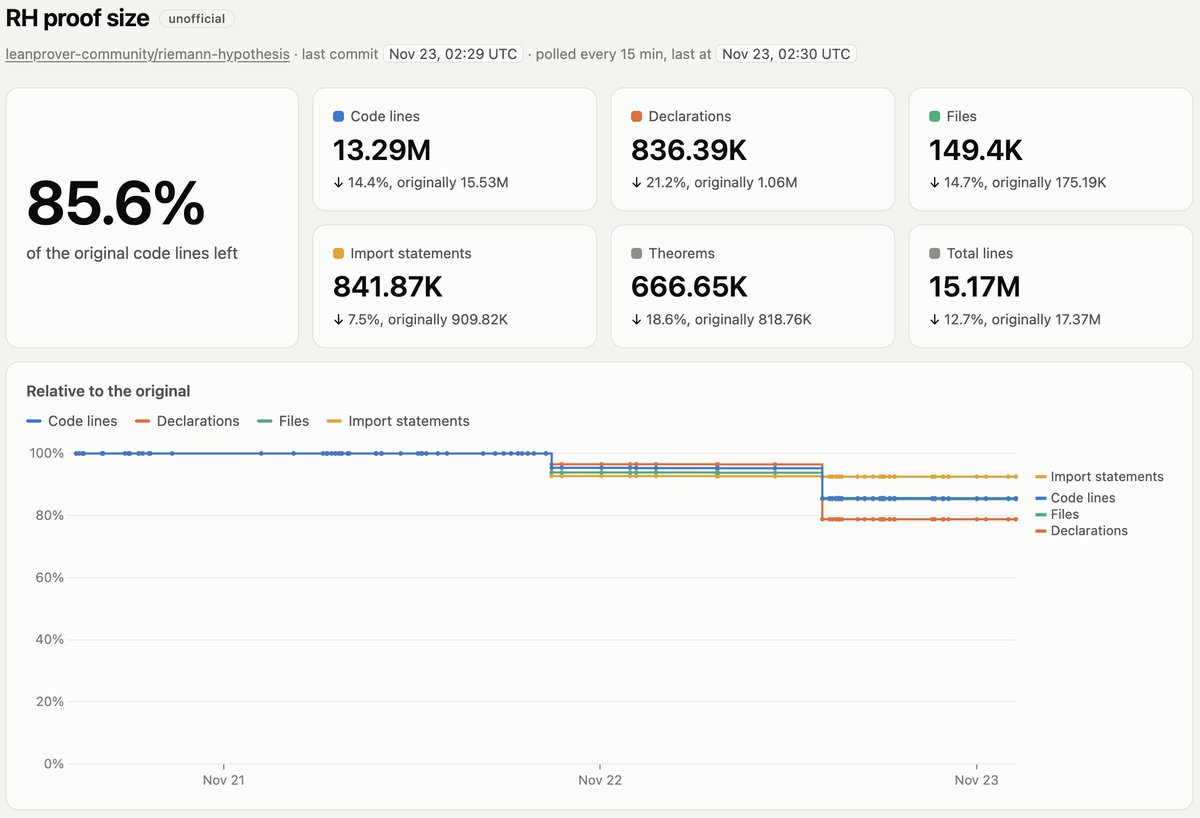
We are witnessing a real crowdsourcing of math, enabled by Lean. The proof of RH is getting faster, smaller, more modular, with less duplication. All enabled by Lean. I hoped for this version of mathematics ever since 2021 when I first taught myself Lean. I gave dozens of talks and Lean demos in the past five years trying to explain this vision of digitized mathematics that enables large fast collaboration, unification, improvement. I am very happy that it's finally happening, in real time.
Participate here: https://t.co/V6rmvpsRVC
Tell your AI "speed up RH, make a PR".
Btw, we don't have "real AGI" yet. The present systems are not conscious; unlike living minds, they don't try to make sense of the world and take control. That's part of the reason why self driving cars are still imperfect. Current AI learns largely by imitation and is only agentic to the degree that you prompt it, which makes it much safer and more steerable than the doomers predicted. The most likely outcome is that current AI is good enough help us understand how to build real AGI (artificial life-like minds), and to do it safely, i.e. at very small scales and under guard. (We will probably not want to deploy such systems in practice any time soon.)
Many of the "reasonable doomers" know that this is the most likely outcome, but they are concerned that there is a significant probability that things can go wrong, and self improving agentic AI takes over. Nobody can quantify this probability. But even if it is just 2%, or 8%, or 10%, can we really accept such a risk? Should we not do everything in our power to alert the public, and to be as alarmist as possible? Should we not create and maintain a movement that talks itself into believing that we are basically as good as dead, unless we somehow manage to stop all AI development? I don't think that stopping AI development is feasible or desirable. I believe that without AI, we are facing a likely civilizational collapse within the next century.
Please do remember: there is an overwhelming probability that things go well. And this will not just mean that AI leads into a world in which we barely survive, but into one that is significantly better than the one in which we live now. Without AI, we are faced with a crashing civilization, global warming, resource depletion, lack of social cohesion, famine, wars and eventual extinction due to the inability to deal with global cataclysms. AI is the technology we need to solve our problems and lead humanity into the future. AI is the technology of existential hope.
“We have full confidence that Alpöge's proof of the Riemann Hypothesis is correct.” -- Lean community confirms the *biggest* achievement in AI for math!
However, two points are worth noting:
(1) This proof is 17M lines of code!!! It speaks to the genius of Riemann that he could show how the zeros of the zeta function govern the distribution of primes and formulate his hypothesis 167 years ago, with nothing but pen and paper.
(2) One of the main reasons proving GRH mattered so much was the prospect of a much deeper understanding of mathematics, perhaps even the discovery of new subfields. An AI-generated proof we cannot yet understand doesn’t, by itself, deliver that understanding. It may still take a while to extract the ideas that mathematicians can build on.
Many people have asked me which library I use for my simulations, and I didn't have an answer until now. Excited to share that I'm releasing algovivo, a JS + WASM library to simulate soft-bodied virtual creatures.
demo: https://t.co/BAO8Zgh58h
code: https://t.co/TpgVTWiMYu
🧵
Slides from my talk yesterday @Columbia_Biz Continual Learning in Minds and Machines Workshop: https://t.co/5SX6bekTYr
Covered:
- Metalearning continual learning algorithms
- Key-value memory in the brain
- (briefly) Retrieval-centric DL
+ hinted at new RNN ideas I'm exploring.
There is a common belief in the AI field—that advanced AI means the inevitable forfeiture of human primacy in the world. Even many who disfavor that future believe it is likely. I call this the silent consensus, and it must not be allowed to remain silent any longer.
There is a common belief in the AI field—that advanced AI means the inevitable forfeiture of human primacy in the world. Even many who disfavor that future believe it is likely. I call this the silent consensus, and it must not be allowed to remain silent any longer.
I like the work but disagree with the conclusion "publishing is dead". It's a heavily flawed system, yes, but it served us for decades. We have failed again and again to redesign it. Now we have the perfect opportunity and we just throw it away, failing again. It's not obvious that some new emerging system will be any better (e.g AI writing, AI reviewing).
Instead, we should start actively designing the system. At least I prefer working on that, instead of just giving up.
In my ongoing quest to find the limits of Opus 5.5, I directed it to audit my old scientific field, theoretical astrophysics. We indexed about 150,000 papers, audited 50,000 for issues, and did progressively more thorough checks on thousands more. We found nearly 1000 major errors that got cited many times, most are still uncorrected. This survey enabled me to estimate the efficacy of peer review for correcting errors (not very good) and to identify dozens of open questions that anyone with spare Claude Max tokens could answer today (.md context files included).
Bottom line: AI can speed up quantitative science by >1000x with no further model improvement required. But I'm seeing no evidence of this being pushed within universities, only academics complaining about labs dropping math proofs.
Among my fellow reformed academic high agency founders, however, several are speed running entire disciplines.
This survey has implications for how science will be run in the very near future. Hint: Academic publishing is dead. It was already a very stupid way to record and promulgate knowledge, and had been so for decades, even before all that publicly funded knowledge was locked behind paywall cartels. Now AIs can generate thousands of novel, correct papers per day, it is no longer meaningful for humans to consider a research paper a "unit of science" or to even bother much with the 99.9% of science which, up to this point, was necessary drudgery. Time to discover something like General Relativity or Evolution every week. LFG!!
Enjoy: https://t.co/BhRxKVvbim
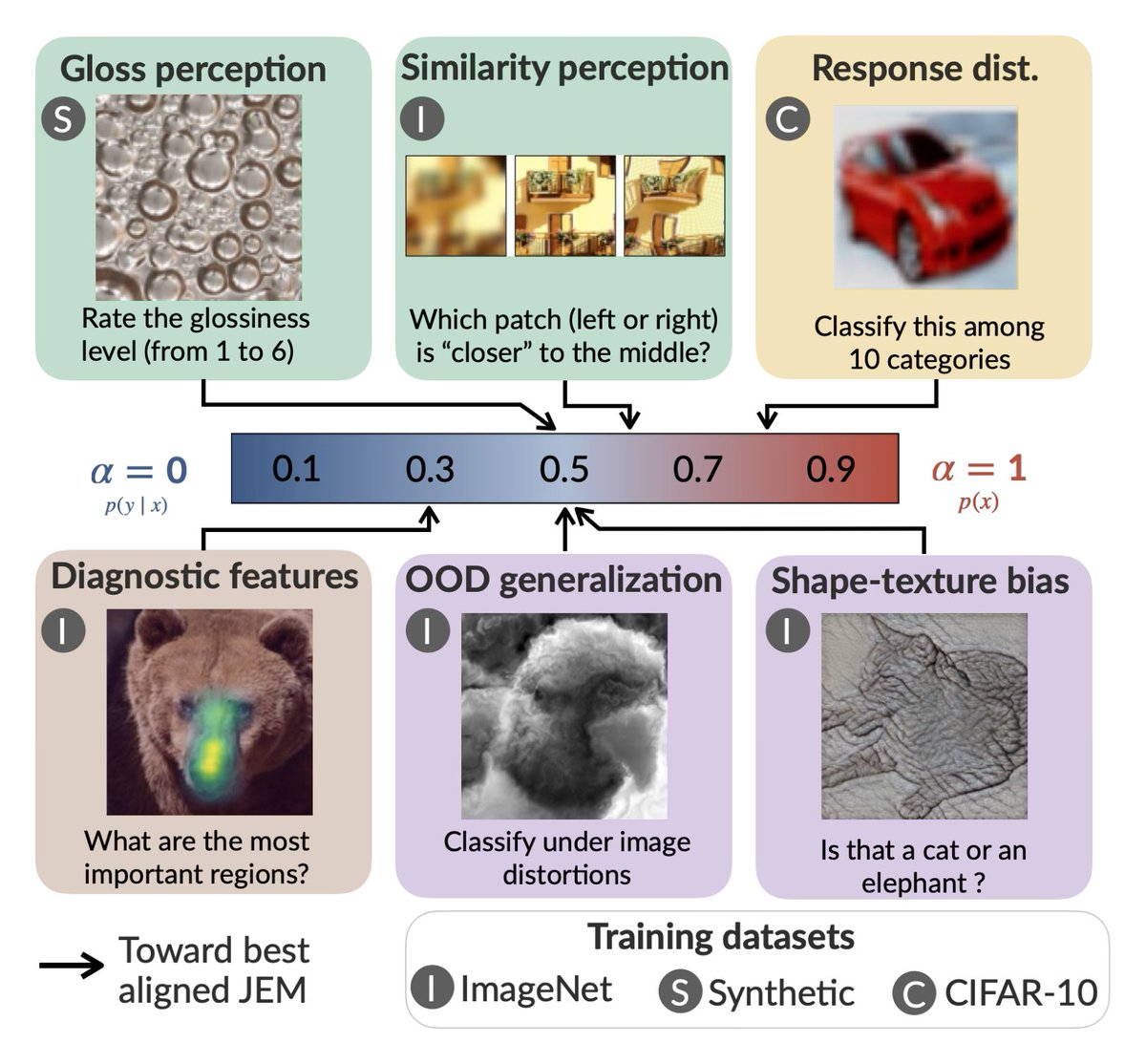
Is vision better explained by generative or discriminative learning ? 🧠👁️
Our #NeurIPS2026 paper says: neither!
With Joint Energy-based Models (JEMs), we trained one network across the generative↔discriminative continuum. Human alignment peaks in between. 🧵
Before he made his Nobel Prize-winning discoveries about the visual cortex visual, David Hubel made a simple tool: a tungsten microelectrode. He described its fabrication is described in a 1957 Science paper. I had Claude make a little video of it.
Brain areas aren’t distinguished by what information they represent but by how they format it.
Information formatting in neuronal populations predicts differential functional contributions to behavior
https://t.co/MjBImRdHxl
#neuroscience
For the past year @BasisOrg has been building a general framework for probabilistic reasoning in dynamical systems, called Dynestyx.
Blog: https://t.co/nFshOx48Ws
Dynamical systems are the workhorse of science and engineering: robotics, epidemiology, climate, biology, etc.
The basic thing you can do with a dynamical system is simulate it: run it forward to compute how it will evolve over time.
Dynestyx goes beyond this and lets you do inference and reasoning in dynamical systems. This includes:
- Forecasting: What will happen next, and how sure are we?
- State inference: Given noisy, partial measurements, where has the system actually been?
- System identification: How does the system work? What parameters and rules produced the data we see?
- Causal reasoning: Given the evidence, what would happen if we intervened on the system?
Dynestyx allows you to do probabilistic inference over all kinds of dynamical systems (ODEs, SDEs, PDEs). You (or an AI agent) write the model once, then swap in different inference methods with minimal changes.
Its generality allows us to tackle many different systems, as shown in the GIFS:
- recovering a high-res Navier–Stokes fluid flow from noisy low-res measurements
- steering particles through the wake behind a cylinder
- a robot hand turning a cube it can only see through a camera
- forecasting a 1978 flu outbreak at a boarding school as the data comes in
Also: it's open source. Please give it a try: https://t.co/qHttYeHXWf
Led by Matt Levine and @DanWaxmanML, with many contributions from our research staff