New preprint! 🤖🧠
The cost of thinking is similar between large reasoning models and humans
👉 https://t.co/0G6ay4NQc5
w/ Ferdinando D'Elia, @AndrewLampinen, and @ev_fedorenko (1/6)
While I'm here: I think multilingual LLMs are vastly underrated as scientific tools for studying language. They have to represent hundreds of languages in one set of weights, so whatever those languages share gets compressed into the same place. I think that is very cool!
Thrilled that my thesis on multilingual LLMs in cog sci won a Glushko prize! Huge thanks to my advisor Marco Marelli who supported me throughout and to @ev_fedorenko who I did the multilingual brain work with. Thanks also to @cogsci_soc and the Glushko-Samuelson Foundation! 🙏
Congratulations to Yang ICoN fellow Andrea de Varda @devarda_a, who has been named a winner of the prestigious Glushko Dissertation Prize! 👏👏
🔗 https://t.co/5aFmCF8NAY
@cogsci_soc
We don't start out with a bilateral language system: it's already strongly left-lateralized in young kids! Resilience of language to early LH damage must occur in spite of this early hemispheric bias. Congrats to Ola @olaozpa and Amanda @Amanda_M_OBrien! Out in NatComms now! 🎉
🎉 Happy to share that our paper on function words & language learning (w/ Heidi Getz & @weGotlieb) is accepted to #ACL2026! A little late to the party, but still worth celebrating 🥳
We ask: what statistical properties help a learner abstract grammatical knowledge from linear input? Turns out function words, though often overlooked, play an important role.
Check out our updated preprint: https://t.co/qYUclllZzg
🧵 1/4
Language, Intelligence & Thought lab is looking for a lab manager! This is a 2-year postbac position that will allow you to gain experience in human neuroscience, cognitive science, and AI research prior to applying to PhD programs.
Express interest here: https://t.co/HMUll9bH6q
Can we process meaning unconsciously? Our new study suggests: not really… unless language has a way to express it!
New paper out with Andrea Nadalini @D_Casasanto@CrepaldiDavide@BottiniRob
📢 PhD position in Developmental Language Modelling (plz RT🙏)
What can human language acquisition teach us about training language models? Join us as a PhD!
4 yrs, fully funded, MPI-NL; april 3
https://t.co/BCCap6MzPh
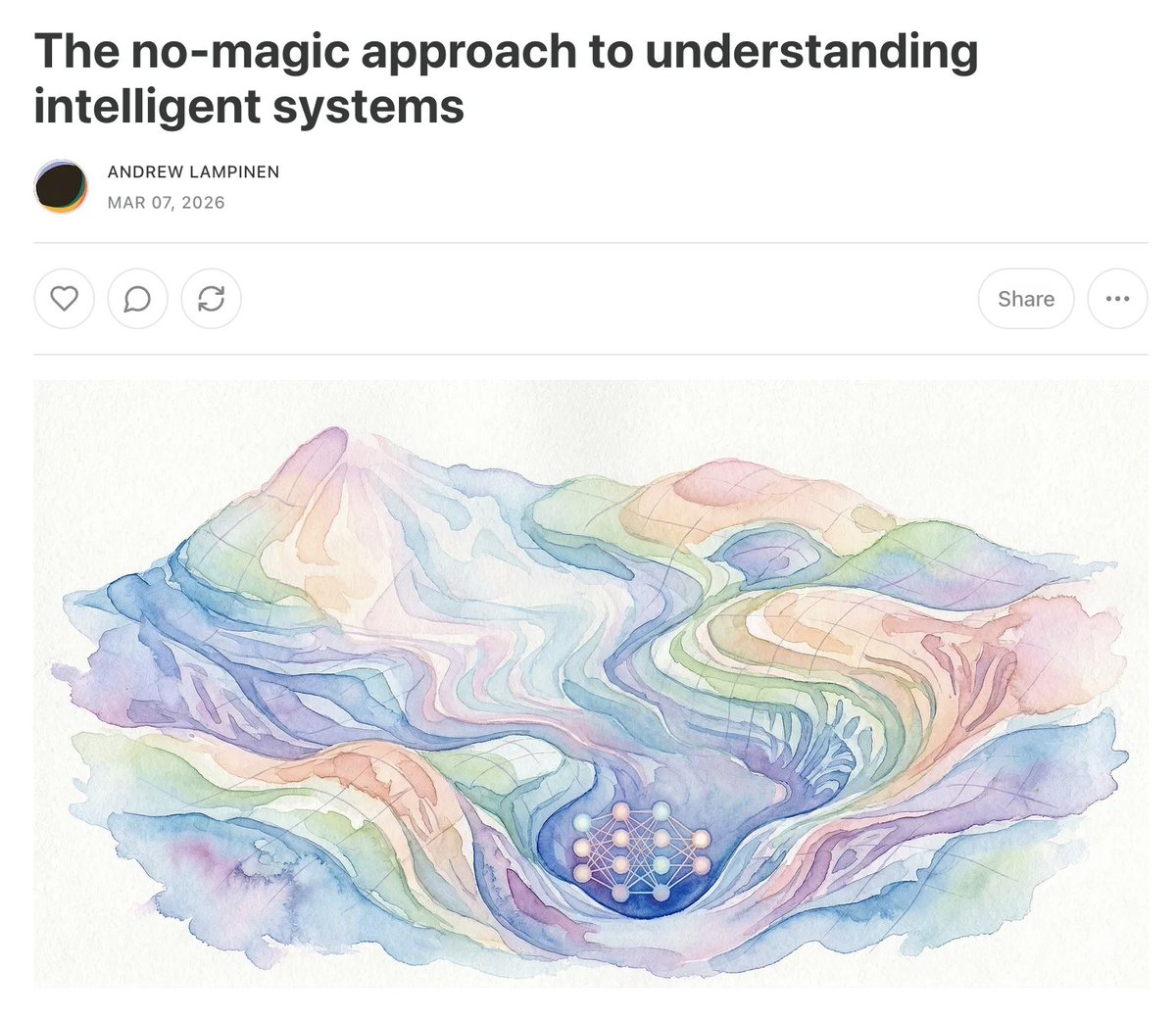
Short post on what I call the "no-magic approach to understanding intelligent systems" — the philosophy I think of as motivating our work on understanding intelligence without resorting to magical thinking about AI or humans! Link below:
📢 PhD position in the NeuroAI of Language
Why can LLMs predict brain activity so well? We're hiring a PhD student to find out -- AI interpretability meets neuroimaging
Deadline March 20.
Please RT 🙏
https://t.co/fVohGLZlmN
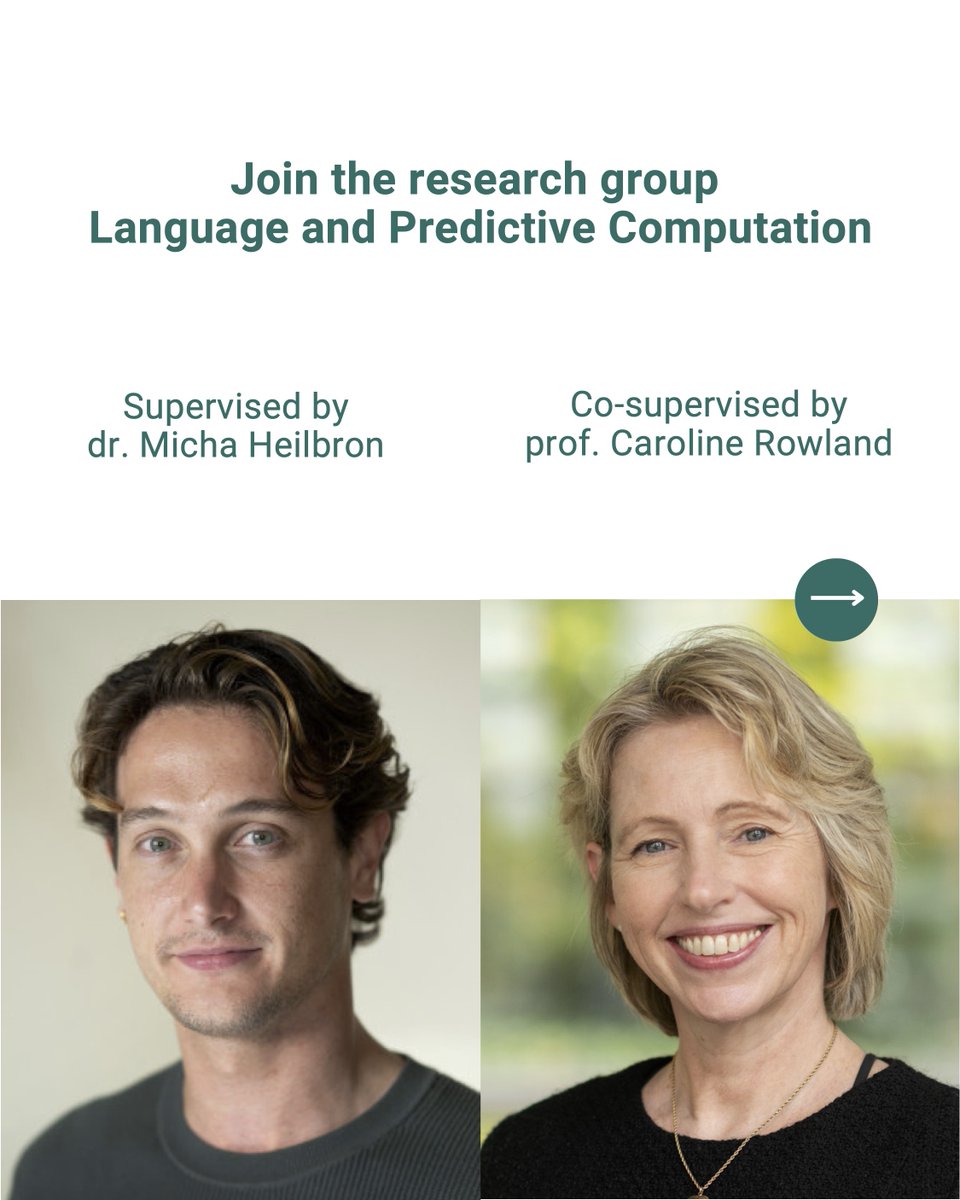
My PhD thesis is out 🥳🎓
How do LLMs, trained on trillions of tokens, reason?
Can they generalise beyond their training data or are they constrained by what they've seen before?
My takeaway: they can generalise beyond training in interesting ways, showing genuine reasoning
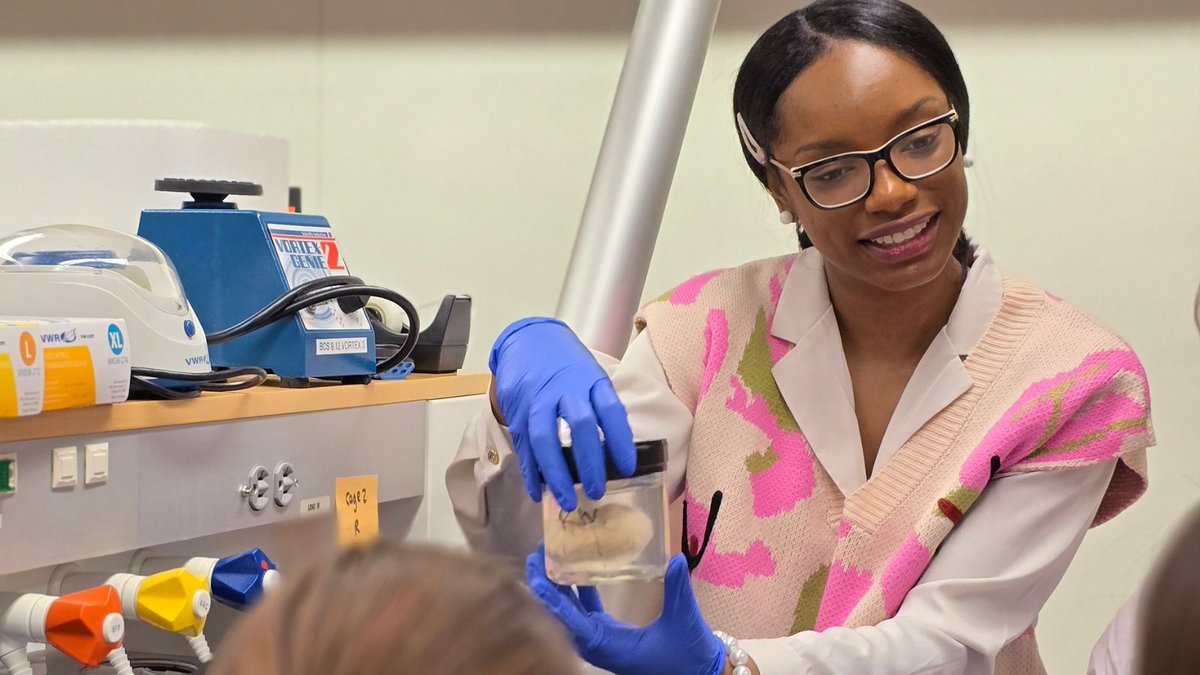
Our researchers don't just study the brain - they help young students see themselves as future neuroscientists. @mitbrainandcog research scholar Zadriana Smith + postdoc @HalieOlson recently took time away from their labs to inspire the next generation of neuroscientists! ✨
Fed up with hot anecdotal takes on AGI? 🤖🧪
Join us in Warsaw for actual science on how models reason.
📅 Jan 8, Warsaw🔗 Program: https://t.co/2oLaTSVZSL
Featuring @DieuwkeHupkes @MilekPl@leo_bertolazzi@IPrattHartmann@devarda_a and others.
LLMs develop novel biases from experience.
New preprint: LLMs that make decisions & get feedback develop new views — including ⚠️harmful stereotypes that target demographics!
[1/7]
I may be a *little* biased but this 📘 is GREAT! If you ever found language structure interesting, but were turned off by implausible+overly complicated accounts, this book is for you: a simple and empirically grounded account of the syntax of natural languages. A must-read!
It's fascinating that you can explain *so much* with dependency distance (effects in language production, comprehension, cross-linguistic differences in word orders, the difficulty of 'legalese'...). Highly recommended!
New book! I have written a book, called Syntax: A cognitive approach, published by MIT Press.
This is open access; MIT Press will post a link soon, but until then, the book is available on my website:
https://t.co/ksQfTGoxpK
The last chapter of my PhD (expanded) is finally out as a preprint!
“Semantic reasoning takes place largely outside the language network” 🧠🧐
https://t.co/Z7cgHsvIbu
What is semantic reasoning? Read on! 🧵👇
Finally out in @PNASNews: https://t.co/ahDbYpAOA7 (Three distinct components of pragmatic language use: Social conventions, intonation, and world knowledge–based causal reasoning), with many new analyses (grateful for a thoughtful and constructive review process at PNAS!)
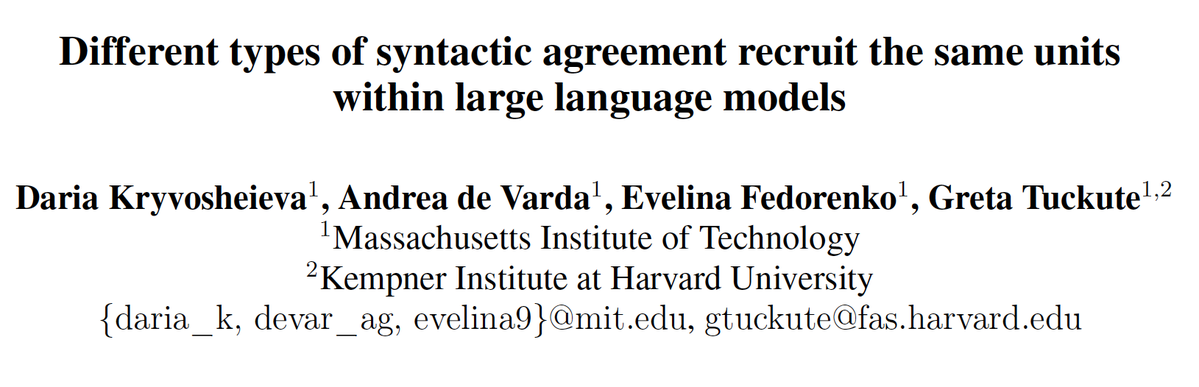
Really nice demonstration (led by @DKryvosheieva and @GretaTuckute) that agreement phenomena seem to carve out a shared subspace in LLMs: very different agreement types rely on overlapping units, also across languages!
How do LLMs process syntax? Do different syntactic phenomena recruit the same model units, or do they recruit distinct model components? And do different languages rely on similar units to process the same syntactic phenomenon?
Check out our new preprint (to appear at ACL 2026)!







![theryanliu's tweet photo. LLMs develop novel biases from experience.
New preprint: LLMs that make decisions & get feedback develop new views — including ⚠️harmful stereotypes that target demographics!
[1/7] https://t.co/yg9Ld3iFqg](https://pbs.twimg.com/media/G88hu9nbwAAX6rP.png)