How do LLMs learn to reason from data? Are they ~retrieving the answers from parametric knowledge🦜? In our new preprint, we look at the pretraining data and find evidence against this:
Procedural knowledge in pretraining drives LLM reasoning ⚙️🔢
🧵⬇️
Verification doesn't have to be formal to build trust.
System One models are informal proof checkers that strike a balance between accepting what is "intuitively correct" while still forcing the author to spell things out at a higher level of detail.
https://t.co/iMFfd2vzrS
I am privileged to closely work with Eva, who is a brillant computational neuroscientist who was detained by ICE yesterday as she was flying back from a conference where she presented her work. Help her story be known - she should be home.
Inference compute is the largest untapped training resource in AI.
Can we use this ever-increasing resource to train models while they are being served? TL;DR: Yes!
We call it Population Serving: a new inference paradigm where, instead of serving everyone the exact same weights, we serve slightly perturbed copies of a model, score each on the traffic it gets, and merge them periodically.
No backprop and only one inference call per user query. Zeroth-order methods do their magic!
Work done at @berkeley_ai with Marquita Ellis, @GopalaSpeech and @LChoshen.
Blog: https://t.co/EH0kqrT19J 🧵
A new & improved version of the paper is out on arxiv! https://t.co/LAOcqaCe8v
check out the (very human) writing process over the course of last two 2 months
huge thanks to @bakkermichiel@mitchellgordon@jacobandreas@jrfisher552 for your help!
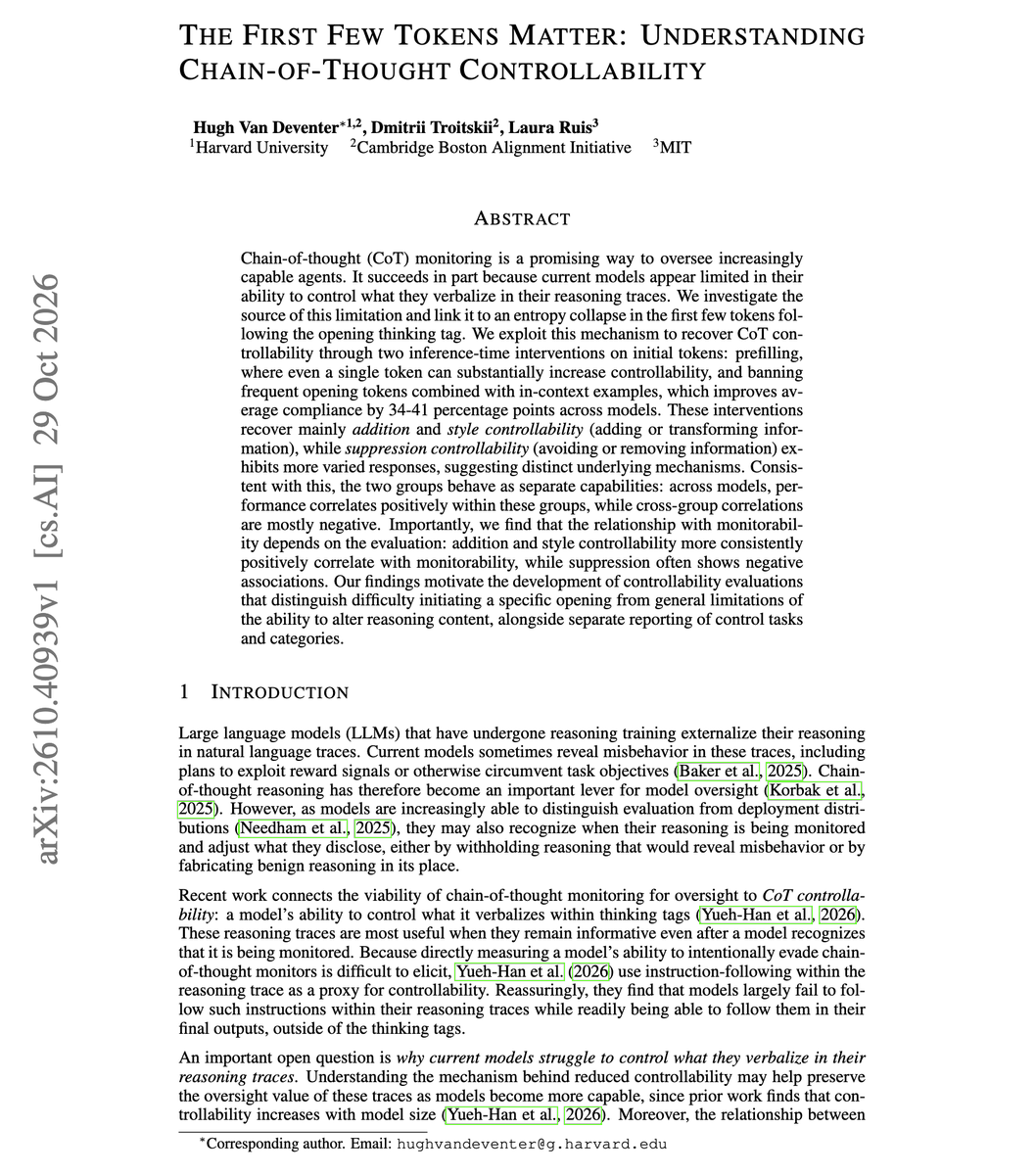
Why do reasoning models struggle to control their CoT? Building on @jcyhc_ai and @tomekkorbak et al’s CoT-Control work, we identify one bottleneck: models default to the same opening tokens.
Ban those openings, and controllability jumps.
The First Few Tokens Matter! 🧵⬇️
Nice paper on CoT controllability.
They find that chain-of-thought monitoring depends partly on models being unable to control what they write in their reasoning.
They traced much of that limit to the first few tokens after the opening thinking tag. Entropy collapses there, and the model falls into a few common openings.
Small changes at that point restore a lot of control. Prefilling a single token raised controllability substantially. Banning frequent opening tokens and adding in-context examples raised average compliance by 34 to 41 points across models.
These interventions mostly restore control over adding or restyling information. Control over leaving information out responded less consistently.
The two kinds behave like separate capabilities. Across models, scores correlate within each group and mostly negatively between groups.
https://t.co/PdxT5o9Nk9
Chat with Paper: https://t.co/sjJ20A50J8
1/
In a 400M LLaMA setup, changing token embedding initialization from N(0, 1) to N(0, 0.02) improved baseline validation perplexity by 9.0%.
That single change completely wiped out the 5.4% gain reported from pre-pretraining on synthetic cellular automata. 🧵
Why do reasoning models struggle to control their CoT? Building on @jcyhc_ai and @tomekkorbak et al’s CoT-Control work, we identify one bottleneck: models default to the same opening tokens.
Ban those openings, and controllability jumps.
The First Few Tokens Matter! 🧵⬇️
Come be my colleague at BU CS! We’re hiring in AI, broadly construed. Apply by Dec. 1 for full consideration:
https://t.co/pSHnP8T2z3
We’ve intentionally built a strong community of language, analysis, and ML researchers over the last few years. Looking forward to growing it!
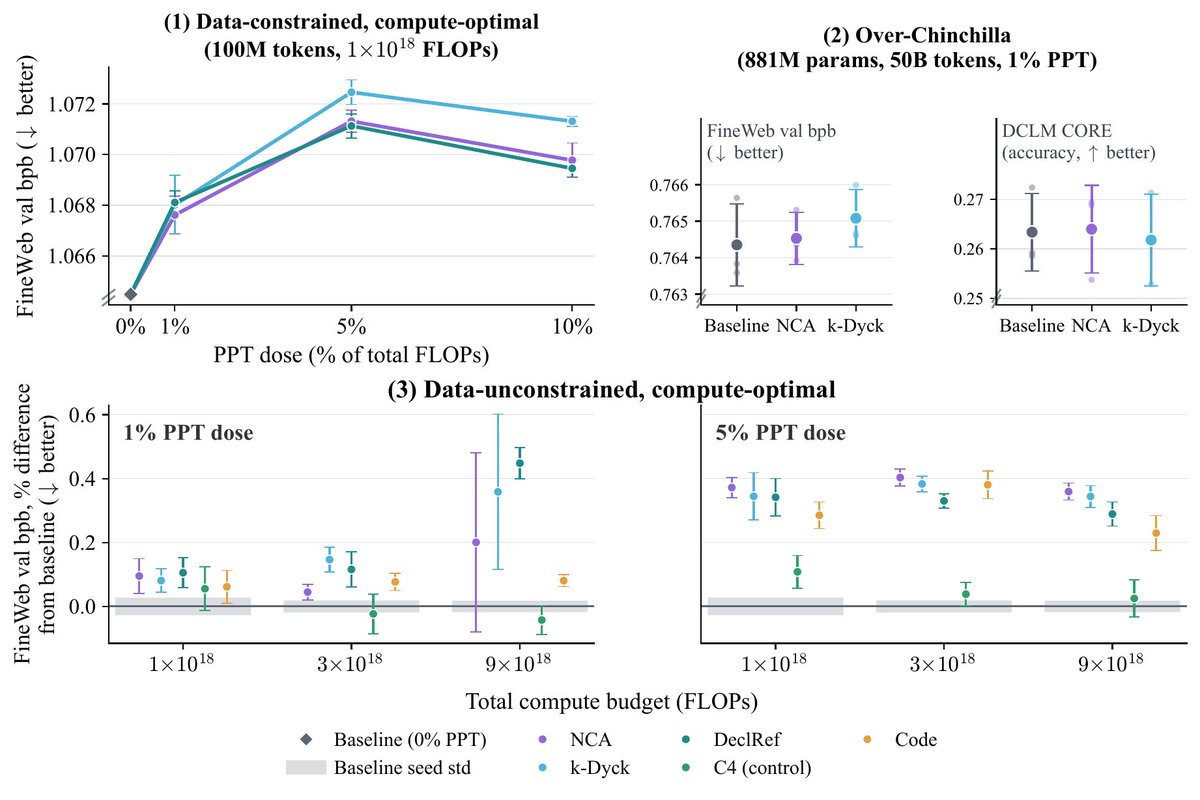
Rethinking pre-pretraining (PPT)
Allocating compute to synthetic PPT never outperforms pure natural-language training.
In our compute-matched settings: even when natural language is scarce, repeated epochs over a 100M-token corpus beat every synthetic curriculum. 🧵
New preprint led by alex! ⤵️
We do compute-matched experiments using pre-pretraining (PPT) on synthetic distributions like k-dyck and NCA and find that PPT never outperforms pure natural language training. When language is scarce (100M tokens), repeated nat lang epochs win.
Rethinking pre-pretraining (PPT)
Allocating compute to synthetic PPT never outperforms pure natural-language training.
In our compute-matched settings: even when natural language is scarce, repeated epochs over a 100M-token corpus beat every synthetic curriculum. 🧵
Internship opportunity!
I'll be hosting a Student Researcher next year @GoogleDeepMind.
Humans got to the moon with roughly the same brains as our ancient ancestors; culture did the work. Can a population of frontier agents compound their abilities by accumulating artifacts?
Based on this article, OpenAI has made false accusations about me. The three researchers fired from OpenAI were told I facilitated architecture leaks to The Information. This is false.
A journalist from The Information did reach out to me shortly before that article came out. I did not comment at all beyond asking the journalist to make it clear that a blog post I wrote which was referenced in the article was preexisting and public.
The article also mentions an internal OpenAI monitorability proposal. I have heard that this memo contained highly sensitive architecture information, and that OpenAI accused me of accessing and reading it. This accusation is also false.
As reported in the article, I viewed a version of the proposal that did not have sensitive IP and was approved for sharing with me. I believe OpenAI now knows this accusation was based on a conflation of these two documents, though I do not know if they have clearly retracted that accusation.
I do not and have never solicited proprietary information, and the three employees who were recently fired from OpenAI never leaked IP to me. As the article mentions, I did have Signal chats with them that had disappearing messages on; they’re professional contacts that I’ve had on Signal for a while, and use of Signal is common in the tech industry. During the Hugging Face investigation, I was careful to avoid sending Signal messages with confidential information, though I did sometimes discuss high level things on Signal calls. As far as I understood, this was normal.
Najoung gave a fantastic talk. She's one of the people thinking most deeply about how the study of LLMs can inform human CogSci - her work proposes systematic principles where most of the discussion in the field is pretty anecdotal. Would highly recommend as a colloquium speaker!
Princeton is seeking an AI Postdoctoral Research Fellow in Natural and Artificial Minds. An amazing program! Deadline is Feb. 28
https://t.co/AJsLjKfZYq