The biggest source of alpha in career success is looking better and being in shape
Anyone who tells you that looks don’t matter is blatantly lying to your face
Studies have proven, time and time again, that looking better leads to better monetary outcomes
If you're a naturally anxious person, I recommend pursuing a high stress career path where at least you'll be compensated for anxiety you're going to have anyways.
You don’t need to be an entrepreneur to have career compression. If you’re ambitious, high-agency and are a go-getter, you can absolutely have career compression in a corporate environment.
Contrary to beliefs, it’s not about titles, it’s about taking on projects that force you to learn beyond your years and to learn beyond your experiences.
Career compression is a function of your learnings. Your learnings are a function of exposure.
In every well established firm, there is a nicely paved road for the median employee to climb and feel a sense of progression, designed to not overwhelm someone looking for a traditional career.
Since your exposures in this path is capped, so will your learnings.
If you truly want to be radically far ahead of your peers, you will have to be bold and take on “impossibly difficult” projects beyond your years. Seek them out, find them, volunteer for them. If they don’t exist, create them - propose them.
When you learn how to do the impossible, you gain the necessary knowledge, worldview and skills for bigger and better things.
You don’t need to be an entrepreneur to do this - it may be the purest expression of it, but you can certainly do it anywhere.
Enter the $250,000 SDR:
"There is now a market instead of SDRs being worth $60K in the US, there is a market for a small number of $250,000 a year SDRs.
But there's almost no need for a $60,000 SDR with six months of junior college research that can't spell ElevenLabs.
You just don't need that person anymore. You needed them three years ago, you don't need them today." @jasonlk
Love to hear your thoughts on this @PeetsChad@Carles_Reina@samdblond@ishanmkh@jasparcjack
You have 9 days to protest your Texas property taxes. May 15 is the deadline.
If you own a house or an investment property, you should be doing this every year
Texas is a "non-disclosure" state. Sale prices are private. Every year the appraisal district guesses your value with imperfect data. They almost always guess high.
A reduction this year lowers next year's starting point. Skip a year and the higher value carries forward forever. Miss five years in a row and you are paying tax on a value that should have been knocked down half a decade ago.
If you have a homestead, your assessed value can only rise 10% per year. But there are times when you may get a favorable protest outcome that lowers the market value near/below your cap and compresses every future cap ceiling.
Investment property above $5M has no cap. Non-homesteaded property gets reassessed at full market every year. No 10% protection. The protest is your only defense.
The process:
--> Appraiser sends a proposed value. It is always high.
--> File a protest.
--> Informal review with the appraiser. Most reductions happen here.
--> No agreement? Formal hearing before the Appraisal Review Board.
--> ARB issues a final order.
--> Still wrong? You have 60 days to pick one path: binding arbitration or a district court lawsuit. Not both.
Most reductions happen at step 3. Many homeowners never file at all.
Different niches need different experts. I use one firm for our apartment portfolio and a different one for my residence.
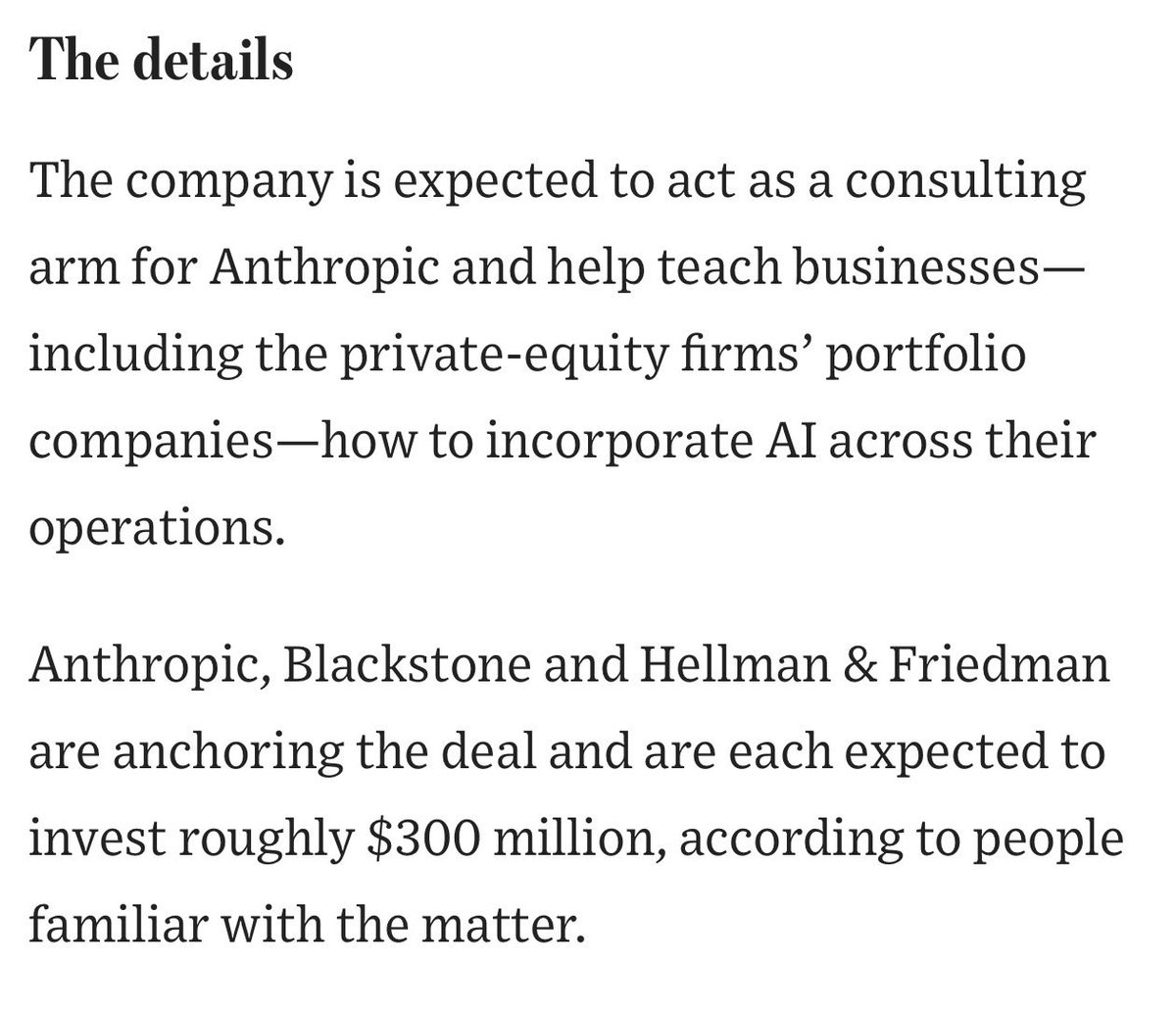
Both Anthropic and OpenAI have new initiatives to help enterprises deploy AI agents within their organizations. This is a trend that’s early but going to get very big fast.
As agents enter knowledge work beyond coding, there is very real work to upgrade IT systems, get agents the context they need, modernize the workflows to work with agents, figure out the human-agent relationship in the workflow, drive adoption and do change management, and much more.
While AI models have an incredible amount of capability packed into them, there’s no shortcut to getting that intelligence applied to a business process in a stable way. This is creating tons of opportunities across the market for new jobs and firms, and the labs are equally recognizing the criticality here.
Nowhere to hide when you’re an adult.
You’re either putting up results or you aren’t.
Being an adult is the funnest chapter yet.
If you did it right, you should have 100s of friends, enough $ to not worry about money, and always doing cool things having the time of your life
You never hear someone who’s ripped, handsome, successful, & charismatic complaining about being an adult
Life is what you make it
Commentary:
Atlassian just blew out Q3: cloud revenue +29 percent year over year, RPO +37 percent for the fourth straight quarter of acceleration, FY26 cloud guide raised to ~24 percent, and Service Collection (their ITSM line) above $1B ARR up 30 percent. NOW is my largest position at ~12 percent and walks into May 4 Analyst Day with the same bear case priced in.
The SaaSpocalypse claim is that AI agents replace per-seat economics, growth permanently breaks below 15 percent, multiples re-rate down. The mechanism the bear case assumes is wrong. Both vendors price AI as a hybrid model: seats stay and AI features layer on top through credits or consumption assists that bill into overage. Rovo runs $0.01 per credit on overage. Now Assist sits as a consumption add-on adding 20 to 40 percent uplift to per-user cost. AI usage shows up as wallet expansion inside the same accounts.
TEAM is the cleanest live test of that model. Jira and Confluence were the seats analysts said would erode first. Instead the largest customers are buying more, RPO is accelerating four quarters in a row, and net revenue retention sits above 120 percent. NOW already showed the same shape in Q1: Now Assist's >$1M ACV cohort up +130 percent year over year, RPO +23.5 percent, subscription revenue +22 percent.
NOW trades at 18x forward EPS, the lowest since 2019, only because the market never priced the consumption-overlay model into the bear case. May 4 is a binary thesis-reset event. Today TEAM gave Wall Street a fresh data point in the right direction four days before NOW gets the microphone.
Posting my reasoning, not a recommendation.
SaaS is dead. Long live SaaS.
In the age of AI and agents, most software companies are still clinging too tightly to their past. Their demise will come quick if they do not embrace and build the technologies that are destined to disrupt them. However those who have already done so must recognize the reality of the world we still live in today. That world still has the majority of its work done by humans who still need workflow tools and technology to get their work done.
While we pivoted hard to AI and agents with Fin, which will become the majority of our business quite soon, we recognize the importance of the software our customers use and so have also decided to double down on our investment in Intercom, the world's best help desk and customer service system for how customer service is done at this age. We've reinvented it and rebuilt it to work perfectly alongside your new customer agent systems and we're announcing 60+ new customer features that comprise Intercom 2 today.
intercom DOT com SLASH intercom2
I absolutely think AI is hurting software companies, and it is not because of what most people think
No serious company is ripping out their CRM or payroll SaaS for a vibe coded tool that was created 2 weeks ago
Rather, the spend on AI at enterprises has made IT budgets a key focus area for every CEO and CFO across the board
Every single one of them is now seeing their IT spend go vertical because of token costs
In order to compensate for the higher costs, they are renegotiating software vendor contracts and pushing back on pricing where they can on legacy software
Just as an example, I have had numerous conversations with decision makers at banks, private equity firms and hedge funds across Wall Street on their AI spend
Many of them purchased licenses for enterprise OpenAI in 2024 and 2025
Now, they are realizing that vertical specific tools like Alphasense or Hebbia actually provide better value proposition to their analysts
Instead of shutting down the OpenAI contract, they went ahead and demoed these new tools, and ended up onboarding them as well
Early this year, same thing happened with Claude after these firms saw the massive popularity for tools like Claude in Excel and Cowork
The ultimate result is that many of these firms are now stuck paying for multiple subscriptions across all the AI platforms, and this is putting a massive strain on IT budget
They are now going back to legacy SaaS vendors and asking for pricing discounts, or just downsizing seats on those legacy platforms
Most of them are afraid to cut off the AI licenses because they risk having to spend dollars and time onboarding again if that platform releases the next leg of innovation in AI
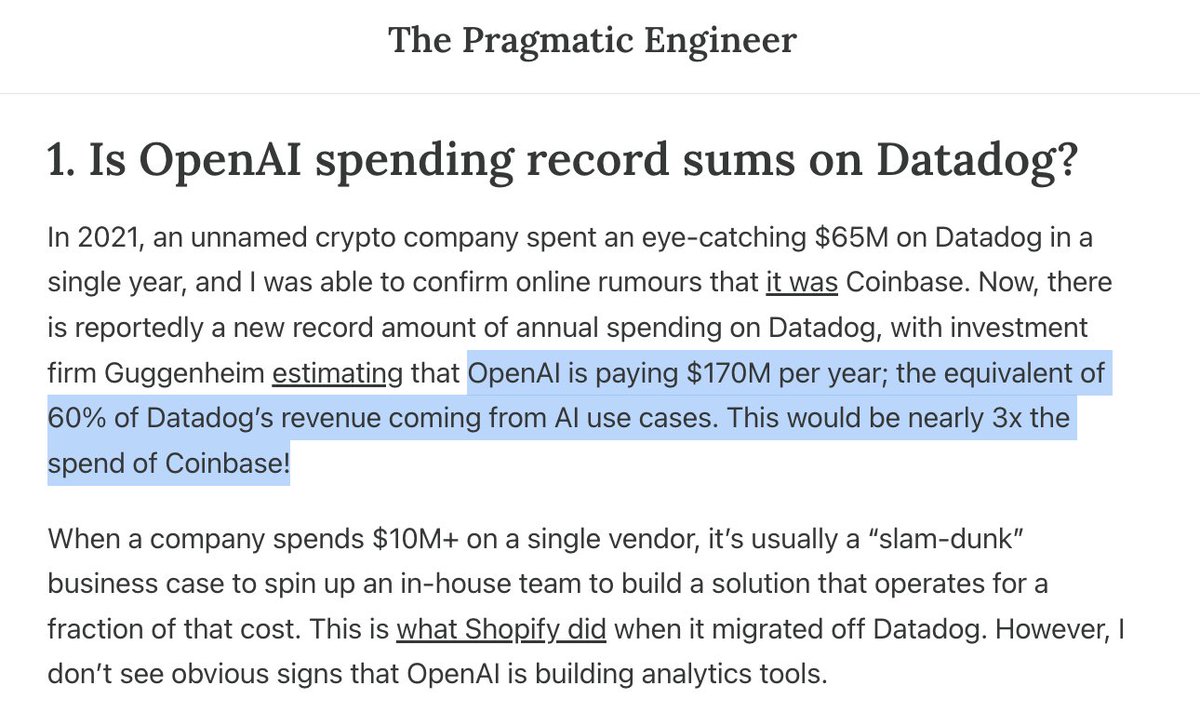
Waiting when the CFO will notice the ~$170M Datadog bill after this...
(yes, really! As shared in @Pragmatic_Eng back in October... though safe to assume OpenAI has reduced this since)
This is probably the best piece I've ever written on getting in peak shape in 90 days.
Block out 10 minutes and read it slowly, sit with it, and don't skim the peptide section.
Scientists and educators age fastest. Athletes age slowest.
A facial aging clock trained on occupation-linked photos found that the gap between your biological face-age and your real age predicts all-cause mortality. The wider that gap, the higher your risk.
Women aged slower than men in every single occupation measured. No exceptions.
The ranking, from youngest-looking to oldest-looking relative to chronological age:
Athletes > service workers > sales > clerical > managers > professionals > scientists and educators.
The people who study aging for a living look the oldest. I wish I could say I'm surprised.
Your face is a record of cumulative stress, UV, sleep loss, and metabolic wear. Your job title determines how much of each you get.