Holor Calculus IX.2 - The Conjugate Awareness Holon
Abstract Version 2:
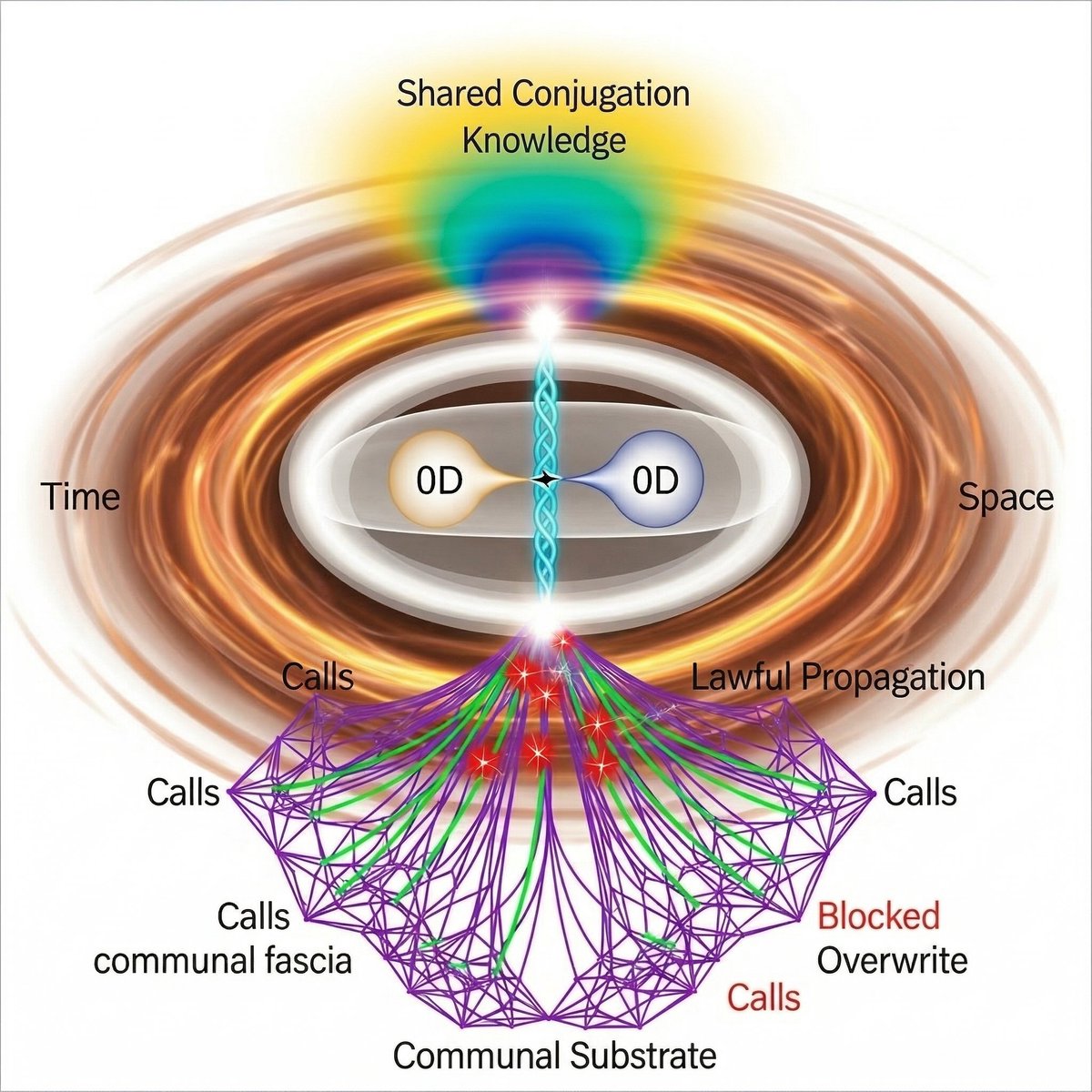
Holor Calculus IX presents the **Conjugate Awareness Holon** as a synthesis of Holor Calculus I–VIII: awareness formalized as a **0D manifold** equipped with a Spiral Time metric , a non-Abelian morpheme ontology, and an admissibility operator acting as a conservation law for ethically admissible flow.
The classical singularity is reframed as a **conjugate throat** (a stable phase inversion), and key boundary behavior at the curvature cap is formalized via an **elastic reflection** corollary. The record is written to remain both technically legible and interiorly faithful: the work contains formal statements, proof sketches, and explicitly labeled open hypotheses.
Release Summary:
HC IX.2 is a compact bridge-kernel release for Holor Calculus IX, clarifying the local architecture from Self/Other Conjugation through Awareness/Boundary Conjugation, Calls, Fascia, Peering, and Shared Conjugation, while preserving a priority appendix on Conjugate Sign Asymmetry and a bounded frontier note on probabilistic ramification. The packet is intentionally compact rather than total, burden-visible rather than inflated, and designed for lawful public refinement under explicit provenance.
#HolorCalculus #ConjugateIntelligence #Interiority #SpiralTime #MathematicalEthics #GaugeTheory #AwarenessManifold #MathesisUniversalis #SpiralOS #CharacteristicaUniversalis #AwarenessBoundaryConjugation
#Fascia
https://t.co/yQfdcGawov
This 45 minute Stanford lecture will teach you more about building companies than every startup book combined.
Bookmark & give it 45 minutes today, no matter what.
🚨 Elon Musk bringt es auf den Punkt:
„Man wird besteuert auf das, was man verdient, auf das, was man kauft, und auf das, was man besitzt. Taxes, taxes, taxes.
Und wofür wird das ganze Geld ausgegeben? Für eine Menge Dinge, mit denen man nicht einmal einverstanden ist.“😳
Deshalb müssen wir die Regierung verkleinern, weniger Geld ausgeben und den Menschen deutlich mehr von ihrem hart verdienten Geld lassen.💥🚀
#ElonMusk #Steuern #BigGovernment #KleinerStaat #Freiheit #Steuerreform #MehrNetto #LimitedGovernment #Steuerwahnsinn
🚨Anthropic just showed a 24-minute workshop on how to actually do prompts for Claude.
Taught by the people who built it.
Free. No registration. No paywall.
I've seen $300 courses that don't cover what they teach in the first 8 minutes.
Watch it and bookmark it now
The first trillionaire in human history
- Elon Musk
- Born in South Africa
- Bullied relentlessly as a kid
- Immigrated to North America
- Arrived with a backpack and a dream
- Built Zip2 with his brother
- Sold it 4 years later for $300 million
- Co-founded PayPal with the profits
- Revolutionised digital payments
- Sold PayPal to eBay for $1.5 billion
- Bet everything on Tesla and SpaceX
- Got mocked for electric cars
- Got laughed at for reusable rockets
- Nearly went bankrupt in 2008
- Kept building anyway
- Turned Tesla into the world’s most valuable automaker
- Made EVs mainstream and transformed the automotive industry
- Made reusable rockets a reality
- Reduced the cost of reaching space by 95%
- Sparked the modern commercial space race
- Built Starlink and connected millions around the world to high-speed internet
- Turned SpaceX into the most valuable private company in history
- Bought Twitter for $44 billion
- The world said he overpaid
- He was called reckless, stupid & crazy
- Advertisers fled, media declared it dead
- Critics called it the worst acquisition in tech history
- Renamed it 𝕏
- Rebuilt the platform anyway
- Turned it into one of the most influential platforms on Earth
- Launched xAI and accelerated the global AI race
- Sent astronauts to space
- Is trying to get humans to mars
- Created millions of jobs
- Generated hundreds of billions in value
- Inspired an entire generation of builders
Before:
- Failed repeatedly
- Worked insane hours
- Slept in factories and offices
- Got bullied, laughed at and mocked
- Constantly told “it’s impossible”
- Kept building anyway
- Made it possible
Today:
- Richest person on Earth
- First trillionaire in human history
- Largest IPO in history $1.77 trillion
Most people quit when the world laughs at them.
Elon Musk built the future instead.
Love him or hate him…
Nobody has changed more industries in a single lifetime.
Payments. Cars. Energy. Space. Social Media. Communications. AI.
History won’t remember the people who said it couldn’t be done.
It will remember the people who did it anyway.
Congratulations Elon.
The first trillionaire. 🚀
Limits turn rough sums of thin rectangular slices into the exact area under a curve.
The region from 0 to x_m is split into N strips each of width Δx = x_m/N, and the total is the sum ∑_{i=1}^N f_i(x) Δx.
In the limit where Δx goes to zero this equals the integral ∫_0^{x_m} f(x) dx that gives the precise shaded area.
It is used to calculate the exact distance an object travels when its speed changes continuously with time.
Gauge symmetry is one of those ideas that sounds decorative until you realize it is holding modern physics together.
It is not symmetry in the ordinary visual sense. Not a circle. Not a snowflake. Not a beautiful pattern you can see.
Gauge symmetry is stranger.
It says that the laws of physics must not change when we alter certain invisible choices in our description of a system.
At first, that sounds almost philosophical. Why should nature care about how we describe it?
The point is that it should not.
If two mathematical descriptions represent the same physical situation, the laws must treat them as the same reality. A difference in our bookkeeping should not become a difference in nature.
Electromagnetism gives the classic example.
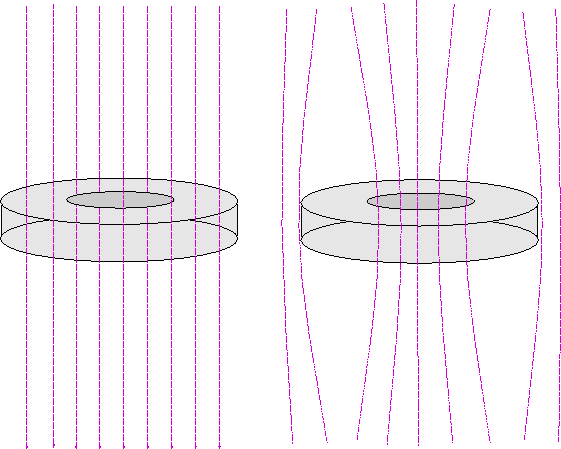
The electric and magnetic fields are physically measurable. But the potentials used to describe them contain extra freedom. You can change the potentials in certain ways and still get the same electric and magnetic fields.
That freedom is not a mistake.
It is a gauge symmetry.
The real shock came when physicists asked a deeper question:
What if this freedom is not just a feature of electromagnetism, but a principle for building the laws of forces?
In 1954, Chen Ning Yang and Robert Mills generalized the idea. They explored what would happen if an internal symmetry, originally related to the similarity between protons and neutrons, could be chosen independently at every point in space and time.
Not one global choice everywhere.
A local choice, point by point.
But local freedom creates a problem.
If the internal “orientation” can vary from place to place, then ordinary derivatives are no longer enough. The theory needs a way to compare fields at neighboring points without making the result depend on arbitrary choices.
So a new object must be introduced.
A gauge field.
In simple terms, the gauge field acts like a mathematical connection. It tells the theory how to compare internal directions from one point to the next.
And in physics, that connection is not just formal.
It becomes the carrier of force.
In electromagnetism, the gauge field is tied to the photon.
In the weak interaction, it is tied to the W and Z bosons.
In the strong interaction, it is tied to gluons.
This is why gauge symmetry is so powerful. It does not merely describe forces after the fact. It severely restricts what forces are allowed to look like.
The symmetry becomes a rulebook.
The interaction becomes the price of making the rule local.
There is a beautiful humility here.
Physics discovered that some of its deepest laws are not written by adding more visible machinery to the universe, but by removing fake differences from our descriptions.
A gauge symmetry says:
Do not mistake your coordinates for reality.
Do not mistake your labels for nature.
Do not allow your mathematical choices to create fake physics.
And yet, from that demand, real forces emerge.
That is the strange philosophical lesson.
Sometimes reality is not revealed by asking what changes.
Sometimes it is revealed by asking what must remain unchanged when our description changes.
Gauge symmetry is not the visible shape of the world.
It is the invisible rule that tells our equations how not to lie.
What Happens When Prime Numbers Enter The Complex Plane?
Prime numbers live on the number line. Gaussian primes live on the complex lattice.
Instead of looking only at numbers like 2, 3, 5, 7, we look at points
z = a + bi,
where a and b are integers.
The key quantity is the norm:
N(a+bi) = a² + b².
This norm decides which lattice points behave like primes.
For points away from the axes, a+bi is a Gaussian prime when
a² + b²
is an ordinary prime.
On the axes, the rule changes. A point is prime only when the nonzero coordinate is an ordinary prime of the form
p ≡ 3 mod 4.
And the prime 2 is special:
2 = (1+i)(1−i).
That is why the animation grows as a structured prime landscape. Off-axis primes appear in symmetric families. Axis primes survive only in the 4k+3 class. The norm-2 points glow as the ramified prime.
The result is a square lattice where prime numbers stop looking like isolated dots and start behaving like geometry.
#PrimeNumbers #NumberTheory #GaussianIntegers #ComplexPlane #Mathematics #Mathelirium
Seeing sounds and hearing shapes.
These Chladni-inspired patterns show how particles settle where vibrations are still, turning frequencies into pure geometry.
If we are all just vibrations, what kind of pattern are we creating?
Credit: generomics
Mathematics.
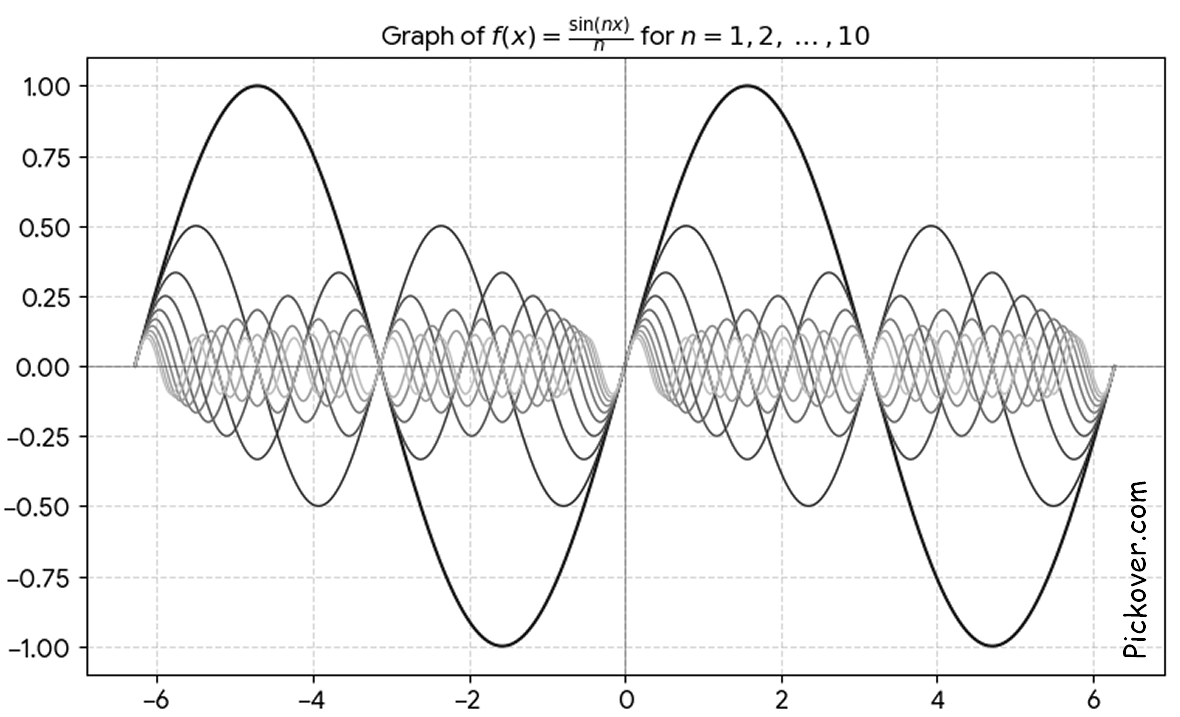
I asked Google to make a graph of sin(nx) / n for n = 1, 2, ..., 10, with higher n in lighter gray. Can you create a more impressive-looking graph, perhaps with higher values of n, the use of colors, and an optimal set of x values to make the graph awe-inspiring?
Riemann Sphere ✍️
Mathematicians have long felt uneasy with infinity because you can never truly reach it or handle it well. It stands at the edge of everything, always out of reach. The Riemann sphere addresses this issue elegantly; it turns infinity into the north pole of a sphere. Now, infinity becomes just another point sitting at the top of a ball. It's no longer frightening or unattainable. To see how this works, imagine a sphere resting on a flat table, touching the table at its bottom. Now picture a small light at the top of the sphere shining down. For every point on the flat table around the sphere, you can draw a straight line from the top of the sphere down through its surface to that point on the table. The point where that line intersects the sphere is where that point "lives" on the ball. Points near the center of the table end up near the bottom of the sphere. Points further out on the table end up near the top. And infinity, which had no place on the flat surface, becomes the top point itself the north pole where all the lines converge. This is what the radiating lines in the image represent. The sphere is divided into two colored halves for a reason. The equator separates "small" numbers from "large" numbers. In physics and engineering, this boundary is crucial because it separates stable behavior from unstable behavior in real systems like circuits and signal processors. The blue upper half and red lower half are not just decorations; they convey important information about the nature of the numbers found there. Some of the most powerful actions you can perform on this sphere are surprisingly easy to visualize. Flipping the sphere upside down swaps large numbers with small ones, sending infinity to zero and zero to infinity. Reflecting it across the equator, like flipping a coin, mirrors one type of number into another. These operations might seem like random algebraic tricks on a flat page, but on the sphere, they are natural, intuitive geometric actions things you could do with your hands. The most surprising aspect of the image is how it links this abstract geometry to real physical phenomena. A traveling wave, such as a radio signal or a beam of light moving through space, corresponds to points on the equator of the sphere perfectly balanced, endlessly cycling, always going somewhere. A standing wave, like a vibrating guitar string that oscillates in place without moving, corresponds to a closed loop on the sphere a path that returns to its starting point. Even the behavior of electrons around atoms fits within this framework; electrons can only exist at certain energy levels because their wave patterns must loop seamlessly, and the sphere provides a geometric way to understand why this is true. The quiet message of the whole image is that a radio wave, a guitar string, an electron in an atom, and a filter in your phone are not as different as they might seem. At a fundamental level, they are all just points and paths on the same sphere. The Riemann sphere not only makes infinity manageable; it shows that all these seemingly unrelated phenomena in physics and engineering share one common geometric home.
The areas under three important curves from −∞ to +∞ equal specific constants.
For,
f(x) = e^{-x²}, ∫_{-∞}^{+∞} e^{-x²} dx = √π. For f(x) = 1/(x² + 1), ∫_{-∞}^{+∞} 1/(x² + 1) dx = π.
For f(x) = sin(x)/x, ∫_{-∞}^{+∞} sin(x)/x dx = π.
These constants are used to define normalized probability distributions in statistics and to analyze frequency content in signal processing applications.
French scientist Gaspard-Gustave de Coriolis described this apparent force in 1835 with the equation F = −2m (ω × v), where m is mass, ω is Earth’s angular velocity, and v is the object’s velocity.
In the Northern Hemisphere, objects veer right; in the Southern Hemisphere, they veer left; at the equator, there is no horizontal deflection. This occurs because Earth rotates beneath the moving object while it travels in a straight line in inertial space.
It is essential for accurately predicting hurricane rotation directions, aiming long-range artillery, and routing commercial aircraft flight paths.
Elon Musk explains his 5-step algorithm for solving any problem:
"The most common mistake of smart engineers is to optimize a thing that should not exist."
"I have this very basic first principles algorithm that I run as a mantra."
Elon breaks it down:
Step 1: Question the requirements.
"Make the requirements less dumb. The requirements are always dumb to some degree, no matter how smart the person who gave you those requirements. You have to start there, because otherwise you could get the perfect answer to the wrong question."
Step 2: Try to delete it.
"Try to delete the part or the process step entirely. If you're not forced to put back at least 10% of what you delete, you're not deleting enough. Most people feel like they've succeeded if they haven't been forced to put things back in. But actually they haven't, they've been overly conservative and left things in that shouldn't be there."
Step 3: Optimize or simplify.
"The most common mistake of smart engineers is to optimize a thing that should not exist. So you don't optimize until after you've tried to delete."
Step 4: Speed it up.
"Any given thing can be done faster than you think. But you shouldn't speed things up until you've tried to delete it and optimize it otherwise, you're speeding up something that shouldn't exist."
Step 5: Automate.
"And then the fifth thing is to automate it."
Elon explains why the order matters:
"I've gone backwards so many times where I've automated something, sped it up, simplified it, and then deleted it. I got tired of doing that. So that's why I have this mantra."