Ive been heads-down revamping our website to show what Yanvi is really capable of. Its live now with 100/100 Lighthouse scores across the board.
Check out https://t.co/3QvdT2mVHv and share your feedback.
Note: actual product photos are clearing legal review and will be on the site soon.
Yanvi - Your own AI computer.
Just applied to @hf0 with Yanvi.
I'm building a standalone AI computer with an expressive body. Our first commercial focus: helping education providers answer admissions questions and connect prospective students with staff.
Next: turn the prototype into paid deployments.
Finding a slide and answering a question are two different jobs.
Imagine describing a diagram you half remember and getting matching slides from old decks. A match alone doesn't establish whether a slide is current or correct.
Open the original before you quote it.
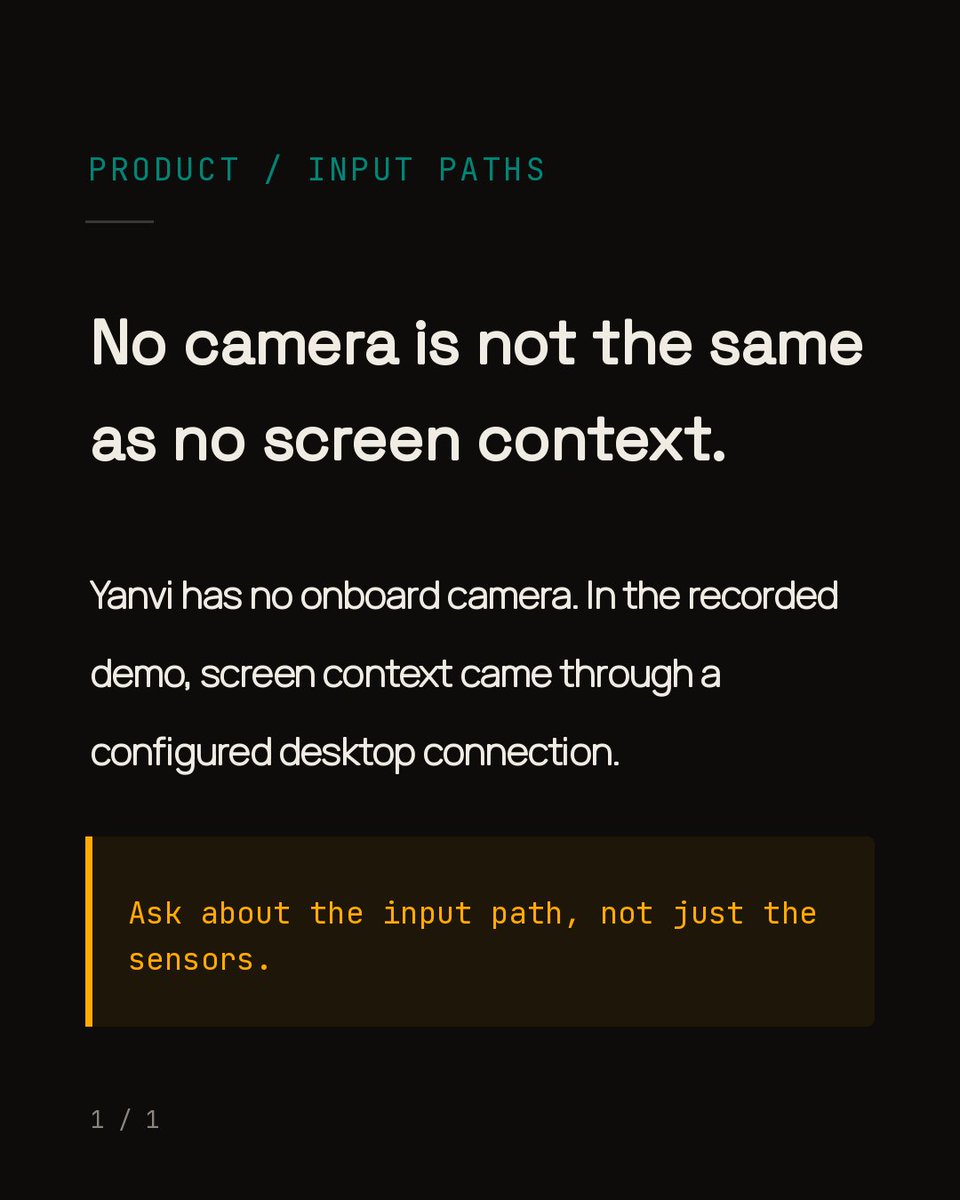
"No camera" tells you about the hardware. It doesn't tell you what the AI can see.
Yanvi has no onboard camera. In our recorded demo it still summarised the page on my screen, through a desktop connection I'd configured.
Ask about the input path, not just the sensors.
Your line between inside the box and leaving the box is exactly right. And yes, that's the trade-off. If approvals happen on the device, the risky stuff waits until you're back. For a push or a payment I'm fine with it being slower. Where would you draw it, would you approve a deploy from your phone?
Day 1 of 30. The hardest question about Yanvi is the obvious one: why hardware at all?
Hermes, OpenClaw and GrokBot already do a lot of what Yanvi does, in software. Yanvi even runs Hermes onboard. So the case for a standalone AI computer with its own expression engine has to come from evidence, not from my enthusiasm.
For the next 30 days I'm working through that in public, in a sprint with @boardyai , ending at Bengaluru Tech Summit, 17-19 November.
Three hypotheses I'm testing, not claiming:
1. Presence. Does an agent you can see working or waiting change how you use it?
2. Local AI. Does running on the device make privacy easier to trust?
3. Touch. Are physical controls better than a chat box for some decisions?
Where things stand: electronics and 3D printed parts are expected by the end of October. Patent filings are under way in India.
If you use a software agent every day, what would a physical one have to do to earn space on your desk?
Fair, that's a sharper framing than mine. It's a permission problem, not a compute one. On Yanvi, "needs a human" is physical: touch and click controls on the device, so you approve or decline right there instead of on a watch or a phone. And the idea is to agree upfront what it can do alone, so it only stops for the rest. What would you let a sandboxed agent do without asking?
@neo2223 Keeping it read-only because mistakes cost money makes total sense. Honest question from someone building a standalone AI computer: what would have to be true before you'd let it act on its own?
@HchGee19@dario Love the one-person office on Claude Max. I'm building a standalone AI computer and testing whether always-on agents are worth it for setups like yours. What's the thing it still can't do that you'd pay to fix? Happy to take this to DMs.
@dusangran@DanKornas Approving agent prompts from the supermarket queue is so real. I'm building a standalone AI computer and trying to disprove my own case for it this month. What's the one thing your setup still can't do that you'd actually pay to fix?
@HenilMehta18962 That's a great example. For a shop owner, seeing that it read today's orders matters more than any feature list, and a box on the counter makes that visible. We have started with a few early users, and shops are high on our list..
What would you want it to show first?
A model loading locally is only the first check.
An agent also needs room for the context it actually uses: file excerpts, tool output and conversation history. Ollama's docs are clear: a larger context length needs more memory.
Size for the job, not just the model.
Working and waiting for you shouldn't look the same.
If both look busy, you can't tell whether to leave the agent alone or make a decision.
Yanvi lists working and waiting as visible states. A useful distinction: whose move is next?
How should an assistant signal that?
Understanding the goal isn't the same as knowing how to do it.
LeRobot docs separate them: a planner picks an instruction, a learned policy tries it, then the result is assessed.
When you watch a robot demo, which of those three are you actually seeing?
Hermes v0.22.0 is "about getting through the door."
New desktop installs open on a setup chat ending in up to four suggested first tasks.
A blank prompt makes people guess what an agent is for. A first task answers that.
A useful design test for Yanvi too.
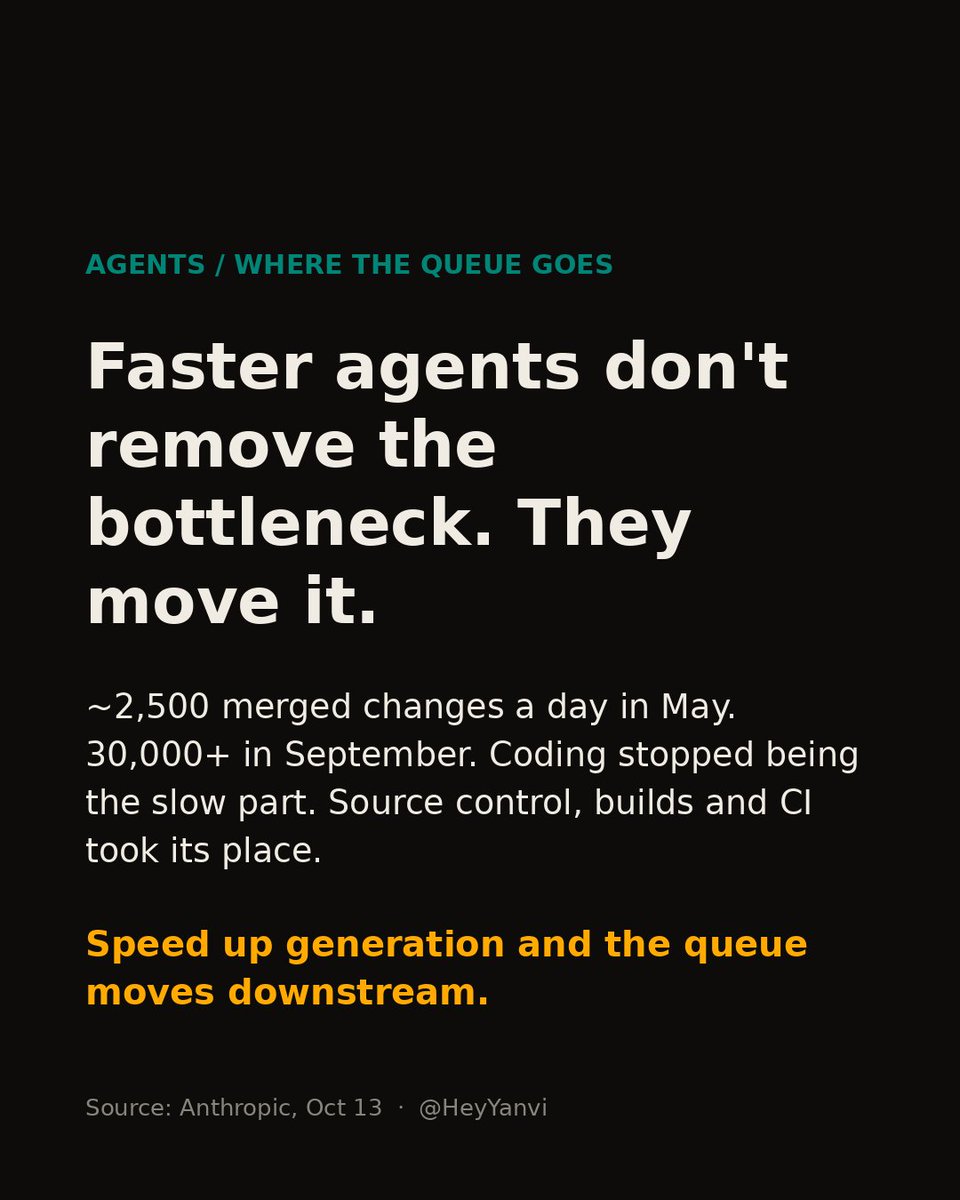
Anthropic says it went from ~2,500 merged code changes a day in May to 30,000+ in September, and coding stopped being the bottleneck. Source control, builds and CI took its place.
Their scale is unusual. The pattern isn't.
Speed up generation and the queue moves downstream.