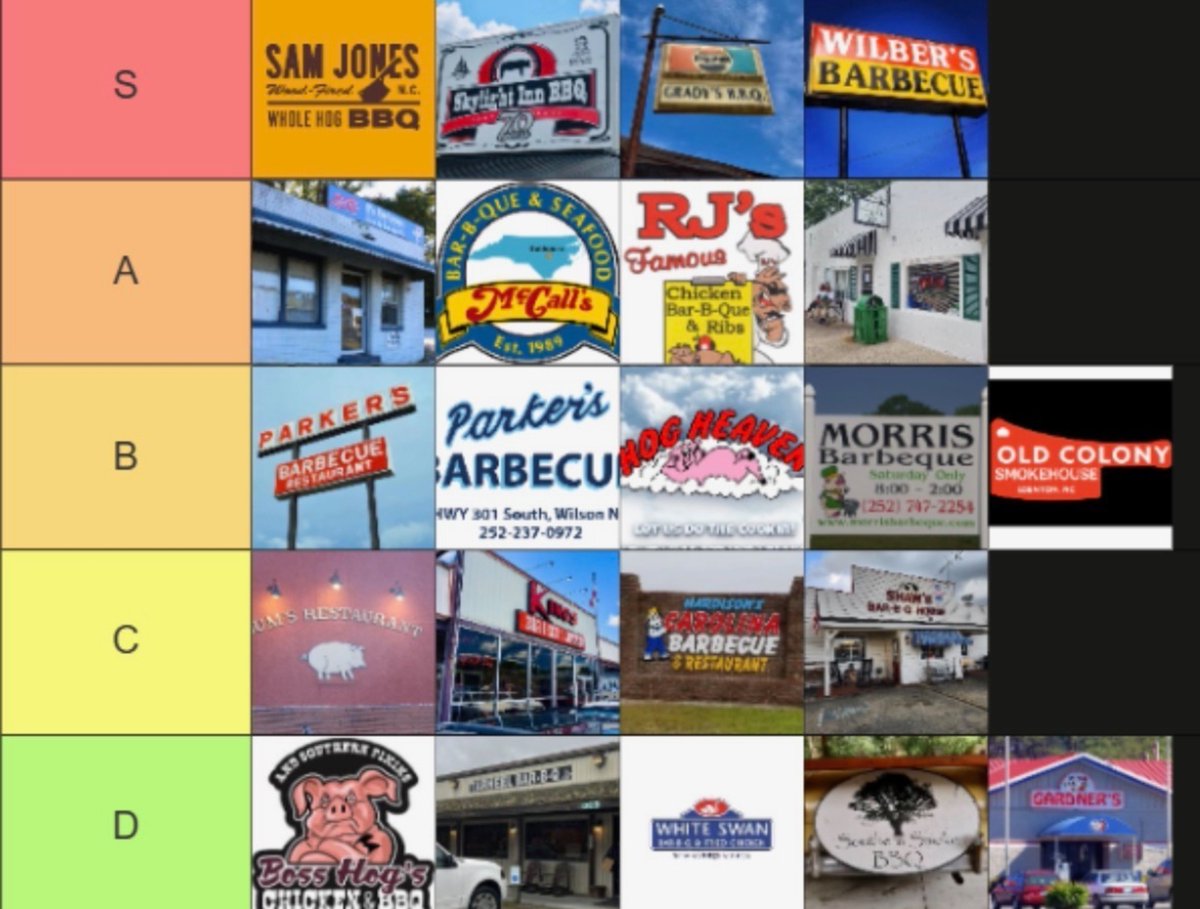
My rating based on Eastern NC BBQ spots only. This is based on since the last time I've had BBQ sandwich at them. I have been to all of these within a year.
Many have asked for a pocket guide to ENC BBQ east of I-95...well here ya have it. 😋👇
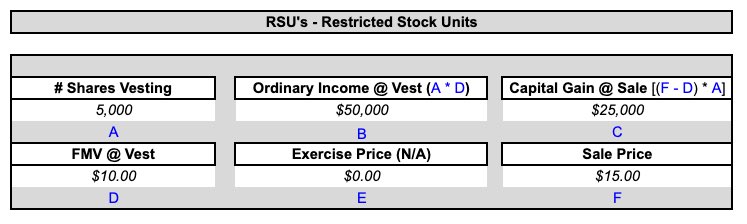
This rundown of RSUs should be part of every new hire onboarding at all companies that issue them:
A = # shares vesting (according to vesting schedule)
B = Value at vest (ordinary Income, same as wages)
C = Capital Gain at Sale
D = FMV at Vest (live price on day of vest if public)
E = Exercise Price (N/A for RSUs - you don't buy them)
F = FMV at time of Sale
"B" is treated the same as your regular salary/bonus income
4 year vesting with a 1 year cliff:
= 25% at 1 year mark, then typically monthly or quarterly vesting after that for the remaining 75% of the grant
RSUs will have withholding at time of vest for Fed / State / FICA (typically in the form of shares held back)
Bonuses and RSU vests are taxed as "supplemental wages"
22% is the default Federal tax withholding rate for supplemental wages
As soon as you hit the $1M mark for the year, any amount amount OVER $1M will get withheld at 37%
(and no, there isn't a way to get around this)
If anything, you MIGHT be able to change your tax withholding % to be higher -- which might be a good idea in your situation to avoid a big tax shortfall in April of next year
So 10,000 shares vesting at $20 results in $200,000 ordinary income
You would get maybe $130,000 (68%) worth of net shares "released" to you depending on your resident state
Now you hold that stock outright as a common shareholder and will be subject to changes in the share price if you hold
Most people get into a pattern of vesting and then selling right away because there’s not much benefit to holding
(unless you thought the stock was going to explode upward -- you just have to admit this is speculation on the stock price)
When you sell in the future, you pay capital gains on the difference between FMV at time of vest (-) FMV at time of sale
--sell >1 year post vest = long-term cap gain/loss
--sell <1 year post vest = short-term cap gain/loss
If you sell right away, your capital gain/loss = ~$0
If you held and the shares went up in value you, would sell and realize in capital gains on the delta between $170,000 and what you sold for
I encourage clients to look at RSUs as a bonus every time they have a vesting event
(The bonus just happens to be paid in the form of stock)
If you wanted to hold RSUs post-vesting (and take a bet on the company longer term), you just wouldn’t sell everything after vest
RSUs are good in that they typically don’t require a ton of strategy other than:
---Whether or not to hold or sell after you vest
---Tax withholding selection and tax impact management
I bought a box of slides in a Los Angeles warehouse for twenty dollars.
Thanksgiving, 2019.
An antique store was emptying an old warehouse. Inside was a pile of Kodachrome that almost went nowhere. The woman selling it said the slides had belonged to a photographer whose house had been liquidated after he died.
The boxes were addressed to Hugh Stevens Bell.
Bell was born in St. Joseph, Missouri, on January 10, 1899. He served in the Navy in 1918, finished Western Reserve University with honors, edited the campus paper, and worked at the Cleveland Museum of Natural History. He wrote for the Cleveland Plain Dealer, Nature Magazine, and the Journal of Geology. In the 1930s he joined the U.S. Indian Service and then soil conservation work. A son was born in Flagstaff in 1936. He did hydraulic research at Caltech and in 1942 published a USDA study on stratified flow in reservoirs.
National Geographic published his photographs along the way.
He lived out his last years in Sierra Madre and died there in 1989 at ninety.
What I found was not a few snapshots. It was a working life in color.
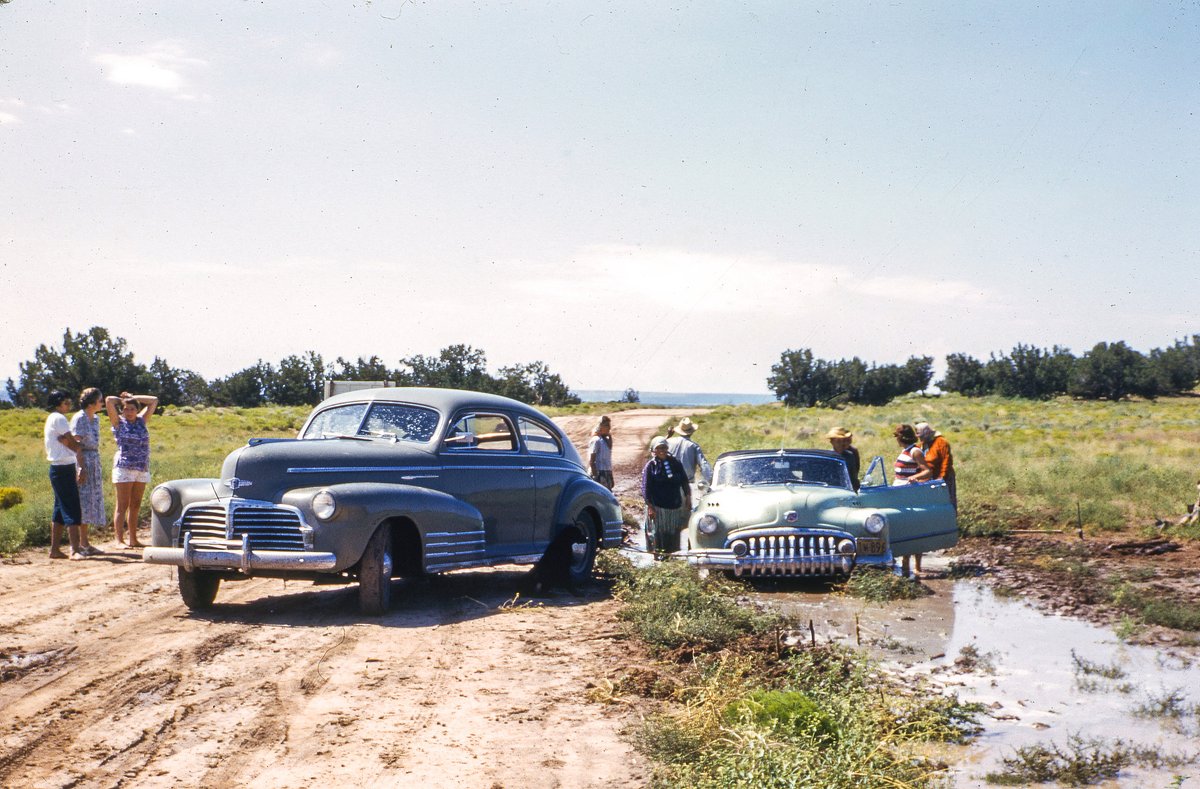
Desert roads. Cars stuck in the mud. Families standing in the sun. Monument Valley. Native communities of the Southwest in the 1940s and 1950s.
Mixed in were the personal frames. His people. His trips. The ordinary days that never make a magazine.
Kodachrome is why these still look alive. The dyes hold. Reds stay red. Skies stay blue. Seventy and eighty years later the film has not faded the way so many other color processes have. You can still feel the heat coming off the dirt.
I scanned them. I put them online. That box is what started my own personal collecting of what I've since learned is called vernacular photography.
Since then I have collected tens of thousands of snapshots, slides and photo albums and organized them into many different digital albums on Flickr.
Everything after that, the estate sales, the lockers, the orphaned pictures, began with the Hugh Stevens Bell Collection, sitting in a warehouse waiting to be thrown away.
Here is one of them.
The full collection is here if you are a fan of the American Southwest you will enjoy this trip back in a time machine:
https://t.co/TmOoHG50Oh
@markcecchini I would say this was the biggest surprise to me when working HNW. Charitable giving is much lower than I would have expected. Most like the idea of QCD’s but usually something like $5-10k when they could easily do more. Like you said, I don’t judge, it was just a surprise to me.
What if the man who's decided he's smarter than markets and should set the world's oil price, currency prices, treasury prices, and stock prices is really just an idiot?
@Eric_M_Courage Typically best to get portfolio margin instead of Reg T for box spreads.
Regulation T Margin: Limits borrowing to 50% of the purchase price for eligible stocks, with fixed maintenance rules for individual positions.