Selama ni mereka berjuang habis-habisan nak jatuhkan Tuanku Muhriz.
Alasannya, kata mereka: Tuanku kacau tanah adat.
Kali ini kami bongkar apa yang mereka tidak beritahu. Memang pasal tanah tapi bukan tanah adat. Ada perkara yang mereka tidak ceritakan.
N9 State Secretary will not gazette the change of Yamtuan, saying state exco has no power or authority to make such a declaration.
Earlier today, MB Ismail said the State Secretary has been instructed to gazette that Nadzaruddin has replaced Yamtuan Tuanku Muhriz.
we should treat our pets like babies because that’s exactly how they see us. their entire little world revolves around us and they deserve all the love we can give.
Lelaki Korea Selatan dulunya purata ketinggian 160+. Sekarang, purata ketinggian lelaki diorang 170+.
Apa yang berubah? Diet. Diorang bagi lebih protein kepada kanak2 & remaja.
Observation bro tak salah.
Ada study lengkap dari China pasal ni. Tu bukti paling kuat.
You must NEVER EVER announce your goal to everyone.
Apart from it giving you a false sense of accomplishment, you’d also attract so many losers who want to see you fail.
Never underestimate how petty people around you can be.
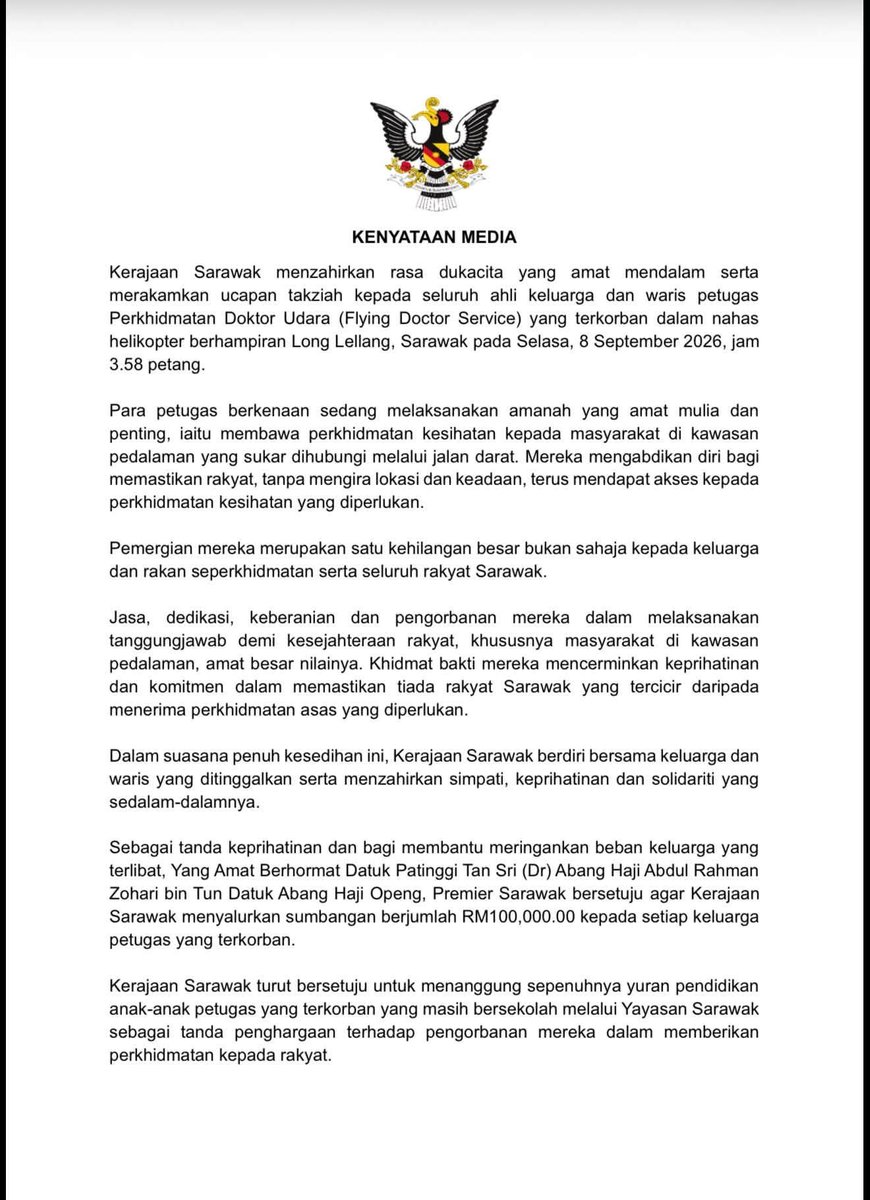
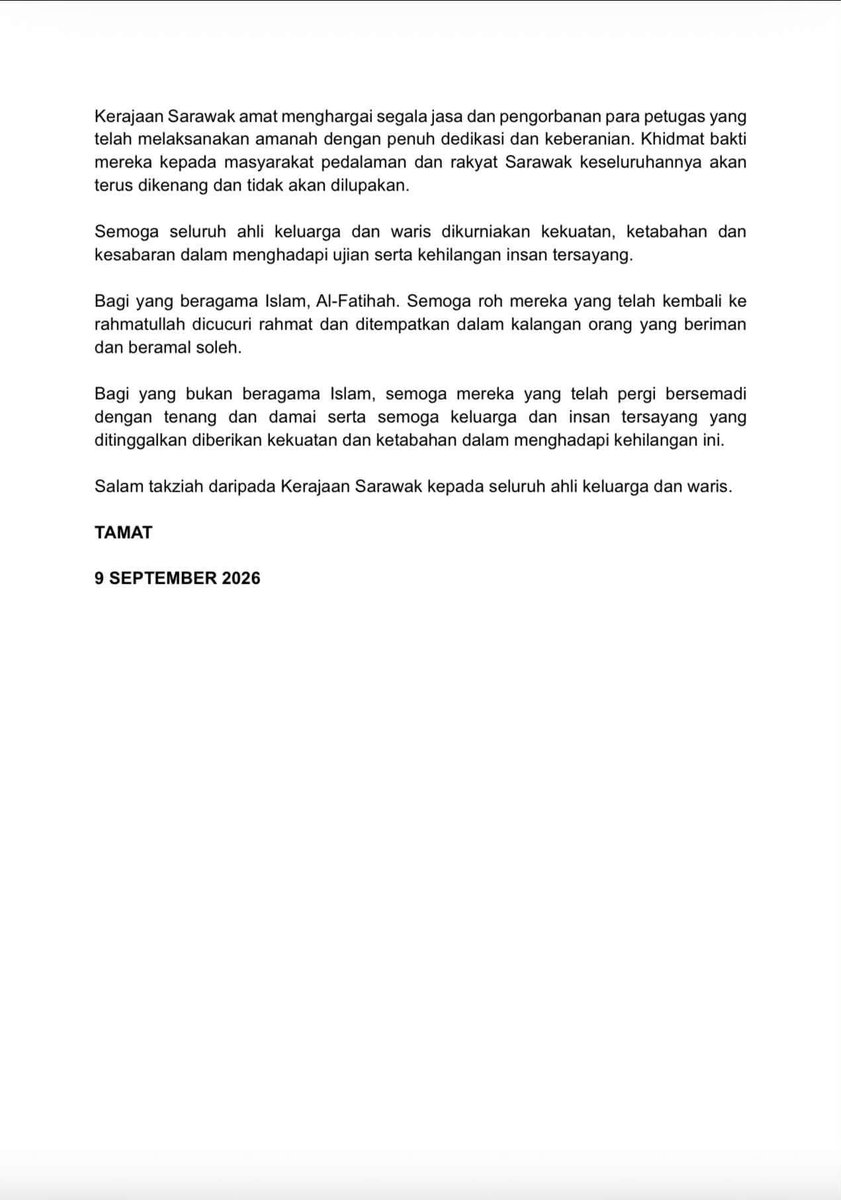
Kerajaan Sarawak akan menyalurkan sumbangan sebanyak RM100,000 kepada setiap keluarga petugas yang terkorban dalam nahas helicopter di Long Lellang, Sarawak.
Kerajaan Sarawak juga akan menanggung sepenuhnya yuran pendidikan anak anak mangsa yang masih bersekolah.
Salam takziah
The most worrying finding from PISA 2025 is not Malaysia’s ranking.
It is how many of our 15-year-olds are still below the minimum level needed to function confidently in the real world.
In Science, about 46% are below minimum proficiency, while only around 0.5% are top performers.
In Reading, about 56% are below minimum proficiency, and only around 0.1% reach the top levels.
In Mathematics, about 65% are below minimum proficiency, while only around 0.6% are top performers.
Even in Computational Problem Solving, where Malaysia performs relatively better, about 40% are still below the baseline, although around 12% reach Levels 5–6.
In plain English:
Nearly two-thirds of Malaysian 15-year-olds cannot consistently apply basic mathematics to ordinary real-life situations.
More than half lack minimum reading proficiency.
That is the real education crisis.
Not whether we moved up or down a few places in the ranking.
Fadhlina failed to turn the tide and make it even worse in Maths.
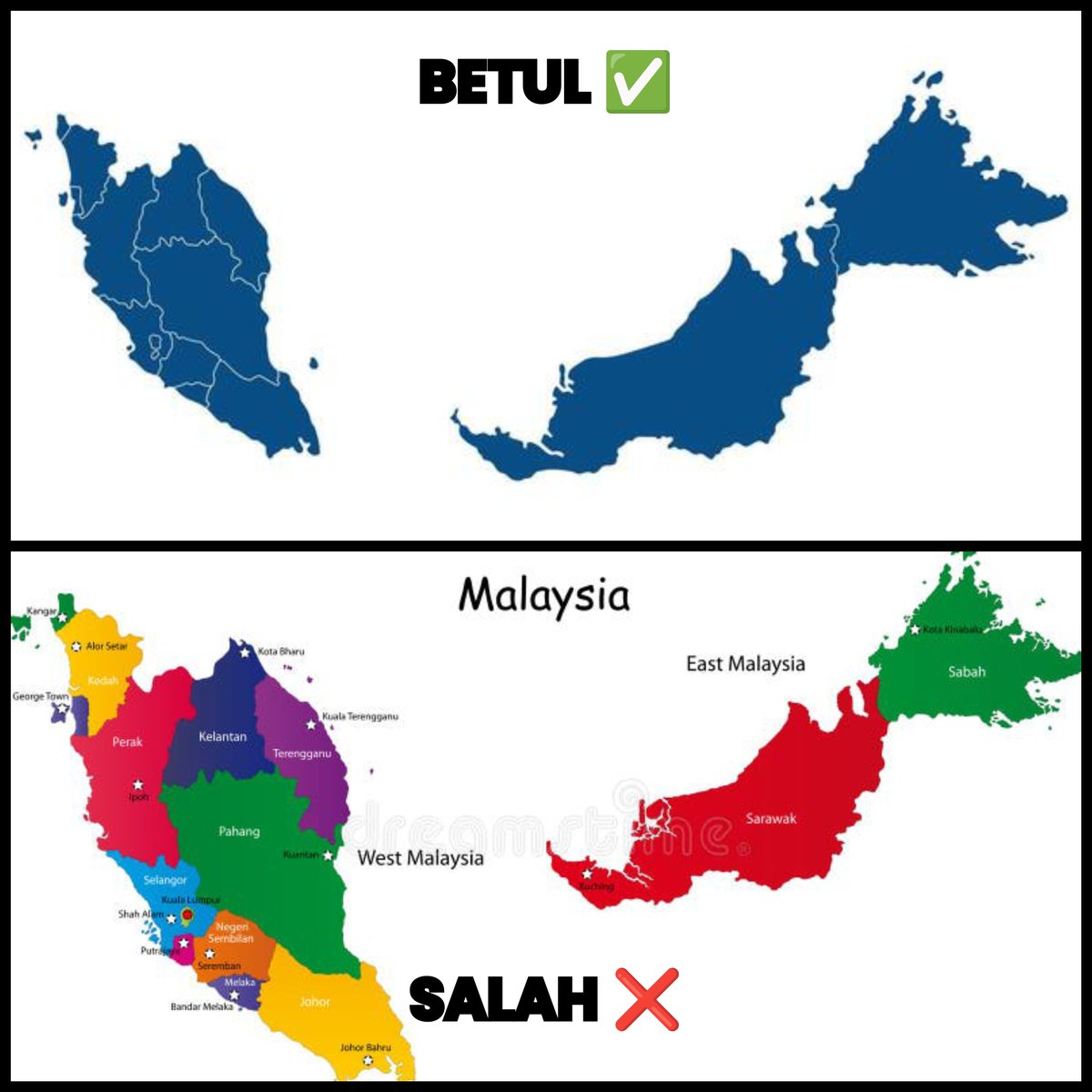
@3ricO2l7 This is for the clueless IDIOTS in the comments section
Sabah+Sarawak is about 60% of Malaysia total land area
That's mean Semenanjung is SMALLER than Malaysian Borneo. Not bigger.
A University of Tokyo professor recently shared that Malaysia is ageing at a faster pace than Japan did in the 1970s.
This is not only a public-health issue - it is a financial one too.
Ageing well requires a holistic plan: better daily habits, preventive healthcare and financial preparation.
Very happy to share that https://t.co/m5f4tiirMv has been updated with SPR's proposed map (1141 DMs, 99 DUNs, 31 Parlimens).
It has never been easier for Malaysians to come up with alternative maps and make representations to SPR.
The boundary data, electorate counts, and demographics are preloaded into Lukis, so you literally need ZERO data skills to draw your own alternate map.
All you need is the proper local knowledge to examine what SPR has proposed, and move the DMs around to form alternative constituencies.
My goal with Lukis is very simple - lower the barrier to entry (for scrutinising and countering SPR's proposal) as close to zero has possible.
If anyone has any feedback/feature requests, just lmk!
https://t.co/NjTpfmUmKv
Gak ada negara maju yang ekonominya ditopang sektor informal...
Di Indonesia-> MAYORITAS diisi sektor INFORMAL->pedagang kaki lima dan kerja serabutan.
Nih sektor informal, gak bikin org kaya, tapi hanya buat BERTAHAN HIDUP.
Inilah PR negara, gagal menciptakan lapangan kerja formal berkualitas dalam jumlah yg cukup...
Ironisnya, demi bersaing harga di jalanan, dagangan yang paling laris justru didominasi:
Tepung, Gula, dan Micin.
Bahkan-> Anak SD jajan pagi larinya ke CILOR
Sudahlah gak maju, gak sehat pula anak-anaknya.
Any Malaysian subsidiaries found responsible should just be stripped of their access in the local market and MITI trade network, RSPO or MSPO and penalized immediately as long as their names are listed for polluting (we can throw the appeals in the court pipeline as we go)
Something that I told my wife otw belanja grocery that I want to document it here.
Masyarakat kita sebenarnya dah tenat dan semakin jauh daripada cara agama mengajar kita melihat kehidupan.
Orang muda nak berkahwin pun ditakut-takutkan.
“Dah cukup duit ke?”
“Kerja dah stable?”
“Rumah dah ada?”
“Macam mana nak survive?”
“Macam mana nak bagi anak bini makan?”
As if marriage only becomes permissible once a man has achieved some arbitrary level of financial certainty.
Sedangkan Allah sendiri berfirman:
“If they are poor, Allah will enrich them from His bounty.”
Surah An-Nur 24:32
Notice what Allah is telling us.
Allah did not say,
“Only marry once you are financially stable.”
Allah explicitly acknowledges poverty as a possibility and then reminds us that poverty is not beyond His ability to remedy.
Kita terlalu yakin dengan financial planning kita, tapi terlalu lemah keyakinan kita kepada Ar-Razzaq.
Selama kita hidup, bukankah selama ini Allah yang cukupkan rezeki kita?
Sebelum kita ada pekerjaan, Allah dah beri makan.
Sebelum kita tahu dari mana duit akan datang, Allah dah tahu apa yang kita perlukan.
Makhluk yang tak mempunyai pekerjaan, bank account, business plan atau financial security pun Allah bagi makan.
Anjing liar pun Allah bagi makan.
Anak yatim yang kehilangan mak ayah pun Allah bagi makan.
Tiba-tiba bila seseorang nak berkahwin, kita pula yang sibuk bertanya:
“Siapa nak bagi mereka makan?”
Who exactly have we been relying on all this time?
Our salary?
Our employer?
Our savings?
Or Allah?
Of course, this does not mean seorang lelaki boleh kahwin secara reckless, malas bekerja, tak mahu belajar, tak mahu merancang, kemudian label semua itu sebagai tawakkul.
That's not tawakkul.
Tawakkul means you take the means and then place your reliance upon Allah, not upon the means themselves.
Jadi ya, lelaki wajib berusaha mencari nafkah, belajar mengurus kewangan, bersedia memikul tanggungjawab dan buat keputusan dengan matang.
Tetapi menjadikan takut miskin or whatever other reasons sebagai alasan untuk menakut-nakutkan orang daripada perkahwinan adalah sesuatu yang sangat berbeza.
And if marriage eventually turns out to be the wrong decision for someone, so what?
Adakah manusia sejak lahir sampai mati tidak pernah membuat keputusan yang salah?
Of course we do.
Human life is literally a sequence of decisions, consequences, corrections, failures, lessons and improvements.
Some decisions turn out beautifully.
Some decisions turn out terribly.
Some decisions look foolish in hindsight.
Some decisions hurt the person who made them.
And sometimes, the consequences are also felt by the people around them.
That's life.
What does a healthy community do when someone makes a bad decision?
If they're wise, they guide, advise, assist and help the person recover.
If they're foolish, they condemn the person as though they themselves have never made a single mistake in their entire life.
Bukankah begitulah manusia belajar?
Bukankah begitu keluarga berfungsi?
Bukankah begitu komuniti membantu anggotanya?
Bukankah sebahagian besar kemajuan manusia sejak awal peradaban datang daripada manusia membuat kesilapan, mengalami consequences, belajar daripada kesilapan itu, kemudian memperbaiki diri?
So why do we suddenly treat marriage as though every possible negative outcome must be eliminated before a person is allowed to take the first step?
And this is where our hypocrisy becomes even more obvious.
Look at how society treats riba.
Kita hidup dalam sebuah masyarakat di mana household debt sangat meluas, lebih 80% isi rumah membedal riba. Kalau kau jalan kat public, 8/10 daripada orang yang kau jumpa bedal riba.
But people will casually discuss:
“Loan mana paling murah?”
“Ambil berapa tahun?”
“Credit card mana paling banyak cashback?”
“Macam mana nak maximise points?”
“Ambil loan dulu, nanti refinance.”
“Macam mana nak build credit score?”
In other words, masyarakat bukan sekadar tolerating riba. Sometimes they actively teach people how to optimise it.
Yet Allah's warning regarding riba is not:
“Be careful, nanti susah sikit.”
Allah says:
“If you do not, then be informed of a war from Allah and His Messenger.”
Surah Al-Baqarah 2:279
That is the severity of the warning.
But somehow, our society is often more terrified of a young man/woman getting married while poor than a person entering a transaction that Allah describes in terms of war against Him and His Messenger.
A young man says:
“Aku nak kahwin, tapi aku ada duit sangat.”
“Jangan! Nanti susah!”
A young man says:
“Aku nak ambil loan.”
“Okay, jom kira interest, tenure, cashback and monthly instalment.”
What happened to our priorities?
Why are we so terrified of the possibility that marriage might lead to temporary financial hardship, but so comfortable normalising a financial system explicitly condemned by Allah?
And here's something even more disturbing, Allah Himself tells us who whispers this fear into our hearts.
“Satan threatens you with poverty and commands you to immorality, while Allah promises you forgiveness from Him and bounty.”
Surah Al-Baqarah 2:268
Syaitan menakutkan kita dengan kemiskinan. Allah menjanjikan kita keampunan dan kurniaan.
Read that again.
So when a society constantly tells young people:
“Don't get married, nanti miskin.”
“Don't have children, nanti tak cukup duit.”
“Wait until you're financially perfect.”
“Wait until everything is guaranteed.”
We should at least ask ourselves:
Are we teaching people wisdom and responsibility or are we inadvertently teaching them the very fear of poverty that Allah attributes to the whispers of Shaytan? Are we trying to become Shaytan?
And why are we so terrified of being poor anyway?
Miskin bukan dosa. Susah bukan kehinaan. Hidup miskin bukan failure.
The Prophet ﷺ himself lived through periods of severe material hardship.
Aisha رضي الله عنها narrated that two months could pass without a fire being lit in the households of the Prophet ﷺ, and their food would be little more than dates and water.
Would the modern “provider police” look at that and say:
“Nabi tak cukup provide.”
“Nabi patut kerja harder.”
“Nabi patut bagi lifestyle yang lebih comfortable.”
Of course not.
Because deep down, we know something our modern riba consumerist mindset keeps trying to make us forget:
Being a good husband is not synonymous with making your wife rich.
Providing does not mean guaranteeing your family a life free from hardship.
A man can fulfil his responsibilities and still be poor.
He can work hard and still struggle.
He can provide what he is capable of while his family lives simply.
And none of that automatically makes him a failure.
The companions رضي الله عنهم likewise included many who lived through poverty, hunger and extraordinary hardship.
Yet they did not measure the worth of a life by how comfortable it was.
Because they believed in something we increasingly struggle to believe which is this dunya is temporary.
We are not promised a life without hardship.
We are promised that hardship has meaning when endured with iman and obedience.
And for the believer, the final calculation is not made at the end of this month.
It's made in the Akhirah.
Imagine reaching Jannah by the mercy of Allah after a lifetime of hardship.
The hunger.
The financial struggles.
The tiny house.
The cheap food.
The difficult years.
The sacrifices.
All of it becomes insignificant compared to what Allah has prepared.
Allah says:
“No soul knows what joy has been hidden for them as a reward for what they used to do.”
Surah As-Sajdah 32:17
And no, this isn't an argument for irresponsible marriage. It is an argument against turning financial uncertainty into a religion of its own.
Plan.
Work.
Save what you can.
Learn.
Take responsibility.
Choose your spouse wisely.
Fulfil your obligations.
But after you've done all that, understand one fundamental reality:
You are not the provider.
You are merely one of the means through which Ar-Razzaq provides.
And perhaps that's the part modern people has forgotten.
We have become so obsessed with making sure we can guarantee tomorrow that we have forgotten:
Tomorrow was never ours to guarantee in the first place.
Jadi jangan sampai kita terlalu takut miskin sehingga kita mula meragui janji Allah.
Because poverty is not the greatest disaster.
The greatest disaster is becoming so afraid of poverty that you lose your trust in Allah, normalise what He has forbidden, and abandon what He has made lawful.
how to flirt with life:
(as a professional life flirter)
> go to things alone! you'll end up in more spontaneous situations
> talk to strangers - at coffee shops, events, literally anywhere. serendipity maxx
> be 5% more silly in your life. dance in your room, sing badly in the car, crack a bad joke. it's not that serious. grow the silly muscle
> playing it cool is overrated and people will never be able to know the real you
> make a bucket list and work your way through said bucket list!!
> try to find the good/kindness/love in every single person that you come across. get curious about this human in front of you that's filled with endless stories, thoughts, and perspectives
> stop dimming your light to make others comfortable. not everyone will be for you & that's okay. it's not that deep!
> start a random hobby just for fun - pottery, dance, improv, cooking. not everything needs to "be productive" ok??
> react authentically - laugh loudly, get animated, show emotion, be YOU!
> do something random *JUST BECAUSE* you feel like it - take the long way home, extend the walk, buy the chocolate, eat the ice cream
> surround yourself with people and spaces that light you up & make you feel like the BEST version of you
> compliment people genuinely. "you seem really interesting" beats small talk any day. you can catch me giving out at least 1 compliment per day
> surround yourself with people who make you feel lighter - your time and energy is precious
flirt with LIFE!!!
it's beautiful out there
let life surprise you!!!
dare yourself to enjoy it for the short time that we're all here - you got nothing to lose!!!
How Malaysia got itself stuck in a giant EV traffic jam of its own making.
A short story of good intentions, cheap batteries, and a massive policy headache.
1)Once upon a time, the government wanted everyone to go green.
The idea was simple: we need electric cars on the road to cut emissions and look modern.
2)Back then, an EV was basically a Tesla or a legacy brand.
Super expensive, fancy, and strictly for the Bangsar and Damansara crowd.
3)So the plan went like this:
• Waive all import and excise duties on EVs.
• The rich get their tax-free toys.
• The government looks progressive on climate change.
• Perodua and Proton get five to ten years of breathing room to slowly figure out how to build their own electric cars.
4)To make sure nobody messed with our local rice bowls, they set a strict house rule:
No imported EV can be sold below RM100k.
The logic? Keep the cheap imported cars out so ordinary Malaysians keep buying Myvis, Axias, and Sagas.
Win-win, right?
5)Then China walked into the room.
While everyone thought EVs would stay expensive for decades, China figured out how to churn out decent, reliable electric cars for RM50k to RM70k.
Suddenly, the whole game flipped.
Instead of an EV being a luxury status symbol, it became cheaper to build than a petrol car.
6)Now our policymakers are sweating, because they are stuck in a corner with three conflicting problems:
If they remove the RM100k floor:
A flood of RM60k smart Chinese EVs arrives at Port Klang. The man on the street gets a modern, cheap runabout. But Perodua and Proton panic, and hundreds of local car parts factories making exhaust pipes, spark plugs, and gearboxes face sudden trouble.
7) If they keep the RM100k floor:
The average Malaysian is forced to keep paying RM80k to RM100k for regular petrol cars, while watching the rest of the world buy sub-RM60k EVs.
8)Going green stays an elite hobby for people with landed houses and double garages.
9) If everyone actually buys EVs:
The taxman loses billions in automotive import duties and road tax, right when fuel subsidy rationalisation is already shaking things up.
Cute takeaways:
•The RM100k floor was meant to be a fence to protect local makers.
China built a ladder and made the fence look ridiculous.
• We wanted green transport, but only if it stayed expensive enough not to disturb the status quo.
• The man in the street just wants a reliable RM50k runabout with cold air-cond and cheap maintenance, but policy is caught trying to save 1990s engine factories from 2026 battery tech.
10)The lesson: You cannot plan a slow, 10-year transition in an industry where technology cuts prices in half every three years.
Hope my thinking is not too outlandish.
I hate Non-Tariff Barriers except for products or services that endanger our sovereignty