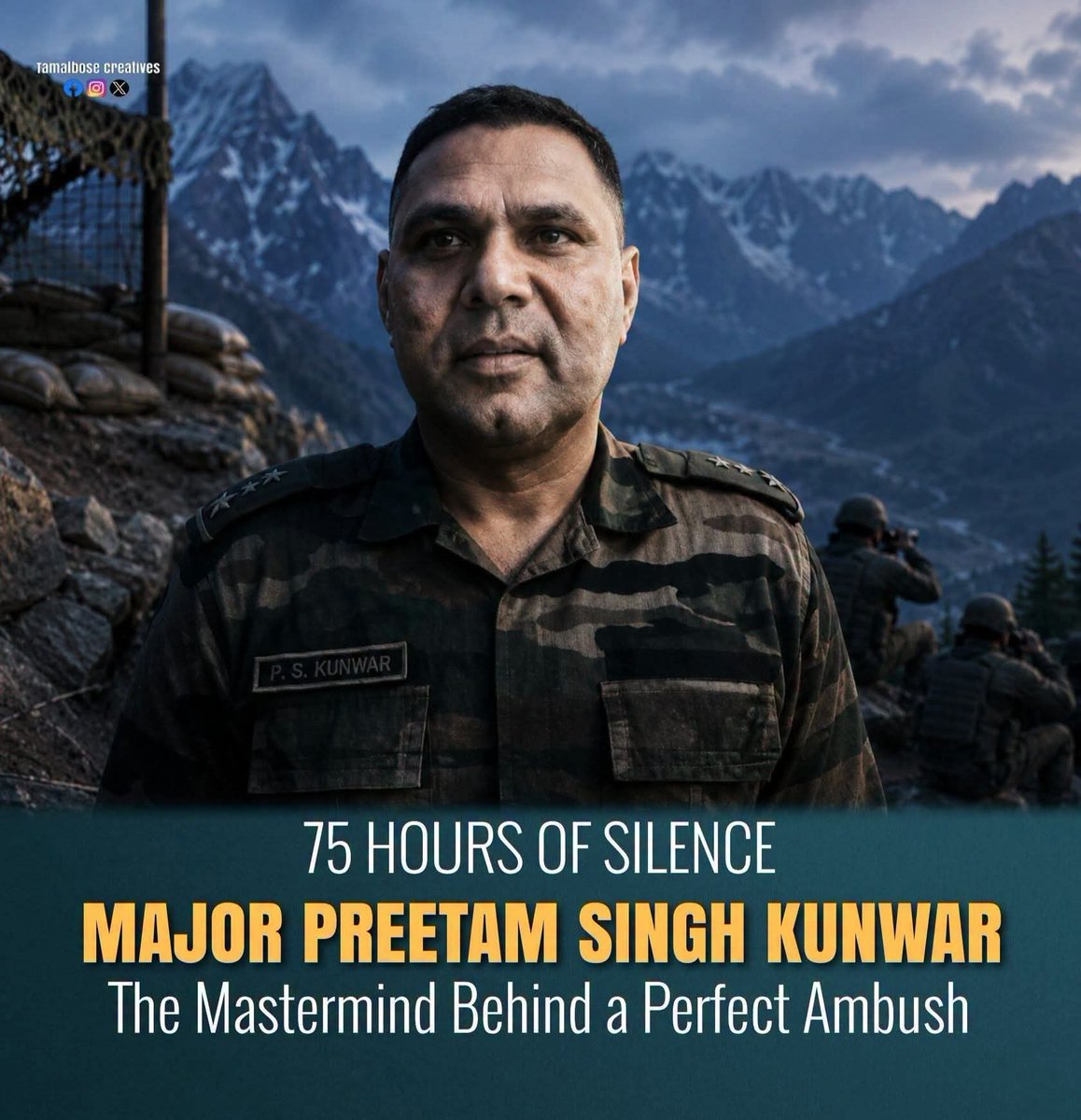
He Waited 75 Hours… Then Ended It in 15 Minutes. The Story of Major Preetam Singh Kunwar.
On 23 May 2017, a thermal imager along the Line of Control detected six suspicious figures near the Badori hills in Pakistan-occupied Kashmir (PoK). They were heavily armed Lashkar-e-Taiba (LeT) terrorists preparing to infiltrate into India for a major attack. It was the first major infiltration attempt since the 2016 surgical strikes.
The operation was led by Major Preetam Singh Kunwar of the 4 Garhwal Rifles.
Many commanders might have opened fire the moment they spotted the terrorists. Major Kunwar didn't. He understood that firing too early might eliminate only a few, allowing the rest to escape. Instead, he chose patience over impulse.
For nearly 75 hours, he and his men tracked the infiltrators through rugged mountains, dense forests, icy streams, and dangerous minefields. To cross one mined stretch safely, they even improvised a bridge using a six-foot log, advancing inch by inch. Every step carried the risk of death, but Major Kunwar refused to compromise either the mission or the safety of his soldiers.
On the evening of 26 May, the terrorists finally crossed into Indian territory, unaware that they had entered a carefully prepared kill zone. Even then, Major Kunwar held his fire until every infiltrator was within range.
At exactly 7:13 p.m., he calmly transmitted a single command over the radio:
"Open Fire."
The silence of the mountains was shattered.
In just 15 minutes, all six terrorists were eliminated. Not one escaped. Even more remarkably, all 17 Indian soldiers involved in the operation returned without a single casualty or injury.
The weapons, ammunition, and supplies recovered from the terrorists revealed they had been preparing for a major strike in Kashmir. By stopping them at the border, Major Kunwar and his team likely prevented a devastating terrorist attack.
For his exceptional courage, leadership, and tactical brilliance, Major Preetam Singh Kunwar was awarded the Kirti Chakra, India's second-highest peacetime gallantry award.
Yet when asked about his actions, his response reflected the humility of a true soldier:
"I didn't do anything extraordinary. I simply did the job I had signed up to do."
Some heroes become legends because they charge into battle. Others become legends because they know exactly when not to pull the trigger.
Major Preetam Singh Kunwar belongs to the second kind.
Copied
No where in the world, with a per capita of $3000 and per sq km population density of 500 humans, can you see herds of large wild and dangerous beasts roaming about freely and growing in numbers.
It can happen only in India.
Do not let those who massacred their wild animals to live freely, and cull their dangerous beasts if they increase in numbers or attack humans, preach us and program you against the nation when there's some human animal conflict in India.
Or tell us about human rights.
Kudos to Assam for doing so much in conservation of nature and increase in numbers of India's big beasts like Elephants, Tigers, and Rhinos.
There was a cab driver in Delhi who dreamt every day of becoming an army man. He finally made it on his third attempt & was assigned to the J & K Rifles. Within a year he was in Kargil and there was a war on. On this day, 26 years ago, Rifleman Sanjay Kumar volunteered to lead an attack on Point 4875 in the Mushkoh Valley. When they were pinned down by machine gun fire, Sanjay Kumar jumped out and charged. He took a couple of bullets, reached the bunker, killed all three inside, and then turned their machine gun on the rest of the bunkers and fleeing enemy troops. He was awarded a Param Vir Chakra, one of only seven living winners.
यह मध्य प्रदेश के खंडवा में तैनात अपर सत्र न्यायाधीश अक्षय कुमार द्विवेदी हैं। यह उन लोगों में से हैं जिन्हें हम सबको प्यार करना चाहिए।
जज साहब ने आलीशान सरकारी बंगला, वीआईपी कार और अन्य सरकारी सुविधाएं लेने से इंकार कर दिया है। वे एक छोटे से कमरे में रहते हैं, अपना खाना खुद बनाते हैं और रोजाना पैदल ही कोर्ट जाते हैं।
जज अक्षय ने मध्य प्रदेश हाई कोर्ट को आवेदन देकर अपनी सैलरी आधी करने की मांग भी की है। निजी संपत्ति के नाम पर उनके पास सिर्फ अपनी मां द्वारा दिया गया एक मोबाइल फोन है। उन्होंने आजीवन अविवाहित रहने का फैसला किया है। तबादले पर उन्होंने विभाग से कहा है कि उन्हें देश में कहीं भी भेजा जाए, वे न्यूनतम सरकारी सुविधाएं ही लेंगे।
बचपन में अपनी मां को संपत्ति विवाद के दौरान अदालत के चक्कर लगाते देखकर उन्होंने जज बनने का निर्णय लिया था। इसी कारण वे अपनी अदालत में आने वाले मुकदमों, खासकर जमीन-जायदाद से जुड़े मामलों का निपटारा बेहद तेजी से करते हैं ताकि आम लोगों को जल्द से जल्द न्याय मिल सके।
सलाम जज साहब
ये हैं टी अंबाजगेन कलेक्टर साहब ,धन्य है वे माँ बाप जिन्होंने इन्हे मानव सेवा के संस्कार दिए.!
80 साल की बूढ़ी माता घर में बिल्कुल अकेली। कई दिनों से भूखी। बीमार अवस्था में पड़ी हुई। खाना-पीना और ठीक से उठना-बैठना भी दूभर। हर पल भगवान से उठा लेने की फरियाद करती हुई,
खबर तमिलनाडु के करूर जिले के कलेक्टर टी अंबाजगेन के कानों में पहुंचती है। दरियादिल यह आइएएस अफसर पत्नी से खाना बनवाता है फिर टिफिन में लेकर निकल पड़ता है वृद्धा के चिन्नमालनिकिकेन पट्टी स्थित झोपड़ी में।
जिस बूढ़ी माता से पास-पड़ोस के लोग आंखें फेरे हुए थे, कुछ ही पल में उनकी झोपड़ी के सामने जिले का सबसे रसूखदार अफसर मेहमान के तौर पर खड़ा नजर आता है,
वृद्धा समझ नहीं पातीं क्या माजरा है डीएम कहते हैं-माता जी आपके लिए घर से खाना लाया हूं, चलिए खाते हैं।
वृद्धा के घर ठीक से बर्तन भी नहीं होते तो वह कहतीं हैं साहब हम तो केले के पत्ते पर ही खाते हैं। डीएम कहते हैं-अति उत्तम। आज मैं भी केले के पत्ते पर खाऊंगा,
किस्सा यही खत्म नहीं होता चलते-चलते डीएम वृद्धावस्था की पेंशन के कागजात सौंपते हैं। कहते हैं कि आपको बैंक तक आने की जरूरत नहीं होगी, घर पर ही पेंशन मिलेगी डीएम गाड़ी में बैठकर चले जाते हैं, आंखों में आंसू लिए वृद्धा आवाक रहकर देखती रह जातीं हैं
इंसानियत आज भी जिंदा है....Read News
Durin the Ottoman period, the Muslim Turks, in order to terrorize the Greeks, impaled and roasted alive Athanasios Diakos. But, they gave him a chance: "Will you become a Turk, Diakos? Will you change your faith? Will you pray in the mosque and abandon the church?"
He replied to them: "Go away, you and your faith, may you perish, you renegades! I was born a Greek, and as a Greek I shall die."
According to eyewitness accounts from the time, two Turks lit a fire next to the stable and placed an iron grate and a large copper cauldron filled with oil over it. Then they lifted Diakos, still bound as he was, and made him sit on an old wooden stool. They raised his legs. The Turks began to mock him, asking him various questions. For every negative nod, they drove nails into his feet. Afterwards, they took the boiling oil and first poured it over his bare feet.
When they saw that he did not react, they tore his clothing and began pouring it on his back and chest. He groaned silently in pain, and the soldiers, under orders not to kill him, used needles to burst the blisters that had formed on his skin from the boiling oil. This continued for hours, until the next morning.
Exhausted as he was, they dragged him through the town to execute him. His execution was carried out in public view with the permission of Halil Bey, so that the Greeks would be warned about what would happen to anyone who dared to revolt. Testimonies state that even Diakos’s mother was present at his torture.
After tying him backwards onto a saddle with his legs spread apart, the executioner began pushing the sharp tip of a wooden stake into his groin area and then slowly drove it deeper, going all the way through his body until it emerged near his right ear. The executioner moved carefully, as he had orders not to kill him quickly; with every push of the stake, Diakos’s screams confirmed he was still alive.
Once the executioner had finished his work, the Turks tied the body tightly with the stake so that the skin would not tear, and they propped him up, almost upright, against a tree.
As he was dying, it is said that he uttered these sorrowful verses: "Look at the time Death has chosen to take me, now, when the branches are blossoming and the earth brings forth grass."
Halil Bey gave the order to light a fire beneath him and to turn him slowly, so that he would be roasted alive like an animal. After many hours of torture, the Greek chieftain passed away on April 24, 1821. However, this had the opposite effect from what the Turks had expected.
When the Greeks learned of his story and his martyrdom, they were filled with even greater rage and strength to liberate themselves from the barbarous Muslims and Islam.
Athanasios Diakos is one of the most important heroes in the Greek history.
IAF's MiG-25 and its mighty camera.
Some photos from our archives. The colour pix of the massive A70M camera was taken on 1 May 2006.
The enigmatic MiG–25 (NATO: Foxbat) served in the
ultra high altitude strategic reconnaissance role with
the Indian Air Force for near 25 years from its induction
on 17 August 1981 till its formal phasing out from service
on 1 May 2006 at Air Force Station Bareilly.
We were there to cover the event.
Qutbuddin Aibak, the first ruler of the Slave Dynasty in the Delhi Sultanate, died after falling from a galloping horse.
But is it really possible that a general who rode a horse for the first time at the age of 11 and fought countless battles on horseback could die from a galloping horse?
Real History vs. Fabricated Story
When Qutbuddin Aibak plundered Rajputana, he killed the king of Mewar and captured Prince Karan Singh. Along with the looted wealth and the prince, he also took the prince's horse "Shubhrak" to Lahore.
In Lahore, Karan Singh tried to escape and was captured. Qutbuddin ordered his beheading and, to add insult to injury, ordered a polo match played using the dead prince's head as a ball.
On the day of the beheading, Qutbuddin arrived at the venue riding Shubhrak. Upon seeing its master Karan Singh, the horse bolted uncontrollably, causing Qutbuddin to fall from the horse. Shubhrak kicked the fallen Qutbuddin with a powerful kick. The powerful blows to the chest and head proved fatal. Qutbuddin Aibak died instantly in 1210 CE.
Everyone was stunned. Shubhrak ran towards Karan Singh, and taking advantage of the ensuing chaos, the prince jumped onto his valiant horse, which immediately took off running and began the most arduous race of his life.
It was a continuous race for almost more than three days, finally stopping at the gates of the kingdom of Mewar. When the prince dismounted, Shubhrak stood still like a statue. Karan Singh lovingly stroked the horse's head, but was shocked when Shubhrak fell to the ground.
The powerful horse managed to save its master and safely escorted him back to his kingdom before succumbing to his injuries.
We've read about Chetak, but the story of Shubhrak is beyond belief! Facts like this never make it into the curriculum of our modern education system. Most of us haven't even heard of it. Have we?
It is permanently buried in history. It's time to share the glory.
🙏🏻🇮🇳Jai Hind🙏🏻
The Douglas C-47 Dakota was a civilian transport aircraft. It was unpressurized, it was slow & it was mathematically incapable of operating as a combat bomber over the highest, most unforgiving mountain range on the planet.
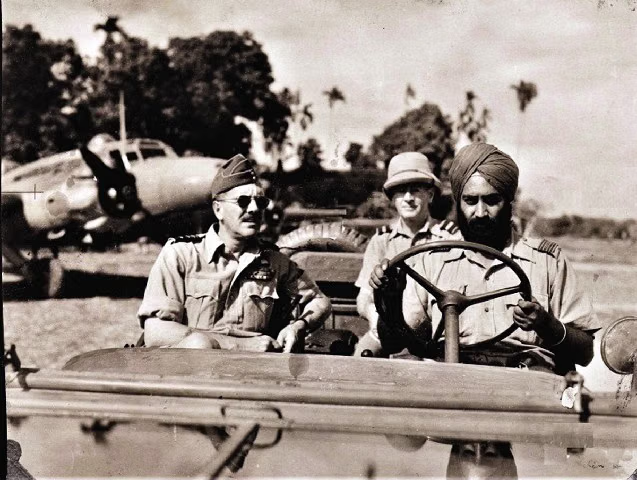
But international aviation manuals did not account for the sheer, desperate crisis of late 1947. & they certainly did not account for Air Commodore Mehar Singh, the legendary, "Baba" Mehar Singh & the fierce, unbreakable defiance of the fledgling Indian Air Force.
It is 1947. The picturesque valley of Poonch is completely besieged. Tribal raiders & hostile forces have surrounded the town, choking off all land routes. Inside, 1000s of innocent refugees & a small, battered garrison of Indian Army jawans are trapped. If Poonch falls, the strategic gateway to Kashmir is lost forever. The jawans are fighting with their backs to the wall, but they are facing heavy, relentless enemy fire from the dominating heights.
They desperately need air support. They need heavy artillery. They need something to break the siege from above.
The IAF’s Tempests & Spitfires are exceptional fighters, but they cannot carry the sheer weight of ordnance required to obliterate dug-in mountain bunkers. India needs a heavy bomber. The problem? The young nation does not own a single 1.
Baba Mehar Singh looks at the lumbering, twin-engine C-47 Dakota transport planes idling on the tarmac. He smiles. We will make them bombers.
- The Modification: Zero blueprints. No factory assistance.
- The Method: Remove the cargo doors, weld makeshift metal tracks to the floor & stock the cabin with heavy, volatile 250 pound bombs.
To reach the besieged valley of Poonch, these primitive, unpressurized aircraft had to clear the towering, jagged peaks of the Pir Panjal range, forcing them to climb to staggering altitudes b/w 15000 & 18000 feet.
There were no oxygen systems. There was no heating.
As the Dakotas clawed their way into the sky, the air inside the cabin turned violently thin & bitterly cold, freezing the breath in the aircrews' lungs. The pilots & the cargo handlers, airmen who volunteered for a suicide run had to fight off the rapid, dizzying onset of hypoxia. Their heads throbbed, their limbs grew heavy as lead & their fingers turned blue from the sub-zero temperatures.
Yet, as the mountains rushed beneath them, the real battle began. With the cargo doors completely removed, the freezing Himalayan slipstream roared into the cabin at over 150 mph, creating a deafening, chaotic vortex.
There were no automated bomb bays, no targeting computers & no release switches. The bombing mechanism was pure, raw human muscle.
As the pilot lined up the lumbering transport plane over the enemy positions on the craggy peaks, he would shout a verbal cue over the roar of the engines. In the back, battling the violent turbulence, the sub-zero wind & the suffocating lack of oxygen, the airmen would manually fuse the heavy 250-pound explosives. Working in perfect, terrifying unison, they would physically heave the massive bombs onto the metal tracks & kick them out of the open door, sending them hurtling into the abyss below.
It was frantic, it was primitive & it was devastatingly effective. The sight of massive, rumbling cargo planes suddenly acting as heavy bombers, raining destruction from the heavens, completely shattered the morale of the enemy forces. The siege of Poonch was broken & 1000s of lives were saved.
When those frostbitten, exhausted crews touched down back at base, gasping for the thick air of the plains, they had not just completed a mission. They had executed 1 of the most audacious, crude & brilliant improvised bombing campaigns in the annals of military aviation.
They proved to the world that when freedom is on the line, Indian airmen do not wait for the right weapons, they forge them in mid-air.
In the spring of 2014, inside a hospital dialysis unit in Montreal, a sixteen-year-old student named Anya Pogharian began a volunteer shift expecting to help with simple tasks.
Instead, she noticed the patients.
They sat for hours in reclining chairs, connected to large machines by tubes carrying blood in and out of their bodies. The treatment lasted four hours at a time and had to be repeated several times each week.
Their schedules, careers, travel plans, and daily lives revolved around those machines.
Anya couldn't stop thinking about it.
That evening, she went home, opened her laptop, and started reading dialysis machine manuals.
At the time, she had just been assigned a high school science fair project. The requirement was only ten hours of work.
She ended up spending more than three hundred.
As she researched, she learned that the dialysis machines used in hospitals cost roughly thirty thousand dollars each. What surprised her most was that many of the components didn't seem especially rare or complicated.
So she asked a simple question.
Did they really need to cost that much?
Anya studied engineering diagrams, technical documents, and equipment manuals. She broke the machine down into its essential parts: pumps, filters, valves, tubing, and an electronic controller.
The more she learned, the more convinced she became that a cheaper version could be built.
So she decided to try.
Working from a bench in her parents' home, she ordered parts and assembled a prototype herself.
The total component cost was about five hundred dollars.
And it worked.
She entered the project into the 2014 Google Science Fair, earning scholarships and awards. A Canadian science competition awarded her a bronze medal, and news of her invention quickly began spreading.
Soon, messages arrived from around the world.
Patients, families, and medical professionals from countries across several continents wanted to know more about the teenager trying to make dialysis affordable.
Support followed.
Medical companies offered assistance. Research organizations opened their doors. In 2015, Anya joined a laboratory internship where she could test and improve her design using real human blood under controlled conditions.
There, researchers set a goal.
The prototype needed to filter four liters of blood in two and a half hours, matching the performance of standard hospital machines.
Anya's machine, which she named Dialysave, completed the task in just twenty-five minutes.
It was not yet approved for patient use. It was not yet mass-produced. Many years of testing and certification still stood ahead.
But the most important question had already been answered.
Could a dialysis machine be built for a fraction of the traditional cost using readily available parts and determination?
The prototype answered for itself.
Yes.
Sometimes a breakthrough doesn't begin inside a billion-dollar corporation.
Sometimes it begins with a teenager who sees a problem, refuses to accept it, and spends three hundred hours proving that a better solution is possible.
At least 40+ people have died in France in the last week due to extreme heat. France24, one of the alleged red-green cabal infiltrated media cartel, has still not done a news piece titled "40+ poor people die in Macron's France." like they do for "Modi's India."
All French media did news on "extreme heat" in India just a month ago. And Indian media haven't covered the heat waves in Europe and how they are suffering without AC and dying. This is India's failing.
There must be a balance. Also, offense is the best defense. If India wants to shut their nonsense about India at the behest of their anti-India globalist, islamist and communist sponsors and editors, Indian media must focus on bringing all the dirt out about these countries.
Indian media need to cover just one crime, rape, accident from EU, US, and China everyday in India. Program 1.4 billion Indians against how bad things are. The way they do against India everyday. What INC used to do to Indians against the US, China, Pak one time.
The strategy will be extremely effective at shutting these foreign state media constantly doing negative stories on India. Even if not, it will ensure Indians understand it's not like only in India everything is the worst.
📅 JUNE 22 DAY 28 | THE WOMEN KARGIL LEFT BEHIND
We talk a great deal about the men who went to Kargil.
We talk much less about the women who stayed.
The mothers who watched news channels all day, cataloging every casualty list, terrified to see a familiar name. The wives who managed households, raised children, received the folded flag. The sisters who kept vigil by the phone. The fiancées who waited for someone who would never come back.
The News Cycle and the Family Room
Kargil was the first Indian war covered extensively on live television. With 24-hour coverage, embedded journalists, and raw frontline broadcasts from Star News, India watched the war unfold in real time.
For families of soldiers at the front, this was both a blessing and a curse.
You could sometimes glimpse the rocky, unforgiving landscape where your son was fighting. You could hear updates that suggested operations were succeeding. But you could also watch, in real time, the casualty figures rise. You didn't know, on any given night, whether the unit mentioned in the crossfire was the one your husband was in.
Many military wives have described those weeks as 60 days of sustained, unrelenting dread.
The Widows
For the 527 families who received the worst news, the Kargil War didn't end on July 26.
While immediate financial compensation was delivered faster than in previous wars, the long-term practicalities of widowhood were a different battle.
In 1999, navigating the long-term support systems formal pension processing, transferring housing, securing children's educational assistance meant facing a government bureaucracy that was incredibly slow.
Some families waited months for paperwork to clear. Young widows found themselves fighting for entitlements in a system structurally designed for a different era.
Organizations like the Armed Forces Flag Day Fund helped, and individual regiments did even more, but the central system itself has taken years of advocacy to become what it should be.
What They Deserve
Dimple Cheema Captain Vikram Batra's fiancée never married. She has stated publicly that she considers herself his widow in every way that matters, spending years honoring his memory and maintaining a steadfast bond with his parents.
Her choice is extraordinary. And it is entirely her own.
But it should not be necessary for a family to fight to survive after their soldier has already fallen. A country that asks its soldiers to die should build systems strong enough that the women they love are not left to navigate their grief through red tape.
Kargil's families deserve more than just our respect on Vijay Diwas. They deserve flawless systems, active support, and a government that processes their paperwork as quickly as it frames their husbands' photographs.
🇮🇳 #Kargil27 #KargilVijayDiwas
While we often praise Indira Gandhi for the 1971 war, we should certainly read the statement made in the Pakistani parliament by Asif Ali Zardari—the husband of Benazir Bhutto.
This was a time when over 90,000 Pakistani soldiers were in Indian custody, and the Pakistan Army had surrendered. The Indian Army had integrated the Tharparkar district of Sindh into India—declaring it a new district of Gujarat—and the Tricolour had been hoisted over the parliament building in Muzaffarabad.
When Zulfikar Ali Bhutto arrived to sign the Simla Agreement with Indira Gandhi, he brought his daughter, Benazir Bhutto, along with him.
Indira Gandhi placed a condition before Zulfikar Ali Bhutto: if he wanted his 93,000 soldiers back, he would have to hand over Kashmir to India. Bhutto refused, telling her that he would not give up Kashmir, nor would he sign any such agreement; he told her to keep the 93,000 soldiers herself.
Indira Gandhi had never imagined that Zulfikar Ali Bhutto was an even shrewder player than she was. He knew how to turn a military defeat at the border into a victory at the negotiating table.
Indira Gandhi found herself in a very tight spot.
Both Pupul Jayakar and Kuldip Nayar have written in their books that Indira Gandhi missed a crucial opportunity; neither she nor her advisors possessed the diplomatic acumen required to handle such a situation.
Under the Geneva Convention, if a country captures prisoners of war, it is obligated to fully uphold their dignity. That evening at the hotel, Zulfikar Ali Bhutto said to his daughter, Benazir Bhutto, "India's back has been broken in this war; we fought with great valor. We have dealt a severe blow to India's economy. India was already burdened by Bangladeshi refugees; how will it now sustain 93,000 Pakistani soldiers? And if India wants to settle these 93,000 Pakistani soldiers there, let it do so—what use would we have for such cowardly soldiers anyway? I have reduced Indira Gandhi to a pathetic state."
And in the end, Indira Gandhi was reduced to a meek, cowering figure.
Indira Gandhi handed over Kashmir to Pakistan, returned the 93,000 soldiers, and abandoned 56 of her own soldiers to die in Pakistani prisons. Furthermore, eight months later—driven by a desire for the Nobel Prize—she returned the Tharparkar district (which had been incorporated into the Indian state of Gujarat) to Pakistan, even though 98% of Tharparkar's population at the time was Hindu.
In the book he wrote after retiring, the Army Chief at the time of the Shimla Agreement stated, "We won this war on the battlefield, but politicians defeated India at the negotiating table—and that politician was Indira Gandhi."
This is the truth about the so-called 'Iron Lady'...
His name is Varun Baranwal.
He grew up in Boisar, a small town in Maharashtra’s Palghar district. His father ran a bicycle repair shop, and fixing punctures was the only income the family had.
In March 2006, four days after Varun finished his Class 10 board exams, his father died of a heart attack.
The hospital bills left the family deep in debt. Varun was sixteen. He was expected to shut his books, take over the shop, and keep his mother and sister fed.
For a while, he did exactly that.
Then his Class 10 results arrived. He had topped his school and placed second in the city.
His mother, who had never repaired a cycle in her life, sat down at the shop and took over the work herself so he could keep studying. A doctor named Kampli, a friend of his late father, paid his Class 11 fees and stood by him for years.
Varun wanted to study medicine, but the family could not afford it.
He chose engineering instead, and they sold their small piece of ancestral land to cover his first year fees at MIT College in Pune. He topped his first semester and won a scholarship that carried him through the rest of his degree.
He took a job at a multinational company. For most families in his position, that would have been the end of the struggle.
But he wanted more.
He spent his evenings collecting old notes and borrowing books from NGOs because coaching was beyond his reach. While others paid lakhs for preparation, he built his future from borrowed material and whatever time he could find after work.
In 2016, he sat the UPSC Civil Services Examination.
He cleared it on his very first attempt with an All India Rank of 32.
The boy who was expected to give up school and repair punctures for the rest of his life became an IAS officer.
Follow for stories India deserves to remember.
As an Indian woman from Muslim heritage, I write this rebuttal with the clarity and directness that comes from living the reality @Ilhan only tweets about from afar. Ilhan Omar’s claim that India has reached the “eighth stage of genocide” against Muslims is not analysis. It is reckless, fact-free propaganda that insults every one of us who actually live here, work here, raise families here, and exercise our rights every single day.
If there were even the beginning of genocide, our population would not have exploded. In 1951, Muslims were about 9.8% of India. By 2011, we were 14.2%. Today we are estimated around 14.5–15%, heading toward 18% by 2050 according to Pew projections. From roughly 35 million in 1951 to over 200 million now. Absolute numbers have multiplied nearly six-fold while the country’s overall population grew far slower in percentage terms. Genocide does not produce the world’s largest Muslim-minority population that keeps growing faster than the national average for decades. It produces mass graves and fleeing refugees. We have neither.
We vote in every election in the world’s largest democracy. We contest seats, win them, become MPs, ministers, judges, IAS officers, doctors, engineers, and business leaders. Three Presidents of India have been Muslim. We serve in the armed forces and police. We own businesses, run hospitals, produce films, and dominate segments of entertainment and sports. This is not the signature of a community facing extermination.
We are thriving and prospering — with real data and real lives. Yes, like every large community, we have internal challenges — lower average literacy and educational enrollment in some metrics, pockets of poverty, and the need for better skilling. But the narrative of uniform victimhood is a lie told by people who have never walked through a Muslim-dominated area in Mumbai, Hyderabad, Lucknow, or Kerala and seen the middle class, the professionals, the entrepreneurs, and the young women studying medicine and engineering.
Prominent Indian Muslims — from business (Wipro’s Azim Premji built one of India’s largest companies), to cinema (generations of stars and directors), to sports, academia, and medicine — show what is possible when talent meets opportunity in a free society. Millions of ordinary Muslim families have moved from villages to cities, from informal work to formal jobs, from one generation of limited schooling to the next pursuing professional degrees. That is prosperity in motion, not persecution.
We enjoy specific rights and accommodations that Hindus as a group do not. This is the part Omar and her echo chamber never mention. Indian Muslims operate under a parallel personal law system for marriage, divorce, inheritance, and maintenance rooted in Sharia. Hindus do not.
After independence, Hindu personal law was comprehensively reformed and codified into a uniform framework (Hindu Marriage Act, Hindu Succession Act, etc.). Muslims retained the right to follow their own religious laws — including provisions for polygamy (up to four wives) and differential inheritance rules that the Hindu majority surrendered decades ago.
We also have constitutional minority protections under Articles 29 and 30 that allow us to establish and administer our own educational institutions with significant autonomy — rights the Hindu majority does not claim as a group because it is not classified as a minority. The Waqf Act gives Muslim institutions unique control over vast religious and charitable properties in a manner unparalleled for any other community.
In short: the Indian state has gone out of its way, through personal laws and minority safeguards, to preserve and accommodate Muslim religious and cultural identity in ways it has not extended equivalently to the Hindu majority. These are not “equal rights” in every narrow sense — they are deliberate accommodations that give us more space to live according to our traditions than the majority community receives under the same Constitution.
As a woman from Muslim heritage in India, I have the full protection of the Indian Constitution plus the framework of personal law. The criminalization of instant triple talaq in 2019 removed a specific vulnerability that existed under uncodified practice. I can study, work, vote, travel, criticize the government, wear what I choose (or not), and practice my faith openly — all while living in a country where my community’s population share has steadily risen for 75 years.
@Ilhan Omar’s “eighth stage of genocide” rhetoric is not solidarity. It is the lazy export of American culture-war talking points onto a country and a people she does not understand. It erases the agency of 200+ million Indian Muslims who are neither cowering nor waiting for rescue from Washington. It cheapens the word “genocide” while real atrocities happen elsewhere.
Stop peddling foreign fantasies about our lives. We are here. We are visible. We are voting. We are building. And we reject your narrative with the facts of our own existence. That is the view from inside — not from a podium in the United States.
Why is this patriot missing from the pages of our history?
Seth Ramdas Gudwala was one of the greatest financiers and revolutionaries of the 1857 War of Independence, yet his name remains largely forgotten.
Born into a wealthy Agarwal family in Delhi, Ramdas Gudwala was among the richest men in North India. A prominent banker and businessman, his wealth was the subject of popular legends. It was said that he possessed immense treasures of gold, silver, pearls, and diamonds.
When the flames of revolution reached Delhi in 1857, thousands of Indian soldiers gathered to fight the British. However, feeding, clothing, and paying such a force became a major challenge.
At this critical moment, Seth Ramdas Gudwala stepped forward.
He placed his enormous fortune at the service of the nation, providing food, clothing, grain, animals, supplies, and financial support for the revolutionary forces. He also helped organize intelligence networks and communication channels across North India, connecting revolutionaries, rulers, and military camps.
His activities became a nightmare for the British administration.
Determined to crush the resistance, the British eventually recaptured Delhi. Seth Ramdas Gudwala was arrested and subjected to unimaginable brutality.
According to accounts, he was tied to a post and attacked by hunting dogs before being publicly executed in Chandni Chowk as a warning to others.
Historian Tara Chand, in his work History of the Freedom Movement, described Seth Ramdas Gudwala as one of the wealthiest men in North India, whose vast resources were dedicated to the cause of freedom.
Yet today, few Indians know his name.
The story of Seth Ramdas Gudwala reminds us that India’s freedom struggle was not fought only by soldiers on the battlefield, but also by courageous patriots who sacrificed their wealth, influence, and ultimately their lives for the motherland.
How many more such forgotten heroes are still waiting to be remembered?
📅 JUNE 19 DAY 25 | SANJAY KUMAR THE SOLDIER WHO CHARGED ALONE
There is a category of heroism that defies rational analysis.
When everything screams stop when your unit is pinned, when the position is defended, when the arithmetic of the situation says retreat some men go forward anyway.
Rifleman Sanjay Kumar of 13 JAK Rifles is in that category.
The Action
During operations in the Mushkoh Valley sector, 13 JAK Rifles was attacking Area Flat Top, a feature held by Pakistani forces. The company assault was stalled pinned down by heavy, effective fire from connected enemy bunkers.
Rifleman Sanjay Kumar a junior soldier, not an officer, not an NCO volunteered as the leading scout. Seeing the column paralyzed by fire, he assessed the situation and made a decision.
He charged. Alone. With utter disregard for his own safety. Directly at the first enemy position.
During the charge, he took two bullets one in the chest, and one in his forearm. Bleeding profusely, he refused to drop. He reached the bunker, fought the occupants in brutal hand-to-hand combat, and killed three intruders.
Despite his severe injuries, he didn't wait. He immediately charged the second position. The enemy, taken completely by surprise by the sheer ferocity of a bleeding man charging them alone, abandoned a Universal Machine Gun and fled. Kumar picked up their own weapon and fired on the fleeing soldiers.
His actions broke the tactical paralysis. Seeing him bleed and fight, his comrades took no notice of the treacherous terrain, charged the enemy, and wrested control of Area Flat Top.
The Man
Sanjay Kumar was not from a privileged background. He was not an officer-class product of the NDA. Before the war, he worked as a taxi driver in New Delhi and was rejected by the Army twice before finally making the cut. He was a rifleman the basic infantry rank from Himachal Pradesh, who just wanted to serve.
He has given interviews over the years that are remarkable in their matter-of-factness. He describes the action with precision but without drama. He says he did what needed to be done.
He is one of only two Kargil Param Vir Chakra recipients who survived to receive the medal.
The Importance of the Rifleman
The Kargil narrative in popular culture tends to focus on officers Vikram Batra, Manoj Pandey, Anuj Nayyar. Officers make better biopic subjects. Their backgrounds are more easily narrated.
But Kargil was won by riflemen. By jawans. By the basic Indian infantry soldier who climbed those peaks, carried those loads, fought in those temperatures, and died in numbers that dwarf the officer casualties.
Sanjay Kumar represents those men. Not as a symbol as a specific, real person who did a specific, real thing.
A Param Vir Chakra winner who, bleeding from the chest and arm, charged and cleared two fortified enemy positions alone.
His name is Sanjay Kumar.
🇮🇳 #Kargil27 #KargilVijayDiwas #SanjayKumar #PVC
🚨 Massive controversy erupt in Wadala (East) ahead of #MumbaiMonsoon.
While private contractors were paid crores for mechanical drain cleaning, residents of LBS Nagar & Korba Salt Pans caught them using child laborers to manually haul toxic garbage out of deep nullahs with zero protective equipment.
This isn't just a scam; it’s a criminal violation of child rights. Strict action needed NOW! 🚨
#MumbaiNews #BMC #ChildExploitation @mybmc@CPMumbaiPolice@NCPCR