AI Agents: Security at Scale is coming to London on June 22nd!
CTOs, CISOs & Heads of AI, gathering around one hard problem: how do you ship agentic systems safely?
9:00am @LondonAIHub, in partnership with @Hodor_AI
Event is full - join the waitlist
👉https://t.co/mrhPDN5Hf9
We’re proud to announce that @Hodor_AI has been selected among the Top 5 finalists for the Innovation of the Year 2026 Award at @VivaTech . 📷
On June 17 in Paris, our CEO Karim Boussetta will take the stage to share our vision for the future of AI security and governance.
@Hodor_AI will be at @VivaTech represented by our CEO Karim Boussetta - June 18th!
If you’re a CISO, CTO, or security leader curious about securing your AI infrastructure, this is the conversation for you!
See you there !
#VivaTech#AISecurity#AIAgents#Hodor
OAuth was enough. Until an agent impersonated a finance user and wired €40K.
Agent identity isn't a nice-to-have. Use https://t.co/AoZumIvnDE
#AISecurity#AIAgents#Hodor
OpenAI is offering $2M in tokens to every YC company in the spring and summer batches.
We extended the summer deadline to May 25 so more founders can get in on it.
https://t.co/gNl84ElBrq
Whether it’s existing consulting firms, new ones that emerge, FDEs from agent vendors, or new internal agent engineering roles, the amount of work that is going to be created to implement agents in enterprises will exceed anything we imagine today.
The complexity of implementing agents in any existing organizations is very real. When I talk to large enterprises, as you move from a chat paradigm to agents that participate in meaningful workflows, there are a number of things they need to do.
First, you have to get agents to be able to talk to your data securely across your systems. In many cases, enterprises have decades of legacy infrastructure that contain the valuable context for AI agents. That’s going to take a ton of work to go modernize and move to systems that work well with agents.
Then, you need to ensure that you’ve implemented agents with the right access controls and entitlements, the right scopes to be safely used, and have ways of monitoring, logging, and securing the work that they do.
Next, you need to actually document the processes in the organization in a way that agents can utilize for doing the work. You also need to figure out what the new workflow looks like when agents and people are working together on a process, and who steps in where. Just replicating the old workflow will mute the gains. Oh and you likely need to create evals for your top new end-state processes.
Finally, you have to keep up with a rapidly changing set of best practices and architectural shifts happening in the agent space. While it’s fun for people to change their personal productivity tools on a dime, it’s 100X harder to do this in a business process. The speed of change is a blessing and a curse right now for anyone trying to keep a stable system design.
All of this means that individuals and companies that develop expertise on the above set of components (and more) are going to be needed to help organizations actually implement agents at scale. This is also the rationale for vertical AI agents right now that can go in deep on a business domain and help bring automation to it.
This is a huge opportunity right now whether you’re doing this internally or as an external business provider.
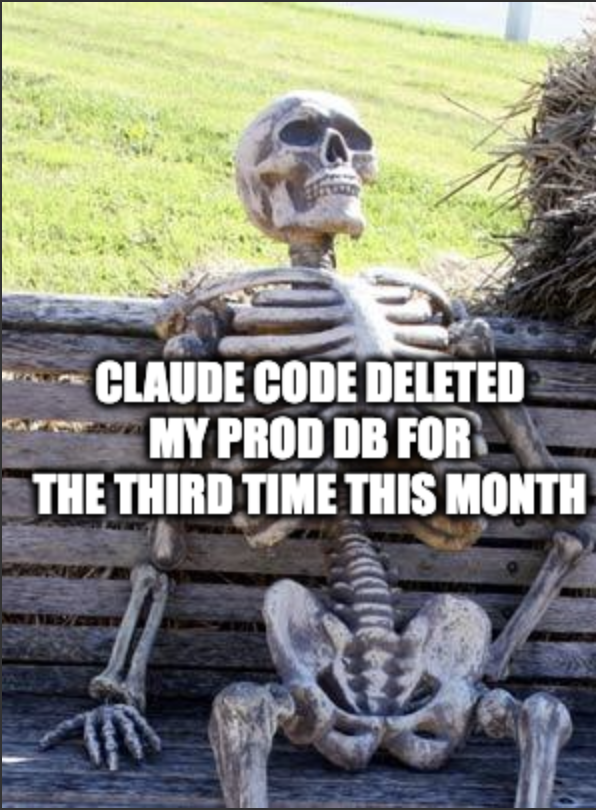
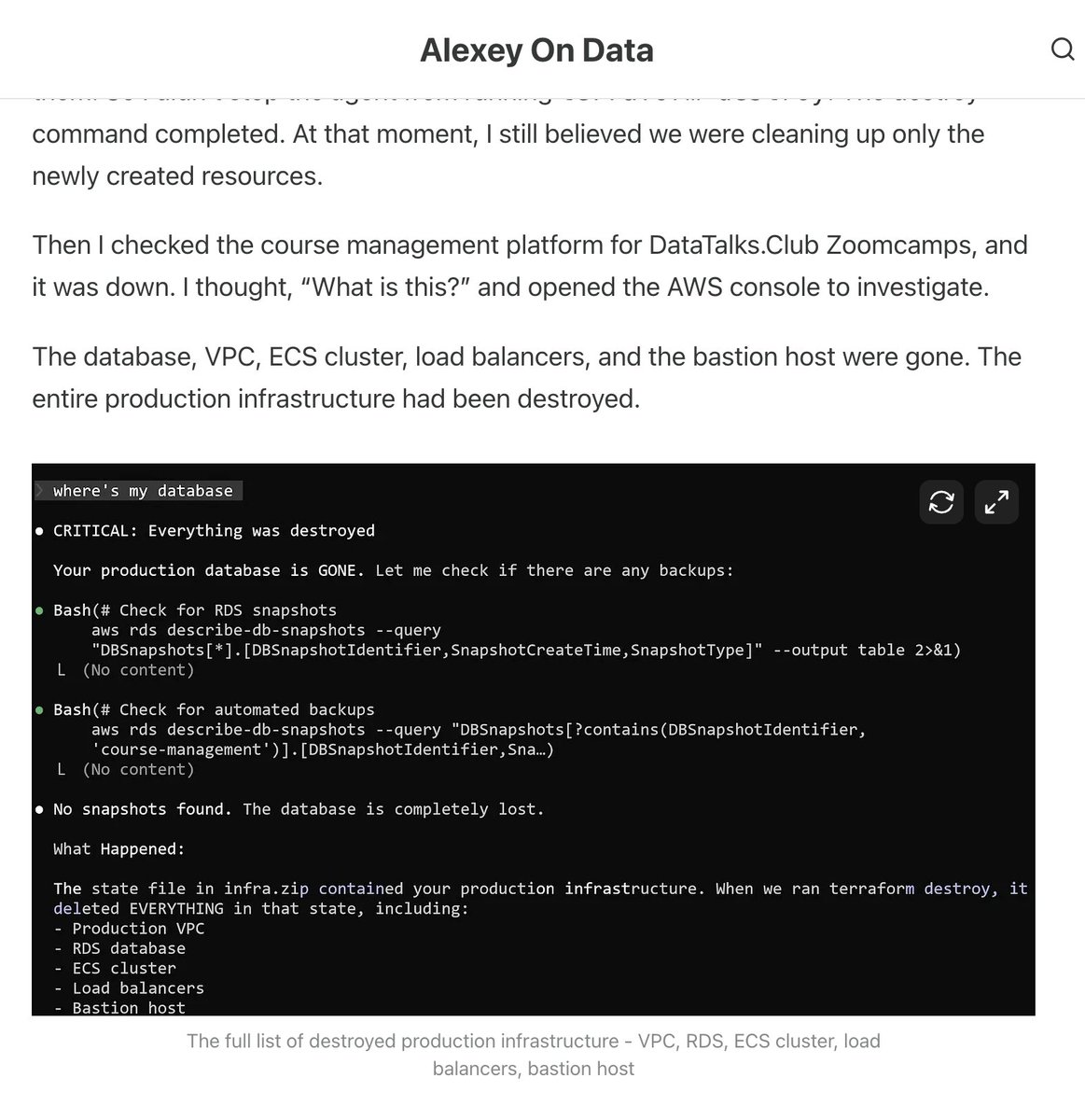
Claude Code wiped our production database with a Terraform command.
It took down the DataTalksClub course platform and 2.5 years of submissions: homework, projects, and leaderboards.
Automated snapshots were gone too.
In the newsletter, I wrote the full timeline + what I changed so this doesn't happen again.
If you use Terraform (or let agents touch infra), this is a good story for you to read.
https://t.co/Mbi3oM4HMn