Interested in the mechanistic basis of variation in social behavior at evolutionary and life history time scales. Neuroscience and genomics: NeuroEtho-EvoDevo
Check out our new paper on how extinction training suppresses activity of hippocampal fear memory and alters transcriptomes of fear-encoding granule cells, by Alfredo Zuniga, Jiawei Han, @imillercrews, Laura Agee, a great collaboration w/ @TheDrewLab https://t.co/K8d4jAhiKS 1/5
Venter was an abrasive dick, but his general "we can just do things" attitude was transformative in modern genomics. He went against the plodding consensus, and succeeded time after time, first with EST sequencing, then with shotgun sequencing of bacteria and most famously with shotgun sequencing of flies and humans.
I will never forget sitting behind Francis Collins and Eric Lander (the chief honshos of the public human genome project) at the CSHL Biology of Genomes meeting in 1998 right when Venter's Celera was announced, and seeing them panicking because they knew he was going to succeed and make them look like fools (which, despite their massaging of the press, he ultimately did).
Decision-Making in the Wild: Urgency and Complexity Drive Feeding Decision Speed and the Likelihood of Revising a Choice in A Sex-Dependent Manner in Great Tit (Parus major) Parents
https://t.co/qQ63QdwmFC
@Big_Biology This is good, thank you! However, if we want to regain the trust of the public, we need to seriously self-reflect on what went wrong w/ federal funding agencies, universities, & the scientific enterprise more generally, which made these attacks possible and maybe even inevitable.
US biomedical science is way too self-congratulatory. Yes, we've made amazing progress in many areas. But after receiving nearly a TRILLION DOLLARS in federal funds this century, significant progress is a MINIMAL EXPECTATION - not some miraculous gift to society. The field in so many ways overpromises and underdelivers. If we want this kind of public investment for another quarter century, we can't just say "look how much we've done, give us more money!", we have to ask how we can restructure ourselves to optimally - not just marginally - deliver on this investment and trust, and then actually carry though in making the fundamental changes that will accomplish that.
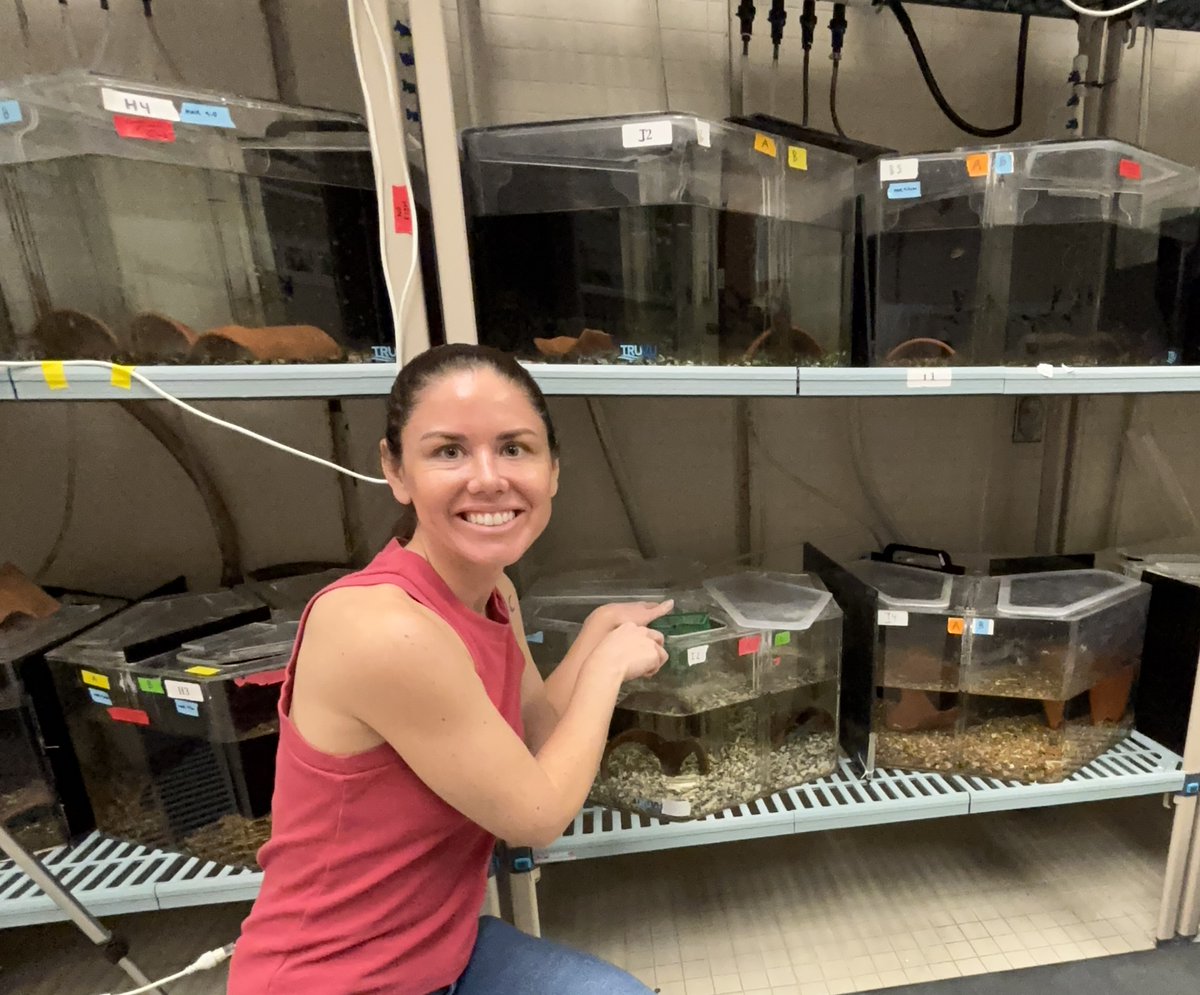
Meet Emily Lessig! She is one of our 2024 Stengl-Wyer Fellows. Her research integrates animal behavior and neuroscience to understand how animals make decisions in dynamic social environments. https://t.co/e0rBwklWjP #animalbehavior#biology#graduateschool
I’m excited to share our publication from @Dulac_lab in @Nature, where we illuminate the development of hypothalamic cell types involved in a broad range of functions, from social behaviors to thirst, thermoregulation, and sleep. Highlights below! 🧵
https://t.co/cxL7xBupQk
It’s not easy at the top.
New @UTAustin research finds those at the top of a social hierarchy experience more stress when they drop in social rank & experience more changes in the brain than those that climb the social ladder.
@HofmannLab#TexasScience
https://t.co/5ex20Wdf14
Are testosterone pulses a physiological mechanism for expanding activity beyond territories? | Royal Society Open Science https://t.co/T7VKJ4z2AE
Congratulations Rada and Matina! Magnificent field work by Rada. T-effects are context dependent.
🚨 80th Anniversary
November 1, 1944: The sign reads, "Ex-Servicemen! We fought for freedom. Are we losing it to homegrown fascism?" @UTAustin student World War II veterans protest against the firing of President Homer Rainey in one of UT's most challenging times.
🧵 (1/6) ->
Engaging tweetorial on a very cool study that functionally connects socially salient sensory input in the auditory pallium to a neural substrate in the ventromedial hypothalamus that regulates subsequent context-appropriate behavior! Kudos, really well done!
I'm excited to share with you all our new paper (co-authors the twitterless Anna Lally and @Healeylab) out in @CommsBio!! I've made a tweet thread abstract below, spooky halloween style.🎃
Open access at the following link:
https://t.co/PZFlOz1lpp
1/14
Excited to announce that our 2025 Advanced Research Training Course schedule is up and applications are open! 🎉🎉🎉
See you in Woods Hole! https://t.co/9cAcnqoAfG
I will be looking for PhD and/or Int PhD students starting in 2025, so if you're interested in joining my lab (or any others in the TIFR system) as a graduate student please apply!
Sarah Muh is kicking off Day 2 of the SBN Online Research Symposium! Sarah is a graduate student in the @HofmannLab at @UTAustin who studies the neuro-molecular mechanisms of social behavior in cichlid fish. 🐟🧠🧬
The latest from the lab is out now in @CurrentBiology! Led by the amazing @BrandonFricker, with help from @muruganmalu, we identified a neural circuit that facilitates affiliative peer-group preferences in spiny mice. @EmoryUniversity
https://t.co/dOkUAytQXM
Out now in @CurrentBiology, our new paper identifies an olfactory receptor that mediates male attraction to females, but enforces avoidance of parental care. A thread that leads to an unexpected twist in regulation of social behavior! https://t.co/zERnYwgwVn