Shame on Leading brand for feeding poison to trusting customer , their restaurant shound be shut down immediately and management should be penalised 1 Lac times the Value , face criminal case ,
Food adulteration and servicing bad , expired food be treated as attempt to murder!
Expired meat, fish & milk found in Bengaluru’s top luxury hotels.
30 teams inspected 26 three-star & five-star hotels across BBMP limits today. 35 food samples collected for lab testing.
Hotels where food was seized:
• The Lalit Ashok – 76 kg meat, 200 kg vegetables & 32 litres expired milk
• Shangri-La Bengaluru – 15 kg meat
• Four Seasons Bengaluru – 19 kg meat
• Vivanta Whitefield – 3 kg expired bakery products
• Taj Yeshwantpur – 72 kg meat/fish
• Radisson Blu (The Atria) – 105 kg expired food (50 kg chicken, 25 kg meat, 23 kg fish, 7 kg vegetables)
Violations included expired food, fungal growth, unhygienic kitchens, misbranding, FSSAI labelling violations and improper veg/non-veg storage. Notices issued; further action to follow after lab reports. #Bengaluru #FoodSafety
Impressive statistics indeed. This is the kind of excellence India needs to compete globally because reaching the top is one thing, but staying there demands innovation and continuous improvement.
@krishnabgowda Stop 10 Mts delivery vehicle going around on footpaths , reverse direction and breaking all signals, they are not stopped not penalised is there monthly arrangement with these companies for flat retainer fee ?
@krishnabgowda
ಸುರಕ್ಷಿತ ಪಾದಚಾರಿ ಮಾರ್ಗ ಅಭಿಯಾನದ ಮತ್ತೊಂದು ಯಶಸ್ವಿ ದಿನ!
ಸವಾಲುಗಳಿರಬಹುದು... ಆದರೆ ನಮ್ಮ ಹೆಜ್ಜೆಗಳು ಎಂದಿಗೂ ನಿಲ್ಲುವುದಿಲ್ಲ..! ದಿನಂಪ್ರತಿ ಜನಹಿತಕ್ಕಾಗಿ, ಪಾದಾಚಾರಿಗಳ ಸುರಕ್ಷತೆಗಾಗಿ ದೃಢಸಂಕಲ್ಪದೊಂದಿಗೆ ಶ್ರಮಿಸುತ್ತಿರುವ ಜಿಬಿಎ ಅಧಿಕಾರಿಗಳಿಗೆ ಅಭಿನಂದನೆಗಳು.
One day in the Safer Footpath Campaign. We take everything in our stride and keep moving forward.
Great job by GBA officers! 👏
@GBA_office@BlrCityPolice
#GreatOfficials
#GreaterBengaluru
Three 16-year-old Indian students turned a simple observation into a groundbreaking environmental innovation.
While visiting a rural village, Avyana Mehta, Ariana Agarwal, and Vivaan Chhawchharia noticed a young child drinking water from a communal plastic container. That moment sparked their concern about invisible microplastics contaminating drinking water.
Motivated to find a solution, the trio developed Plas Stick, a biodegradable powder made from waste tamarind seeds. When added to water, the powder causes microplastic particles to clump together, making them easier to filter out. The invention requires no electricity, no expensive equipment, and is designed to be affordable and practical for communities lacking advanced water treatment systems.
Their innovation earned them a historic achievement in 2026: they became the first Indian team to win The Earth Prize, one of the world’s most prestigious environmental awards for teenagers.
Beyond the award, the students have conducted workshops reaching over 8,000 people across India, raising awareness about microplastic pollution and sustainability.
Their story proves that meaningful change can start with curiosity, compassion, and the courage of young minds determined to solve real-world problems.
800+ million voices. Hundreds of dialects. 🇮🇳
One unicorn forging India’s AI destiny. 🤖
Sarvam turns India’s linguistic complexity into AI strength.
While global LLMs fail on Indian languages, Sarvam has built sovereign foundational models for accents, code-mixing & cultural depth.
Strategies: Train on vast regional data. Serve 800M+ vernacular users in healthcare, education & governance. Reject rented intelligence.
Uniqueness: Diversity = powerful moat.
India: Massive TAM. Transform public services & enterprised.
Global: Export to Africa, SE Asia & beyond. Export inclusive AI to diverse markets.
Implications: Sovereignty, jobs & leadership.
Way forward: Heavy R&D + scale training, strong benchmarks, deeper partnerships.
“We have to build it (AI) ourselves.” - @pratykumar
Diversity isn’t a barrier, it’s India’s language moat.
@SarvamAI
By @sudhirchaudhary
#SarvamAI #AIforBharat
I ran across this video a few days ago and couldn’t stop watching it.
It’s about something ordinary & boring, a plastic gas lighter. But it changes how one thinks about manufacturing.
That lighter in so many of our homes, holds pressurised gas. It has over 30 microscopic parts, has to pass international safety codes, & travel 10,000 miles by sea, & the total cost of doing all that, materials, labour, freight, every middleman along the way, comes to fifteen U.S cents.
So how does anyone make money on this?
Turns out almost the entire world’s supply comes from one place: a county called Shaodong, in China’s Hunan province.
It wasn’t always there.
But today, Shaodong has 114 lighter-related companies packed into the place & between them they source more than 200 different components from each other, all within a 20-kilometre radius. They supply something like seventy percent of the world’s disposable lighters. And the industry alone employs over 80,000 people locally.
Nobody there is winning on cheap labour anymore. They’re winning by shaving a thousandth of a cent off the thickness of a plastic wall, or redesigning a base so a few thousand more units fit into the same shipping container.
It took my thoughts back to an old professor of mine, Michael Porter.
His 1980 book, Competitive Strategy, is still the 1st book most MBAs read, the one that gave the world the Five Forces and basically invented modern strategic thinking.
But there’s a quieter piece of his work, on industrial clusters, that never got nearly the same attention, and it is the one that explains exactly what is happening in Shaodong.
His argument was that nations and regions rarely win because of cheap inputs. They win when rival firms and specialist suppliers crowd into the same small geography for long enough that they keep pushing each other past what any one of them could manage alone. He found it in the Swiss watchmaking towns of the Jura, in the German printing press industry and in Italy’s ceramic tile and footwear districts (interestingly, it’s the SAME blueprint which built Morbi, in Gujarat, into the world’s second-largest ceramic cluster, now outproducing Italy by volume. I have posted before, about Morbi)
None of these started out as giants. The neighbourhood made them giants.
Which is exactly why it’s so relevant to India’s climb up the global manufacturing table
I’ve also attached a slide with this post that I saw recently and which shows us breaking into the top 5 manufacturing globally. (A quick reference check told me that we may not have overtaken Korea yet, but the trajectory’s clear)
That climb has happened on the back of scale: bigger plants, bigger parks, more FDI.
I should declare an interest here, because the Mahindra Group set up 2 of India’s first integrated, plug-and-play business cities, in Chennai in 2002 & Jaipur in 2006.
Both have been extremely successful. Chennai’s business zone alone today employs 45,000 people..
But I admit that we need to think differently.
A park brings in investors and hands them a ready plot, power, water & roads
A cluster is a completely different animal: hundreds of small, specialised suppliers, each obsessed with doing a tiny thing better than anyone else, feeding off each other’s presence for years until no outsider can compete with the whole.
I think that’s the work ahead of us now.
Not just more factories, and not just more parks.
Policymakers & developers like us need to start consciously pulling as many of the inputs and resources a sector needs, the toolmakers, the component suppliers, the testing labs, the logistics specialists, into the same neighbourhood.
Shaodong and Morbi both got there by accident, one town stumbling onto a way to shave a thousandth of a cent off a lighter wall, the other discovering it had the clay and, later, the gas pipeline for tiles.
We don’t have the luxury of waiting for accidents anymore.
We need to do it on purpose
Anand, very insightful.
The math behind the 15¢ lighter shows exactly why manufacturing cost is only half the battle. When that same lighter sells for $1.25 in a Dollar Tree or £1 in Poundland, where does the other $1.10 go based on realistic expereinces.
Dollar Tree and Poundland rarely sell a single loose lighter for $1 or £1. In a typical 3-pack, the consumer is still paying roughly 41¢ per lighter (assuming a similar equivalent for Poundland).
Building a world-class cluster like Morbi or Shaodong solves the 15¢ manufacturing challenge. But to win the global market, our firms must also master global distributor networks, retail shelf space, and destination-market economics.
Toyota has invented a water-powered car engine! 😁😁😁
In a move designed to shatter the global automotive industry, Toyota has just unveiled a water-powered hydrogen engine produced by electrolysis - and it only emits steam! No lithium. No charging stations. Nothing but pure revolution. With this bold choice, Toyota isn't just competing with electric cars - it's declaring the end of the battery era.
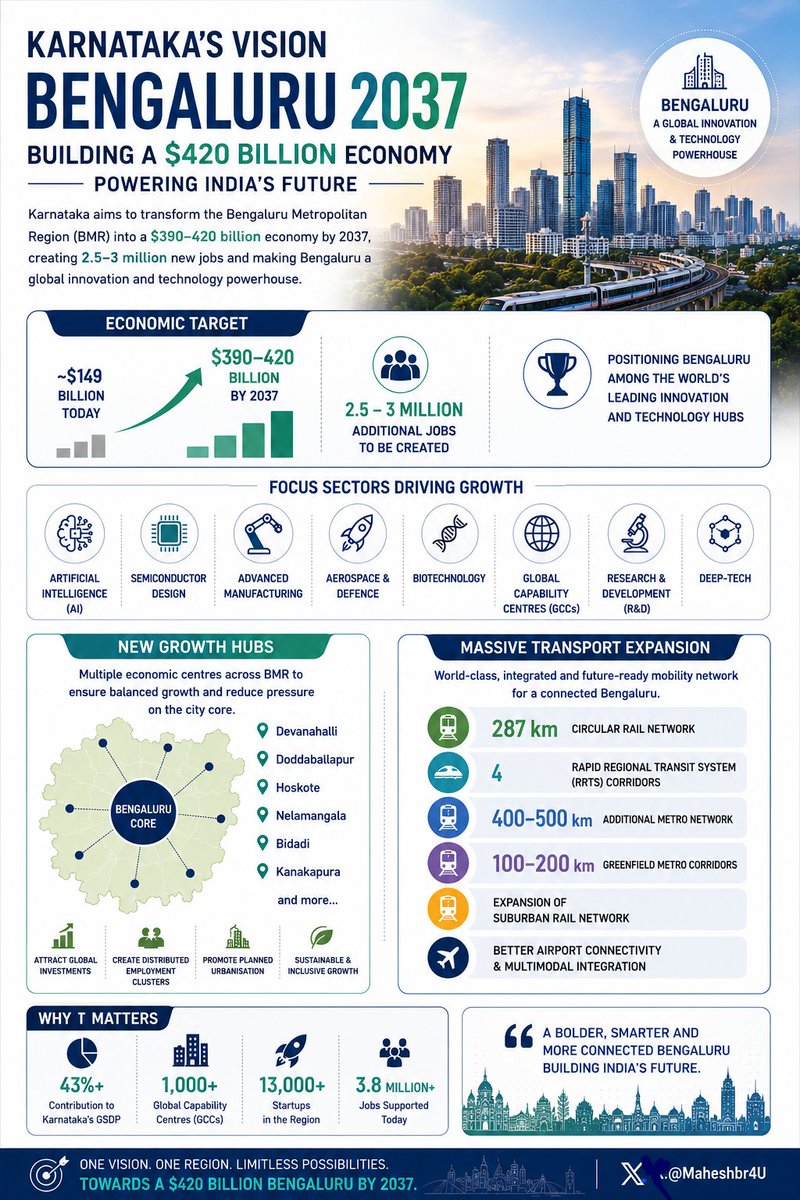
■#Karnataka has released #Bengaluru Vision doc, aiming at Nearly Tripling of Economy in 10 Yrs.
■Focus on New growth hubs of #Devanahalli, #Doddaballapur, #Hoskote, Bidadi ,Nelamangala, Kanakapura is welcome.
■ Increase in #Green Coverage & Restoration of #Lakes needs to be added.
■ While ambitious Metro connectivity is needed, however Execution needs to be streamlined
■ City's growth is driven by such Visions, however needs a periodic review & Execution mechanism.
@CMofKarnataka@DKShivakumar
IP :@ChristinMP_@DeccanHerald@moneycontrolcom
Research shows a 72-hour fast can completely rebuild your immune system.
A study from the University of Southern California has revealed that fasting for 72 hours can trigger a complete regeneration of the immune system.
Researchers found that prolonged fasting causes the body to deplete its glucose and fat reserves, forcing it into a detoxifying state that eliminates damaged cells and toxins.
When normal eating resumes, stem cells are activated, leading to the production of fresh, healthy white blood cells. This immune reboot effect was observed in both mice and humans, particularly in chemotherapy patients who showed improved immune health after fasting cycles.
Lead researcher Dr. Valter Longo explains that during fasting, a gene called PKA is suppressed—this gene must be turned off for stem cells to enter regenerative mode.
As a result, the immune system essentially clears out older, weaker components and rebuilds itself anew. While more research is needed to explore the full range of benefits across organs, the study suggests that fasting could be a powerful, drug-free strategy for enhancing immunity, especially for those with weakened systems due to aging or cancer treatment.
[Valter Longo. USC Leonard Davis School]
A landmark study has found that two years of regular, structured exercise can dramatically rejuvenate the aging heart, effectively turning back the clock by as much as 20 years in previously sedentary middle-aged adults.
Conducted by researchers at the University of Texas Southwestern Medical Center and published in the journal Circulation, the trial involved healthy but inactive adults aged 45–64. Participants followed a supervised exercise program four to five days per week, combining moderate aerobic training (such as walking, cycling, or swimming), high-intensity intervals, and strength sessions.
After two years, the exercise group showed significant improvements in cardiovascular function. Their hearts became more elastic and efficient at filling with and pumping blood, changes that made their heart performance resemble that of people 15–20 years younger. The control group, which did not exercise, showed continued age-related decline in heart stiffness.
This NIH-funded study is one of the longest and most rigorous trials demonstrating that it’s never too late to start exercising in middle age, and that consistent effort can produce profound, measurable reversal of age-related heart changes.
[Howden EJ, Sarma S, Lawley JS, et al. Reversing the Cardiac Effects of Sedentary Aging in Middle Age—A Randomized Controlled Trial: Implications for Heart Failure Prevention. Circulation. 2018;137(15):1549-1560. doi:10.1161/CIRCULATIONAHA.117.030617]
Mars Mission Timeline
1960s: First attempts to reach Mars
1971: First spacecraft enters Mars orbit
1976: First successful landing on Mars
1997: Sojourner becomes the first Mars rover
2004: Spirit & Opportunity begin exploring the Red Planet
2012: Curiosity lands and searches for signs of habitability
2021: Perseverance and Ingenuity arrive, making the first powered flight on another world
2030s?: Humans may finally set foot on Mars
From distant dreams to robotic explorers, every mission brings us one step closer to becoming an interplanetary species.
Mars isn't just a planet—it's humanity's next frontier.
India has overtaken England and joined the top five manufacturing countries list in the world.
By 2029, India will be the third-largest manufacturing country
12% of your basic salary goes to your retirement fund - EPF. But is it truly withdrawable?
Rejections and months of delay come from issues you could've spotted in few minutes.
Run a free AI-powered PF Health Check. Know exactly where you stand before EPFO does.
🚨 JUST IN:
Yesterday, 🇺🇸 US export controls forced Anthropic to globally disable its advanced AI models Fable 5 and Mythos 5.
Today, 🇫🇷 President Macron & 🇮🇳 PM Modi launched India-France Cooperative AI Partnership for sovereign, open & inclusive innovation.


![Rainmaker1973's tweet photo. Research shows a 72-hour fast can completely rebuild your immune system.
A study from the University of Southern California has revealed that fasting for 72 hours can trigger a complete regeneration of the immune system.
Researchers found that prolonged fasting causes the body to deplete its glucose and fat reserves, forcing it into a detoxifying state that eliminates damaged cells and toxins.
When normal eating resumes, stem cells are activated, leading to the production of fresh, healthy white blood cells. This immune reboot effect was observed in both mice and humans, particularly in chemotherapy patients who showed improved immune health after fasting cycles.
Lead researcher Dr. Valter Longo explains that during fasting, a gene called PKA is suppressed—this gene must be turned off for stem cells to enter regenerative mode.
As a result, the immune system essentially clears out older, weaker components and rebuilds itself anew. While more research is needed to explore the full range of benefits across organs, the study suggests that fasting could be a powerful, drug-free strategy for enhancing immunity, especially for those with weakened systems due to aging or cancer treatment.
[Valter Longo. USC Leonard Davis School]](https://pbs.twimg.com/media/HLACjX2XUAAfKN3.jpg)
![Rainmaker1973's tweet photo. A landmark study has found that two years of regular, structured exercise can dramatically rejuvenate the aging heart, effectively turning back the clock by as much as 20 years in previously sedentary middle-aged adults.
Conducted by researchers at the University of Texas Southwestern Medical Center and published in the journal Circulation, the trial involved healthy but inactive adults aged 45–64. Participants followed a supervised exercise program four to five days per week, combining moderate aerobic training (such as walking, cycling, or swimming), high-intensity intervals, and strength sessions.
After two years, the exercise group showed significant improvements in cardiovascular function. Their hearts became more elastic and efficient at filling with and pumping blood, changes that made their heart performance resemble that of people 15–20 years younger. The control group, which did not exercise, showed continued age-related decline in heart stiffness.
This NIH-funded study is one of the longest and most rigorous trials demonstrating that it’s never too late to start exercising in middle age, and that consistent effort can produce profound, measurable reversal of age-related heart changes.
[Howden EJ, Sarma S, Lawley JS, et al. Reversing the Cardiac Effects of Sedentary Aging in Middle Age—A Randomized Controlled Trial: Implications for Heart Failure Prevention. Circulation. 2018;137(15):1549-1560. doi:10.1161/CIRCULATIONAHA.117.030617]](https://pbs.twimg.com/media/HKyBM7mWIAAqrdh.jpg)


