@Original_Libbro Yeah for sure, my point still stands, proto-Bantoids were differenciated from Yorubas and Esans, Igbos received later admixture from assimilated Bantoids which makes them closer to the proto Bantoids comparer to the former 2 groups.
@Original_Libbro and could push till the southern tip of Africa while those expanding simultaneously in the West African rainforests had been prematurely blocked by the Atlantic ocean.
@Original_Libbro Basically 4600 years ago, NCs (or Atlantic-Congos at min) were still in proximity somewhere in western Africa. We're talking about a recent Bantu expansion but it really is a recent Niger-Congo expansion all over, Bantus being the eastern most ones, they simply had an open field
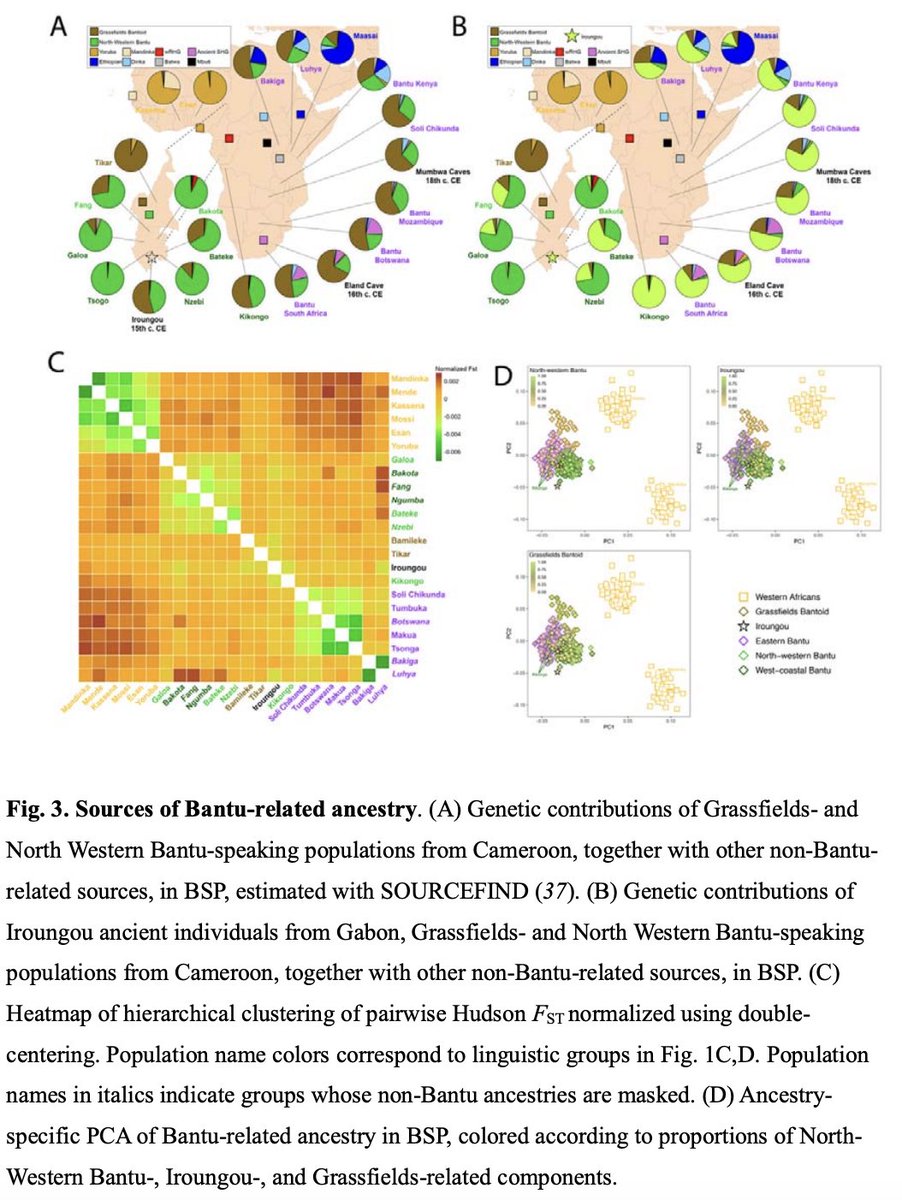
@ShihabAdDinAhmd@oumarou_rahim Some Masai especially from Tanzania are also more Bantu shifted as we can see here, only a few individuals have like 5-10% of the Bantu Green component. They're not homogeneous so it's still an ongoing admix process, pastoralists in the region are likeky to be more diverse imo
The concept of "cool" in West and Central African languages.
In his research, Robert Farris Thompson posits that the idea of "cool" representing calmness, composure and nonchalance is a example on African lexical influence on modern parlance.
New preprint from @oguzparasayan looks at the origins of Bantu peoples and sequences four historical (~700BP) Congolese genomes. One interesting finding is a population contraction in both Bantu groups and hunter Gatherers ~1500 BP.
Read it here:
https://t.co/4C7PzBIStF
@BantuHutu@MboyaRon That's not how it works, there's no magical border where you're in and out of an ethno-linguistic group, DNA tests didnt even exist 100 years ago. According to your logic Kikuyus and other Thagicu arent bantus either. You'd have to define "asian" dna first cauz Hans are diverse.
@HornReport1@mutembeimaretem@BantuHutu Nilotes and Cushites come from Sudan, the Hunter gatherers are the oldest in east Africa, everybody elle came afterward in waves
@BantuHutu@MboyaRon Tutsis/Hima arent simply language shifters, they have Bantu ancestry, a considerable amount of Bantu related Paternal lineages are Bantu speakers. They are bantu with mixed nilo, cushitic ancestry, in east africa there's no 100% proto bantu like group.
@BantuHutu@GitheriMann Do you know Kikuyus and Tutsis are genetically closer on average than Kikuyus and Hutus? You don't make sense, every east african bantus has either Nilo, Cushitic or West asian admixture, there's no such thing as a pure bantu, even Hutus have it just more or less
@iIimouni Following your own model it's not less but more. In his model they only have like 7% Bantu-related ancestry while yours indicate a more realistic number of at least 20%.
@47Tolkien@_Keg___@razibkhan Then they didnt resist as you said, they're themselves a result of Bantus meeting Nilo-cushites, they're not purely nilo-cushites. Your model undermine their actual bantu-related ancestry by the way. Some of the Nilotic(recently Niger-Congo admixed) is eating up their bantu admx.
@badmedianews@47Tolkien They're neither, they're a bantu-nilo-cushitic mix, you remove one component they don't exist anymore. The model by OP undermine their bantu-related ancestry
@Cham4l1_gh0mar1@HQuarterma43504 Except it didnt, the IBM E1b1b lineages are just the oldest tested so far but their lineages werent ancestral to most modern E1b1b subclades. It actually looks like the origin is in the Nile Valey where the diversity is the highest then some westward migrations created the iBMs.
@Skidrow511@woolyheadblog7 Not eveey south sudanese got the typical very dark Nilote skin tone and lanky built. One of the biggest group there are the Azande, they're more stocky and closer in built to West and Central africans.