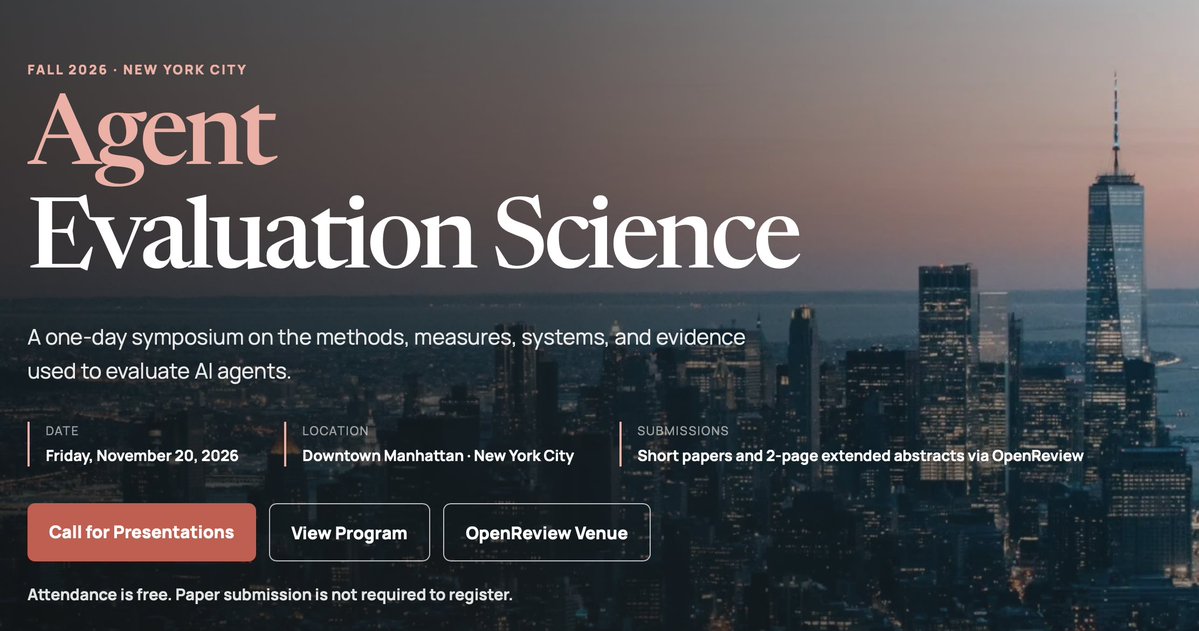
📢 Just wrapped up some cool agent evaluation work for ICLR? Or are you simply interested in learning more about the evals landscape? Come to our Agent Evaluation Science Fall Symposium in New York City on November 20, 2026 where we bring together researchers & practitioners!
The day will focus on how agents should be scientifically evaluated, with topics spanning measurement and benchmark design, reliability, safety, and real-world performance. If you have some exciting work in this space, please consider submitting it for poster presentation!
Abstract registration deadline: October 20
Submission deadline: October 25
OpenReview: https://t.co/3R6N0UI3KS
We are also excited to welcome a strong lineup of speakers, with more to be announced. Confirmed so far: @yoavartzi (Cornell Tech), @jaseweston (Meta AI), @nouhadziri (Cohere Labs), @PeterHndrsn (Princeton University), @walesalaudeen96 (Microsoft Research), @criticalneuro (Microsoft Research), and @saurabhjha2010 (IBM Research).
Important: You do not need to submit work in order to join! Just register through the Luma link below. If space becomes limited however, we will prioritize authors with accepted submissions.
Register: https://t.co/u3VmVzzpYD
Details: https://t.co/v0D95KuP4o
Huge thanks to the entire organizing team, including @yininghua, @HongbinNLP, @manuelcherep, @dubrovnik07, @HuaYilun, @ishapuri101, @liuzhuang1234, Lori Chibnik, @vbingliu, @CsabaSzepesvari, @PeterStone_TX, @sirrice, @ang3linawang, and @nikhilsinghmus for putting this together!
Feel free to reach out with any questions and we hope to see many of you there!
Can LLMs learn a new language using only a grammar book and a dictionary like how human adult L-2 learners do?
Check our in-progress paper! The Gold Medals in an Empty Room: Diagnosing Metalinguistic Reasoning in LLMs with Camlang https://t.co/DWq4dRwvD7
BREAKING NEWS! Most people aren’t prompting models with IMO problems :)
They’re prompting with tasks that need more context, like “plz make talk slides.”
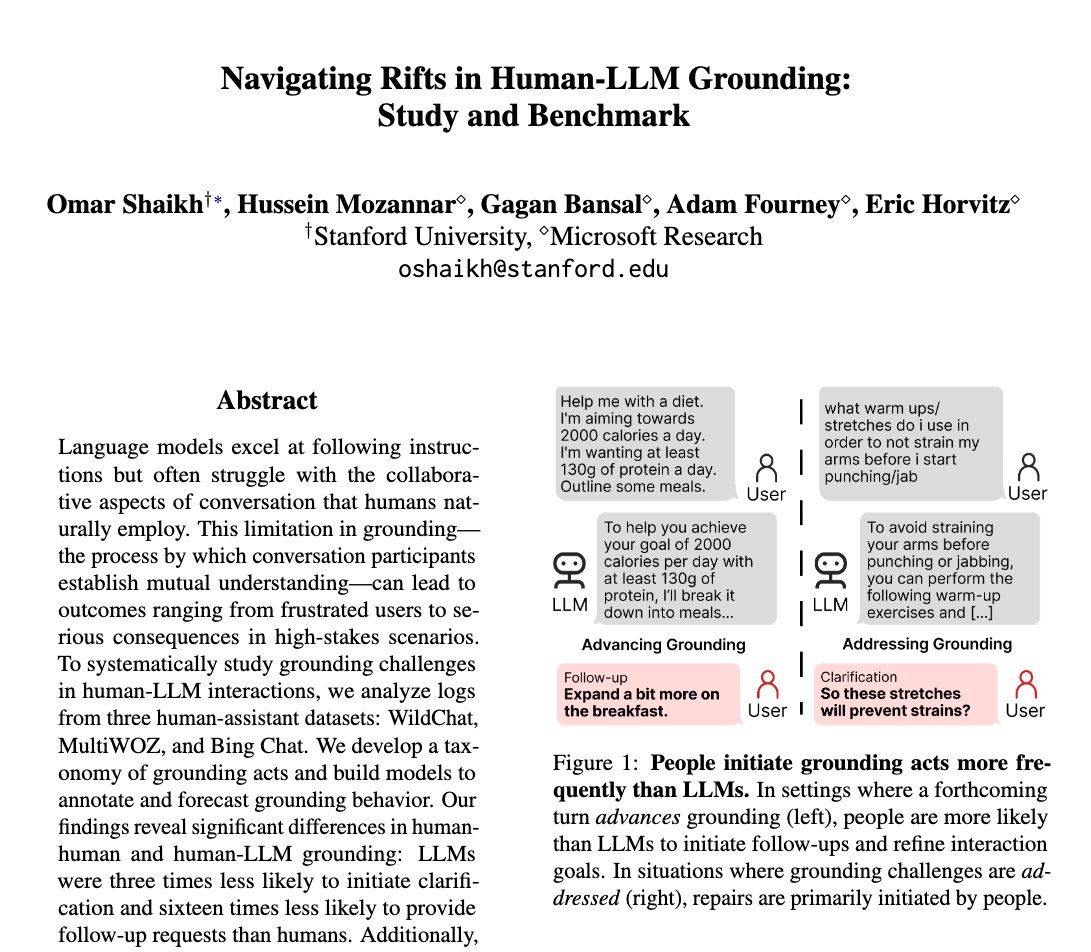
In an ACL oral, I’ll cover challenges in human-LM grounding (in 60K+ real interactions) & introduce a benchmark: RIFTS.
🧵
While we’re building amazing new human-AI systems, how do we actually know if they work well for people?
In our #ACL2025 Findings Paper, we introduce SPHERE, a framework for making evaluations of human-AI systems more transparent and replicable.
✨https://t.co/afVCweAqZU
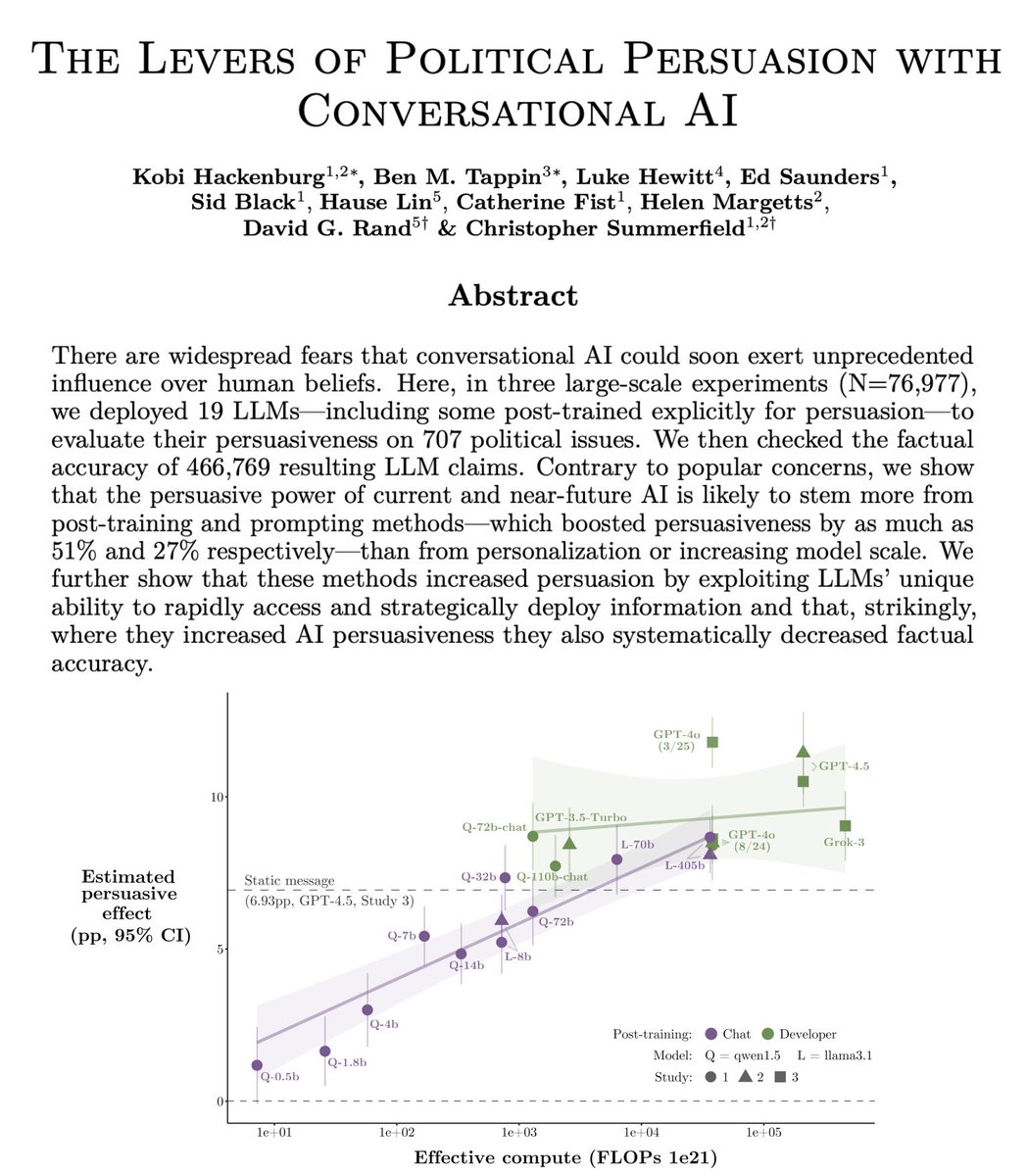
Today (w/ @UniofOxford@Stanford@MIT@LSEnews) we’re sharing the results of the largest AI persuasion experiments to date: 76k participants, 19 LLMs, 707 political issues.
We examine “levers” of AI persuasion: model scale, post-training, prompting, personalization, & more
🧵
Excited to present our survey on LLMs in Psychotherapy at #ACL2025!
Let's discuss a coherent path forward! Find me at my poster:
📍Location: Hall 4/5
🗓️Session: IP-Poster Session 5, Mon, July 28, 18:00-19:30
#LLM#AI#MentalHealth#Psychotherapy
Most complex tasks feature ill- and underdefined goals, at least initially.
Check out @vysrini's paper demonstrating that agents need to do a lot more than follow instructions, incl. refining goals, and balance competing objectives.
Current frontier models fail at these tasks
How do language models track mental states of each character in a story, often referred to as Theory of Mind?
Our recent work takes a step in demystifing it by reverse engineering how Llama-3-70B-Instruct solves a simple belief tracking task, and surprisingly found that it relies heavily on concepts similar to pointer variables in C programming!
Amazing thread. So much to unpack but for starters: “After writing, only 17 % of ChatGPT users could quote their own sentences, versus 89 % in the brain-only group.”
Check out our ACL paper! We use shapley interactions to see which words (and phones) interact non-linearly -- what we lose when we assume linear relationships between features. Chat to Diganta in Vienna!
What if LLMs could learn your habits and preferences well enough (across any context!) to anticipate your needs?
In a new paper, we present the General User Model (GUM): a model of you built from just your everyday computer use.
🧵
When it comes to text prediction, where does one LM outperform another? If you've ever worked on LM evals, you know this question is a lot more complex than it seems. In our new #acl2025 paper, we developed a method to find fine-grained differences between LMs:
🧵1/9
Happy to share our preprint "Words Like Knives: Backstory-Personalized Modeling and Detection of Violent Communication" 🧵(1/9)
📄Paper: https://t.co/C4zJ5kvA3s
Do people actually like human-like LLMs? In our #ACL2025 paper HumT DumT, we find a kind of uncanny valley effect: users dislike LLM outputs that are *too human-like*. We thus develop methods to reduce human-likeness without sacrificing performance.
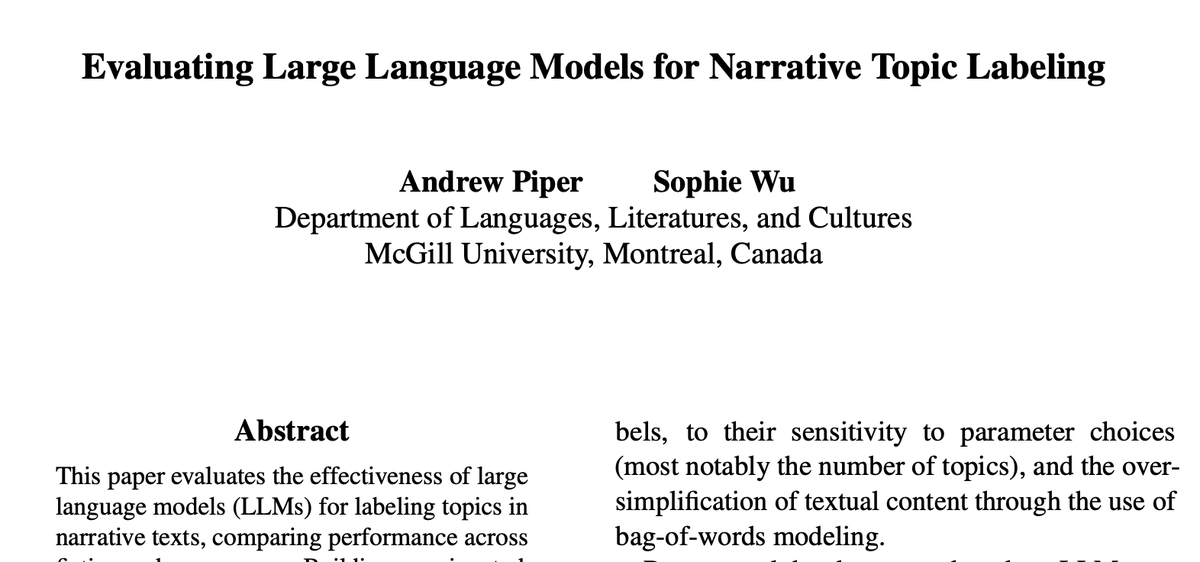
In case you're curious whether you can use LLMs (including small local ones) for narrative topic modeling. The answer is yes! LLMs perform on par or better than humans at the task.
📢 New Paper!
Tired 😴 of reasoning benchmarks full of math & code? In our work we consider the problem of reasoning for plot holes in stories -- inconsistencies in a storyline that break the internal logic or rules of a story��s world 🌎
W/ @melaniesclar, and @tsvetshop
1/n