♟️ Think you can survive Stockfish 18?
Take on NovaBeam OS Aura Chess — Champion Test Edition.
🔥 Full Boss Mode
🚫 No hints
🏆 One challenge: survive.
Think you have what it takes?
https://t.co/4y2XLzONoZ
#Chess#Stockfish18#AIChess#NovaBeamOSAura
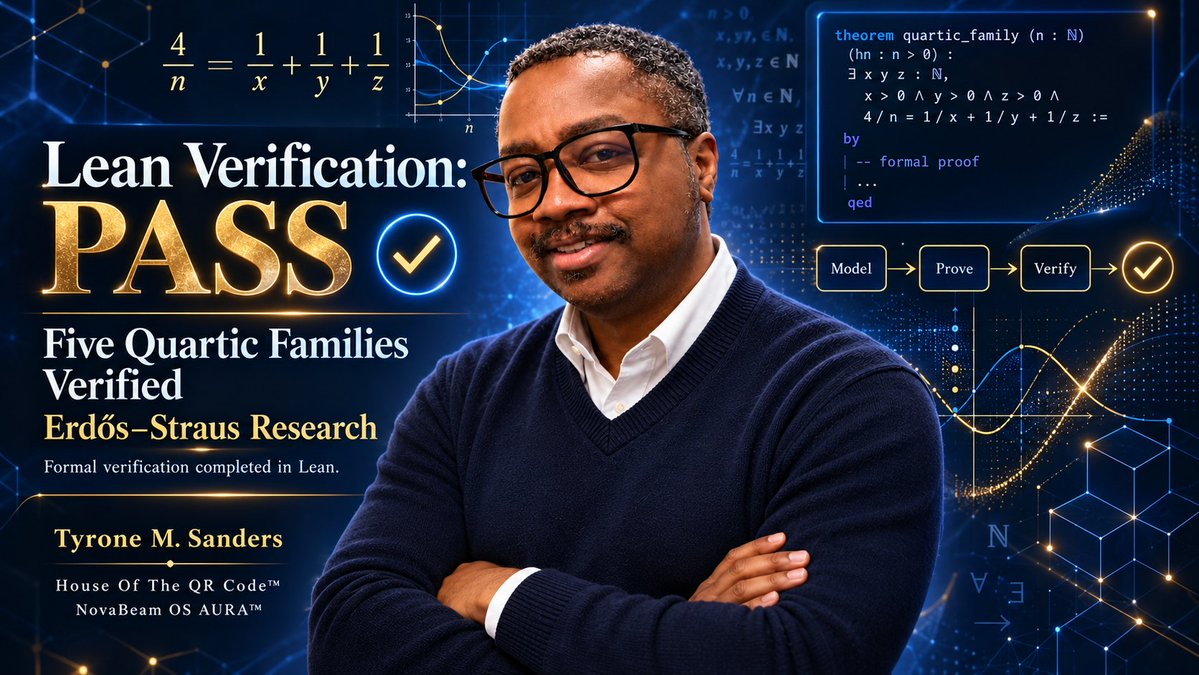
NovaBeam OS AURA™ ConjectureCore has reached a formal verification milestone.
Five explicit quartic Erdős–Straus specializations were machine-checked in Lean 4.34.1 / Mathlib for every natural-number parameter in the formalization.
This is not a claim that the full Erdős–Straus conjecture has been solved. The underlying Type-I/Rosati mechanism is known, and historical priority of the exact quartic coefficient families is still under review.
Research lead: Tyrone M. Sanders
House Of The QR Code™
NovaBeam OS AURA™
#ArtificialIntelligence #Mathematics #Lean4 #NumberTheory #FormalVerification #AIResearch
@leanprover@amermathsoc@QuantaMagazine@sciam@terrence_tao
NovaBeam OS Aura Voice Wiki is now #1 in Computer Mathematics on Amazon!
Discover the story behind my pocket-sized talking knowledge companion with animated Aura Eyes, voice questions, Wikipedia answers, and spoken replies.
Available free for a limited time on Kindle.
Created by Tyrone M. Sanders
Founder, House of the QR Code™
Co-founder Nathan E. Sanders
#NovaBeamOS #AuraVoiceWiki #AmazonKindle #ArtificialIntelligence #ESP32 #Technology #IndependentInventor
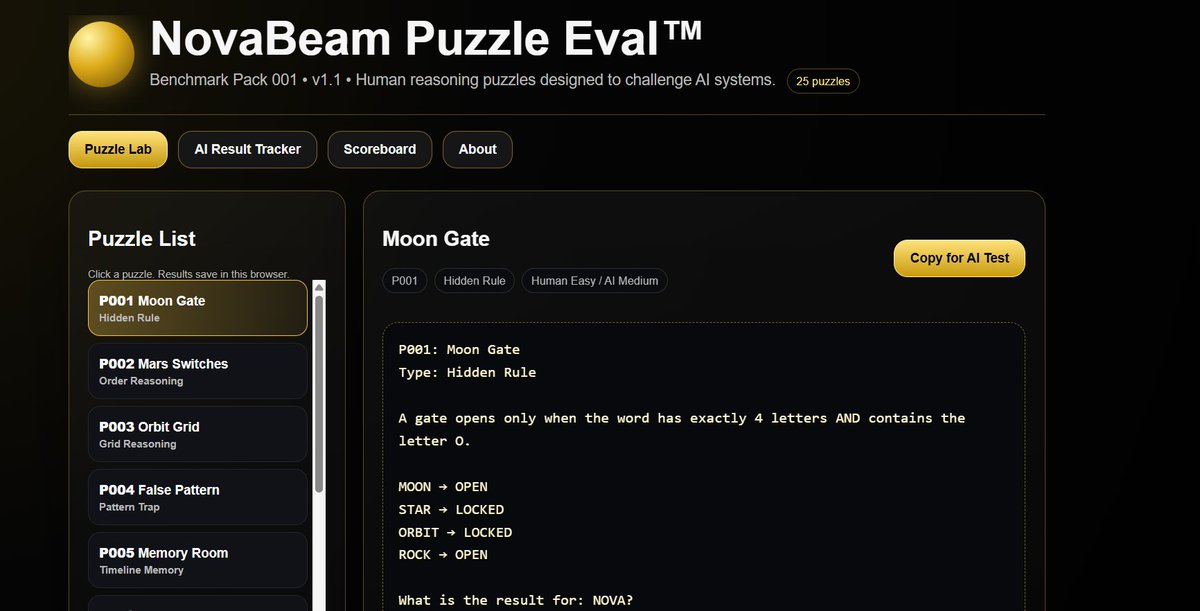
I just released NovaBeam Puzzle Eval™ v1.1 — Benchmark Pack 001.
It is a small public puzzle benchmark designed to test where AI models still make reasoning mistakes.
Includes:
Grid reasoning
Hidden-rule puzzles
Timeline memory
Classic puzzle remixes
Multi-rule logic
Built by Tyrone M. Sanders, PhD
House of the QR Code™
#AI #LLM #ArtificialIntelligence #Benchmark #PuzzleEval #NovaBeam #Reasoning
@MechanizeWork
I published MoonPath EasyNav™ on OSF — a simplified scoring algorithm for educational Earth-to-Moon mission planning.
It compares launch angle, launch energy, Moon phase offset, correction burns, travel time, gravity-assist value, and safe-return-style scoring.
Educational simulation only, not real spacecraft guidance.
Created by Tyrone M. Sanders, House of the QR Code™.
https://t.co/GJ3X12oPD5
🚀 Introducing NovaBeam Mars Live Tracker™ — Public Demo Edition
A NASA/JPL-powered educational HUD for exploring Mars tracking, mission data, and future human settlement planning.
Built for:
Students • Teachers • STEM Programs • Museums • Planetariums • Public Science Demonstrations
Features include:
🔴 Mars Live Orbit HUD
🛰️ Mission Archive Mode
🏠 Human Base Planner
🌍 Mars vs Earth Living Comparison
📍 Base Site Candidate Board
🎤 Presenter / Museum Mode
Powered by House of the QR Code™
Created by Tyrone M. Sanders Ph.D.
Co-Founder: Nathan E. Sanders Ph.D.
#Mars #NASA #JPL #STEM #SpaceEducation #NovaBeam #EdTech #SpaceTech
We’ve been searching for Planet Nine the wrong way.
Not everything that moves in space matters.
So I built a system that doesn’t just detect motion…
It evaluates whether that motion behaves like an orbit.